Do Electric Cars Pay Clean Air Zone Charges in the UK?
Every active UK Clean Air Zone explained -- and why EVs remain fully exempt from all of them
Quick answers
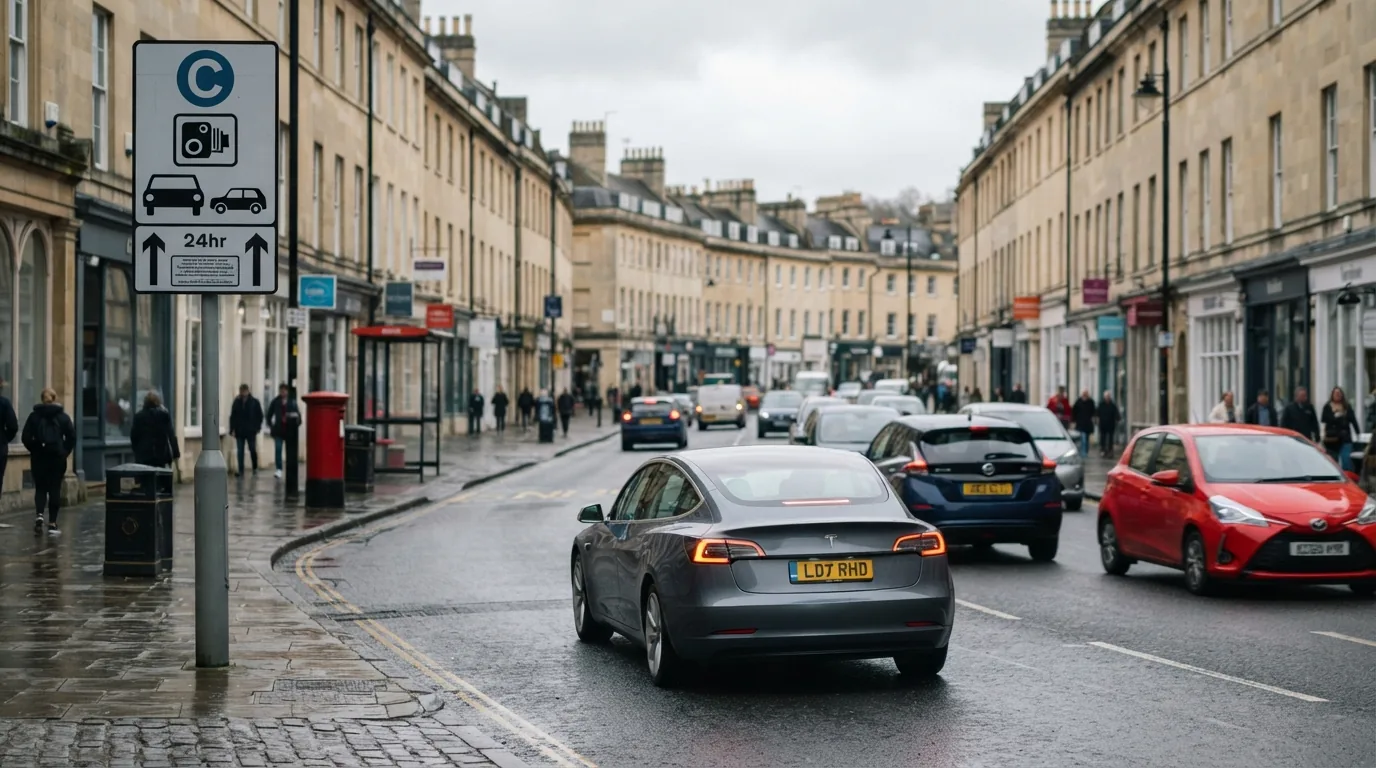
- No. Fully electric cars are exempt from all UK Clean Air Zone (CAZ) charges, with no registration date requirement and no registration process needed.
- What is a Clean Air Zone: A Clean Air Zone is a defined geographic area where stricter emission standards apply to reduce pollution from road transport.
- For private car drivers who are not in a taxi or private hire vehicle, the cities most likely to affect their daily costs are London, Birmingham, Bristol and Oxford.
- In a Class D CAZ, petrol cars must meet Euro 4 standards -- broadly, cars registered after 2005.
- Why do EVs get a permanent exemption: The purpose of CAZs is to reduce tailpipe emissions -- particularly nitrogen dioxide (NO2) and particulate matter -- that cause air quality harm in urban areas.
- Many ULEZ articles incorrectly state that EVs now pay to enter London.
No. Fully electric cars are exempt from all UK Clean Air Zone (CAZ) charges, with no registration date requirement and no registration process needed. This applies to the London ULEZ, Birmingham, Bristol, Oxford’s Zero Emission Zone and every other active CAZ in England. The exemption is permanent under current legislation — there is no government proposal to remove it. EVs also remain exempt from London’s Low Emission Zone (LEZ) charges, which apply to heavier vehicles.
What is a Clean Air Zone?
A Clean Air Zone is a defined geographic area where stricter emission standards apply to reduce pollution from road transport. Councils set up CAZs under powers granted by the Environment Act. Vehicles that do not meet the emission standard for the zone pay a daily charge; those that do meet it — or that are fully zero-emission — pass through free.
The government classifies English CAZs from Class A to Class D:
- Class A: Charges buses and taxis only
- Class B: Charges buses, taxis and HGVs
- Class C: Charges buses, taxis, HGVs and vans
- Class D: Charges all vehicle types including private cars
For private car drivers, only Class D zones impose a daily charge. Most English cities outside London and Birmingham operate Class A, B or C zones, meaning private cars enter for free regardless of fuel type or emission standard.
Which active CAZs charge private cars in 2026?
| Location | Zone type | Daily charge (non-compliant car) | EV charge |
|---|---|---|---|
| London (ULEZ) | ULEZ (all of Greater London) | £12.50 | £0 |
| Birmingham | Class D | £8.00 | £0 |
| Bristol | Class D | £9.00 | £0 |
| Oxford (Zero Emission Zone) | ZEZ | £2 — £10 depending on emission level | £0 |
| Bath | Class B | Taxis/HGVs only — cars free | £0 |
| Bradford | Class B | Taxis/private hire only | £0 |
| Portsmouth | Class B | Coaches, taxis, HGVs | £0 |
| Sheffield | Class B | Buses and HGVs only | £0 |
| Tyneside (Newcastle/Gateshead) | Class B | Buses and HGVs only | £0 |
For private car drivers who are not in a taxi or private hire vehicle, the cities most likely to affect their daily costs are London, Birmingham, Bristol and Oxford.
What emission standards do petrol and diesel cars need to meet?
In a Class D CAZ, petrol cars must meet Euro 4 standards — broadly, cars registered after 2005. Diesel cars must meet the stricter Euro 6 standard — broadly, cars registered after September 2015 or, for many models, late 2014.
A diesel car registered in 2013 will almost certainly be non-compliant and would pay the daily charge in London (£12.50), Birmingham (£8) and Bristol (£9). A petrol car registered in 2006 would typically be compliant in all three cities.
Why do EVs get a permanent exemption?
The purpose of CAZs is to reduce tailpipe emissions — particularly nitrogen dioxide (NO2) and particulate matter — that cause air quality harm in urban areas. Fully electric cars produce zero tailpipe emissions and therefore cause none of the pollution the zones are designed to reduce. The exemption is consequential of the zone’s design purpose, not a subsidy.
There is no current government proposal to extend CAZ charges to electric vehicles. The London Congestion Charge exemption was removed from January 2026 for a different reason — traffic management rather than air quality — but CAZ exemptions operate under a separate legal framework.
What is the difference between the ULEZ and the Congestion Charge?
These are frequently confused. The ULEZ (Ultra Low Emission Zone) is an air quality measure covering all of Greater London 24/7. Electric cars are fully exempt and pay nothing. The London Congestion Charge is a traffic management tool covering just central London (zone 1 roughly), operational on weekdays and weekend afternoons. Electric cars lost their full exemption in January 2026 and now pay a discounted charge of £13.50 per day.
Many ULEZ articles incorrectly state that EVs now pay to enter London. They do not pay the ULEZ charge. They do pay the Congestion Charge if entering the central zone during charging hours, unless they are registered on TfL Auto Pay for the 25% discount. The two systems are entirely separate. See our Congestion Charge explainer for full detail.
How much can a CAZ exemption be worth for an EV driver?
For a driver commuting daily into Birmingham in a non-compliant diesel:
- Birmingham daily charge: £8
- 5 days per week, 48 weeks: £1,920 per year saved by driving an EV
For a London commuter in a non-compliant vehicle:
- ULEZ daily charge: £12.50
- 5 days per week, 48 weeks: £3,000 per year saved by driving an EV
These are material savings. In cities with Class D zones, the CAZ exemption is one of the strongest financial arguments for switching to an EV for drivers of older, non-compliant petrol or diesel cars.
Are Scotland and Wales included?
Scotland and Wales operate separate legislative frameworks. Glasgow introduced its Low Emission Zone (LEZ) for private cars in 2023, with daily charges applying to non-compliant vehicles. Fully electric cars are exempt from the Glasgow LEZ. Edinburgh, Aberdeen and Dundee have also introduced LEZs affecting private cars, with electric vehicles exempt from all of them.
Cardiff does not currently have an active LEZ or CAZ for private cars as of mid-2026. Wales has powers to introduce CAZs under the Environment (Wales) Act, and several Welsh local authorities have consulted on clean air measures, but no charges affecting private cars are yet in force.
Do I need to register my EV for a CAZ exemption?
No. Unlike the London Congestion Charge’s Auto Pay discount for EVs (which requires registration), CAZ exemptions are automatic. ANPR cameras in CAZ cities read your number plate; if the DVLA record shows your vehicle as zero-emission, no charge is applied. No action is required from the driver.
Summary
- Fully electric cars pay zero charges in all UK Clean Air Zones
- The exemption is automatic — no registration is needed
- Private cars are only charged in Class D zones: London ULEZ, Birmingham, Bristol and Oxford
- The ULEZ and Congestion Charge are separate — EVs pay neither the ULEZ nor the Birmingham/Bristol CAZ charges
- EVs do now pay the London Congestion Charge (£13.50/day on Auto Pay) — but this is not a CAZ
- CAZ savings for EV drivers in cities with Class D zones can be £1,920 to £3,000 per year
For the full picture of what owning an EV costs and saves, see the EV running costs and tax hub.
For the models with the lowest total cost of ownership including all tax savings, visit cheapest electric cars to run.
How we test and where our numbers come from
Range figures are official WLTP combined values taken from manufacturer UK specification pages, with real-world estimates drawn from independent comparative testing. Prices are UK list prices at the time of the latest update. Tax, grant and charging-scheme figures come from GOV.UK and HMRC publications. We re-check every guide when pricing, specification or policy changes. Last checked 11 August 2026.
Frequently asked questions
What is a Clean Air Zone?
A Clean Air Zone is a defined geographic area where stricter emission standards apply to reduce pollution from road transport. Councils set up CAZs under powers granted by the Environment Act.
Which active CAZs charge private cars in 2026?
For private car drivers who are not in a taxi or private hire vehicle, the cities most likely to affect their daily costs are London, Birmingham, Bristol and Oxford.
What emission standards do petrol and diesel cars need to meet?
In a Class D CAZ, petrol cars must meet Euro 4 standards -- broadly, cars registered after 2005. Diesel cars must meet the stricter Euro 6 standard -- broadly, cars registered after September 2015 or, for many models, late 2014.
Why do EVs get a permanent exemption?
The purpose of CAZs is to reduce tailpipe emissions -- particularly nitrogen dioxide (NO2) and particulate matter -- that cause air quality harm in urban areas. Fully electric cars produce zero tailpipe emissions and therefore cause none of the pollution the zones are designed to reduce.
What is the difference between the ULEZ and the Congestion Charge?
These are frequently confused. The ULEZ (Ultra Low Emission Zone) is an air quality measure covering all of Greater London 24/7.

EV Compared
The EV Compared editorial team tracks the UK electric vehicle market full time: new model launches, list prices, WLTP and real-world range, public charging tariffs and the tax rules that decide what an EV actually costs to run. Every guide is checked against manufacturer specifications and official GOV.UK figures, and updated whenever the numbers move.
Related reading
View all
What Are the Biggest Myths About Switching to an EV?
The claims that put UK drivers off going electric, and what the evidence actually says

Should You Buy an EV in 2026 or Wait for Cheaper Models?
An honest look at where EV prices are heading and whether the wait is worth it for UK buyers
Buying and Owning an Electric Car in the UK: The Complete 2026 Guide
Everything you need to know about costs, charging, depreciation and day-to-day life with an EV