Can You Live With an Electric Car Without a Driveway?
The realistic options for UK drivers who park on the street
Quick answers
- Yes, you can live with an electric car without a driveway, but it requires more planning than home charging allows, and the running costs are higher if you rely heavily on public chargers.
- Around 40% of UK households do not have access to off-street parking.
- Cross-pavement charging involves running a dedicated charging cable from a wall-mounted unit on your home, through a self-closing channel cut into the pavement, to your car parked at the kerb.
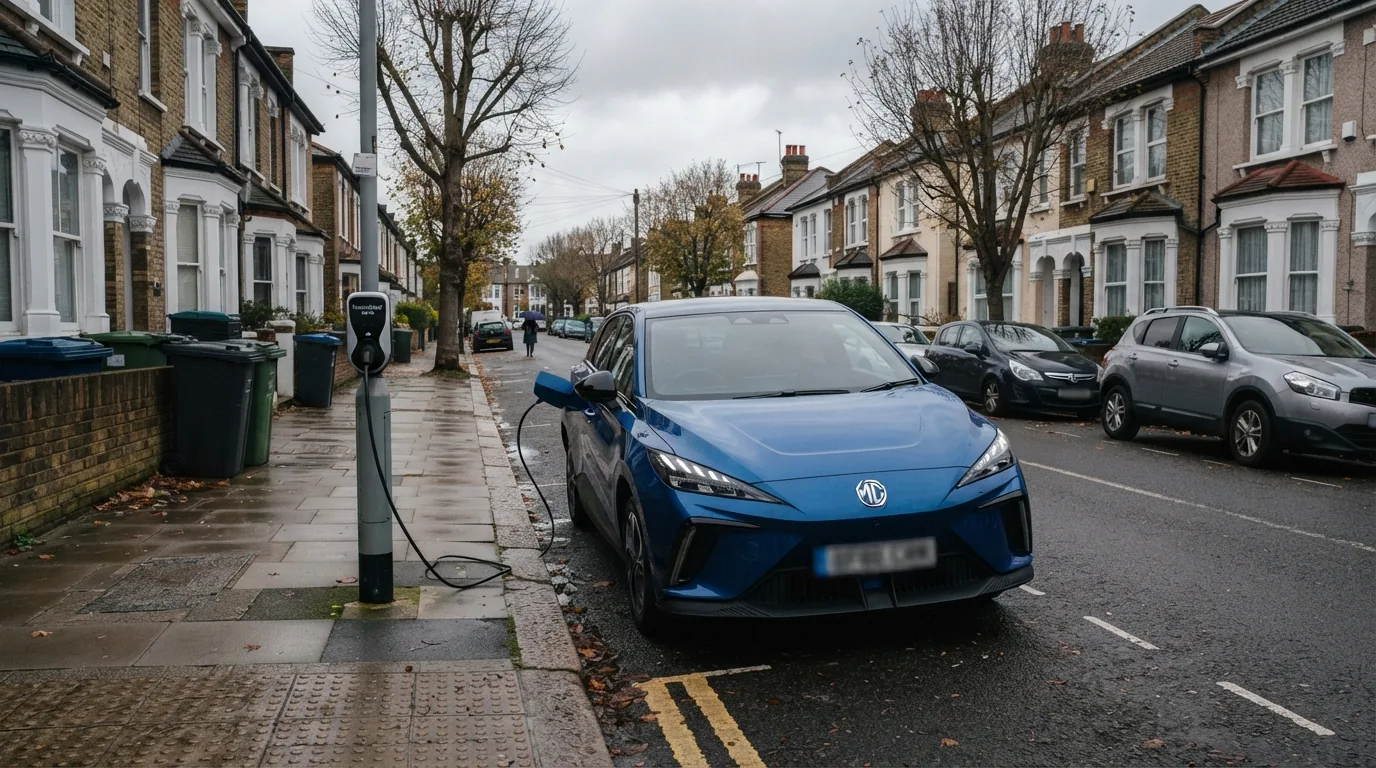
- Option 2: On-street lamp post chargers: Many local authorities have installed charging points on residential street lighting columns.
- Option 3: Workplace charging: If your employer offers EV charging, this can substitute effectively for home charging.
- Option 4: Destination charging: Destination charging describes chargers installed at places you visit: supermarkets, gyms, shopping centres, hotels, leisure facilities, and car parks.
Yes, you can live with an electric car without a driveway, but it requires more planning than home charging allows, and the running costs are higher if you rely heavily on public chargers. For a growing number of UK drivers in 2026, the charging infrastructure has improved enough to make it work practically. Here is what your options actually are and what each one costs.
Why this matters: roughly 40% of UK households have no driveway
Around 40% of UK households do not have access to off-street parking. That is tens of millions of people for whom home charging, the backbone of affordable EV ownership, is not straightforwardly available. Whether you live in a terraced house, a flat, or a property with no private land, this affects your charging options.
The good news is that 2026 has seen significant policy movement on this issue. The situation is materially better than it was two years ago. The challenge is that the UK’s on-street charging infrastructure is still uneven by region and local authority.
Option 1: Cross-pavement charging from your home
Cross-pavement charging involves running a dedicated charging cable from a wall-mounted unit on your home, through a self-closing channel cut into the pavement, to your car parked at the kerb. Done properly, it is neat, safe, and results in a genuinely home-like charging experience.
The rollout of cross-pavement charging is gathering speed. As of April 2026, more than 40% of local authorities in England, Scotland, and Wales plan to have cross-pavement solutions available by the end of the year, according to RAC research. Fifty-six tier-one councils are either currently offering or planning to introduce cross-pavement schemes by year-end.
The catch is inconsistency. Installation costs vary dramatically between councils, from free to over £1,000, depending on local authority policy. Some councils require planning permission. Some operate waiting lists. If your council is among those offering the service, it can be a genuine solution. If not, you will need alternatives.
The OZEV EV Chargepoint Grant also covers up to 75% of installation costs, capped at £500 per socket, for eligible renters and flat owners. This can offset part of the hardware cost, though it does not cover the pavement channel work.
Option 2: On-street lamp post chargers
Many local authorities have installed charging points on residential street lighting columns. These are typically 3 to 6kW slow chargers, operated by network providers including Connected Kerb, Ubitricity, and BP Pulse.
Slow lamp post chargers add roughly 12 to 20 miles of range per hour. If you park next to one overnight for eight hours, you might recover 100 to 150 miles, sufficient for most daily use.
The limitation is availability. Not all streets have them, and demand can exceed supply in some areas. Apps such as Zap-Map show the location and current availability of on-street chargers.
The cost is typically around 35 to 55p per kWh via a membership or pay-as-you-go card, working out at around 10 to 16p per mile, which is still meaningfully cheaper than petrol but not as cheap as a home tariff.
Option 3: Workplace charging
If your employer offers EV charging, this can substitute effectively for home charging. The Workplace Charging Scheme provides grant funding for businesses to install chargers. Many employers offer charging free to employees, or at cost-price electricity rates.
If you charge at work five days per week and cover typical daily commute mileage, workplace charging alone can cover most of your energy needs.
Option 4: Destination charging
Destination charging describes chargers installed at places you visit: supermarkets, gyms, shopping centres, hotels, leisure facilities, and car parks. These typically offer slow to fast charging (7 to 22kW) while you go about your business.
The strategy for a driver without a driveway is to combine destination charging opportunities. Top up while you shop. Charge for a few hours while parked for work. Pick hotels and holiday locations that offer charging.
This requires more thought than plugging in at home, but many driveway-less EV drivers describe it as becoming habitual within a month or two.
Option 5: Public rapid charging as the primary method
If none of the above is available, public rapid charging at a petrol-station-style hub is an option. These range from 50kW to 350kW, adding 100 miles in 15 to 45 minutes depending on speed and your car’s maximum charge rate.
The cost matters here. Pay-as-you-go rapid charging typically costs 54p to 79p per kWh in 2026, working out at 15 to 23p per mile. That is in the same ballpark as petrol at current prices. The convenience of not stopping at a petrol station is the main benefit, rather than a significant cost saving.
For drivers with genuinely no other option, this can still work, particularly if your mileage is low and you can top up infrequently. But it undermines one of the two main financial arguments for switching to electric.
The cost comparison at a glance
| Charging method | Typical rate | Cost per mile (3.5 miles/kWh) |
|---|---|---|
| Home wallbox on off-peak EV tariff | ~7p/kWh | ~2p |
| Home wallbox on standard Ofgem rate | 24.67p/kWh | ~7p |
| Lamp post / on-street slow charger | 35–55p/kWh | ~10–16p |
| Public fast charger (7–22kW) | 40–60p/kWh | ~11–17p |
| Public rapid charger (50–100kW) | ~54p/kWh | ~15p |
| Public ultra-rapid charger (150kW+) | ~79p/kWh | ~23p |
| Petrol (40mpg, 159.6p/litre) | , | ~18p |
| Diesel (50mpg, 184.9p/litre) | , | ~16p |
The table shows clearly that lamp post and on-street slow charging remains cheaper per mile than petrol, and that rapid public charging breaks approximately even with petrol on running costs.
What models suit drivers without a driveway?
If you rely on public charging, the most important specification is not range but charging speed. A car that can rapid charge at 100kW or faster makes public top-ups quicker and less disruptive.
Cars particularly well suited to driveway-less charging:
- Hyundai Ioniq 5 and 6: 800V platform supports up to 220kW charging; 10 to 80% in around 18 minutes.
- Kia EV6: same 800V architecture, up to 240kW charging.
- Tesla Model 3: access to the UK’s largest fast charger network (Supercharger), now open to non-Tesla drivers.
- Volkswagen ID.7: up to 200kW DC charging on the Pro version.
For models suited specifically to drivers without driveways, including car-sharing and charging habit tips, see our best electric cars for drivers without a driveway page.
The honest conclusion
Living with an EV without a driveway is viable in 2026, particularly in urban areas where charging infrastructure is denser. It requires a different approach: building charging into your routine rather than treating it like a petrol stop.
The cross-pavement solution, where your council offers it, provides the closest thing to home charging without off-street parking. Combining lamp post, workplace, and destination charging covers most needs for moderate-mileage drivers.
The challenge remains for drivers in areas with poor on-street provision who cover significant mileage. For them, the calculus is harder, and a hybrid may be a more practical interim step. For the rest, EV ownership without a driveway in 2026 is genuinely workable.
For the full topic guide on switching, return to the switching from petrol or diesel hub. For model recommendations for your situation, see best first electric cars for switching from petrol.
Sources: RAC research on cross-pavement charging April 2026, OZEV EV Chargepoint Grant guidance, GOV.UK EV chargepoint statistics March 2026, Ofgem energy price cap Q2 2026, RAC fuel watch data May 2026.
How we test and where our numbers come from
Range figures are official WLTP combined values taken from manufacturer UK specification pages, with real-world estimates drawn from independent comparative testing. Prices are UK list prices at the time of the latest update. Tax, grant and charging-scheme figures come from GOV.UK and HMRC publications. We re-check every guide when pricing, specification or policy changes. Last checked 11 August 2026.
Frequently asked questions
What models suit drivers without a driveway?
If you rely on public charging, the most important specification is not range but charging speed. A car that can rapid charge at 100kW or faster makes public top-ups quicker and less disruptive.

EV Compared
The EV Compared editorial team tracks the UK electric vehicle market full time: new model launches, list prices, WLTP and real-world range, public charging tariffs and the tax rules that decide what an EV actually costs to run. Every guide is checked against manufacturer specifications and official GOV.UK figures, and updated whenever the numbers move.
Related reading
View all
What Are the Biggest Myths About Switching to an EV?
The claims that put UK drivers off going electric, and what the evidence actually says
Should You Buy an EV in 2026 or Wait for Cheaper Models?
An honest look at where EV prices are heading and whether the wait is worth it for UK buyers
Buying and Owning an Electric Car in the UK: The Complete 2026 Guide
Everything you need to know about costs, charging, depreciation and day-to-day life with an EV