Kia EV6 vs Hyundai Ioniq 5: Range and Charging Compared
Sister cars with the same platform, different personalities. Which one is right for UK drivers?
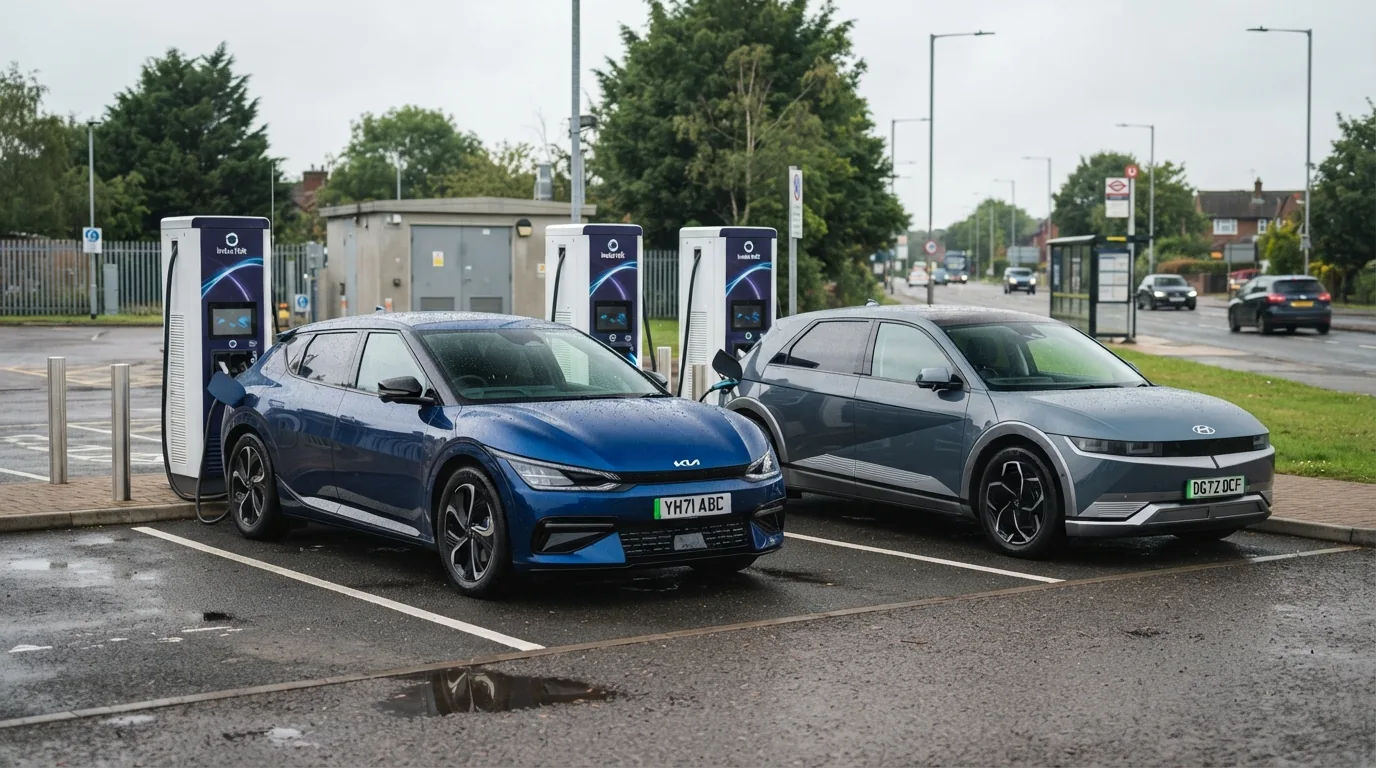
Quick answers
- The Kia EV6 and Hyundai Ioniq 5 share the same E-GMP platform, the same 800-volt charging architecture, and broadly the same battery options. On paper they are nearly identical.
- Range: nearly identical in practice: The Kia EV6 Long Range RWD claims 361 miles WLTP versus the Ioniq 5 Long Range's 354 miles.
- Charging: effectively the same system: Both cars share the E-GMP 800-volt architecture and support peak DC charging rates of 240 to 260 kW.
- The Ioniq 5's boxy, upright body shape was designed specifically to maximise interior space.
- The EV6's lower, sleeker profile and more driver-focused setup give it a sportier character that car enthusiasts prefer.
- The AWD versions: power and towing: For buyers who need towing capacity above 1,600 kg, the EV6 AWD's 1,800 kg rating has a clear advantage.
The Kia EV6 and Hyundai Ioniq 5 share the same E-GMP platform, the same 800-volt charging architecture, and broadly the same battery options. On paper they are nearly identical. In practice, the Ioniq 5 is the family car: spacious, relaxing, practical. The EV6 is the enthusiast pick: sleeker, sportier, slightly less spacious. Neither is a clear winner on range or charging; the differences are about character and priorities.
For UK buyers, the Ioniq 5 costs less to start (from around £40,695 vs the EV6’s £45,585) and offers more interior space. The EV6 Long Range RWD offers more absolute WLTP range (361 miles vs 354 miles for the Ioniq 5 Long Range). Both are excellent; the choice is personal.
Head-to-head specification
| Specification | Kia EV6 Long Range RWD | Hyundai Ioniq 5 Long Range RWD |
|---|---|---|
| WLTP Range | 361 miles | 354 miles |
| Real World (mixed est.) | ~275-305 miles | ~267-295 miles |
| Motorway 70 mph (est.) | ~258-285 miles | ~252-280 miles |
| Battery (usable) | 77.4 kWh | 80.9 kWh (84 kWh gross) |
| Power | 229 hp | 228 hp |
| 0-62 mph | 7.3 seconds | 8.5 seconds |
| Peak DC Charging | 240 kW | 260 kW |
| 10-80% charge time | ~18-20 min | ~18 min |
| Boot space | 490 litres | 527 litres |
| Starting Price (UK) | £45,585 | ~£44,495 |
| Drag coefficient | 0.28 | 0.29 |
| BiK rate (2026/27) | 4% | 4% |
Note: The Ioniq 5 Long Range has a larger battery (84 kWh gross, 80.9 kWh usable) than the EV6 Long Range (77.4 kWh). The EV6 is more aerodynamically efficient despite less battery, hence similar real-world range.
Range: nearly identical in practice
The Kia EV6 Long Range RWD claims 361 miles WLTP versus the Ioniq 5 Long Range’s 354 miles. In real-world mixed UK conditions, the difference is around 8 to 15 miles in favour of the EV6. At motorway speeds, the EV6’s slightly better Cd of 0.28 versus the Ioniq 5’s 0.29 gives a marginal efficiency advantage. Neither figure is particularly impressive by 2026 mid-size EV standards; both cars use a boxy body style that compromises aerodynamic efficiency compared with the Ioniq 6 saloon or Tesla Model 3.
The practical reality: both cars deliver around 265 to 305 miles of real-world mixed range. For most UK buyers, the difference of 8 to 15 miles between the two is irrelevant in daily use.
Charging: effectively the same system
Both cars share the E-GMP 800-volt architecture and support peak DC charging rates of 240 to 260 kW. In practice, the charging times are almost identical: approximately 18 minutes from 10 to 80 per cent at a 350 kW charger. At the more common 150 kW chargers on the UK network, both cars are limited by the charger speed rather than their own capability and complete a similar 10 to 80 per cent top-up in around 22 to 25 minutes.
Both cars precondition the battery automatically when you navigate to a compatible charger, ensuring near-peak charging rates regardless of ambient temperature. This battery preconditioning is one of the strongest features of the E-GMP platform and gives both cars a meaningful advantage in consistent charging performance over cold UK winters.
The EV6 does have an updated larger battery option (84 kWh) in some markets and trims, which charges at up to 240 kW peak. Check the exact specification at the time of purchase, as battery size has been updated in mid-cycle for both models.
Interior and practicality: Ioniq 5 is more spacious
The Ioniq 5’s boxy, upright body shape was designed specifically to maximise interior space. The result is exceptional: despite being shorter overall than many rivals, the Ioniq 5 offers 527 litres of boot space, genuinely flat rear floor, and rear passenger room that rivals many larger SUVs. The pixel-inspired interior design, reclining driver seat (on some trims) and USB-C charging points throughout give it a distinctive, contemporary feel.
The EV6’s more conventional fastback SUV shape delivers 490 litres of boot space and good front passenger space, but the more coupe-like roofline limits rear headroom for tall passengers. It is not cramped, but it is noticeably less airy than the Ioniq 5 in the rear.
For families with children or regular back-seat passengers, the Ioniq 5 is the more liveable car.
Driving character: EV6 is the enthusiast choice
The EV6’s lower, sleeker profile and more driver-focused setup give it a sportier character that car enthusiasts prefer. Steering feel is more direct, body roll slightly more controlled, and the overall driving experience is more engaging. Hyundai’s N division focus shows in the platform tuning: the EV6 has been developed with performance in mind, and it shows on a good road.
The Ioniq 5 is more relaxed and more comfortable at a sedate pace. It absorbs British road surfaces well and is less tiring over long distances. For an urban commuter or a family car, the calmer character of the Ioniq 5 is likely more appealing.
The AWD versions: power and towing
Both cars are available with dual-motor AWD. The Kia EV6 AWD produces 320 hp and does 0 to 62 mph in 5.1 seconds, with 1,800 kg towing capacity and around 339 miles WLTP range. The Hyundai Ioniq 5 AWD produces 325 hp with 0 to 62 mph in 5.1 seconds, 1,600 kg towing capacity and around 285 to 300 miles WLTP range.
For buyers who need towing capacity above 1,600 kg, the EV6 AWD’s 1,800 kg rating has a clear advantage. For pure on-road performance, both cars are evenly matched.
Price comparison in the UK market
Both cars start below £46,000 in long-range RWD form. The Hyundai Ioniq 5 Long Range is currently available from approximately £44,495, while the Kia EV6 Long Range RWD starts at £45,585. The Ioniq 5 saves buyers around £1,000 to £1,500 in initial cost.
Over a three-year ownership cycle, the difference is small. Both cars have strong residual value retention due to their reputation and the consistent demand for 800-volt EVs with fast charging.
For company car drivers, both attract the same 4 per cent BiK rate. The slight difference in P11D means the Ioniq 5’s tax bill is negligibly lower.
Verdict: which should you buy?
Choose the Hyundai Ioniq 5 if: you have a family and need maximum interior space, you prefer a more upright, airy cabin, or you value the lower starting price. The Ioniq 5 is the more versatile, practical choice.
Choose the Kia EV6 if: you want the more driver-focused experience, you prefer the sleeker exterior design, or you need the EV6’s higher 1,800 kg towing capacity in AWD form. The EV6 is the car for buyers who consider the driving experience a priority alongside the practical credentials.
Both are genuinely outstanding electric cars built on the same excellent foundation. There is no wrong choice; the decision comes down to whether you want a family-first or driver-first car from the E-GMP platform.
For the full market context on range and charging across all UK EVs, see longest range electric cars. For our fastest-charging rankings, see the fastest charging electric cars guide. More on how charging architecture affects real-world performance is in the range and performance hub.
Sources: Kia UK EV6 pricing and specification, Hyundai UK Ioniq 5 pricing, EV Database UK E-GMP platform data, US News EV6 vs Ioniq 5 comparison, Carwow UK testing, Recharged used comparison.
How we test and where our numbers come from
Range figures are official WLTP combined values taken from manufacturer UK specification pages, with real-world estimates drawn from independent comparative testing. Prices are UK list prices at the time of the latest update. Tax, grant and charging-scheme figures come from GOV.UK and HMRC publications. We re-check every guide when pricing, specification or policy changes. Last checked 11 August 2026.
Frequently asked questions
Verdict: which should you buy?
Both are genuinely outstanding electric cars built on the same excellent foundation. There is no wrong choice; the decision comes down to whether you want a family-first or driver-first car from the E-GMP platform.

EV Compared
The EV Compared editorial team tracks the UK electric vehicle market full time: new model launches, list prices, WLTP and real-world range, public charging tariffs and the tax rules that decide what an EV actually costs to run. Every guide is checked against manufacturer specifications and official GOV.UK figures, and updated whenever the numbers move.
Related reading
View all
Do Bigger Wheels Reduce Electric Car Range?
Yes, significantly. Here is the data on how much wheel size costs in miles and why it happens
BMW i4 vs Tesla Model 3: UK Range and Efficiency Test
The BMW costs more and goes less far, but is it worth it? A data-led head to head for UK buyers
How Far Can an Electric Car Really Go on One Charge?
Real-world range figures for UK drivers: what the numbers mean and which cars go furthest