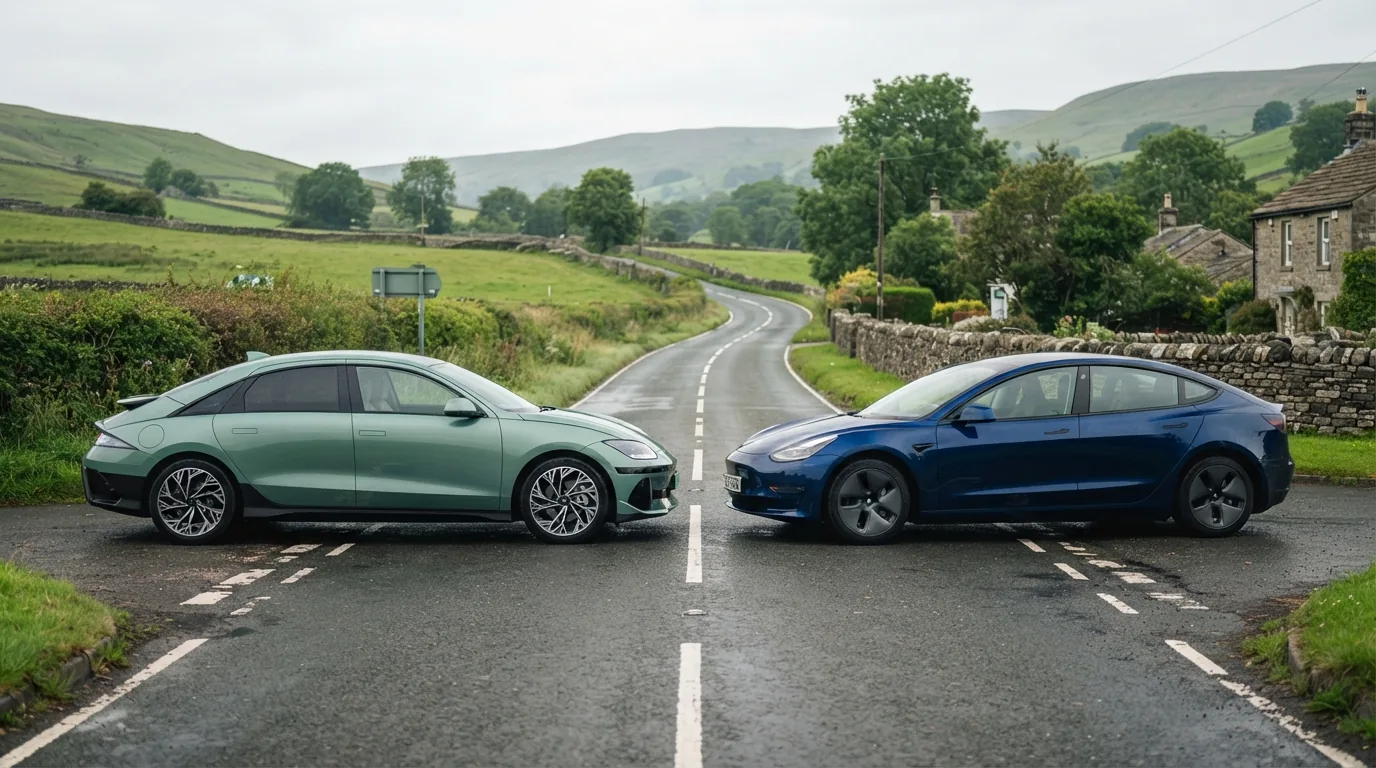
Hyundai Ioniq 6 vs Tesla Model 3: Which Goes Further?
The aerodynamic showdown between two of the most range-efficient electric saloons available in the UK
Quick answers
- The Tesla Model 3 Long Range claims 466 miles WLTP to the Hyundai Ioniq 6 Long Range RWD's 338 miles. That headline advantage for the Tesla is real, and it comes from the Model 3's substantially larger battery (79 kWh usable vs 74 kWh).
- On UK roads, the Ioniq 6 Long Range RWD typically achieves 4.0 to 4.4 miles per kWh in mixed conditions.
- Charging: Ioniq 6 is significantly faster: The Ioniq 6's 800-volt architecture with 260 kW peak charging is its most practical advantage over the Model 3.
- The Model 3's charging network advantage remains significant.
- Interior, practicality and comfort: The Ioniq 6's interior quality is generally rated above the Model 3 in material terms, with softer surfaces and a more premium feel.
- Winter range: who handles the cold better: In absolute terms, the Model 3 retains more miles in winter simply because it starts with more range.
The Tesla Model 3 Long Range claims 466 miles WLTP to the Hyundai Ioniq 6 Long Range RWD’s 338 miles. That headline advantage for the Tesla is real, and it comes from the Model 3’s substantially larger battery (79 kWh usable vs 74 kWh). But per kWh of battery, the Ioniq 6 is the more efficient car, with one of the lowest drag coefficients of any production vehicle at 0.21.
In practical terms: if you charge to the same level, the Tesla goes further. The Ioniq 6 charges to 80 per cent faster (around 18 minutes on a 350 kW charger vs 25 to 30 minutes for the Model 3) and is cheaper to buy at £46,260 versus £45,990 for the Model 3 Long Range, making it almost identically priced. The right choice depends on whether you prioritise maximum range per charge or maximum charging speed.
Head-to-head specification
| Specification | Hyundai Ioniq 6 Long Range RWD | Tesla Model 3 Long Range RWD |
|---|---|---|
| WLTP Range | 338 miles | 466 miles |
| Real World (mixed est.) | ~260-285 miles | ~350-380 miles |
| Motorway 70 mph (est.) | ~255-275 miles | ~325-360 miles |
| Battery (usable) | 74 kWh | 79 kWh |
| Efficiency (miles/kWh) | ~3.7-4.4 | ~3.8-4.2 |
| Power | 228 hp | 258 hp |
| 0-62 mph | 7.4 seconds | 5.8 seconds |
| Peak DC Charging | 260 kW (800V) | 250 kW (Supercharger) |
| 10-80% charge time | ~18 min | ~25-30 min |
| Boot space | 361 litres | 594 litres |
| Starting Price (UK) | £46,260 | £45,990 |
| Drag coefficient | 0.21 | 0.23 |
| BiK rate (2026/27) | 4% | 4% |
The efficiency paradox: Ioniq 6 is more efficient per kWh but goes shorter distances
The Ioniq 6 is the more efficient car per unit of battery. Its drag coefficient of 0.21 is exceptional, matching the Mercedes EQS as the lowest Cd of any production car and better than the Porsche Taycan’s 0.22. The EPA recognised the Ioniq 6 as the most energy-efficient EV in North America for two consecutive years.
On UK roads, the Ioniq 6 Long Range RWD typically achieves 4.0 to 4.4 miles per kWh in mixed conditions. The Tesla Model 3 Long Range achieves around 3.8 to 4.2 miles per kWh. The Ioniq 6 is measurably more efficient per kWh, but because it has 5 kWh less usable capacity, its absolute range is shorter.
If both cars had the same battery, the Ioniq 6 would very likely go further. In the UK market, where they are priced almost identically, the Model 3’s larger battery gives it the longer absolute range.
Charging: Ioniq 6 is significantly faster
The Ioniq 6’s 800-volt architecture with 260 kW peak charging is its most practical advantage over the Model 3. At a 350 kW charger (available at Gridserve Electric Highway hubs and select other sites), the Ioniq 6 achieves a 10 to 80 per cent charge in approximately 18 minutes. The Tesla Model 3 Long Range at a Supercharger V3 takes around 25 to 30 minutes for the same.
For a driver doing multiple long-distance legs in a day, the 7 to 12 minute difference per charge stop is meaningful. Over four charge stops on a busy driving day, that is 28 to 48 minutes of additional charging time in the Model 3.
The Ioniq 6 also preconditions its battery automatically when you navigate to a compatible charger, ensuring peak charging rates even in winter.
The Supercharger network vs CCS: the Model 3’s practical advantage
The Model 3’s charging network advantage remains significant. Tesla Superchargers on UK motorways are consistently more reliable and faster to access in practice than the public CCS network. While the Ioniq 6 can use any CCS charger (theoretically including Superchargers, which are now open to third-party vehicles), the experience at non-Tesla sites is less streamlined and reliability varies.
For drivers who do most of their long-distance driving on major UK corridors where Tesla Superchargers are well-represented, this matters. For drivers who do longer or more varied routes where Gridserve or BP Pulse sites are more accessible, the Ioniq 6’s 800-volt CCS compatibility is equally practical.
Interior, practicality and comfort
The Ioniq 6 is not the roomiest car in its class. Its swept-back aerodynamic silhouette limits rear headroom, and the 361-litre boot is 233 litres less than the Model 3’s 594 litres (which benefits from its saloon-style boot and frunk). For buyers who regularly carry passengers or large loads, the Model 3 is the more practical car.
The Ioniq 6’s interior quality is generally rated above the Model 3 in material terms, with softer surfaces and a more premium feel. Both use Android-based infotainment (though Tesla’s is proprietary). The Ioniq 6 uses Google native apps; the Tesla uses its own ecosystem with a strong third-party app scene.
Winter range: who handles the cold better?
Both cars have heat pumps. Independent winter testing data from the cold-weather season shows the Tesla Model 3 Long Range losing approximately 17 to 20 per cent of its WLTP range at 0 to 5 degrees Celsius. The Ioniq 6 loses a similar 18 to 22 per cent. Neither car is a clear winter leader, though the Model 3’s slightly better battery thermal management gives it a marginal edge in very cold conditions.
In absolute terms, the Model 3 retains more miles in winter simply because it starts with more range.
Which is better for: different UK buyers
Daily commuter (under 50 miles a day, home charging): The Ioniq 6’s shorter range makes no practical difference. The faster DC charging is a bonus for occasional long trips. Both cars work equally well here.
Regular long-distance motorway driver: The Model 3 Long Range wins on raw motorway range and the Supercharger network. For covering 250-plus-mile days, the extra 90 miles of WLTP range (translating to roughly 65 to 70 miles of motorway range) allows longer runs between charges.
Frequent fast-charging user (no home charging): The Ioniq 6’s 18-minute 10 to 80 per cent charge on 800-volt infrastructure is the most relevant factor. If you rely on public rapid charging daily, the Ioniq 6 spends less total time at chargers.
Company car driver: Both attract the same 4 per cent BiK rate. The Ioniq 6 is £270 more expensive (£46,260 vs £45,990), making the annual BiK tax negligibly higher. For fleet management purposes, either works; individual preference on range and charging network should guide the choice.
Verdict
The Tesla Model 3 Long Range wins on: absolute range, motorway range, boot space and the quality of the charging network experience.
The Hyundai Ioniq 6 wins on: charging speed (800V, 18 min to 80%), efficiency per kWh, drag coefficient and interior material quality.
For most UK buyers who want the better single-charge range and the more established charging infrastructure, the Model 3 Long Range is the stronger choice. The Ioniq 6 is the right car for drivers who do shorter regular journeys and value the fastest possible rapid-charging turnaround on those occasions when they do need to top up.
For the full ranking of both models against the wider market, see longest range electric cars. For more on how efficiency and aerodynamics affect motorway range, see most efficient EVs for motorway driving and the range and performance hub.
Sources: Hyundai UK Ioniq 6 pricing and WLTP data, Tesla UK pricing, EV Database UK, Recharged comparative testing, Carparison UK comparison, EPA efficiency rankings.
How we test and where our numbers come from
Range figures are official WLTP combined values taken from manufacturer UK specification pages, with real-world estimates drawn from independent comparative testing. Prices are UK list prices at the time of the latest update. Tax, grant and charging-scheme figures come from GOV.UK and HMRC publications. We re-check every guide when pricing, specification or policy changes. Last checked 11 August 2026.
Frequently asked questions
Winter range: who handles the cold better?
Both cars have heat pumps. Independent winter testing data from the cold-weather season shows the Tesla Model 3 Long Range losing approximately 17 to 20 per cent of its WLTP range at 0 to 5 degrees Celsius.

EV Compared
The EV Compared editorial team tracks the UK electric vehicle market full time: new model launches, list prices, WLTP and real-world range, public charging tariffs and the tax rules that decide what an EV actually costs to run. Every guide is checked against manufacturer specifications and official GOV.UK figures, and updated whenever the numbers move.
Related reading
View all
Do Bigger Wheels Reduce Electric Car Range?
Yes, significantly. Here is the data on how much wheel size costs in miles and why it happens
BMW i4 vs Tesla Model 3: UK Range and Efficiency Test
The BMW costs more and goes less far, but is it worth it? A data-led head to head for UK buyers
How Far Can an Electric Car Really Go on One Charge?
Real-world range figures for UK drivers: what the numbers mean and which cars go furthest