How Much Range Do You Lose in Winter With an EV?
Honest figures on cold-weather range loss, which cars handle it best and how to minimise the impact
Quick answers
- In typical British winter conditions, an electric car loses between 20 and 40 per cent of its usable range compared with the WLTP figure. Most real-world tests put the average at around 25 per cent.
- The combination of reduced battery capacity and high heating load is what drives the significant winter range losses measured in real-world tests.
- Which cars lose the least range in winter: Independent testing and owner data consistently identify heat pump-equipped vehicles as the clear winners.
- When does most winter range loss happen: The first 15 minutes of a journey account for a disproportionate share of cold-weather losses.
- Is winter range loss a dealbreaker: The practical rule: if you drive more than 100 miles in a day regularly, and you expect to do some of that in winter, prioritise a car with a heat pump and aim for a WLTP figure of at least 300 miles.
In typical British winter conditions, an electric car loses between 20 and 40 per cent of its usable range compared with the WLTP figure. Most real-world tests put the average at around 25 per cent. At the lower end, a well-specified car with a heat pump might lose just 10 to 15 per cent. At the worse end, an older model running resistive heating in sub-zero temperatures can shed more than 40 per cent.
That means a car rated at 300 miles WLTP might return around 180 to 240 miles on a cold January day, depending on the model, the temperature and whether you use heated seats and steering wheel instead of cranking the cabin heater to full.
Why does cold weather hurt EV range so much?
Two separate problems hit simultaneously in cold weather.
Battery chemistry slows down. Lithium-ion cells operate less efficiently at low temperatures. Below around 10 degrees Celsius, internal resistance rises, which means the battery cannot deliver as much power, and it cannot accept charge as quickly either. At 0 degrees Celsius, a pack typically delivers around 80 per cent of its room-temperature capacity. At minus 10 degrees, that can fall to 70 per cent or below.
Heating the cabin costs energy. A petrol car heats the cabin essentially for free, using waste engine heat. An EV has no waste heat to speak of, so it has to generate heat electrically. A resistive heater (the traditional type) draws 3 to 5 kW continuously. On a 77 kWh battery, 5 kW of continuous heating is equivalent to around 10 to 15 miles of range consumed every hour simply to keep you warm.
The combination of reduced battery capacity and high heating load is what drives the significant winter range losses measured in real-world tests.
Which cars lose the least range in winter?
Independent testing and owner data consistently identify heat pump-equipped vehicles as the clear winners. A heat pump extracts thermal energy from outside air (even at very low temperatures) to warm the cabin and battery, using roughly one-third of the electricity that a resistive heater would need for the same output.
| Car | WLTP Range | Winter Real World (0-5°C) | Estimated Loss |
|---|---|---|---|
| Tesla Model Y Long Range | 331 miles | ~293 miles | ~11% |
| BMW iX xDrive40 | 380 miles | ~330 miles | ~13% |
| Hyundai Ioniq 5 Long Range | 354 miles | ~302 miles | ~15% |
| Tesla Model 3 Long Range | 466 miles | ~370-390 miles | ~16-20% |
| Mercedes EQE 350+ | 394 miles | ~310-325 miles | ~18-21% |
| Kia EV6 Long Range | 361 miles | ~280-300 miles | ~17-22% |
| Volkswagen ID.4 Pro | 323 miles | ~245-270 miles | ~16-24% |
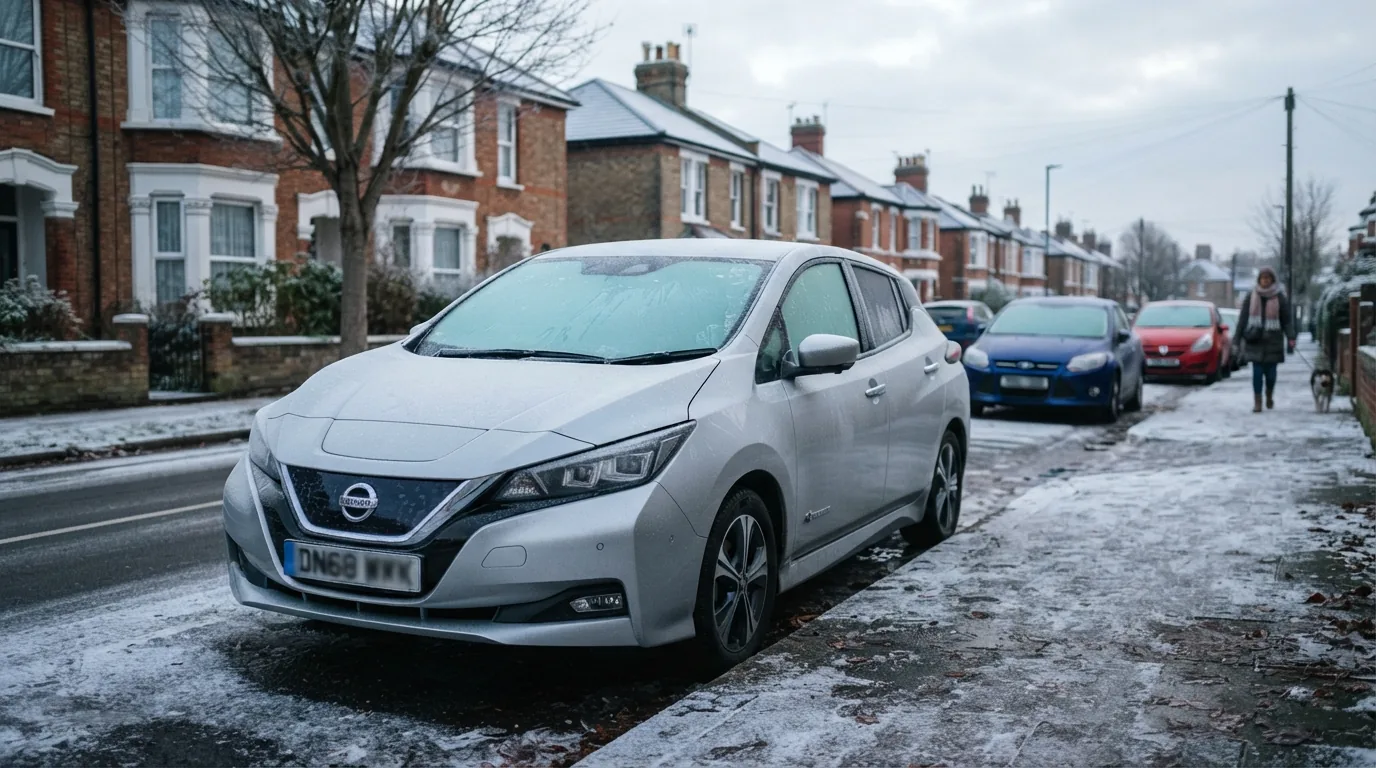
Models without a heat pump, and particularly older EVs with simpler thermal systems, sit at the worse end of this range. The Nissan Leaf (older versions without heat pump) and some budget market entrants can lose 30 to 40 per cent of range in winter.
It is worth noting that the Tesla Model Y Long Range’s 11.8 per cent winter loss figure, reported in independent testing, is unusually good. Tesla’s battery thermal management system, which actively heats the pack as part of navigation-assisted preconditioning, is one of the best in the industry.
When does most winter range loss happen?
The first 15 minutes of a journey account for a disproportionate share of cold-weather losses. A cold battery at 0 degrees cannot operate at full efficiency, so the car draws more energy than it should. Once the battery warms up, efficiency improves significantly. This is why short journeys in winter are especially harsh on range.
Cabin preconditioning, available on most modern EVs, addresses this by warming the battery and cabin while the car is still plugged in. If you set your car to be ready at 7:30am while it is still connected to the charger, the energy used to warm the cabin and battery comes from the mains, not from your driving range.
How much does the temperature matter specifically?
| Temperature | Approximate Range Retained (vs WLTP) |
|---|---|
| 20°C (mild day) | ~80-85% |
| 10°C (cool autumn) | ~75-80% |
| 5°C (cold UK morning) | ~70-75% |
| 0°C (freezing) | ~65-70% |
| -5°C (hard frost) | ~60-65% |
| -10°C and below | ~55-60% |
These are broad averages. The actual figure for your specific car will depend on whether it has a heat pump, the efficiency of the thermal management system, and how aggressively you use climate control.
Practical tips to limit winter range loss
Use heated seats and steering wheel instead of the cabin fan. Heated seats warm you directly and draw around 100 to 200 watts each. The main cabin heater draws 3 to 5 kW. If you can keep the cabin temperature lower (18 to 19 degrees rather than 22 to 23 degrees) and use seat heat to compensate, you can cut heating energy consumption by 40 to 50 per cent.
Precondition before you leave. Set the car to reach operating temperature while plugged in, not on the road. This costs nothing from your driving range and means the battery is already at optimum temperature when you set off.
Drive smoothly. In cold weather, the battery takes longer to warm up after a cold start. Gentle acceleration for the first few miles helps the pack reach efficiency sooner and reduces the risk of the car limiting power output.
Keep tyre pressures correct. Cold air reduces tyre pressure. Under-inflated tyres increase rolling resistance, which compounds winter range losses. Check pressures at least monthly in winter; most EVs have tyre pressure monitoring, but the warnings only trigger when the drop is significant.
Charge overnight. A battery that has been sitting fully charged inside a garage (or at a minimum, plugged in) will be warmer than one left overnight in cold air with no power. Most home chargers can be set to maintain the battery at a comfortable temperature.
Is winter range loss a dealbreaker?
For most UK drivers, no. The average UK daily drive is around 20 miles. Even an EV that loses 30 per cent of its real-world range in winter still delivers adequate range for the vast majority of commutes and local journeys. The issue arises on longer winter motorway trips, where careful planning and a mid-route charge stop may be needed.
The practical rule: if you drive more than 100 miles in a day regularly, and you expect to do some of that in winter, prioritise a car with a heat pump and aim for a WLTP figure of at least 300 miles.
For our full comparison of how different models perform in cold weather, see the best electric cars for range in cold weather guide. The range and performance hub covers related topics including WLTP accuracy, motorway range and tips for maximising efficiency year-round.
Sources: Recurrent Auto winter range study (30,000+ vehicles), independent winter testing data, EV Database UK specifications, manufacturer thermal management documentation.
How we test and where our numbers come from
Range figures are official WLTP combined values taken from manufacturer UK specification pages, with real-world estimates drawn from independent comparative testing. Prices are UK list prices at the time of the latest update. Tax, grant and charging-scheme figures come from GOV.UK and HMRC publications. We re-check every guide when pricing, specification or policy changes. Last checked 11 August 2026.
Frequently asked questions
Why does cold weather hurt EV range so much?
The combination of reduced battery capacity and high heating load is what drives the significant winter range losses measured in real-world tests.
Which cars lose the least range in winter?
Independent testing and owner data consistently identify heat pump-equipped vehicles as the clear winners. A heat pump extracts thermal energy from outside air (even at very low temperatures) to warm the cabin and battery, using roughly one-third of the electricity that a resistive heater would need for the same output.
When does most winter range loss happen?
The first 15 minutes of a journey account for a disproportionate share of cold-weather losses. A cold battery at 0 degrees cannot operate at full efficiency, so the car draws more energy than it should.
How much does the temperature matter specifically?
These are broad averages. The actual figure for your specific car will depend on whether it has a heat pump, the efficiency of the thermal management system, and how aggressively you use climate control.
Is winter range loss a dealbreaker?
For most UK drivers, no. The average UK daily drive is around 20 miles.

EV Compared
The EV Compared editorial team tracks the UK electric vehicle market full time: new model launches, list prices, WLTP and real-world range, public charging tariffs and the tax rules that decide what an EV actually costs to run. Every guide is checked against manufacturer specifications and official GOV.UK figures, and updated whenever the numbers move.
Related reading
View all
Do Bigger Wheels Reduce Electric Car Range?
Yes, significantly. Here is the data on how much wheel size costs in miles and why it happens
BMW i4 vs Tesla Model 3: UK Range and Efficiency Test
The BMW costs more and goes less far, but is it worth it? A data-led head to head for UK buyers
How Far Can an Electric Car Really Go on One Charge?
Real-world range figures for UK drivers: what the numbers mean and which cars go furthest