Is Now a Good Time to Switch to an Electric Car in the UK?
The honest answer, with current UK prices, incentives and infrastructure facts
Quick answers
- Yes, for most UK drivers, now is a good time to switch to an electric car. Prices have fallen, ranges have lengthened, the charging network has expanded substantially, and the government has restored a purchase grant for affordable models.
- What makes 2026 a strong moment to switch: Three things have converged to make 2026 arguably the strongest year yet for UK EV buyers: falling entry-level prices, a restored purchase grant, and a public charging network that has passed the point of critical mass.
- What are the financial facts: The numbers above show why home charging is the pivot point.
- The UK government's ban on new petrol and diesel car sales takes effect in 2035 (new petrol and diesel cars cannot be sold after that date; hybrids have a slightly different timeline).
- What about the used EV market: If a new EV is beyond your budget, the used market is now substantial.
- What is the honest verdict: For a UK driver who has a driveway, covers a typical 8,000 to 12,000 miles per year, and can access an EV tariff electricity rate, switching to an electric car in 2026 makes sound financial sense.
Yes, for most UK drivers, now is a good time to switch to an electric car. Prices have fallen, ranges have lengthened, the charging network has expanded substantially, and the government has restored a purchase grant for affordable models. The caveats are real but narrowing: if you cannot charge at home and rely on public rapid charging for everyday use, the maths is less compelling. For everyone else, the case is solid.
What makes 2026 a strong moment to switch?
Three things have converged to make 2026 arguably the strongest year yet for UK EV buyers: falling entry-level prices, a restored purchase grant, and a public charging network that has passed the point of critical mass.
Prices are coming down. New EVs in 2026 start from around £14,495 for the Leapmotor T03 (after the grant) and the Fiat Grande Panda Electric from £20,995. The Renault 5 E-Tech, which won UK Car of the Year 2026, starts from £22,995 with a 52kWh battery and 255 miles of WLTP range in the top variant. These are no longer token options: they are genuinely capable cars at prices within reach of the mainstream.
The Electric Car Grant is back. Reintroduced in July 2025, the grant provides up to £3,750 off eligible new EVs priced at £37,000 or under. This has brought a material number of models back into the price bracket where switching makes clear financial sense.
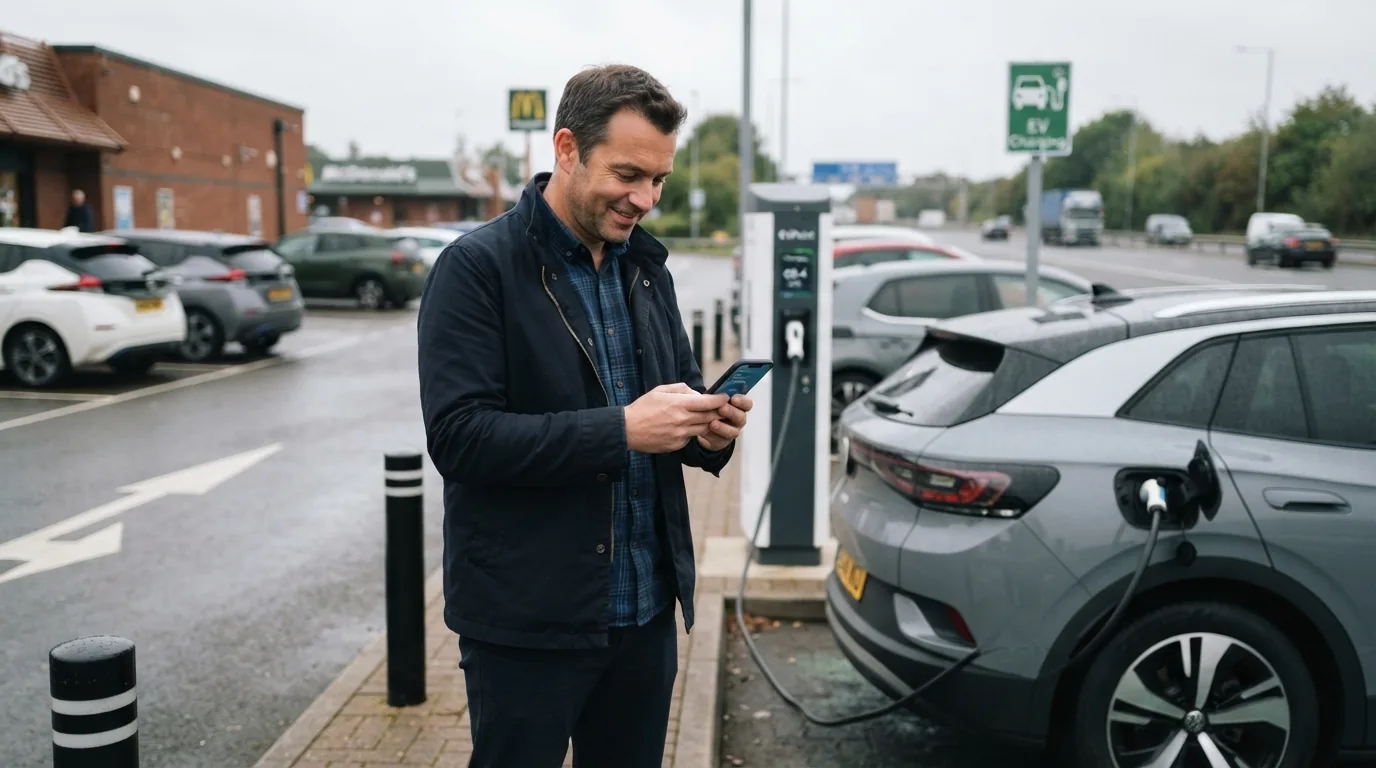
The charging network is the best it has ever been. At the end of March 2026, the UK had 119,080 public charging devices across 46,107 locations, including 27,372 rapid or ultra-rapid chargers at 6,785 sites. Virtually every motorway service area now has multiple 150kW or faster chargers.
EV market share is growing fast. SMMT data shows that in April 2026, electric cars took a 26.2% share of new registrations. Over 473,000 new EVs were registered in 2025 alone. That scale means parts availability, resale values, and the second-hand market are all improving.
What are the financial facts?
| Factor | Figure |
|---|---|
| Petrol price (May 2026) | 159.6p per litre |
| Diesel price (May 2026) | 184.9p per litre |
| Ofgem standard electricity rate (Q2 2026) | 24.67p per kWh |
| Off-peak EV tariff (e.g. Octopus Intelligent Go) | From ~7p per kWh |
| Petrol car cost per mile (40mpg) | ~18p per mile |
| EV cost per mile (home, standard rate) | ~7p per mile |
| EV cost per mile (home, off-peak rate) | ~2p per mile |
| EV cost per mile (public rapid charger) | ~19 to 23p per mile |
| Typical annual fuel saving (10,000 miles, home charging) | £900 to £1,600 |
| Electric Car Grant (eligible models under £37,000) | Up to £3,750 |
| EV road tax (VED) from April 2025 | £190 per year |
| EV BiK company car tax 2026/27 | 4% |
The numbers above show why home charging is the pivot point. If you can plug in overnight on an off-peak tariff, you are paying roughly one-ninth of the per-mile cost of petrol. Even on the standard electricity rate, you are paying less than half.
When is it not a good time to switch?
There are genuine circumstances where switching now is premature or financially unattractive:
You have no home charging and high daily mileage. If you are covering 80 or more miles per day and relying entirely on public rapid chargers, your cost per mile rises to 19 to 23p, broadly matching diesel. The convenience advantage also shrinks.
You need maximum range for a specialist use case. Rural drivers travelling 200 or more miles between destinations with limited charging options face a harder calculation. The charging network is improving, but remote areas still have gaps. Read our best electric cars for rural UK drivers guide for models that mitigate this.
You are buying a cheap petrol car to run for one or two years. The upfront cost gap between EVs and petrol equivalents means short-term ownership rarely allows savings to compound. If you plan to keep the car for three or more years, the arithmetic shifts in the EV’s favour.
You are about to face very high public charging bills. If your work or lifestyle makes public charging the norm rather than home charging, model your real costs before committing. The saving exists, but it is smaller and requires more active management.
Does the 2030 petrol and diesel ban affect timing?
The UK government’s ban on new petrol and diesel car sales takes effect in 2035 (new petrol and diesel cars cannot be sold after that date; hybrids have a slightly different timeline). This does not create an urgent deadline for most drivers in the next year or two.
However, what the policy does do is create a clear direction of travel for residuals, insurance pricing, infrastructure investment, and manufacturer focus. Cars that are petrol or diesel today will retain value less well as the transition deepens. EVs registered in 2026 will be driving into a world increasingly set up to support them.
The Zero Emission Vehicle mandate requires 28% of new car sales to be electric in 2026, rising steeply towards 80% by 2030. Manufacturers are under legal pressure to sell more EVs, which is contributing to incentive pricing and competition in the market.
What about the used EV market?
If a new EV is beyond your budget, the used market is now substantial. SMMT data for Q1 2026 shows 86,943 used battery electric cars changed hands, up 32% on Q1 2025. Prices have softened from their 2022 peaks. A used Nissan Leaf, Renault Zoe, or early Volkswagen ID.3 can be found for under £12,000 in 2026. These are shorter-range cars suitable for urban and suburban driving with home charging.
The caution with used EVs is battery health. Always request a battery health report, consider models with a known strong battery warranty record, and factor in whether the car supports rapid charging for occasional longer trips.
What is the honest verdict?
For a UK driver who has a driveway, covers a typical 8,000 to 12,000 miles per year, and can access an EV tariff electricity rate, switching to an electric car in 2026 makes sound financial sense. Running cost savings of £900 to £1,600 per year, lower servicing costs, and a significantly easier refuelling routine in daily life all point the same direction.
The purchase price gap is the remaining barrier, and it is narrowing. The grant, manufacturer incentives, and falling entry-level prices are closing it further each year.
If you are still undecided on which car suits you, start with our best first electric cars for switching from petrol page. The rest of the switching from petrol or diesel guide covers every major question in detail.
Sources: SMMT vehicle registrations April 2026, Ofgem energy price cap Q2 2026, GOV.UK EV chargepoint statistics March 2026, RAC fuel price data May 2026, GOV.UK Zero Emission Vehicle mandate.
How we test and where our numbers come from
Range figures are official WLTP combined values taken from manufacturer UK specification pages, with real-world estimates drawn from independent comparative testing. Prices are UK list prices at the time of the latest update. Tax, grant and charging-scheme figures come from GOV.UK and HMRC publications. We re-check every guide when pricing, specification or policy changes. Last checked 11 August 2026.
Frequently asked questions
What makes 2026 a strong moment to switch?
Three things have converged to make 2026 arguably the strongest year yet for UK EV buyers: falling entry-level prices, a restored purchase grant, and a public charging network that has passed the point of critical mass.
What are the financial facts?
The numbers above show why home charging is the pivot point. If you can plug in overnight on an off-peak tariff, you are paying roughly one-ninth of the per-mile cost of petrol.
Does the 2030 petrol and diesel ban affect timing?
The UK government's ban on new petrol and diesel car sales takes effect in 2035 (new petrol and diesel cars cannot be sold after that date; hybrids have a slightly different timeline). This does not create an urgent deadline for most drivers in the next year or two.
What about the used EV market?
If a new EV is beyond your budget, the used market is now substantial. SMMT data for Q1 2026 shows 86,943 used battery electric cars changed hands, up 32% on Q1 2025.
What is the honest verdict?
For a UK driver who has a driveway, covers a typical 8,000 to 12,000 miles per year, and can access an EV tariff electricity rate, switching to an electric car in 2026 makes sound financial sense.

EV Compared
The EV Compared editorial team tracks the UK electric vehicle market full time: new model launches, list prices, WLTP and real-world range, public charging tariffs and the tax rules that decide what an EV actually costs to run. Every guide is checked against manufacturer specifications and official GOV.UK figures, and updated whenever the numbers move.
Related reading
View all
What Are the Biggest Myths About Switching to an EV?
The claims that put UK drivers off going electric, and what the evidence actually says
Should You Buy an EV in 2026 or Wait for Cheaper Models?
An honest look at where EV prices are heading and whether the wait is worth it for UK buyers
Buying and Owning an Electric Car in the UK: The Complete 2026 Guide
Everything you need to know about costs, charging, depreciation and day-to-day life with an EV