Ford E-Transit vs Vauxhall Vivaro Electric: Best UK Fleet Van?
Head-to-head on range, payload, price and fleet running costs in 2026
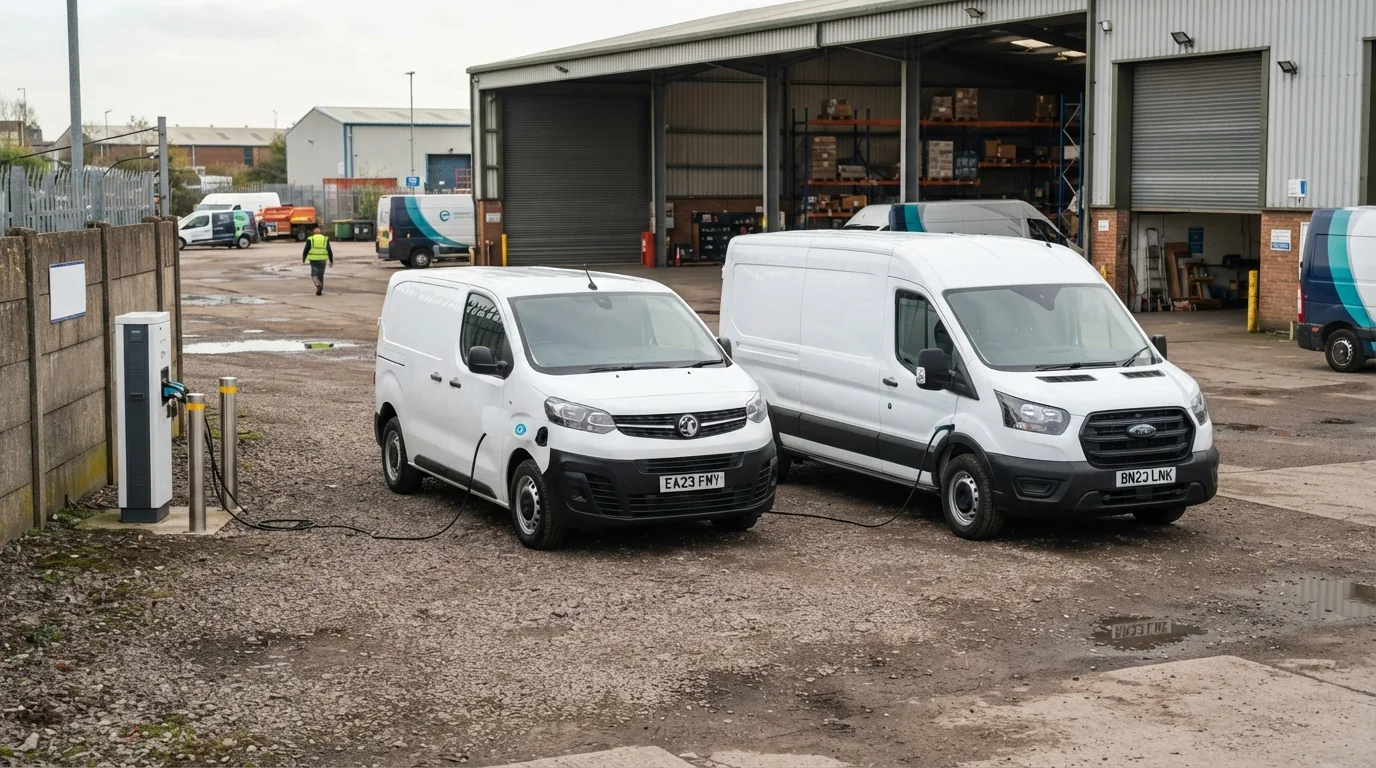
Quick answers
- The Ford E-Transit and Vauxhall Vivaro Electric compete in adjacent segments: the E-Transit is a large panel van; the Vivaro Electric is a medium.
- Head-to-head specification table: Note: The Vivaro Electric qualifies for the £5,000 PiVG if the variant's GVW places it in the large van category.
- Range and real-world usability: The E-Transit's 89kWh variant offers 232 miles WLTP, with a real-world figure of around 175–195 miles in mixed urban/motorway driving.
- Payload: E-Transit dominates: The E-Transit's maximum payload of 1,616 kg is the highest of any electric van available in the UK market, and it significantly exceeds the Vivaro Electric's 1,226 kg.
- Charging speed comparison: The E-Transit charges at up to 115kW DC; the Vivaro Electric peaks at 100kW.
- Price: Vivaro Electric wins substantially: The Vivaro Electric's purchase price advantage over the E-Transit is approximately £10,000 before grant and £10,000 after, given both qualify for the £5,000 Plug-in Van Grant at the appropriate GVW tier.
The Ford E-Transit and Vauxhall Vivaro Electric compete in adjacent segments: the E-Transit is a large panel van; the Vivaro Electric is a medium. They are not direct like-for-like rivals, but they are frequently compared by fleet managers making the decision about which electric van to standardise across their operations. Our verdict: the Ford E-Transit is the better choice for fleets that need large van capacity, payload above 1,000 kg, and the widest body variant selection. The Vauxhall Vivaro Electric wins on upfront cost and suits fleets with lighter, shorter-range urban and suburban routes. For medium-duty fleet operators comparing the two specifically, the Vivaro Electric’s £5,000 price advantage and adequate real-world range often make the decision straightforward.
Head-to-head specification table
| Ford E-Transit (panel van) | Vauxhall Vivaro Electric | |
|---|---|---|
| Category | Large panel van | Medium panel van |
| Max GVW | 3.5 tonnes | 3.1 tonnes |
| Max payload | 1,616 kg | 1,226 kg |
| Battery capacity | 68 kWh or 89 kWh | 75 kWh |
| WLTP range | 196 miles (68kWh) / 232 miles (89kWh) | 170 miles |
| Real-world range | ~155–175 miles | ~140–160 miles |
| Max DC charging | 115 kW | 100 kW |
| Time to 10–80% | ~30–35 minutes | ~45 minutes |
| Load volume (standard) | 11.8 m³ (long body) | 5.3–6.1 m³ |
| Height options | Standard / High Roof | Standard / High Roof |
| Price exc. VAT (from, before grant) | ~£48,000 | ~£38,000 |
| Plug-in Van Grant | £5,000 (large van) | £5,000 (large van, if GVW qualifies) |
| Net price exc. VAT (approx.) | ~£43,000 | ~£33,000 |
Note: The Vivaro Electric qualifies for the £5,000 PiVG if the variant’s GVW places it in the large van category. The standard Vivaro Electric is borderline; check with your dealer to confirm grant eligibility.
Range and real-world usability
The E-Transit’s 89kWh variant offers 232 miles WLTP, with a real-world figure of around 175–195 miles in mixed urban/motorway driving. For regional distribution routes or longer inter-city legs, this gives fleet managers meaningful buffer. The 68kWh variant manages 196 miles WLTP and around 155–170 miles in real conditions.
The Vivaro Electric delivers 170 miles WLTP and around 140–160 miles real-world. For urban and suburban delivery routes where vans return to the depot overnight, 140–160 miles is adequate for most operations. Where drivers need to cover 150+ miles without guaranteed midday charging access, the E-Transit’s larger battery is a meaningful advantage.
In a head-to-head real-world range test under similar conditions, the E-Transit consistently covers more ground between charges. However, the Vivaro Electric’s real-world range degradation is proportionally similar to the E-Transit’s, meaning neither van drastically underperforms its WLTP figure by comparison with the other.
Payload: E-Transit dominates
The E-Transit’s maximum payload of 1,616 kg is the highest of any electric van available in the UK market, and it significantly exceeds the Vivaro Electric’s 1,226 kg. For fleets carrying heavy goods, the E-Transit is the only serious option.
For lighter delivery and trade work where actual payload requirements are below 1,000 kg (which covers the majority of courier, parcels, and lighter trade applications), the Vivaro Electric’s 1,226 kg is more than sufficient.
Charging speed comparison
The E-Transit charges at up to 115kW DC; the Vivaro Electric peaks at 100kW. Both are CCS-compatible and use the UK’s public rapid charging network. The E-Transit’s 30–35 minute 10–80% charge time (on the 68kWh variant) is slightly faster than the Vivaro’s 45 minutes at 100kW.
For depot overnight charging (the primary scenario for most UK van fleets), both vans charge from near-empty to full in 8–10 hours on a 22kW AC charger, making them equivalent for this use case. The DC charging speed difference is relevant only for mid-route rapid charging.
Price: Vivaro Electric wins substantially
The Vivaro Electric’s purchase price advantage over the E-Transit is approximately £10,000 before grant and £10,000 after, given both qualify for the £5,000 Plug-in Van Grant at the appropriate GVW tier. A fleet of 20 vans represents a total cost saving of £200,000 if standardised on the Vivaro Electric instead of the E-Transit.
For fleet operators who lease rather than buy, the monthly rental difference typically runs to £150–£200 per month per vehicle, which compounds significantly across a multi-year contract.
Tax treatment is identical for both: capital allowances at 100% (FYA for purchase), full lease deductibility, zero Van Benefit Charge, zero Fuel Benefit Charge where the employer provides electricity.
Fleet management: E-Transit’s Ford Pro advantage
Ford’s E-Transit benefits from the Ford Pro Connected Services platform, which gives fleet managers real-time data on vehicle charging status, battery level, location, and driver behaviour through a single dashboard. This is integrated and available as standard on E-Transit fleet orders.
Vauxhall’s fleet management connectivity is less integrated but functional through its own telematics partnerships. For large fleets where data management is critical, the Ford Pro ecosystem has a meaningful operational advantage.
Driver experience
Both vans are competent. The E-Transit drives very similarly to the diesel Transit, which eases transition for drivers already familiar with Ford’s platform. Steering is appropriately weighted for a large van, and the load area dimensions match the diesel model exactly, meaning existing racking, shelving, and fit-outs can be reused.
The Vivaro Electric is well-regarded for a smooth ride and light steering in urban environments. It is slightly more car-like in driving character than the E-Transit, which some drivers prefer for sustained city driving.
Which should you choose?
Choose the Ford E-Transit if:
- You need payload above 1,200 kg
- Routes regularly exceed 150 miles
- You want the largest available load volume
- Ford Pro connected services are valuable to your fleet management
- You already operate a diesel Transit fleet (minimises driver retraining)
Choose the Vauxhall Vivaro Electric if:
- Routes are predominantly urban or suburban (under 130 miles per day)
- Payload requirements are below 1,100 kg
- Upfront cost or lease monthly rate is a primary consideration
- You need a compact medium van rather than a large van
Our verdict
For most urban delivery and trade fleets, the Vauxhall Vivaro Electric is the smarter financial choice: it costs significantly less, handles typical daily ranges adequately, and meets payload requirements for light to medium work. The E-Transit justifies its premium for fleets with genuine heavy payload requirements, longer routes, or the need for the largest available load volume in an electric van.
Fleet operators choosing between a medium van (the E-Transit Custom is the true medium-van rival to the Vivaro Electric) should also consider the Ford E-Transit Custom, which sits in the same payload and range bracket as the Vivaro Electric at a slightly higher price but with the Ford Pro connectivity advantage.
For an overview of all the best electric vans for UK fleets, see our best electric vans for UK fleets page. For the full tax benefits of electric vans for businesses, including capital allowances and Van Benefit Charge savings, see our tax benefits of electric vans for businesses guide. For the broader fleet and company car picture, visit our company cars and fleet guide.
How we test and where our numbers come from
Range figures are official WLTP combined values taken from manufacturer UK specification pages, with real-world estimates drawn from independent comparative testing. Prices are UK list prices at the time of the latest update. Tax, grant and charging-scheme figures come from GOV.UK and HMRC publications. We re-check every guide when pricing, specification or policy changes. Last checked 11 August 2026.
Sources and further reading
- bvrla.co.ukBVRLAPrimary source referenced in this article.

EV Compared
The EV Compared editorial team tracks the UK electric vehicle market full time: new model launches, list prices, WLTP and real-world range, public charging tariffs and the tax rules that decide what an EV actually costs to run. Every guide is checked against manufacturer specifications and official GOV.UK figures, and updated whenever the numbers move.
Related reading
View all
Best Electric Vans Eligible for the UK Plug in Van Grant
The Plug-in Van Grant offers up to £5,000 off a new electric van. These are the models that earn it and deserve it.

Best Electric Vans for Sole Traders in the UK
Top electric vans for the self-employed: tax relief, real-world range and 2026 model rankings
Best Electric Vans for UK Fleets in 2026
Top electric vans ranked for fleet operators by range, payload, charging and total cost