Best Electric Vans for UK Fleets in 2026
Top electric vans ranked for fleet operators by range, payload, charging and total cost
Quick answers
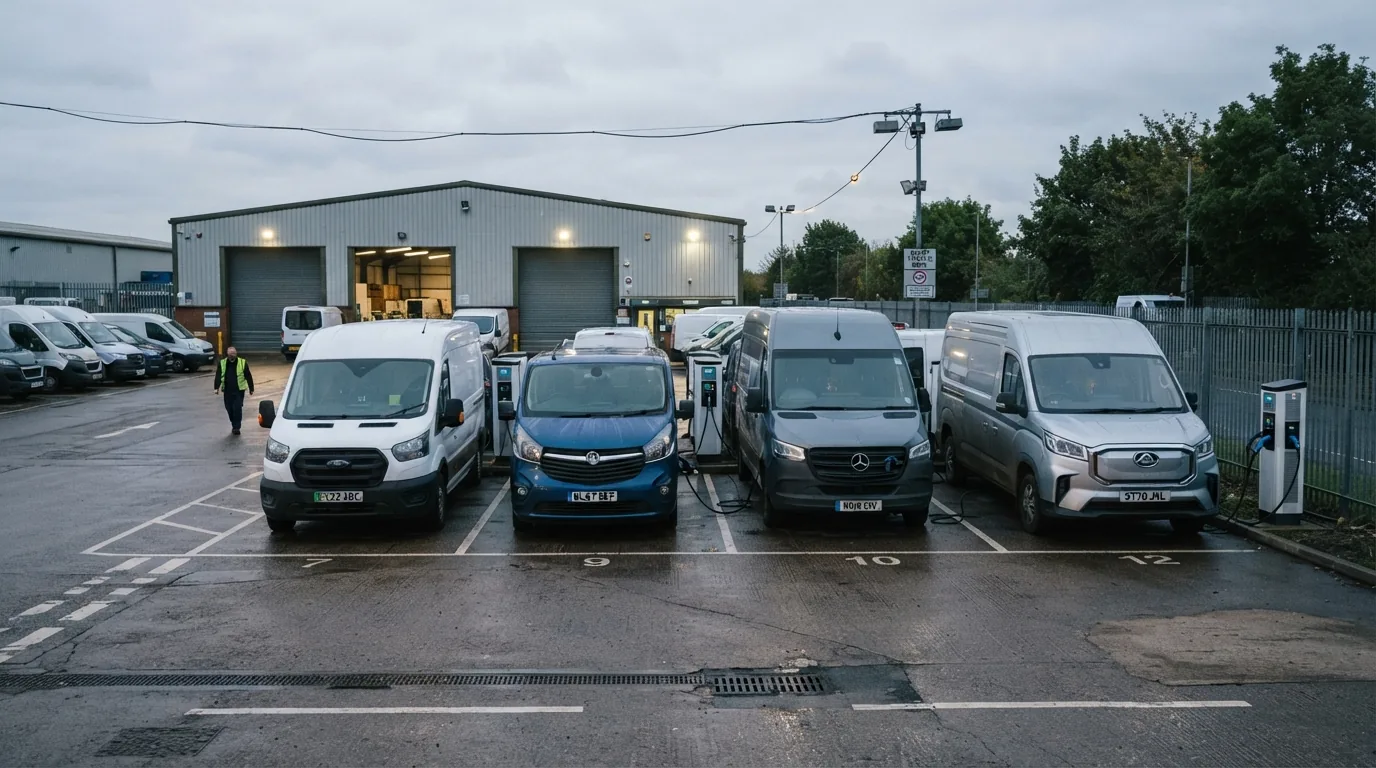
- The case for electrifying a UK van fleet in 2026 is stronger than at any previous point. The ZEV Mandate now requires 24% of new vans sold by each manufacturer to be zero-emission, driving competitive pricing across the market.
- Before the model rankings, the tax saving available to van fleets deserves emphasis.
- Fleet EV van comparison table: Prices are approximate, excluding VAT and before Plug-in Van Grant is applied.
- The Renault Master E-Tech is the benchmark large electric van in 2026.
- 2. Ford E-Transit: best payload in class: The Ford E-Transit offers the highest maximum payload of any electric van in the UK market at up to 1,616 kg.
- The Mercedes eSprinter has been substantially improved and is now the preferred choice for larger corporate fleets that need the MBUX infotainment system, active thermal battery management, and the commercial credibility that comes with the Mercedes brand.
The case for electrifying a UK van fleet in 2026 is stronger than at any previous point. The ZEV Mandate now requires 24% of new vans sold by each manufacturer to be zero-emission, driving competitive pricing across the market. The Plug-in Van Grant provides up to £5,000 off eligible large vans. Electric vans pay zero Van Benefit Charge (a saving of £4,020 per van per year versus diesel equivalents). And real-world ranges have improved substantially: the best large electric vans now exceed 200 miles between charges, making them viable for a majority of daily commercial routes.
The challenge for fleet managers is matching the right van to the right role. Range, payload, body style and charging infrastructure requirements differ significantly between models. The rankings below are based on a combination of range, payload, charging speed, total cost of ownership and availability for UK fleets in 2026.
Van Benefit Charge: the tax saving every fleet manager should know
Before the model rankings, the tax saving available to van fleets deserves emphasis. For 2026/27, the Van Benefit Charge (VBC) for diesel and petrol vans is £4,020 per vehicle per year. An employee who uses a diesel company van for private journeys pays income tax on this amount.
For electric vans, the VBC is £0. An employee using an electric company van pays nothing in Van Benefit Charge. For a fleet of 50 vans with employees in the 40% tax bracket, switching to electric saves those employees a combined £80,400 per year in personal tax. The employer saves Class 1A NI on the VBC, a further £30,150 across the fleet.
Fleet EV van comparison table
| Model | Gross weight | Payload (max) | WLTP range | DC charge (peak) | Price from (exc. VAT, pre-grant) |
|---|---|---|---|---|---|
| Renault Master E-Tech | 3.5 tonnes | 1,125 kg | 285 miles | 130 kW | £47,100 |
| Ford E-Transit | 3.5 tonnes | 1,616 kg | 196 miles | 115 kW | £48,000 |
| Mercedes eSprinter | 3.5 tonnes | 1,106 kg | 195 miles | 115 kW | £55,000+ |
| Vauxhall Vivaro Electric | 3.1 tonnes | 1,226 kg | 170 miles | 100 kW | £38,000 |
| Ford E-Transit Custom | 3.0 tonnes | 1,088 kg | 204 miles | 100 kW | £43,630 |
| Volkswagen ID. Buzz Cargo | 2.86 tonnes | 657 kg | 262 miles | 170 kW | £50,500 |
| Renault Kangoo E-Tech | 1.995 tonnes | 775 kg | 186 miles | 80 kW | £32,000 |
| Ford E-Transit Courier | 1.995 tonnes | 657 kg | 155 miles | 100 kW | £27,000 |
Prices are approximate, excluding VAT and before Plug-in Van Grant is applied.
1. Renault Master E-Tech: best large electric van for fleets
The Renault Master E-Tech is the benchmark large electric van in 2026. Its 87kWh battery delivers 285 miles WLTP, the longest range of any large electric van currently available in the UK. Payload at 1,125 kg is competitive, and cargo volume in panel van form exceeds both the Ford E-Transit and Mercedes eSprinter on a like-for-like basis.
For urban and regional distribution fleets, the Master E-Tech offers the range to handle longer routes without a midday charge. Fleet pricing is competitive, and Renault’s ProVia fleet support network is well-established across the UK.
Best for: Regional distribution, trades covering 100+ miles per day, fleets wanting maximum range in a large van.
2. Ford E-Transit: best payload in class
The Ford E-Transit offers the highest maximum payload of any electric van in the UK market at up to 1,616 kg. If payload is the primary consideration, nothing else comes close. Range of 196 miles WLTP is lower than the Renault Master E-Tech, but for most urban and suburban delivery routes, 196 miles is adequate when overnight depot charging is available.
Ford’s UK dealer and fleet network is the largest of any van manufacturer, which matters for servicing, warranty support and driver familiarity. The E-Transit comes in multiple body styles including panel van, chassis cab, and Jumbo variants.
Best for: Heavy-duty delivery, trades with high payload requirements, fleets that value dealer network coverage.
3. Mercedes eSprinter: best premium fleet van
The Mercedes eSprinter has been substantially improved and is now the preferred choice for larger corporate fleets that need the MBUX infotainment system, active thermal battery management, and the commercial credibility that comes with the Mercedes brand. Range is 195 miles WLTP, competitive with the Ford E-Transit at this size. The eSprinter costs more than either of its main rivals, but for fleets where van specification and driver satisfaction are factors, it justifies the premium.
Best for: Premium courier and corporate logistics, fleets where driver perception matters.
4. Ford E-Transit Custom: best medium electric van
The E-Transit Custom is the electric version of the UK’s best-selling van and it gets the transition broadly right. With a 108kWh battery (in the high-spec variant) offering 204 miles WLTP, and a 1,088 kg maximum payload, it covers most medium-duty roles. The load area dimensions match the diesel Transit Custom, so existing racking and fit-outs can be reused.
100kW DC charging adds 80% charge in approximately 40 minutes, fast enough for a lunch-break top-up on longer routes.
Best for: Medium-duty trades, multi-drop local delivery, businesses already running diesel Transit Customs.
5. Vauxhall Vivaro Electric: best value medium van
The Vivaro Electric undercuts the E-Transit Custom by approximately £5,600 before the Plug-in Van Grant. With a 75kWh battery and 170 miles WLTP range, it is best suited to urban and suburban routes with overnight charging. Payload at 1,226 kg is slightly better than the E-Transit Custom at this weight class. For cost-sensitive fleet operators whose routes stay within 80–100 miles per day, the Vivaro Electric offers strong value.
Best for: Urban delivery, local trades, cost-focused fleet deployment.
6. Volkswagen ID. Buzz Cargo: best for urban premium and smaller payload
The ID. Buzz Cargo occupies a niche but deserves a mention. Its 262-mile WLTP range and 170kW DC charging capability make it the most flexible medium-size van on rapid routes, but its 657 kg payload and panel van body style restrict it to lighter goods. It suits businesses that need range and charging speed more than raw cargo capacity, such as small parcel couriers, photographers, or tradespeople with lighter kit.
Best for: Light cargo, urban premium delivery, tradespeople with minimal payload needs.
Small vans: E-Transit Courier and Kangoo E-Tech
For lighter duties, the Ford E-Transit Courier (155 miles range, 657 kg payload, from £27,000 exc. VAT before grant) and Renault Kangoo E-Tech (186 miles, 775 kg, from £32,000 exc. VAT) are the leading options. Both are eligible for the £2,500 Plug-in Van Grant for vans under 2.5 tonnes GVW.
What about the ZEV Mandate and fleet planning?
Fleet operators with more than 25 vehicles should note that the ZEV Mandate creates strong incentives for manufacturers to offer competitive pricing on electric vans. Manufacturers that fail to meet their ZEV targets pay financial penalties. This means EV van availability, discounting and fleet terms are generally better in 2026 than in previous years.
Fleet managers should plan charging infrastructure alongside vehicle procurement. The Workplace Charging Scheme (WCS) provides up to £350 per socket for businesses installing charge points at depots. For fleets operating overnight returns, depot charging is the most cost-effective approach.
What should you do next?
For the tax benefits of switching to electric vans in more detail, see our explainer on tax benefits of electric vans for businesses. For the broader fleet and company car picture, visit our company cars and fleet guide. For salary sacrifice options for employees who want an EV, see our best electric cars for salary sacrifice page.
How we test and where our numbers come from
Range figures are official WLTP combined values taken from manufacturer UK specification pages, with real-world estimates drawn from independent comparative testing. Prices are UK list prices at the time of the latest update. Tax, grant and charging-scheme figures come from GOV.UK and HMRC publications. We re-check every guide when pricing, specification or policy changes. Last checked 11 August 2026.
Frequently asked questions
What about the ZEV Mandate and fleet planning?
Fleet operators with more than 25 vehicles should note that the ZEV Mandate creates strong incentives for manufacturers to offer competitive pricing on electric vans. Manufacturers that fail to meet their ZEV targets pay financial penalties.
Sources and further reading
- bvrla.co.ukBVRLAPrimary source referenced in this article.

EV Compared
The EV Compared editorial team tracks the UK electric vehicle market full time: new model launches, list prices, WLTP and real-world range, public charging tariffs and the tax rules that decide what an EV actually costs to run. Every guide is checked against manufacturer specifications and official GOV.UK figures, and updated whenever the numbers move.
Related reading
View all
Best Electric Vans Eligible for the UK Plug in Van Grant
The Plug-in Van Grant offers up to £5,000 off a new electric van. These are the models that earn it and deserve it.
Best Electric Vans for Sole Traders in the UK
Top electric vans for the self-employed: tax relief, real-world range and 2026 model rankings
Ford E-Transit vs Vauxhall Vivaro Electric: Best UK Fleet Van?
Head-to-head on range, payload, price and fleet running costs in 2026