Best Electric Vans for Sole Traders in the UK
Top electric vans for the self-employed: tax relief, real-world range and 2026 model rankings
Quick answers
- An electric van is one of the most tax-efficient purchases a sole trader can make in 2026. You can claim 100% of the purchase cost as a First Year Allowance (FYA) against your taxable profits in the year of acquisition, regardless of the van's price.
- For a sole trader paying income tax at 40%, the 100% FYA on a £40,000 electric van saves £16,000 in income tax in year one.
- The FYA for zero-emission vans has been extended to 5 April 2027 for income tax purposes.
- The grant is applied automatically at the point of purchase through approved dealers.
- For trades with lighter loads (electricians, plumbers carrying small tools, couriers, florists), the E-Transit Courier is the standout small electric van.
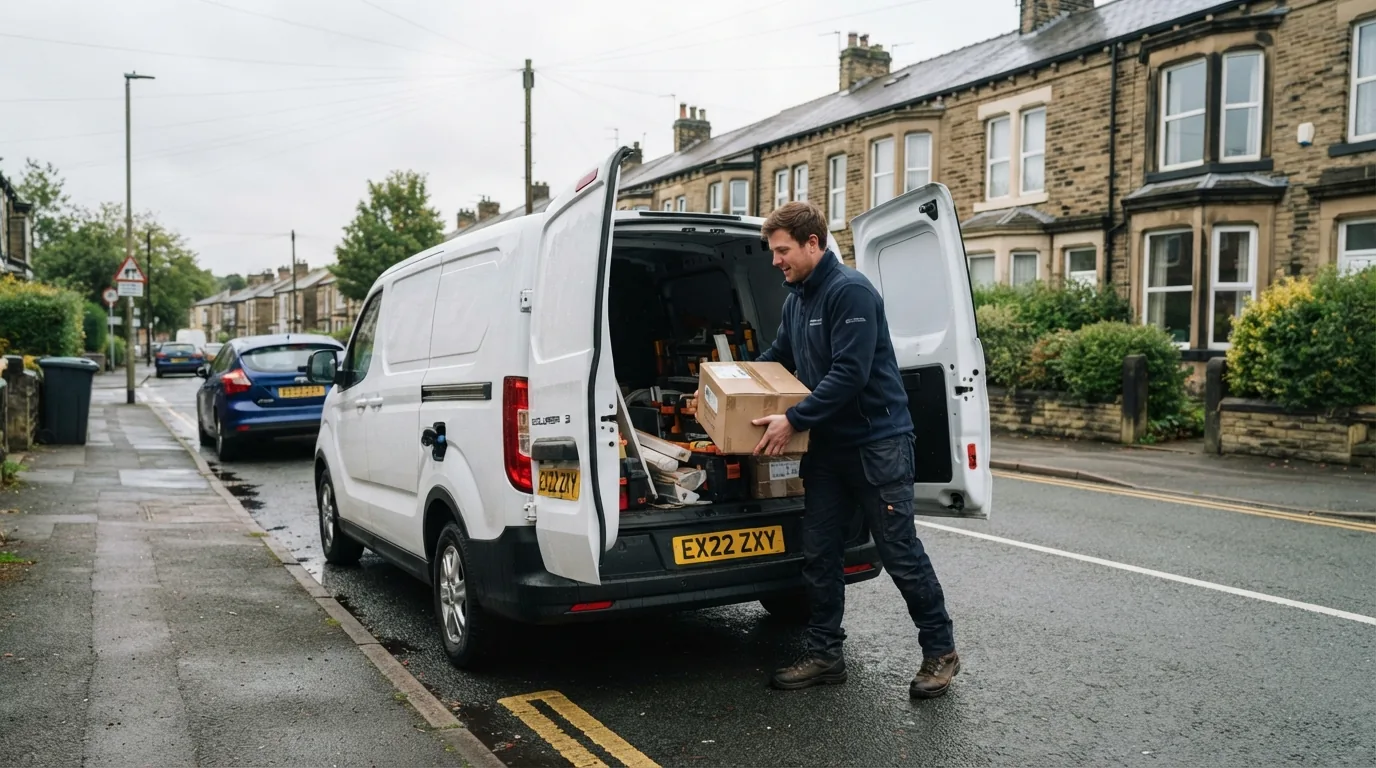
An electric van is one of the most tax-efficient purchases a sole trader can make in 2026. You can claim 100% of the purchase cost as a First Year Allowance (FYA) against your taxable profits in the year of acquisition, regardless of the van’s price. Unlike a car, a van used partly for private journeys does not require you to restrict the capital allowance by your personal use percentage, provided the van is used primarily for business (HMRC takes a pragmatic view on vans: overnight home parking does not by itself constitute private use). Zero-emission vans also pay no Van Benefit Charge, making them significantly cheaper than diesel in the hands of self-employed tradespeople who use their van daily.
Tax relief available to sole traders on an electric van
| Relief | Diesel van | Electric van |
|---|---|---|
| Capital allowances (purchase) | Annual Investment Allowance (100% up to £1m/year) | 100% First Year Allowance (FYA), separately from AIA |
| Lease rental deduction | 100% (zero CO2 restriction) | 100% (zero CO2 restriction) |
| Van Benefit Charge (private use) | £4,020/year (taxable) | £0 |
| Fuel Benefit Charge (employer-provided fuel) | £769/year | £0 |
| VED (road tax) | By weight/emissions | £345/year (standard light goods) |
| ULEZ / Clean Air Zone charges | Applies | Exempt |
| Plug-in Van Grant | Not eligible | £2,500 (small) or £5,000 (large) |
For a sole trader paying income tax at 40%, the 100% FYA on a £40,000 electric van saves £16,000 in income tax in year one. A diesel van at the same price claimed through the AIA saves the same amount, but the AIA is a shared pool (available to all your capital purchases) and the FYA for electric vans sits outside it. If you have already used your AIA on plant and equipment, the FYA on the electric van is additional relief.
100% First Year Allowance: the key detail for sole traders
The FYA for zero-emission vans has been extended to 5 April 2027 for income tax purposes. This means sole traders purchasing a new electric van before this date can deduct the full cost from their taxable profits in the relevant tax year.
You claim the FYA on your Self Assessment return in the year you buy the van. If you begin using the van partway through the tax year (say, in January 2027), the full cost is still claimable in the 2026/27 return.
If you lease rather than buy, you cannot claim the FYA. Instead, you deduct lease payments as a business expense. For a zero-emission van, 100% of the lease rental is deductible (there is no restriction based on CO2 emissions, unlike high-emission cars).
Plug-in Van Grant: money off before you start
The Plug-in Van Grant (PiVG) continues in 2026:
- £2,500 off small vans (up to 2.5 tonnes GVW)
- £5,000 off large vans (2.5–4.25 tonnes GVW)
The grant is applied automatically at the point of purchase through approved dealers. It reduces the purchase price before you pay, which in turn reduces the FYA base (you claim relief on the net cost after grant, not the full list price). Even so, the combined effect of the grant and the FYA is substantial.
Example: A sole trader pays 40% income tax and buys a Renault Master E-Tech (large van) for £47,100. After the £5,000 PiVG, the net purchase price is £42,100. The FYA at 40% saves £42,100 × 40% = £16,840 in income tax in year one.
Best electric vans for sole traders in 2026
1. Ford E-Transit Courier: best small van
For trades with lighter loads (electricians, plumbers carrying small tools, couriers, florists), the E-Transit Courier is the standout small electric van. Range of 155 miles WLTP covers typical daily routes, and the load space is the best in class for a small van. Pricing starts around £27,000 excluding VAT and before the £2,500 PiVG.
For sole traders who are VAT-registered, the VAT is recoverable on the purchase price if the van is used exclusively for business, saving a further £5,400.
Best for: Light trades, short-range courier work, urban service providers.
2. Vauxhall Vivaro Electric: best value medium van
The Vivaro Electric (75kWh) delivers 170 miles WLTP range with a 1,226 kg payload in the medium van category. At around £38,000 excluding VAT and before the £5,000 PiVG, it undercuts the Ford E-Transit Custom significantly. For sole traders with established urban or suburban routes and overnight home charging, the Vivaro Electric’s cost advantage over the E-Transit Custom is compelling.
Vauxhall’s UK dealer network is extensive, keeping servicing straightforward.
Best for: Multi-drop local delivery, medium trades (plumbers, joiners), urban routes.
3. Ford E-Transit Custom: best all-round medium van
The E-Transit Custom is the natural electric successor to the UK’s best-selling van. Its 1,088 kg payload and familiar load bay dimensions (matching the diesel Custom) mean sole traders transitioning from diesel can reuse existing racking and shelving. Range is 204 miles WLTP from the 108kWh variant, and 100kW DC charging adds significant range in 30–40 minutes.
The E-Transit Custom costs more than the Vivaro Electric, but the larger battery and longer range make it the stronger choice for sole traders who cover 100+ miles regularly.
Best for: Tradespeople, regional service calls, sole traders with varied routes.
4. Renault Master E-Tech: best large van for sole traders
If you need a large van for high-payload or high-volume work, the Renault Master E-Tech is the clear leader in 2026. With 285 miles WLTP range, a 1,125 kg maximum payload, and more cargo volume than the Ford E-Transit, it sets the standard in the large electric van segment. After the £5,000 PiVG, the entry price is £42,100 excluding VAT.
For sole traders who previously used a diesel Renault Master or Vauxhall Movano, the transition is straightforward. Running cost savings of £1,500–£2,000 per year in fuel and £400–£600 in servicing, combined with the first-year tax relief, make the business case strong.
Best for: High-volume delivery, large-scale trades, sole traders who currently run a large diesel van.
5. Renault Kangoo E-Tech: best compact van for urban sole traders
The Kangoo E-Tech (45kWh, 186 miles WLTP) is ideal for sole traders whose work is centred on a city or town. Its compact footprint makes parking easier in urban environments, and its 775 kg payload handles light trade tools and equipment comfortably. Starting at around £32,000 excluding VAT before grant, it is priced between the Courier and Vivaro.
Best for: Urban sole traders, estate agents, florists, photographers, light trade.
Running cost savings: how much does an electric van actually save?
For a sole trader covering 15,000 miles per year:
| Cost | Diesel van | Electric van | Annual saving |
|---|---|---|---|
| Fuel (at 25p/mile diesel vs 5p/mile electric) | £3,750 | £750 | £3,000 |
| Service and maintenance | £1,200/year | £650/year | £550 |
| VED | varies | £345 | varies |
| ULEZ/CAZ charges | £15/day (London) | £0 | significant for London users |
| Total indicative saving | , | , | £3,500+ per year |
What should you do next?
For the tax detail on claiming electric vehicles as a sole trader, including cars as well as vans, see our guide to claiming tax back on an electric car. For the broader landscape of fleet and commercial EVs, visit our company cars and fleet guide. For an overview of the best models across all fleet sizes, see our best electric vans for UK fleets page.
How we test and where our numbers come from
Range figures are official WLTP combined values taken from manufacturer UK specification pages, with real-world estimates drawn from independent comparative testing. Prices are UK list prices at the time of the latest update. Tax, grant and charging-scheme figures come from GOV.UK and HMRC publications. We re-check every guide when pricing, specification or policy changes. Last checked 11 August 2026.
Sources and further reading
- gov.ukHMRCPrimary source referenced in this article.

EV Compared
The EV Compared editorial team tracks the UK electric vehicle market full time: new model launches, list prices, WLTP and real-world range, public charging tariffs and the tax rules that decide what an EV actually costs to run. Every guide is checked against manufacturer specifications and official GOV.UK figures, and updated whenever the numbers move.
Related reading
View all
Best Electric Vans Eligible for the UK Plug in Van Grant
The Plug-in Van Grant offers up to £5,000 off a new electric van. These are the models that earn it and deserve it.
Best Electric Vans for UK Fleets in 2026
Top electric vans ranked for fleet operators by range, payload, charging and total cost
Ford E-Transit vs Vauxhall Vivaro Electric: Best UK Fleet Van?
Head-to-head on range, payload, price and fleet running costs in 2026