First Week With an EV: A New Owner's Survival Guide
What to do on days one to seven to get your EV ownership off to the right start
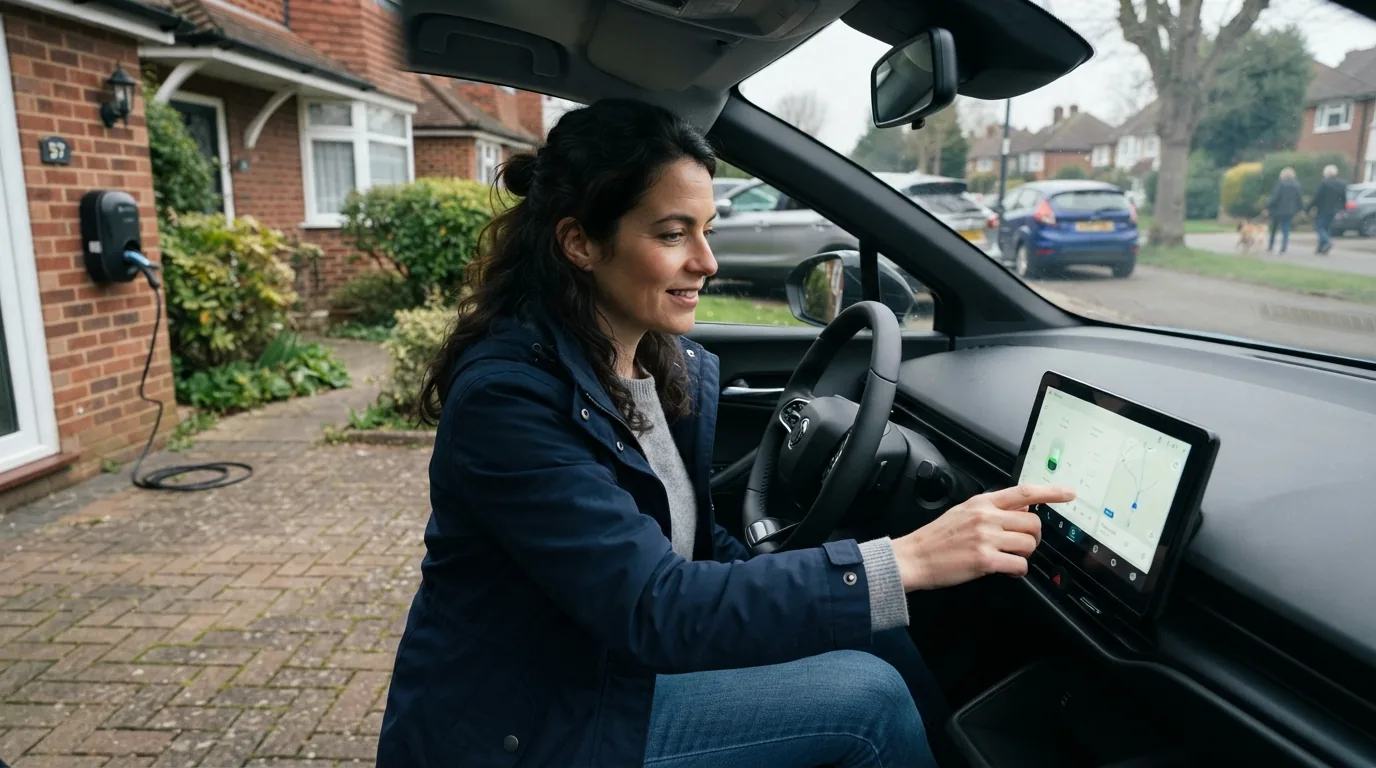
Quick answers
- The first week with an electric car involves a handful of specific setup tasks that will transform your experience for the rest of your ownership. Get them right early and everything else becomes easier.
- Day two: sort your electricity tariff: This is the single most financially impactful thing you can do in the first week.
- Day three: learn to drive it properly: Regenerative braking recaptures energy when you lift off the accelerator, slowing the car and feeding charge back into the battery.
- Day four: plan your first longer trip: Identify a round trip of 80 to 120 miles and plan it deliberately.
- If you took delivery in autumn or winter, or if a cold period arrives in your first week, this matters immediately.
- Day seven: review your first week: Review what your electricity app or wallbox app shows you spent on charging.
The first week with an electric car involves a handful of specific setup tasks that will transform your experience for the rest of your ownership. Get them right early and everything else becomes easier. Ignore them and you will be paying more to charge, adjusting your routine unnecessarily, and wondering why your range fluctuates.
Here is exactly what to do in the first seven days.
Day one: the basics at home
Charge the car immediately. When you collect or take delivery of a new EV, the battery is often at 30 to 50% charge. Plug it in when you get home using whatever cable is available, whether the granny charger (a standard 3-pin cable, about 8 to 10 miles of range per hour) or your new wallbox.
Do not aim for 100% on day one. Set the charge limit to 80% if your car allows it (most do, via the touchscreen settings). Charging to 80% is faster and better for long-term battery health in everyday use. Charge to 100% only when you genuinely need the maximum range for a longer trip.
Download the manufacturer app. Connect the car to your home Wi-Fi and pair it with your phone app. This is what allows you to check charge status from indoors, set charge schedules, and precondition the car before leaving home. Spend 20 minutes on this setup on day one and you will use it daily for years.
Check your wallbox is set up and working. If you had a wallbox installed before delivery, test it properly. Plug in, confirm the car is accepting charge, check the charge rate in the car’s display (7kW wallbox should show around 7kW; a 22kW three-phase wallbox shows higher). If something is wrong, it is easier to address now than in a week.
Day two: sort your electricity tariff
This is the single most financially impactful thing you can do in the first week. If you are on a standard electricity tariff, switch to a dedicated EV tariff.
The Ofgem standard rate for Q2 2026 is 24.67p per kWh. Dedicated EV off-peak tariffs, including Octopus Intelligent Go, OVO Charge Anytime, and British Gas Electric Driver, offer rates as low as 7p per kWh during off-peak overnight hours, typically between 11.30pm and 5.30am or 12.30am and 4.30am depending on the tariff.
At 7p per kWh, filling a 60kWh battery costs £4.20. At the standard rate, it costs £14.80. That difference, repeated across a year, adds up to several hundred pounds.
Set a charge schedule. Once your tariff is confirmed, use either the car’s built-in scheduling or your wallbox app to set charging to happen automatically during the off-peak window. You plug in when you get home; the car does not actually charge until the cheap rate kicks in overnight. You wake up with a full battery at the cheapest possible rate.
Day three: learn to drive it properly
Try one-pedal driving. Most EVs have a setting for strong regenerative braking, sometimes labelled “B” mode, “high regen,” or through a paddle on the steering column. Switch to the strongest available setting and drive your usual routes in town. Within a day, you will understand the feel. Within a week, you will prefer it.
Regenerative braking recaptures energy when you lift off the accelerator, slowing the car and feeding charge back into the battery. It also means your brake pads last significantly longer, since you use them less often.
Notice the range estimate. The number on your dashboard fluctuates depending on how you drive. Accelerate hard and it drops. Drive smoothly at lower speed and it recovers. This is normal and the car is not malfunctioning. You will learn intuitively how your driving style affects range within the first week.
Drive normally. The biggest mistake in the first week is driving ultra-carefully to conserve range. This prevents you from understanding how the car actually behaves and calibrating your range intuition accurately. Drive at your usual pace; the car can handle it.
Day four: plan your first longer trip
Identify a round trip of 80 to 120 miles and plan it deliberately. Use Zap-Map or your car’s navigation to find public chargers along the route in case you want to top up. Note where rapid chargers are at service stations.
Then do the trip without needing to charge, assuming your battery was full at departure. This proves to you, through experience rather than reading, what your car’s real-world range feels like and how quickly or slowly the battery depletes in practice.
If you do stop to charge en route, excellent: use the trip to practise using a public charger. Tap the charging cable against the charger, follow the prompts, and watch the charge speed on your display or the charger screen. You will find it significantly less complicated than you expected.
Day five: set up your charging accounts and apps
Zap-Map: The essential UK charging map. Shows charger locations, speed, connector type, network operator, current availability, and user reviews. Free to use. Download it and spend ten minutes searching for chargers near where you live, work, and drive regularly. You will use this on every significant journey for the rest of your EV ownership.
One or two network apps: Depending on which chargers are most relevant to your area, register with the operators of those chargers. Common networks in the UK include Osprey, Pod Point, BP Pulse, Gridserve Electric Highway, Shell Recharge, and ChargePoint. You do not need all of them; identify which are most local to your regular routes and register with two or three. Many chargers also accept contactless payment, removing the need for a membership card.
A Better Route Planner (ABRP): Useful for longer trip planning. You input your car model, current charge level, and destination, and it calculates the optimal route with charging stops to minimise total journey time. Free tier is adequate for most users.
Day six: figure out your cold weather routine (if relevant)
If you took delivery in autumn or winter, or if a cold period arrives in your first week, this matters immediately.
Enable preconditioning. In the manufacturer app, look for a “departure time” or “preconditioning” feature. Set your usual morning departure time. The car will warm the cabin and battery to optimal temperature while still plugged in, using mains electricity rather than battery power. The result: you climb into a warm car with full battery range, rather than a cold car with reduced range as the heater draws on the battery en route.
This single feature eliminates most of the cold-weather range anxiety that new EV owners experience. It takes five minutes to set up and applies every morning you have it enabled.
Day seven: review your first week
By day seven, most new EV owners have discovered that:
- The range display makes more sense than it did on day one
- Plugging in at home is effortless and will become automatic
- The acceleration is enjoyable
- The car is quieter than they expected
- Setting up the off-peak tariff and charging schedule was the highest-return task of the week
Review what your electricity app or wallbox app shows you spent on charging. Compare it to what petrol would have cost for the same mileage. This is the number that typically makes new EV owners very satisfied with their decision.
Quick reference: first week checklist
| Day | Key tasks |
|---|---|
| Day 1 | Plug in, download manufacturer app, connect to Wi-Fi, set 80% charge limit |
| Day 2 | Switch to an off-peak EV electricity tariff, set charging schedule |
| Day 3 | Try one-pedal driving, pay attention to range display behaviour |
| Day 4 | Plan and complete a deliberate longer trip to calibrate real-world range |
| Day 5 | Set up Zap-Map, two network apps, ABRP for long journeys |
| Day 6 | Enable preconditioning for cold mornings |
| Day 7 | Review charging cost vs petrol equivalent; enjoy the result |
What if something feels wrong?
Common first-week puzzles that are actually normal:
- Range display dropping faster than expected on the motorway. This is normal. Motorway driving at 70mph uses significantly more energy than urban driving. Plan range around motorway speeds, not the WLTP figure.
- The car not starting to charge immediately when plugged in. Likely the charge schedule is active and the car is waiting for the off-peak window. Check the app.
- Range showing lower in cold weather. Normal. Use preconditioning to mitigate it.
- Public charger failing to start. Common issue. Try again (unplug and replug), then use a different charger if the problem persists. Report it on Zap-Map.
For the full story of what surprises new EV drivers in the first month, read What surprises new EV drivers most in the first month?. For model recommendations suited to first-time buyers, see best first electric cars for switching from petrol. Return to the switching from petrol or diesel hub for the complete topic guide.
Sources: Ofgem energy price cap Q2 2026, GOV.UK EV chargepoint statistics March 2026, Zap-Map network data 2026, manufacturer app documentation.
How we test and where our numbers come from
Range figures are official WLTP combined values taken from manufacturer UK specification pages, with real-world estimates drawn from independent comparative testing. Prices are UK list prices at the time of the latest update. Tax, grant and charging-scheme figures come from GOV.UK and HMRC publications. We re-check every guide when pricing, specification or policy changes. Last checked 11 August 2026.
Frequently asked questions
What if something feels wrong?
For the full story of what surprises new EV drivers in the first month, read What surprises new EV drivers most in the first month?. For model recommendations suited to first-time buyers, see best first electric cars for switching from petrol.

EV Compared
The EV Compared editorial team tracks the UK electric vehicle market full time: new model launches, list prices, WLTP and real-world range, public charging tariffs and the tax rules that decide what an EV actually costs to run. Every guide is checked against manufacturer specifications and official GOV.UK figures, and updated whenever the numbers move.
Related reading
View all
What Are the Biggest Myths About Switching to an EV?
The claims that put UK drivers off going electric, and what the evidence actually says
Should You Buy an EV in 2026 or Wait for Cheaper Models?
An honest look at where EV prices are heading and whether the wait is worth it for UK buyers
Buying and Owning an Electric Car in the UK: The Complete 2026 Guide
Everything you need to know about costs, charging, depreciation and day-to-day life with an EV