Best EV Charging Payment Apps in the UK
Paying for public EV charging in the UK still involves too many accounts and apps. Here are the best options for simplifying payment across the fragmented UK charging network
Quick answers
- Paying for public EV charging in the UK is more fragmented than it should be. Over 120,000 charge points are split across dozens of networks, each with their own app and pricing.
- Octopus Electroverse is the most broadly recommended multi-network solution for UK drivers.
- OVO Charge was rebranded from Bonnet after OVO Energy's acquisition.
- Is contactless bank card enough: The UK regulation requiring contactless on rapid chargers was intended to ensure no one is locked out of charging without the right app or card.
- Do you need multiple payment apps: Frustratingly, the answer in 2026 is: probably yes, but only two or three.
- If you charge regularly at one network's sites, their RFID card can be the fastest and most reliable method at those chargers. bp pulse, Pod Point and Osprey all offer RFID cards to registered account holders.
Paying for public EV charging in the UK is more fragmented than it should be. Over 120,000 charge points are split across dozens of networks, each with their own app and pricing. The 2022 regulations requiring contactless payment on new rapid chargers have helped, but you still cannot use a single card or app at every charger with confidence. This guide cuts through the complexity and identifies the best payment options for UK drivers in 2026.
What payment methods work at UK public chargers?
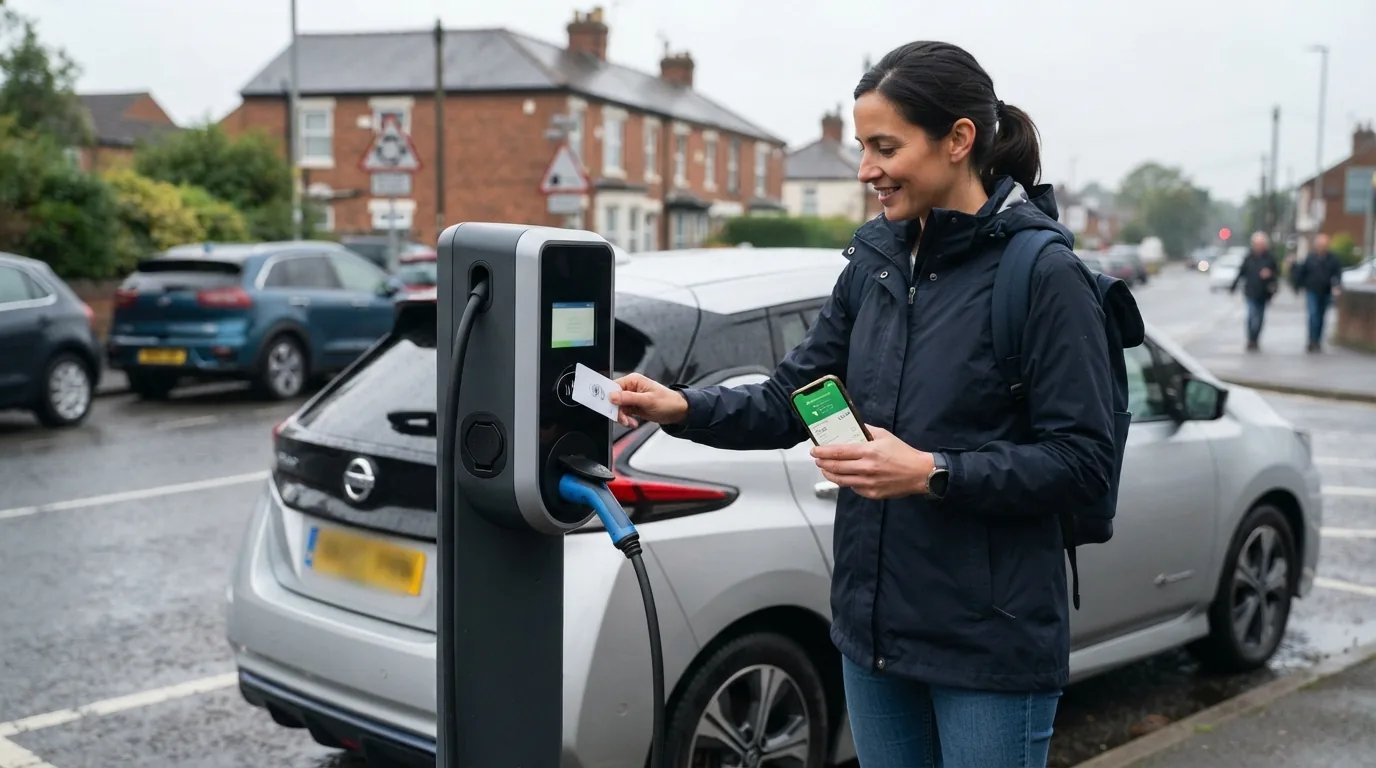
Contactless bank card: Required on all new rapid chargers (50 kW and above) installed since November 2022 and on existing chargers above 50 kW as of mid-2024. This is the universal backup: if your app or RFID card fails, a tap-to-pay card starts the session. The downside is cost: contactless is typically the walk-up rate with no discounts, and it can be 5 to 15% more expensive than network member pricing.
Network app: Each major network has its own app (bp pulse, Pod Point, IONITY, Osprey, Mer, Gridserve, Shell Recharge, Osprey, Char.gy). These give the best session-start reliability on that network’s own hardware, and sometimes offer preferential member pricing. The problem is managing ten different apps.
RFID card: A physical contactless card linked to a charging account. Works like an Oyster card for charging. Can be used at most chargers that have an RFID reader. More reliable than apps in areas with poor mobile signal.
Multi-network roaming apps: Apps and cards like Octopus Electroverse and OVO Charge aggregate access to multiple networks behind one account and payment method. The most practical solution for most drivers.
Plug and Charge (ISO 15118): Automatic authentication when plugged in, no card or app required. Live at IONITY in the UK. See our Plug and Charge explainer for detail.
Best multi-network payment app: Octopus Electroverse
Octopus Electroverse is the most broadly recommended multi-network solution for UK drivers. It gives access to over 1 million charge points across 40+ countries (including all major UK networks) through one account, at the network’s published rate with no mark-up. A physical Electrocard RFID is free to order.
Key advantages:
- No mark-up on charging rates: you pay what the network charges
- Covers most major UK networks including bp pulse, Pod Point, Osprey, Mer, Gridserve, IONITY, Shell Recharge, Char.gy and others
- Physical RFID card works at RFID-compatible chargers without opening the app
- If you are an Octopus Energy customer on Octopus Go or Intelligent Octopus Go, you receive a 5% to 8% discount on Electroverse charging
- Strong European coverage (over 40 countries)
Cost: Free. Pay-as-you-go at network rates.
Best for: Most UK EV drivers who want one account for public charging without managing multiple network memberships.
Best alternative: OVO Charge (formerly Bonnet)
OVO Charge was rebranded from Bonnet after OVO Energy’s acquisition. It operates on a similar roaming model to Electroverse, aggregating access to over 200,000 charge points across Europe with a single app and payment method.
Key advantages:
- Wide UK and European network coverage
- Optional monthly subscription (approximately £17.99/month) includes some reduced-rate sessions
- Clean, straightforward app interface
Cost: Free PAYG. Optional monthly subscription for higher-frequency users.
Best for: Drivers who do not use Octopus Energy and want a roaming alternative to Electroverse.
Comparison table: EV charging payment options for UK drivers
| Method / App | Coverage | Cost model | RFID card | Best for |
|---|---|---|---|---|
| Octopus Electroverse | Most UK networks + 40 countries | Network rate (no mark-up) | Yes (free) | Most UK drivers; Octopus customers get discount |
| OVO Charge (Bonnet) | Most UK networks + Europe | PAYG or £17.99/month | Yes | Drivers not on Octopus Energy |
| Zap-Pay | Many UK networks | Network rate via Zap-Map | No | Zap-Map Premium users |
| Contactless bank card | New rapids (50kW+) and many others | Walk-up rate (highest) | No | Universal backup; occasional users |
| Network RFID cards (e.g. bp pulse card) | That network only | Member rate | Yes | Frequent users of one network |
| IONITY membership | IONITY only | Member rate (lower than PAYG) | Via app | Regular IONITY users on motorway routes |
| Plug and Charge (ISO 15118) | IONITY; expanding | Linked account rate | No (auto) | BMW, Hyundai, Kia, VW owners at IONITY |
Is contactless bank card enough?
For very occasional users who rarely charge publicly, yes. But for anyone who regularly uses the public network, contactless is an expensive default. You will typically pay a premium per kWh compared to a member rate, and sometimes pay a per-session fee on top.
The UK regulation requiring contactless on rapid chargers was intended to ensure no one is locked out of charging without the right app or card. It succeeded in that goal. It was not intended as a cost-effective primary payment method.
Do you need multiple payment apps?
Frustratingly, the answer in 2026 is: probably yes, but only two or three. Electroverse covers the majority of UK networks. For the networks it does not cover (which vary over time as commercial agreements change), having the relevant network app as a backup is sensible.
The networks most likely to require their own app or card at some sites, even in 2026, are Tesla Superchargers (for non-Tesla CCS users), some smaller regional networks and certain destination charging operators.
A practical setup:
- Octopus Electroverse (or OVO Charge) as your primary roaming account
- One or two network apps for the specific networks you use most (IONITY if you regularly do motorway trips; Pod Point if you frequently use Tesco or Lidl chargers)
- A contactless bank card as the universal backup
What about RFID cards from specific networks?
If you charge regularly at one network’s sites, their RFID card can be the fastest and most reliable method at those chargers. bp pulse, Pod Point and Osprey all offer RFID cards to registered account holders.
The limitation is obvious: the card only works at that network’s chargers. RFID cards from specific networks make sense as a supplementary option, not as a primary strategy.
What is the common mistake?
The most common mistake is relying entirely on mobile apps and discovering that signal is poor at a motorway service station charger, or that the app is slow to load, or that the network’s backend is having a service outage. This is not a theoretical risk: it happens regularly enough that every experienced EV driver has a backup plan.
The mitigation: carry a contactless bank card you are comfortable using as a charging card, and keep it accessible. For any journey where rapid charging is planned, also carry the Electrocard RFID card.
The second common mistake is not registering for Electroverse or a similar roaming service before a long journey. Setting up an account takes two minutes, but not when you are standing at a charger in the rain.
For more on managing public charging, see our best EV charging apps roundup and the EV tech and apps hub. For information on Zap-Pay and contactless specifically, see our Zap-Pay vs contactless comparison.
How we test and where our numbers come from
Range figures are official WLTP combined values taken from manufacturer UK specification pages, with real-world estimates drawn from independent comparative testing. Prices are UK list prices at the time of the latest update. Tax, grant and charging-scheme figures come from GOV.UK and HMRC publications. We re-check every guide when pricing, specification or policy changes. Last checked 11 August 2026.
Frequently asked questions
Is contactless bank card enough?
For very occasional users who rarely charge publicly, yes. But for anyone who regularly uses the public network, contactless is an expensive default.
Do you need multiple payment apps?
Frustratingly, the answer in 2026 is: probably yes, but only two or three. Electroverse covers the majority of UK networks.
What about RFID cards from specific networks?
If you charge regularly at one network's sites, their RFID card can be the fastest and most reliable method at those chargers. bp pulse, Pod Point and Osprey all offer RFID cards to registered account holders.
What is the common mistake?
The most common mistake is relying entirely on mobile apps and discovering that signal is poor at a motorway service station charger, or that the app is slow to load, or that the network's backend is having a service outage. This is not a theoretical risk: it happens regularly enough that every experienced EV driver has a backup plan.

EV Compared
The EV Compared editorial team tracks the UK electric vehicle market full time: new model launches, list prices, WLTP and real-world range, public charging tariffs and the tax rules that decide what an EV actually costs to run. Every guide is checked against manufacturer specifications and official GOV.UK figures, and updated whenever the numbers move.
Related reading
View all
Apple CarPlay vs Built In EV Software: Which Is Better?
Apple CarPlay is familiar and loved, but built-in EV software controls your battery, charging and range. We explain when each wins and which cars get the balance right.
Best Apps to Find EV Chargers in the UK
With over 120,000 public charge points in the UK, the right app makes the difference between a smooth charging stop and a wasted detour. Here are the options ranked
What Is Bidirectional Charging and Can It Power Your Home?
Bidirectional charging lets your electric car act as a home battery or feed the national grid. Here is how it works, what it costs and which UK cars support it in 2026