Zap-Pay vs Contactless: Easiest Way to Pay for UK Charging?
Contactless is simple. Zap-Pay is more powerful. We explain the difference, which costs more, and when to use each method for UK public EV charging.
Quick answers
- One of the most common questions from new EV drivers is how to actually pay for public charging in the UK.
- Since 2023, the UK government has required all newly installed rapid chargers (50 kW and above) to accept contactless payment.
- How Zap-Pay works: To use Zap-Pay: open the Zapmap app, find the charger you want to use on the map, tap "check-in," select Zap-Pay as your payment method, and the session starts remotely.
- The cost difference in practice: The pricing gap between contactless and app-based payment varies by network, but the pattern is consistent.
- The UK regulatory context: The government's contactless mandate has significantly improved the charging experience for occasional and new EV users.
- The honest verdict: For regular public charging: set up Zap-Pay (it is free on the standard tier) or a comparable roaming service such as Octopus Electroverse or OVO Charge.
One of the most common questions from new EV drivers is how to actually pay for public charging in the UK. The answer has become more straightforward in recent years: most rapid chargers now accept contactless payment, and Zap-Pay offers a single-app alternative for drivers who want to access multiple networks in one place. But the two methods are not equivalent in cost or capability.
The direct answer: contactless is the simplest method and works without an account or app setup, but it is typically the most expensive option. Zap-Pay consolidates payment across 40-plus networks, often at lower rates, and provides a better experience for regular public charging users.
How contactless payment works at UK chargers
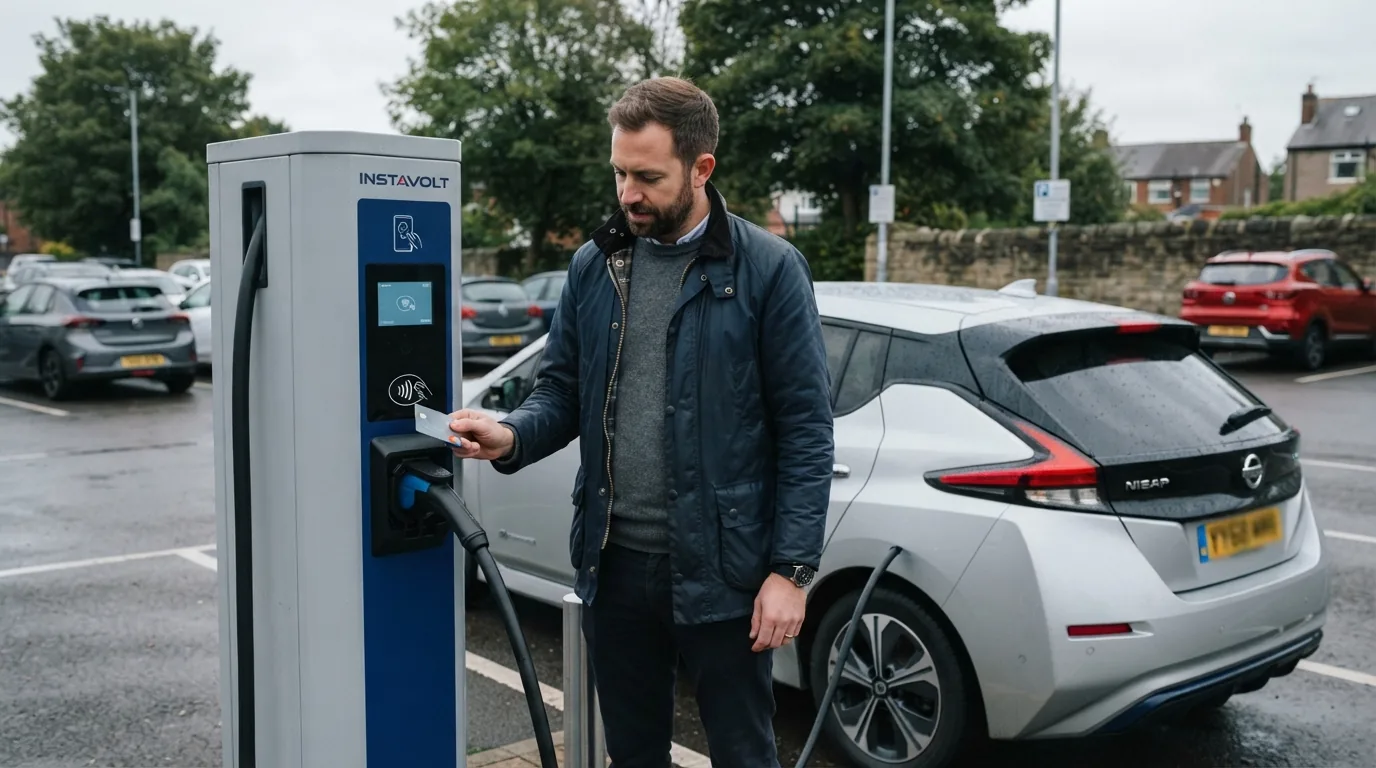
Since 2023, the UK government has required all newly installed rapid chargers (50 kW and above) to accept contactless payment. As of 2026, most rapid chargers in the UK can be started with a standard debit or credit card, Apple Pay or Google Pay. You tap the terminal, the session starts, and you tap again when you want to stop. No app, no account, no pre-registration.
This is genuinely good news for occasional users and for anyone whose usual app or RFID card is not working at a specific charger. Contactless as a backup is always available at compliant rapid chargers.
The limitation: contactless is almost always the most expensive payment method at any given charger. Networks price contactless at a premium, partly to cover the card processing costs (which are higher for tap payments than for app or RFID sessions) and partly to encourage drivers onto their own apps or subscription services.
How Zap-Pay works
Zap-Pay is the payment function built into the Zapmap app. You create a Zapmap account, add a payment method, and can then start charging sessions at over 80,000 chargers across more than 40 UK networks directly from the app.
To use Zap-Pay: open the Zapmap app, find the charger you want to use on the map, tap “check-in,” select Zap-Pay as your payment method, and the session starts remotely. You can monitor the session and stop it from the app. Payment is taken automatically from your linked card or account.
As of March 2026, Zap-Pay supports major networks including BP Pulse, Allego, Be.EV and Smart Charge among others, with the list growing regularly.
| Feature | Contactless | Zap-Pay |
|---|---|---|
| Setup required | None | Zapmap account + payment method |
| Networks covered | Individual network terminals | 40+ networks, 80,000+ chargers |
| Typical cost | Highest (premium for contactless) | Lower (network negotiated rates) |
| Charger type coverage | Rapid (50 kW+) legally required | Rapid and some AC chargers |
| Works without phone/signal | Yes (card terminal) | Requires phone signal |
| Session monitoring | Limited (network display) | Full (in-app) |
| RFID alternative | No | Yes (free Zap-Pay RFID card with Premium) |
| Zapmap Premium required | No | No (Zap-Pay available on free tier) |
The cost difference in practice
The pricing gap between contactless and app-based payment varies by network, but the pattern is consistent. Networks charge a premium for contactless tap-to-start sessions.
At a typical 50 kW charger priced at 44p/kWh via app:
- Via Zap-Pay or network app: 44p/kWh
- Via contactless terminal: 52-60p/kWh (where the network adds a contactless premium)
For a 30-minute, 25 kWh charge session:
- App payment at 44p: £11.00
- Contactless at 55p: £13.75
That is a saving of £2.75 per session. For a driver who uses public rapid charging twice per week, the annual saving of using an app over contactless amounts to roughly £286 per year. The account registration takes five minutes and the saving compounds from the first session.
When contactless is the right choice
Contactless genuinely makes sense in specific situations:
One-off or rare public charging: If you charge publicly once a month or less, the friction of setting up and managing an app may outweigh the cost saving.
App or network failure: If a network’s app is not working, a charger’s RFID reader is broken, or your phone is dead, contactless is the reliable fallback. Good networks maintain their contactless terminals specifically for this reason.
Rapid charger access without membership: At networks where subscription or membership is required for the lowest rates, contactless provides access without committing to a contract. You pay more per session, but there is no monthly fee to offset.
For guests or infrequent users: If you are borrowing a car or driving a car you will not keep, contactless avoids the need to set up an account for a car you will not use regularly.
When Zap-Pay is the better choice
For regular public charging users, Zap-Pay’s advantages compound:
Multiple networks, one account: The UK’s public charging landscape has dozens of separate networks. Without a roaming service like Zap-Pay (or Electroverse, or Bonnet), you need a separate app and account for each network you use. Zap-Pay consolidates them.
Single monthly statement: One payment method, one statement. Useful for expense tracking or personal finance management.
The RFID card option: Zapmap Premium (£5/month or £35/year) includes a free Zap-Pay RFID card. This is a physical card that starts sessions on compatible chargers without needing your phone. Useful if your phone battery is low or signal is poor at a charger.
Better than network-specific apps for infrequent use: If you occasionally use a network you are not a member of, Zap-Pay is simpler than creating an account with that specific network for a one-time session.
The UK regulatory context
The government’s contactless mandate has significantly improved the charging experience for occasional and new EV users. Before the mandate, drivers regularly arrived at chargers that required a specific app or RFID card they did not have, with no fallback.
The mandate applies to new rapid chargers installed from November 2023 onwards. Older chargers are not legally required to retrofit contactless, though many networks have chosen to do so. Some older AC chargers (22 kW and below) at destinations, workplaces and residential streets may still be app or RFID only.
The honest verdict
For occasional public charging: contactless is fine. You pay a small premium for the convenience of not managing another app, and if you charge publicly fewer than once a fortnight, the saving does not justify the setup effort.
For regular public charging: set up Zap-Pay (it is free on the standard tier) or a comparable roaming service such as Octopus Electroverse or OVO Charge. The lower per-session cost, combined with access to multiple networks from one app, provides a meaningfully better experience and lower annual cost.
Use contactless as a backup, never as your primary payment method if you charge publicly more than a few times a month.
What to read next
For a comparison of the major multi-network EV charging apps, see our Octopus Electroverse vs Bonnet comparison. For the full guide to EV apps and digital tools for UK drivers, visit our EV Tech & Apps guide and the best EV charging apps page.
How we test and where our numbers come from
Range figures are official WLTP combined values taken from manufacturer UK specification pages, with real-world estimates drawn from independent comparative testing. Prices are UK list prices at the time of the latest update. Tax, grant and charging-scheme figures come from GOV.UK and HMRC publications. We re-check every guide when pricing, specification or policy changes. Last checked 11 August 2026.

EV Compared
The EV Compared editorial team tracks the UK electric vehicle market full time: new model launches, list prices, WLTP and real-world range, public charging tariffs and the tax rules that decide what an EV actually costs to run. Every guide is checked against manufacturer specifications and official GOV.UK figures, and updated whenever the numbers move.
Related reading
View all
Apple CarPlay vs Built In EV Software: Which Is Better?
Apple CarPlay is familiar and loved, but built-in EV software controls your battery, charging and range. We explain when each wins and which cars get the balance right.
Best Apps to Find EV Chargers in the UK
With over 120,000 public charge points in the UK, the right app makes the difference between a smooth charging stop and a wasted detour. Here are the options ranked
What Is Bidirectional Charging and Can It Power Your Home?
Bidirectional charging lets your electric car act as a home battery or feed the national grid. Here is how it works, what it costs and which UK cars support it in 2026