What Affects Electric Car Range the Most in the UK?
A ranked guide to the factors that drain or preserve your battery, with real numbers
Quick answers
- Speed is the single biggest factor affecting electric car range in the UK, followed closely by temperature. After those two, wheel size, driving style, payload and accessories each play a measurable role.
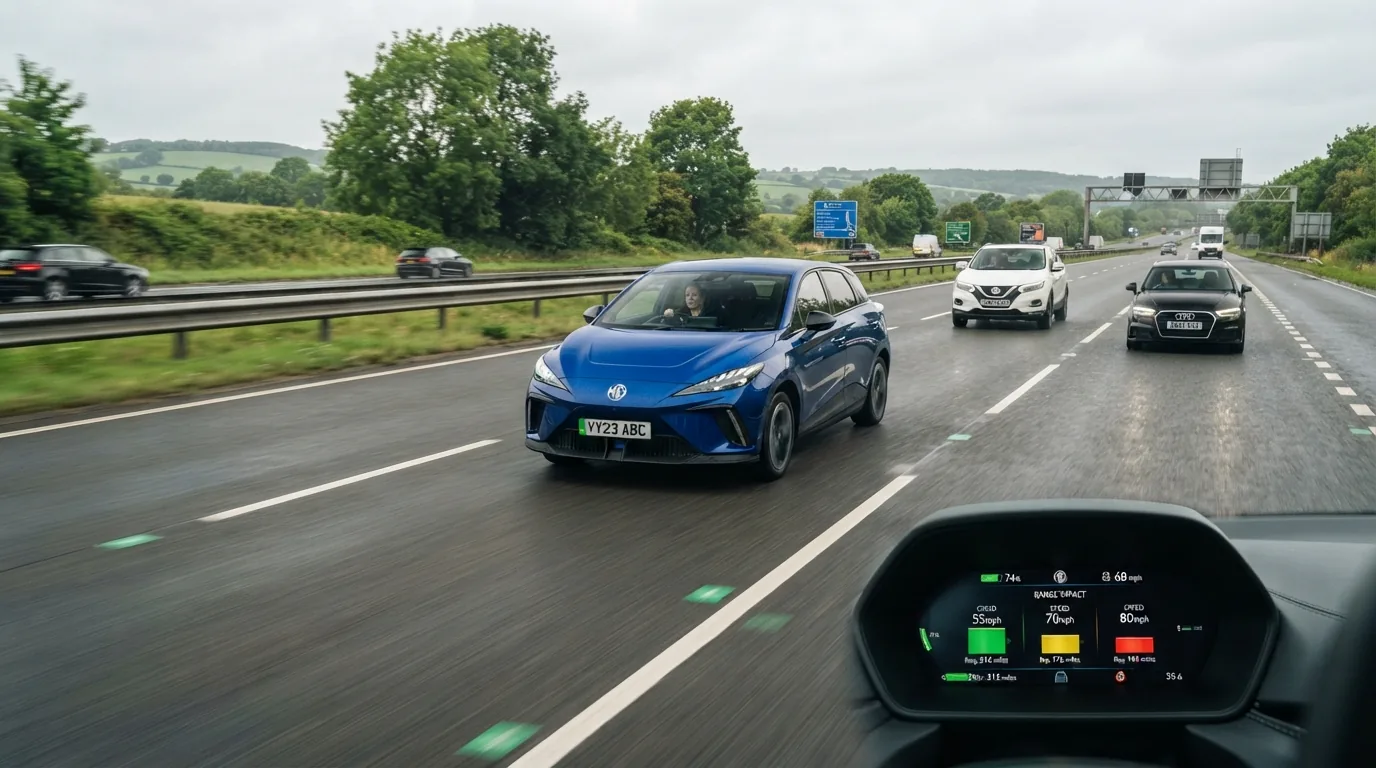
- Speed: the dominant variable: This is why WLTP figures look generous for motorway drivers.
- Temperature: the second biggest drain: In a typical British January, most EVs return around 20 to 35 per cent less range than their WLTP figure, with the actual loss depending heavily on whether the car has a heat pump.
- Wheel size: significant but overlooked: Larger wheels are heavier (requiring more energy to accelerate), have a larger contact patch (increasing rolling resistance), and are usually fitted with wider, less efficient tyres.
- Towing: the most dramatic range reducer: Towing a caravan or trailer is the highest-impact activity for EV range.
- Driving style: recoverable energy matters: Smooth driving and effective use of regenerative braking can extend real-world range by 10 to 30 per cent compared with aggressive, late-braking driving.
Speed is the single biggest factor affecting electric car range in the UK, followed closely by temperature. After those two, wheel size, driving style, payload and accessories each play a measurable role. Knowing which factors matter most, and by how much, lets you make smarter decisions when buying and when driving.
Speed: the dominant variable
Physics sets the hierarchy here. Aerodynamic drag increases with the square of velocity. When you double your speed, drag quadruples. At 70 mph, an EV uses roughly 30 per cent more energy per mile than at 50 mph. Push to 80 mph, and the penalty rises to around 40 to 45 per cent more than at 50 mph.
This is why WLTP figures look generous for motorway drivers. The WLTP test has an average speed of just 29 mph. An EV optimised to score well on WLTP may still be relatively inefficient at sustained 70 mph. Models with low aerodynamic drag coefficients, such as the Hyundai Ioniq 6 (Cd 0.21) and Tesla Model 3 (Cd 0.23), suffer less penalty at high speeds than boxier models like the Volkswagen ID.4 (Cd 0.28).
| Speed | Approximate Energy Use Relative to 50 mph |
|---|---|
| 30 mph | -25% (more efficient) |
| 50 mph | Baseline |
| 60 mph | +15% |
| 70 mph | +30% |
| 80 mph | +45% |
Temperature: the second biggest drain
Cold weather affects EV range through two mechanisms. First, lithium-ion battery chemistry slows at low temperatures. A battery at 0 degrees Celsius delivers roughly 80 per cent of its room-temperature capacity. Second, cabin heating is expensive: a resistive heater draws 3 to 5 kW, equivalent to travelling at motorway speed in terms of energy consumption.
In a typical British January, most EVs return around 20 to 35 per cent less range than their WLTP figure, with the actual loss depending heavily on whether the car has a heat pump. Heat pumps move heat rather than generate it, consuming roughly one-third the electricity of a resistive heater for the same cabin temperature. Cars with heat pumps (Tesla Model Y, Hyundai Ioniq 5, BMW iX, most modern premium EVs) can limit winter range loss to 10 to 15 per cent. Cars without one may lose 30 to 40 per cent.
| Condition | Approximate Range vs WLTP |
|---|---|
| 20°C, no climate control | 80-85% |
| 10°C, light heating | 74-80% |
| 0°C, heater running | 64-73% |
| -5°C, full heater, cold battery | 58-65% |
| 25°C, air conditioning | 74-80% |
Wheel size: significant but overlooked
This factor surprises many buyers. Moving from the smallest factory wheel option to the largest can reduce WLTP-certified range by 5 to 15 per cent. In one documented WLTP comparison, the same car with 18-inch wheels was rated at 381 miles; fitted with 20-inch wheels, it dropped to 339 miles, a 42-mile difference from wheel choice alone.
Larger wheels are heavier (requiring more energy to accelerate), have a larger contact patch (increasing rolling resistance), and are usually fitted with wider, less efficient tyres. The aerodynamic penalty from larger, more protruding spokes also adds up. Most manufacturers offer a smaller, aero-optimised wheel as a factory option that delivers the best range; the sportier-looking larger wheel is always a range compromise.
Towing: the most dramatic range reducer
Towing a caravan or trailer is the highest-impact activity for EV range. Arval UK research found that towing reduces real-world range by 23 to 31 per cent for cars and up to 31 per cent for larger electric vans in controlled testing. Real-world caravan towing tests have recorded far higher figures: the Kia EV9’s range dropped from around 275 miles to approximately 155 miles when a caravan was attached, a reduction of more than 40 per cent.
The exact loss depends on the trailer’s frontal area and drag, the speed (70 mph towing is far more expensive than 55 mph), and the gradient of the road.
Driving style: recoverable energy matters
Smooth driving and effective use of regenerative braking can extend real-world range by 10 to 30 per cent compared with aggressive, late-braking driving. Regen converts kinetic energy back into electricity as the car decelerates, instead of wasting it as heat through friction brakes. In stop-and-go city traffic, regen energy recovery can represent 20 to 40 per cent of the total energy used to propel the car.
The gains are smallest at constant motorway speed, where there is little opportunity to brake. But in mixed urban and rural driving, how you drive matters as much as what you drive.
Payload and accessories
Every extra 100 kg of payload reduces EV range by around 1 to 3 per cent in typical driving. A full load of passengers and luggage in a family-sized car adds perhaps 300 to 400 kg, cutting range by roughly 3 to 9 per cent.
Climate control use matters more than many expect. Air conditioning in summer draws 1 to 3 kW, which can reduce range by 5 to 15 per cent on a hot day. Heated rear windows, heated mirrors and high-beam headlights all add smaller but measurable loads.
Battery state of charge
Lithium-ion batteries deliver their best efficiency in the middle of the charge range, typically between 20 and 80 per cent. At very low charge levels (below 10 to 15 per cent), the battery management system limits power output. At very high levels (above 90 per cent), some cars also reduce regen braking effectiveness to protect the cells. This is why the last 10 and first 10 per cent of charge are both less efficient than the middle 80 per cent.
Tyre pressure
Under-inflated tyres increase rolling resistance. The Department for Transport estimates that tyres at 75 per cent of recommended pressure can increase fuel or energy consumption by 3 to 4 per cent. Cold weather reduces tyre pressure naturally (roughly 1 psi per 10 degrees Celsius drop), so winter is the time when tyre pressure checks matter most.
What is the common myth to correct?
The biggest misconception among new EV owners is that range is fixed: that the car’s WLTP figure is what you get. In reality, range is a variable that you partly control through speed, climate choices, tyre pressure and driving style. A driver who respects these variables will consistently outperform the WLTP figure in city driving and lose far less than average on a motorway run.
The second common mistake is buying based on WLTP without applying any real-world correction. Our guide on WLTP accuracy explains exactly what corrections to make.
For the full range and performance picture, including our best-in-class rankings, visit the range and performance hub and the longest range electric cars guide.
Sources: WLTP methodology, Department for Transport tyre research, Arval UK towing study, Recurrent Auto winter range data, EV Database aerodynamic coefficients, manufacturer specifications.
How we test and where our numbers come from
Range figures are official WLTP combined values taken from manufacturer UK specification pages, with real-world estimates drawn from independent comparative testing. Prices are UK list prices at the time of the latest update. Tax, grant and charging-scheme figures come from GOV.UK and HMRC publications. We re-check every guide when pricing, specification or policy changes. Last checked 11 August 2026.
Frequently asked questions
What is the common myth to correct?
The biggest misconception among new EV owners is that range is fixed: that the car's WLTP figure is what you get. In reality, range is a variable that you partly control through speed, climate choices, tyre pressure and driving style.

EV Compared
The EV Compared editorial team tracks the UK electric vehicle market full time: new model launches, list prices, WLTP and real-world range, public charging tariffs and the tax rules that decide what an EV actually costs to run. Every guide is checked against manufacturer specifications and official GOV.UK figures, and updated whenever the numbers move.
Related reading
View all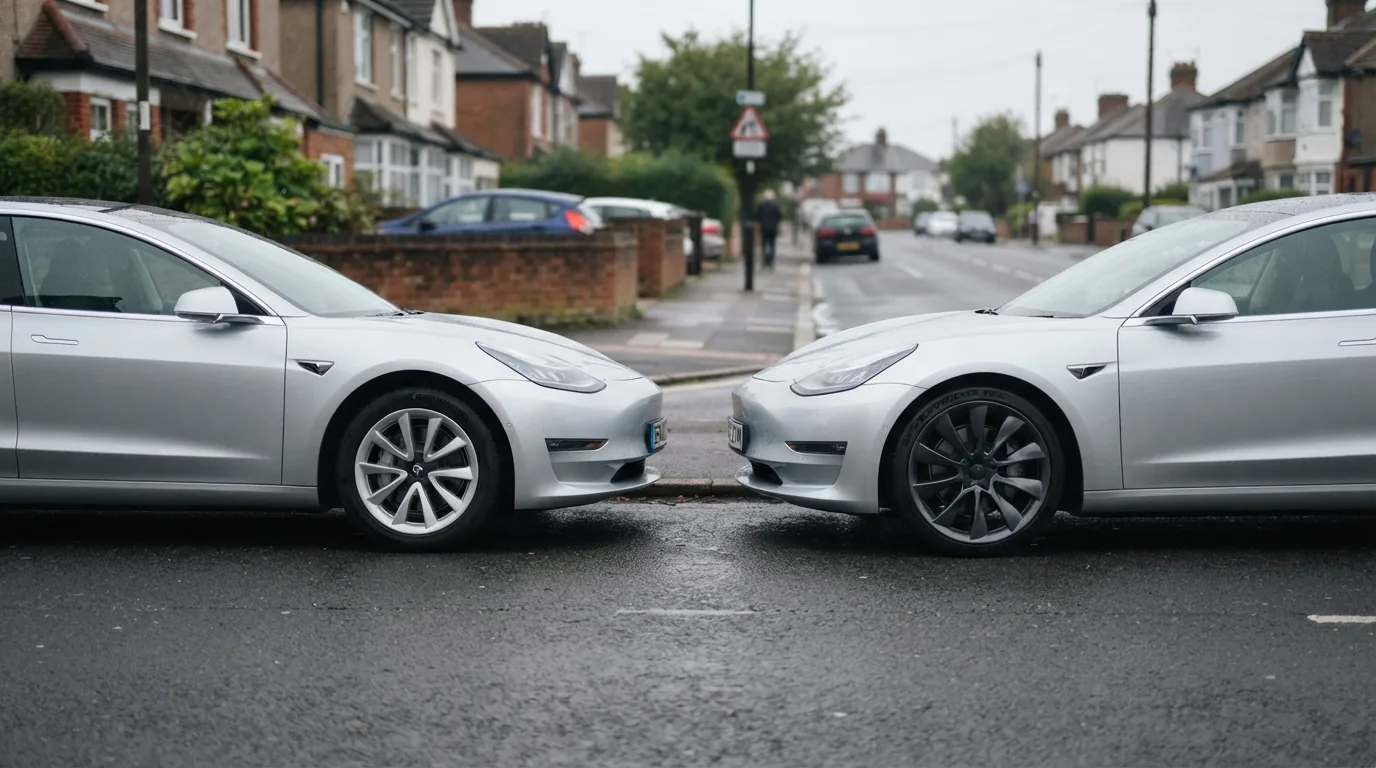
Do Bigger Wheels Reduce Electric Car Range?
Yes, significantly. Here is the data on how much wheel size costs in miles and why it happens
BMW i4 vs Tesla Model 3: UK Range and Efficiency Test
The BMW costs more and goes less far, but is it worth it? A data-led head to head for UK buyers
How Far Can an Electric Car Really Go on One Charge?
Real-world range figures for UK drivers: what the numbers mean and which cars go furthest