Best Used EVs for First Time Buyers in Britain
The easiest, most forgiving and best-value used electric cars for buyers making their first switch to electric in 2026
Quick answers
- Buying your first electric car is different from buying your fifth. The learning curve is real: home charging setup, public charging etiquette, range management, software interfaces and the shift away from filling up at a forecourt all take adjustment.
- This recommendation surprises some people, given that Tesla is not a traditional brand and the cars are more expensive than the alternatives at the bottom of this list.
- The e-Niro 64kWh is the closest thing to a worry-free first EV for buyers who want genuine long-range capability without the Tesla price.
- The Kona Electric has one of the best introductory EV experiences of any used car in its price range.
- The ID.3 makes an excellent first EV for buyers who want a car that feels like a familiar European hatchback but with electric drive.
- If budget is the primary constraint, the Leaf 40kWh is the answer.
Buying your first electric car is different from buying your fifth. The learning curve is real: home charging setup, public charging etiquette, range management, software interfaces and the shift away from filling up at a forecourt all take adjustment. The right first used EV makes that transition straightforward. The wrong one can sour the whole experience.
This guide selects used EVs that are forgiving, practical, well-supported and genuinely good to live with for a buyer who is new to electric motoring.
What makes a good EV for first-time buyers?
The priorities are different from a pure spec sheet comparison:
- Reliability: A first EV should not leave you stranded or dealing with complex faults while you are still learning how to use the technology
- Intuitive charging: Cars with simple charging interfaces, wide network compatibility or a proprietary network (Tesla Supercharger) remove anxiety from the process
- Forgiving range: Enough real-world range that you are not constantly managing your battery on everyday trips
- Good support: Manufacturer app, active software updates, widely available dealer support
- Clear, readable range display: Cars that give accurate range estimates reduce anxiety significantly
The shortlist
| Model | Typical used price | Real-world range | Why it suits first timers | Main caveat |
|---|---|---|---|---|
| Tesla Model 3 (any variant) | £16,000 to £30,000 | 200 to 330 miles | Best software, Supercharger simplicity | Higher entry price |
| Kia e-Niro 64kWh | £17,000 to £23,000 | 240 to 270 miles | 7yr warranty, simple interface | 77kW DC charging limit |
| Hyundai Kona Electric 64kWh | £16,000 to £21,000 | 220 to 250 miles | Compact, easy to drive, reliable | Smaller boot |
| Volkswagen ID.3 (2022+) | £17,000 to £22,000 | 185 to 215 miles | Conventional feel, easy to adapt from petrol | Early models had software issues |
| Nissan Leaf 40kWh | £8,000 to £13,000 | 120 to 145 miles | Simple technology, widely supported | Air-cooled battery; limited range |
| MG4 51kWh | £14,000 to £19,000 | 160 to 190 miles | Modern features, good value | Less established long-term record |
1. Tesla Model 3: the first-time buyer’s favourite for good reason
This recommendation surprises some people, given that Tesla is not a traditional brand and the cars are more expensive than the alternatives at the bottom of this list. But for a first-time EV buyer, Tesla’s ownership experience is the most seamless available.
The reason is the Supercharger network. Finding a charger, plugging in, paying and leaving requires no app, no RFID card, no failed authentication. You plug in, the car handles the rest and you pay through your Tesla account. In a country where public rapid charging reliability remains inconsistent, this matters.
The Tesla app displays real-time battery health, charging status, pre-conditioning and navigation through a well-designed interface. Range estimation is among the most accurate in the industry. Software is updated over the air regularly.
For a first-time buyer who has the budget for a 2020 to 2022 Model 3 (from around £18,000), the Supercharger experience and software quality remove most of the learning curve.
Best pick for first-timers: 2021 to 2022 Model 3 Standard Range Plus (LFP battery). The LFP battery tolerates 100% charges without accelerating degradation, reducing the need to learn complex battery management habits.
2. Kia e-Niro 64kWh: the stress-free long-range first EV
The e-Niro 64kWh is the closest thing to a worry-free first EV for buyers who want genuine long-range capability without the Tesla price. The 240 to 270 miles of real-world range means most UK journeys are completed without needing to charge en route. That removal of charging-related decision-making is genuinely valuable for a first-time buyer.
Kia’s seven-year warranty reduces financial risk. The e-Niro’s interface is straightforward, with a conventional instrument cluster and a touchscreen that does not try to do everything in unexpected ways.
The 77 kW DC charging limit is the main learning: it means longer stops at rapid chargers compared to Tesla or E-GMP platform cars. For a driver who plans ahead and charges at home most of the time, this is a minor issue.
3. Hyundai Kona Electric 64kWh: compact, approachable, reliable
The Kona Electric has one of the best introductory EV experiences of any used car in its price range. It drives much like a conventional compact SUV, meaning the transition from a petrol car feels familiar in almost all respects except the sound. The range estimation system is honest and consistent.
Reliability data is strong: claim rates are low and the battery longevity record on the 64kWh liquid-cooled pack is excellent. Hyundai’s eight-year battery warranty (to 200,000 km) provides meaningful reassurance.
The main limitation is practicality. The 332-litre boot is smaller than the e-Niro, and the car feels smaller overall. For a single person or couple without children, this is rarely an issue.
4. Volkswagen ID.3 (2022 model year onwards)
The ID.3 makes an excellent first EV for buyers who want a car that feels like a familiar European hatchback but with electric drive. From the 2022 model year, the significant software issues that dogged early examples have been resolved. The ID.3 now drives well, with a comfortable ride, good handling and a more intuitive infotainment system.
The ID.3’s 58kWh battery offers around 185 to 215 miles in real-world UK conditions. A 100 kW maximum DC charging speed is adequate for a driver who home-charges predominantly and uses public chargers for top-ups rather than full recharges.
Volkswagen’s broad dealer network across the UK means servicing and support are readily accessible. For a first-time buyer who values that conventional support infrastructure, the ID.3 is reassuring.
Avoid: 2020 and early 2021 ID.3s as a first EV. The software complexity and the elevated risk of encountering residual software bugs add unnecessary stress to an already unfamiliar experience.
5. Nissan Leaf 40kWh: the most accessible first EV
If budget is the primary constraint, the Leaf 40kWh is the answer. At £8,000 to £13,000 it is the cheapest way into a reliable, well-supported EV with a meaningful charging network. The Leaf’s technology is genuinely simple to use. E-Pedal driving is intuitive and enjoyable. The charging interface is uncomplicated.
The main thing first-time buyers need to adjust to is the range. With 120 to 145 miles of real-world range, the Leaf is not a motorway touring car. For commuting, school runs, shopping and local trips it is entirely adequate. Plan longer journeys around charging stops and the Leaf handles them fine.
The LeafSpy app (used with a cheap OBD2 dongle) is the easiest battery health diagnostic tool available on any EV, making it straightforward to check what you are buying and monitor condition over time.
Key tips for first-time EV buyers
-
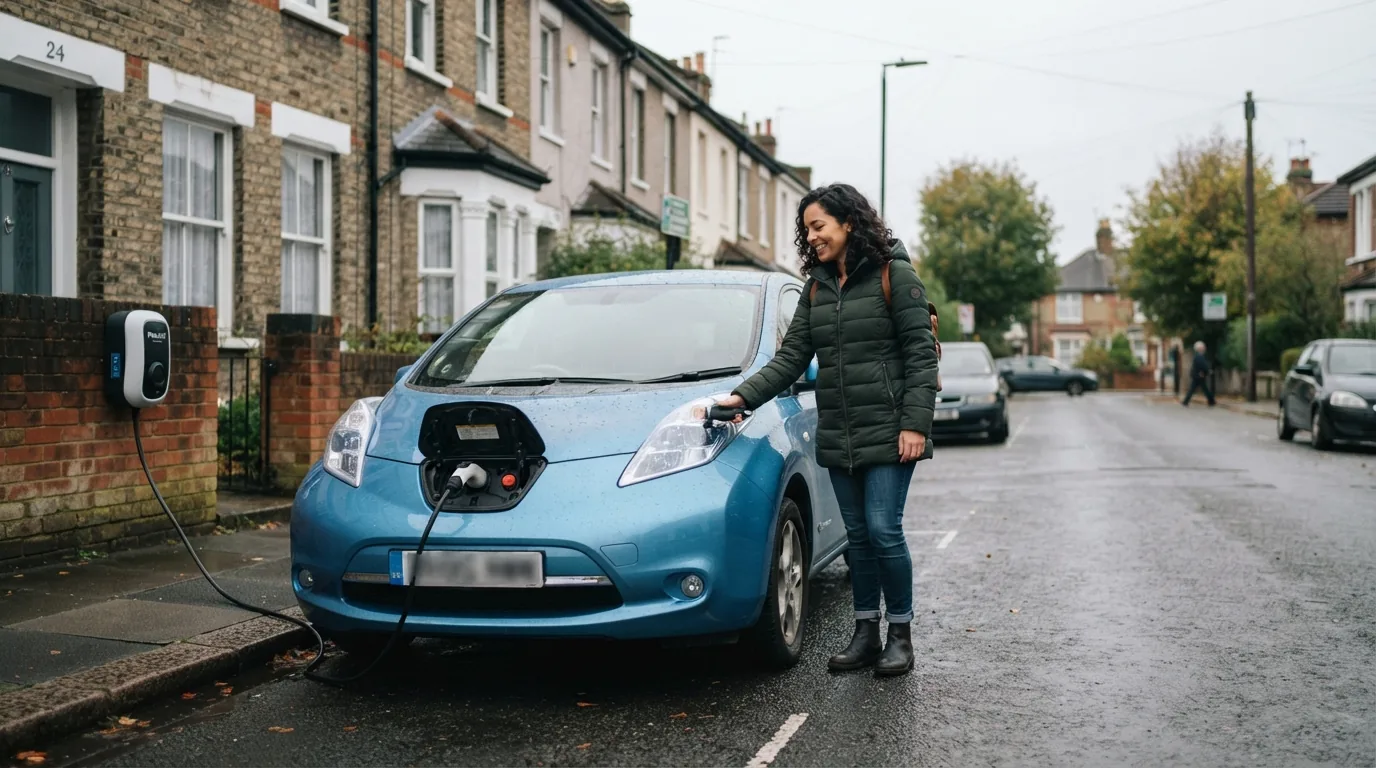
Set up home charging before you collect the car. A 7 kW home wallbox (around £800 to £1,000 installed, or potentially free under your energy supplier’s scheme) transforms the EV ownership experience. Waking to a full battery every morning removes the public charging dependency entirely for most daily use.
-
Download Zap-Map. The UK’s most comprehensive charging network mapping app shows you where chargers are, which networks they use, whether they are working, and how fast they are. Use it to plan your first few longer journeys.
-
Start with a charging limit of 80%. For most EV batteries, keeping regular charges to 80% (rather than 100%) extends battery life. Reserve 100% charges for when you need the full range for a specific journey.
-
Do not stress about the first few weeks. Range estimation improves as the car learns your driving patterns. The first week or two often feel more range-anxious than EV ownership actually is.
-
Consider joining an EV owner’s community. Model-specific forums (Speakev.com for UK owners) and broader EV groups have active, helpful communities who have answered every first-timer question many times over.
Where to next?
Return to the used EVs guide for the full buying process overview, or browse our best used electric cars shortlist for the full range of options across every budget.
How we test and where our numbers come from
Range figures are official WLTP combined values taken from manufacturer UK specification pages, with real-world estimates drawn from independent comparative testing. Prices are UK list prices at the time of the latest update. Tax, grant and charging-scheme figures come from GOV.UK and HMRC publications. We re-check every guide when pricing, specification or policy changes. Last checked 11 August 2026.

EV Compared
The EV Compared editorial team tracks the UK electric vehicle market full time: new model launches, list prices, WLTP and real-world range, public charging tariffs and the tax rules that decide what an EV actually costs to run. Every guide is checked against manufacturer specifications and official GOV.UK figures, and updated whenever the numbers move.
Related reading
View all
What Are the Biggest Myths About Switching to an EV?
The claims that put UK drivers off going electric, and what the evidence actually says
Should You Buy an EV in 2026 or Wait for Cheaper Models?
An honest look at where EV prices are heading and whether the wait is worth it for UK buyers
Buying and Owning an Electric Car in the UK: The Complete 2026 Guide
Everything you need to know about costs, charging, depreciation and day-to-day life with an EV