Used EV Buying Checklist: 15 Things to Inspect Before You Pay
A complete pre-purchase inspection checklist for used electric cars in the UK, covering battery, charging, history, mechanical condition and consumer rights
Quick answers
- Buying a used electric car requires a different checklist from a used petrol or diesel. The engine, exhaust and gearbox concerns fall away, but battery health, charging compatibility, software status and warranty transfer become critical.
- Before the viewing: Run an HPI or CAP HPI check before you travel to see the car.
- At the viewing: battery and charging: Expect a healthy used EV to show 85% SoH or above for its age.
- At the viewing: condition and mechanical: EV tyres wear faster than those on equivalent petrol cars due to the higher vehicle weight and immediate torque.
- Documentation and legal: EVs require less servicing than petrol cars but still need regular checks: tyres, brakes, suspension, coolant (where applicable), cabin air filters and high-voltage system visual inspections.
Buying a used electric car requires a different checklist from a used petrol or diesel. The engine, exhaust and gearbox concerns fall away, but battery health, charging compatibility, software status and warranty transfer become critical. Work through all 15 points below before handing over any money.
Before the viewing
1. Check the vehicle history
Run an HPI or CAP HPI check before you travel to see the car. For around £20 this tells you whether the car has outstanding finance (very common on ex-lease EVs), any write-off category markers, whether the mileage matches MOT records, and the number of previous keepers. If the car has outstanding finance and you buy it unknowingly, the finance company can legally repossess the vehicle.
2. Verify the specification against the listing
Look up the exact battery size and WLTP range for the specific model year and trim. Listings sometimes describe a car as “200 miles range” when that refers to WLTP in ideal conditions. Real-world range in UK mixed driving is typically 15% to 25% lower. Knowing the original spec helps you assess whether the current range reading is consistent with the expected state of health.
3. Research known issues for the model
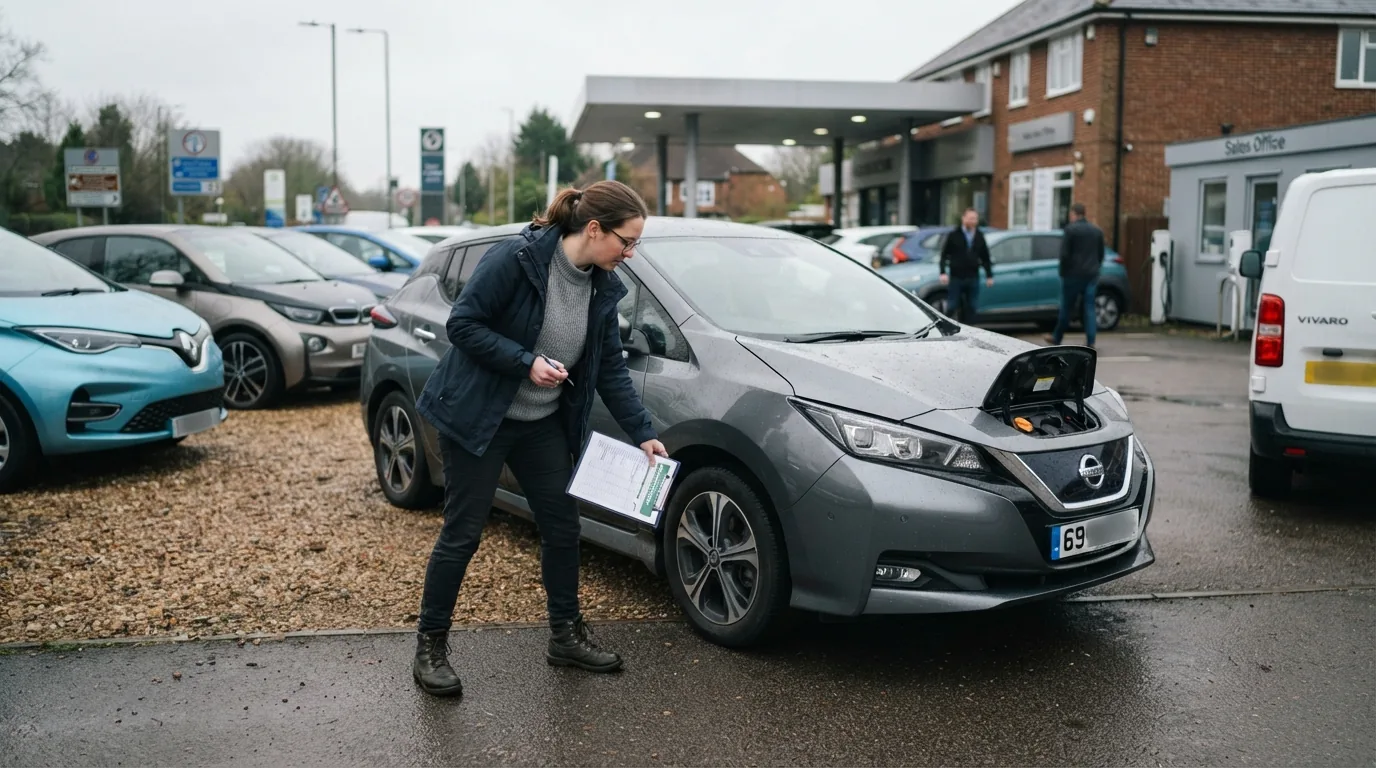
Some models have documented weaknesses. The pre-2019 Nissan Leaf uses air cooling that degrades faster in some conditions. Early Renault Zoes may carry a battery lease. Some Volkswagen ID.3 and ID.4 examples have had software issues. Knowing what to look for before you arrive makes the inspection more focused.
At the viewing: battery and charging
4. Check the battery state of health
This is the most important single check. Ask the seller to show you the battery health reading via the manufacturer’s app (Tesla, Kia, Hyundai and others display this), or use an OBD2 Bluetooth dongle with an appropriate app (LeafSpy for Nissan Leaf, Car Scanner for many others). A written battery health certificate from a dealer or independent specialist (cost: £60 to £150) is the gold standard.
Expect a healthy used EV to show 85% SoH or above for its age. Use the table below as a reference:
| Car age | Minimum acceptable SoH |
|---|---|
| Up to 3 years | 92% |
| 3 to 5 years | 88% |
| 5 to 8 years | 83% |
| Over 8 years | 78% |
5. Check charging speed and compatibility
What is the maximum AC charging rate? What is the maximum DC rapid charging rate? Does the car use CCS (the UK standard), CHAdeMO (used by older Nissan Leafs and less common now) or Type 2 AC only? An older car limited to 50 kW DC charging will take significantly longer to charge on a motorway rapid charger than a newer model at 100 kW or above.
6. Inspect the charging port
Look carefully at the charging port for bent or corroded pins. Test that the port cover opens and closes cleanly. If possible during the viewing, plug in an AC charge cable and confirm that the car accepts a charge. Charging port damage can cost several hundred pounds to repair.
7. Confirm charging equipment is included
Is a Type 2 cable included? A 5-metre Type 2 to Type 2 cable costs £60 to £200 depending on quality. Many used EVs are sold without one. Ask what is included and factor in the cost if it is missing.
At the viewing: condition and mechanical
8. Check all exterior panels and paint
Walk around the car systematically. Look for paint swirls, stone chips, scratches and bodywork repairs (indicated by slightly different paint texture or orange-peel finish). Open every door, the boot and the bonnet. Check panel gaps for consistency. On earlier Tesla Model 3s particularly, panel gaps can be uneven.
9. Check the tyres
EV tyres wear faster than those on equivalent petrol cars due to the higher vehicle weight and immediate torque. Check tread depth on all four tyres (legal minimum is 1.6mm; you want to see 3mm or more). Check for uneven wear that could indicate suspension or alignment issues.
10. Check interior condition and screen function
The large touchscreen in many EVs (Tesla, VW ID range, Polestar) is central to virtually all controls. Test that it responds accurately and loads quickly. Older touchscreen units can develop lag or dead spots. Check that heated seats, air conditioning, and all key interior functions work.
11. Test drive: acceleration, regen, steering and brakes
A test drive should cover multiple scenarios. Test full-throttle acceleration briefly to confirm motor response is normal. Test regenerative braking at several settings (if adjustable). Drive over uneven surfaces and listen for suspension clunks or unusual vibrations. Check that the steering feels direct and consistent. Any grinding or unusual noise from the brakes should be investigated.
12. Check that software is current
Ask the seller to show you the software version screen. An outdated software version can indicate a car that has been disconnected from WiFi for a long period, which sometimes points to storage or neglect. Outdated software can also affect charging speed limits, battery management and safety features.
Documentation and legal
13. Review service history and MOT records
EVs require less servicing than petrol cars but still need regular checks: tyres, brakes, suspension, coolant (where applicable), cabin air filters and high-voltage system visual inspections. A full service history at appropriate intervals adds confidence. Check that MOT history is consistent with the mileage recorded on the odometer.
14. Check battery warranty status
What warranty remains on the battery? Many manufacturers offer eight-year or 100,000-mile battery warranties guaranteeing at least 70% capacity retention. A 2022 car bought today could have up to four years of remaining battery warranty. Confirm the warranty terms in writing, whether it transfers to subsequent owners, and what the claims process is.
15. Confirm the sale terms and your consumer rights
If you are buying from a dealer:
- You have 30 days to reject the car for a full refund if it has a fault that was present at the time of sale (Consumer Rights Act 2015)
- Between 30 days and six months, the burden of proof shifts to the dealer to show the fault was not present at sale
If you are buying privately:
- The car is sold as seen. You have no right to reject it unless the seller has actively misrepresented it
- A professional pre-purchase inspection is strongly recommended before any private purchase
Always get the agreed price, any included items, and any warranty terms in writing before payment.
Quick-reference summary
| Category | Check |
|---|---|
| Before viewing | HPI check, spec verification, known issues research |
| Battery | SoH reading, charging history |
| Charging | Port condition, compatibility, speed, cables |
| Condition | Bodywork, tyres, interior, screen |
| Drive | Acceleration, regen, steering, ride, brakes |
| Software | Version check, update status |
| Documents | Service history, MOT record, battery warranty |
| Legal | Sale terms, consumer rights, finance clearance |
Where to next?
Return to the used EVs guide for the complete overview of buying a used electric car in the UK, or visit our best used electric cars page for shortlisted recommendations across every budget.
How we test and where our numbers come from
Range figures are official WLTP combined values taken from manufacturer UK specification pages, with real-world estimates drawn from independent comparative testing. Prices are UK list prices at the time of the latest update. Tax, grant and charging-scheme figures come from GOV.UK and HMRC publications. We re-check every guide when pricing, specification or policy changes. Last checked 11 August 2026.

EV Compared
The EV Compared editorial team tracks the UK electric vehicle market full time: new model launches, list prices, WLTP and real-world range, public charging tariffs and the tax rules that decide what an EV actually costs to run. Every guide is checked against manufacturer specifications and official GOV.UK figures, and updated whenever the numbers move.
Related reading
View all
What Are the Biggest Myths About Switching to an EV?
The claims that put UK drivers off going electric, and what the evidence actually says

Should You Buy an EV in 2026 or Wait for Cheaper Models?
An honest look at where EV prices are heading and whether the wait is worth it for UK buyers
Buying and Owning an Electric Car in the UK: The Complete 2026 Guide
Everything you need to know about costs, charging, depreciation and day-to-day life with an EV