How Does Towing Affect Electric Car Range?
The real numbers on EV towing range loss, which cars cope best and what to plan for on UK roads
Quick answers
- Towing dramatically reduces electric car range. In UK real-world conditions, pulling a typical caravan at motorway speeds cuts range by 40 to 60 per cent compared with the same car driving solo.
- Why does towing cut EV range so severely: When you attach a trailer or caravan, you add several major energy penalties simultaneously.
- How far can an EV actually tow a caravan: In practical planning terms, many EV-caravan combinations will achieve 100 to 150 miles per charge on UK roads.
- What towing capacity do EV buyers need: UK caravan weights vary from lightweight tourers around 900 to 1,100 kg unladen to large family vans exceeding 1,800 kg.
- For lighter loads, such as a 750 kg box trailer or a small boat trailer, the range penalty is proportionally less.
- The common myth: EVs cannot tow: Many drivers assume electric cars are unsuitable for towing.
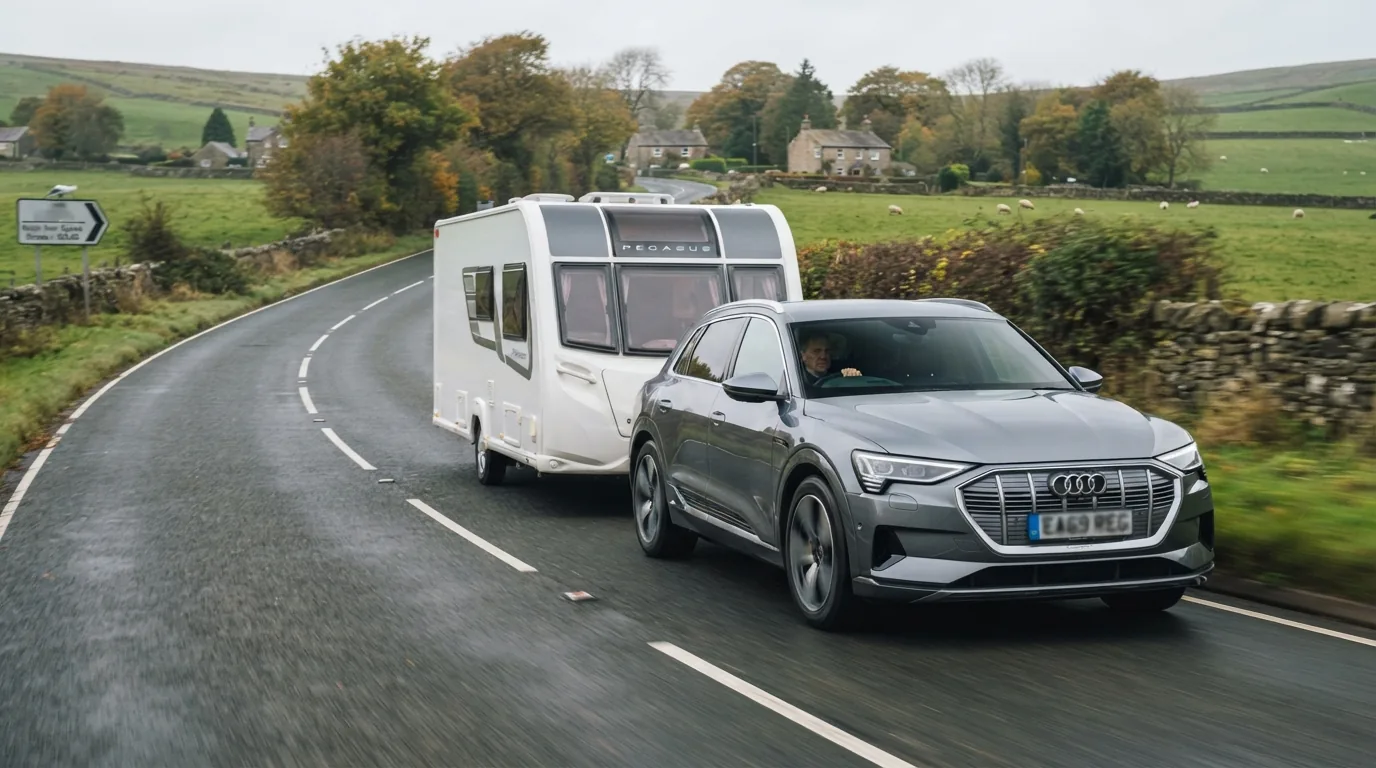
Towing dramatically reduces electric car range. In UK real-world conditions, pulling a typical caravan at motorway speeds cuts range by 40 to 60 per cent compared with the same car driving solo. Controlled testing by Arval UK found a 23 to 31 per cent reduction against real-world (not WLTP) range, and real-world caravan tests have recorded losses above 40 per cent at 60 mph.
If you plan to tow, the first step is not choosing a car by its untowed range, but working backwards from how far you need to travel between charges with a trailer attached.
Why does towing cut EV range so severely?
When you attach a trailer or caravan, you add several major energy penalties simultaneously.
Aerodynamic drag. A caravan typically has a drag coefficient several times higher than the car itself. The combined drag of car plus caravan is dominated by the van’s box shape. At 60 mph, aerodynamic drag is the dominant energy load. At 70 mph, it is even greater.
Extra weight. A typical touring caravan weighs 1,000 to 1,800 kg laden. The extra mass requires more energy to accelerate and to climb hills. Unlike a combustion engine that recovers little from braking anyway, an EV’s regenerative braking can recover some downhill energy, but the gross vehicle weight still means far higher energy consumption per mile.
No recovery from regen. The regen benefit on its own is small relative to the penalty of moving the extra load. The aerodynamic drag of the caravan cannot be recovered at all.
Speed. Towing on UK roads means staying below 60 mph (the UK towing speed limit on motorways and dual carriageways). Aerodynamic drag is lower at 60 mph than at 70 mph, which partially offsets the caravan’s drag penalty. But the combined drag of car-plus-van at 60 mph is still far higher than a solo car at 70 mph.
How far can an EV actually tow a caravan?
The critical figure is real-world towing range, not WLTP. A Kia EV9 with a 110 kWh battery and 385 miles WLTP solo range has been tested at approximately 155 miles towing range with a typical caravan attached: a reduction of more than 40 per cent from its real-world solo figure of around 275 miles.
In practical planning terms, many EV-caravan combinations will achieve 100 to 150 miles per charge on UK roads. This means planning charge stops every 80 to 120 miles depending on the specific car and caravan.
| Car | Solo WLTP | Estimated Towing Range | Towing Capacity |
|---|---|---|---|
| Kia EV9 Dual Motor | 385 miles | ~130-160 miles | 2,500 kg |
| BMW iX xDrive40 | 381 miles | ~130-160 miles | 2,500 kg |
| Hyundai Ioniq 9 | 385 miles | ~130-160 miles | 2,500 kg |
| Tesla Model Y Long Range | 331 miles | ~110-140 miles | 1,600 kg |
| Audi Q6 e-tron quattro | 381 miles | ~120-155 miles | 2,400 kg |
| Volvo EX90 | ~430 miles | ~130-165 miles | 2,500 kg |
| Kia EV6 Long Range | 361 miles | ~105-140 miles | 1,800 kg |
Towing range estimates in the table assume a 1,500 kg caravan at UK towing speed limits (maximum 60 mph on dual carriageways). Actual results vary with caravan weight, profile, gradient and speed.
What towing capacity do EV buyers need?
UK caravan weights vary from lightweight tourers around 900 to 1,100 kg unladen to large family vans exceeding 1,800 kg. The general rule is that the towing vehicle’s maximum towing capacity should be at least as heavy as the caravan at its maximum permitted laden weight (MTPLM).
For a caravan up to 1,500 kg MTPLM, you need a tow car rated for at least 1,500 kg. This rules out many EVs, including the Tesla Model Y (maximum 1,600 kg, which is borderline for larger vans) and the Hyundai Ioniq 5 (1,600 kg maximum).
For larger caravans, you need 2,000 to 2,500 kg capacity. The Kia EV9, BMW iX and Hyundai Ioniq 9 all offer 2,500 kg rated capacity, which covers the vast majority of UK touring caravans.
For motor caravans, the calculation is different. Many motorhomes over 3,500 kg (the common dividing line for driving licences) cannot be towed by a standard EV. Check the specific vehicle types involved carefully.
How should you plan an EV towing trip?
Reduce your inter-charge distance target significantly. If your car delivers 100 to 140 miles when towing, plan to stop for a charge every 80 to 100 miles to give yourself a buffer. Many caravan parks now offer EV charging, and the Zap-Map network shows chargers at many motorway services on popular caravanning routes.
Use a lower speed. At 50 mph instead of 60 mph, aerodynamic drag falls significantly. The range improvement can be 15 to 20 per cent, which meaningfully extends your inter-charge distance.
Choose a car with a large battery. Even with 50 per cent range loss, a car with a 110 kWh battery and 385 miles solo range delivers around 130 to 160 miles towing. A car with a 77 kWh battery and 280 miles solo range might deliver only 90 to 110 miles towing.
Check the towbar specification. Not all EVs come with a factory towbar as standard, and retrofit towbars are not always possible or approved on electric vehicles with integrated bumper crash structures and rear-mounted charging hardware. Verify with the manufacturer before ordering.
Use eco mode and disable unnecessary loads. Climate control draws additional energy on top of the towing penalty. Pre-heat the car and caravan before setting off so the heater demand during the journey is lower.
What about towing trailers rather than caravans?
For lighter loads, such as a 750 kg box trailer or a small boat trailer, the range penalty is proportionally less. Arval’s UK testing found a 23 per cent reduction for a car towing a 500 kg trailer in controlled conditions. For trailers under 750 kg, a loss of 15 to 25 per cent from real-world range is more typical.
The common myth: EVs cannot tow
Many drivers assume electric cars are unsuitable for towing. That was closer to true five years ago when most EV towing limits were low and battery capacity was modest. In 2026, multiple EVs offer 2,500 kg towing capacity and batteries large enough to make towing practical with charge-stop planning. The Kia EV9, Hyundai Ioniq 9 and BMW iX are capable alternatives to traditional diesel tow cars for most UK caravanning use.
The honest caveat is that towing range on an EV requires more frequent stops than a large-tank diesel. For a caravanner doing 200-mile days, two charge stops per day is realistic rather than one or none. Whether that is acceptable depends on the individual.
For our full comparison of the best towing EVs, see the best electric cars for towing guide. For a broader look at how different conditions affect range, visit the range and performance hub.
Sources: Arval UK towing range research, Fleet News towing study, EV Database towing capacity data, manufacturer towbar specifications, UK towing speed limit regulations.
How we test and where our numbers come from
Range figures are official WLTP combined values taken from manufacturer UK specification pages, with real-world estimates drawn from independent comparative testing. Prices are UK list prices at the time of the latest update. Tax, grant and charging-scheme figures come from GOV.UK and HMRC publications. We re-check every guide when pricing, specification or policy changes. Last checked 11 August 2026.
Frequently asked questions
Why does towing cut EV range so severely?
When you attach a trailer or caravan, you add several major energy penalties simultaneously.
How far can an EV actually tow a caravan?
The critical figure is real-world towing range, not WLTP. A Kia EV9 with a 110 kWh battery and 385 miles WLTP solo range has been tested at approximately 155 miles towing range with a typical caravan attached: a reduction of more than 40 per cent from its real-world solo figure of around 275 miles.
What towing capacity do EV buyers need?
UK caravan weights vary from lightweight tourers around 900 to 1,100 kg unladen to large family vans exceeding 1,800 kg. The general rule is that the towing vehicle's maximum towing capacity should be at least as heavy as the caravan at its maximum permitted laden weight (MTPLM).
What about towing trailers rather than caravans?
For lighter loads, such as a 750 kg box trailer or a small boat trailer, the range penalty is proportionally less. Arval's UK testing found a 23 per cent reduction for a car towing a 500 kg trailer in controlled conditions.

EV Compared
The EV Compared editorial team tracks the UK electric vehicle market full time: new model launches, list prices, WLTP and real-world range, public charging tariffs and the tax rules that decide what an EV actually costs to run. Every guide is checked against manufacturer specifications and official GOV.UK figures, and updated whenever the numbers move.
Related reading
View all
Do Bigger Wheels Reduce Electric Car Range?
Yes, significantly. Here is the data on how much wheel size costs in miles and why it happens
BMW i4 vs Tesla Model 3: UK Range and Efficiency Test
The BMW costs more and goes less far, but is it worth it? A data-led head to head for UK buyers
How Far Can an Electric Car Really Go on One Charge?
Real-world range figures for UK drivers: what the numbers mean and which cars go furthest