Tesla Navigation vs ABRP: Best EV Route Planner for UK Trips?
Should Tesla drivers trust the built-in navigation or switch to A Better Routeplanner? We test both on real UK journeys and give an honest verdict.
Quick answers
- Tesla's built-in navigation system is widely regarded as the best native EV routing tool in any production car. A Better Routeplanner (ABRP) is the most popular third-party alternative, used by Tesla owners and non-Tesla EV drivers alike.
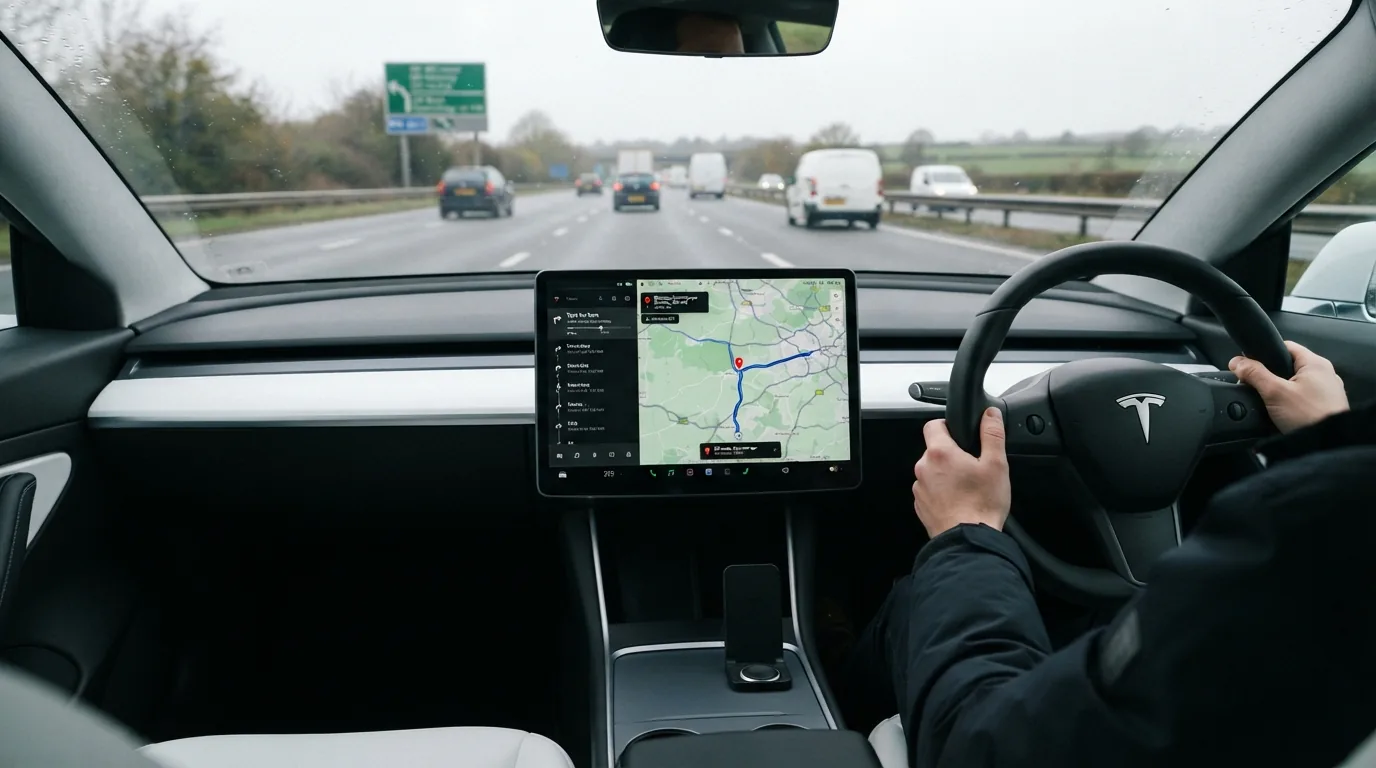
- How Tesla's built-in navigation works: Tesla's navigation is integrated with the car's systems at a level no third-party app can fully replicate.
- How ABRP works with a Tesla: Even with the API token connected, ABRP cannot send preconditioning commands to the Tesla.
- In the UK, Tesla's Supercharger network is the most reliable rapid charging network available, but it is not ubiquitous.
- Our verdict: For a Tesla owner doing typical UK routes with good Supercharger coverage, the built-in navigation is the better tool for the actual driving experience.
Tesla’s built-in navigation system is widely regarded as the best native EV routing tool in any production car. A Better Routeplanner (ABRP) is the most popular third-party alternative, used by Tesla owners and non-Tesla EV drivers alike. For Tesla drivers, the question is whether the third-party app actually improves on what is already in the car.
The direct answer: Tesla’s native navigation wins for Supercharger-only routes, primarily because of battery preconditioning. ABRP wins for route flexibility, non-Supercharger charging, multi-destination planning and transparency of routing decisions. Most frequent Tesla drivers benefit from having both.
How Tesla’s built-in navigation works
Tesla’s navigation is integrated with the car’s systems at a level no third-party app can fully replicate. When you enter a destination beyond your range, the system:
- Plans a route via Superchargers
- Calculates exactly how much charge you need at each stop
- Tells the car’s thermal management system to precondition the battery before you arrive at each Supercharger
That last point, preconditioning, is the key advantage. When a lithium battery is warmed to its optimal operating temperature before rapid charging, it accepts charge at its maximum rate immediately. Without preconditioning, the car may charge slowly for the first five to ten minutes while the battery warms up. Over a long trip with multiple stops, that time compounds.
In real-world UK conditions, Tesla’s preconditioning means arriving at a Supercharger and going straight into high-rate charging. There is no “warming up” period to wait through. ABRP cannot trigger Tesla’s preconditioning because it does not have access to the car’s thermal management system (unless Tesla makes this available via API, which it has not done as of May 2026).
How ABRP works with a Tesla
ABRP offers two levels of Tesla integration:
Standard ABRP: You enter your Tesla model, select your battery size and set your current state of charge manually. ABRP plans the route based on that model’s known consumption profile.
With Tesla API token (ABRP Premium or free): You connect your Tesla account to ABRP, which then reads your actual battery level, ambient temperature and driving speed in real time. This gives ABRP the same accurate starting-point information the Tesla navigation system uses, making its estimates much more accurate.
Even with the API token connected, ABRP cannot send preconditioning commands to the Tesla. The routing logic is more transparent and more flexible, but the thermal management advantage belongs exclusively to Tesla.
| Feature | Tesla Navigation | ABRP (with Tesla API token) |
|---|---|---|
| Battery preconditioning | Yes (automatic) | No |
| Real-time battery data | Yes | Yes (via API token) |
| Non-Supercharger routing | Limited (improving) | Excellent |
| Route customisation | Low | High |
| Multi-stop planning | Basic | Advanced |
| Transparency of routing decisions | Low | High |
| UK CCS network integration | Improving | Comprehensive |
| Car display integration | Full (native) | Via CarPlay (Premium) |
| Cost | Included | Free (basic) / ~£3.99/month (Premium) |
Where Tesla navigation falls short
Tesla’s navigation system, despite its strengths, has limitations that matter for UK drivers:
Non-Supercharger routing: About half of UK Supercharger sites are now open to non-Tesla vehicles, but Tesla’s native navigation still defaults heavily to Superchargers. If you want to route via CCS chargers on other networks (BP Pulse, Gridserve, InstaVolt), ABRP gives you more control over which networks and minimum speeds you want the route to include.
Route transparency: Tesla’s navigation shows you where to stop and how long to charge, but does not show you the calculations behind those decisions. You cannot easily see what would happen if you pushed to the next charger, or what alternative routes exist. ABRP shows you the full picture: expected battery level at each waypoint, margin of safety, and alternative stop options.
Multi-destination trips: For holidays with multiple overnight stops and charging at diverse locations, ABRP’s planning interface is significantly more flexible than Tesla’s native system.
The UK-specific consideration: Supercharger availability
In the UK, Tesla’s Supercharger network is the most reliable rapid charging network available, but it is not ubiquitous. There are around 140 UK sites. On some UK routes, particularly in Scotland, Wales, rural England and Northern Ireland, Supercharger gaps can be large. For these routes, ABRP’s ability to route via any CCS network is more useful than Tesla’s Supercharger-centric planning.
A UK-specific data point worth knowing: Supercharger availability (chargers actually working when you arrive) is consistently above 95 per cent at most UK sites, significantly better than the average across the broader UK public charging network (around 87 per cent uptime). This reliability advantage means the preconditioning benefit of Tesla’s native routing is compounded by the higher likelihood that the planned charger will actually be available.
The experienced Tesla driver’s workflow
In practice, experienced UK Tesla owners typically use a combination:
- For known Supercharger routes: Trust the Tesla navigation completely. It is accurate, preconditions the battery and handles everything automatically.
- For routes with uncertain coverage or non-Supercharger stops: Plan in ABRP first to identify the optimal stop strategy, then navigate in Tesla’s system (which will automatically precondition for any Supercharger stops it includes in the route, even if the stop was suggested by ABRP).
- For routes into remote areas: Use ABRP to plan around CCS chargers on other networks. Use Zapmap to verify charger availability and reliability before committing.
Our verdict
For a Tesla owner doing typical UK routes with good Supercharger coverage, the built-in navigation is the better tool for the actual driving experience. Preconditioning is not a marginal advantage; it meaningfully reduces time at chargers.
For route planning in advance, evaluating options, or travelling on routes that require non-Supercharger charging, ABRP is the more useful tool and the free tier is sufficient for most journeys.
Download both. Use Tesla navigation for driving. Use ABRP for planning. That is the combination that experienced UK Tesla owners consistently report as optimal.
What to read next
For a comparison of Zapmap versus ABRP for non-Tesla drivers, visit our Zapmap vs A Better Routeplanner article. For the full guide to EV apps and digital tools, see our EV Tech & Apps guide and our best EV charging apps page.
How we test and where our numbers come from
Range figures are official WLTP combined values taken from manufacturer UK specification pages, with real-world estimates drawn from independent comparative testing. Prices are UK list prices at the time of the latest update. Tax, grant and charging-scheme figures come from GOV.UK and HMRC publications. We re-check every guide when pricing, specification or policy changes. Last checked 11 August 2026.

EV Compared
The EV Compared editorial team tracks the UK electric vehicle market full time: new model launches, list prices, WLTP and real-world range, public charging tariffs and the tax rules that decide what an EV actually costs to run. Every guide is checked against manufacturer specifications and official GOV.UK figures, and updated whenever the numbers move.
Related reading
View all
Apple CarPlay vs Built In EV Software: Which Is Better?
Apple CarPlay is familiar and loved, but built-in EV software controls your battery, charging and range. We explain when each wins and which cars get the balance right.

Best Apps to Find EV Chargers in the UK
With over 120,000 public charge points in the UK, the right app makes the difference between a smooth charging stop and a wasted detour. Here are the options ranked
What Is Bidirectional Charging and Can It Power Your Home?
Bidirectional charging lets your electric car act as a home battery or feed the national grid. Here is how it works, what it costs and which UK cars support it in 2026