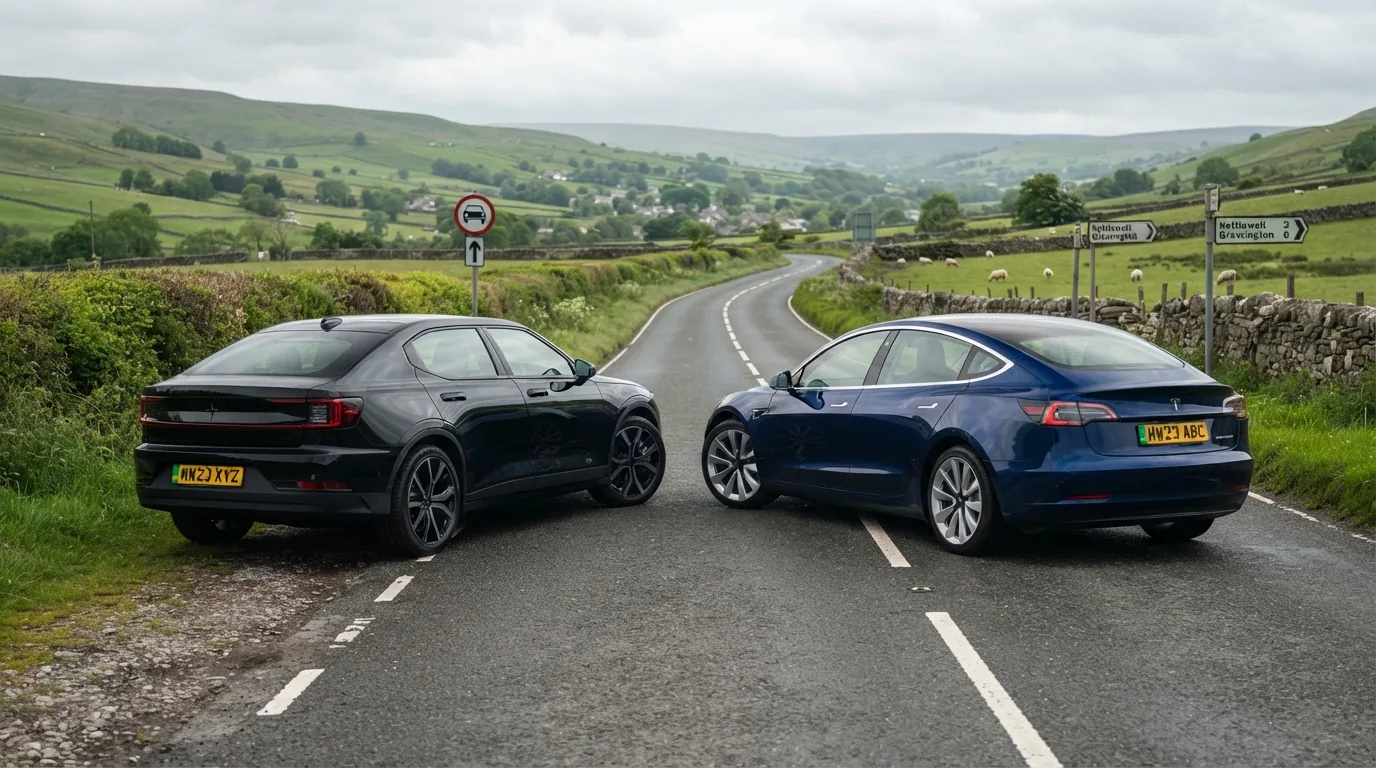
Tesla Model 3 Long Range vs Polestar 2: Real World Range Compared
On paper the Model 3 leads, but the real-world gap is wider than WLTP suggests, and charging, cost and character all play a part in the decision.
Quick answers
- The Tesla Model 3 Long Range claims more WLTP range (up to 436 miles for the RWD Highland) than the Polestar 2 Long Range Single Motor (409 miles), and the real-world gap is wider still.
- The Model 3 is the more efficient car at around 4.3 to 4.5 mi/kWh versus the Polestar 2's roughly 3.7 to 3.9 mi/kWh, which is why it goes further on a charge.
- The Polestar 2 charges marginally slower on peak kW (207 kW vs 250 kW), and Tesla's Supercharger network makes the Model 3 easier to live with on long trips.
- The Model 3 is cheaper to buy (around £44,990 vs £49,160) and cheaper per mile to run.
- Both cars sit above £40,000, so both attract the Expensive Car Supplement on VED from years two to six.
- Choose the Model 3 for range and value; choose the Polestar 2 for cabin quality and ride comfort.
The Tesla Model 3 Long Range claims up to 436 miles WLTP against the Polestar 2 Long Range Single Motor’s 409 miles, and the real-world gap is wider than that because the Tesla is the more efficient car. In mild conditions, expect around 340 miles from the Model 3 and around 295 miles from the Polestar 2. Range is only part of the story though: charging speed, running costs and how each car feels to live with all matter if you are choosing between the two.
Both are serious premium EVs with distinct strengths. The Tesla wins on efficiency, charging convenience and price. The Polestar wins on interior quality and ride comfort. What follows gives you the numbers to compare them directly, with a clear verdict by driver type at the end.
Which has the longest official WLTP range?
The official figures put the Model 3 clearly ahead, and the margin is meaningful when you compare the right trims.
The Tesla Model 3 Long Range RWD (Highland) is rated at 436 miles WLTP on a 75.0 kWh usable battery, according to EV Database. Tesla separately quotes up to 466 miles WLTP for its highest-specification Model 3 variant; that figure applies to a different trim, so check Tesla’s UK configurator for the exact spec you are ordering (figures vary, verify current data).
The Polestar 2 Long Range Single Motor (MY26) is rated at 409 miles WLTP from a 79.0 kWh usable battery. That is 27 miles behind the Model 3 Long Range RWD on paper, and more behind Tesla’s headline 466-mile claim.
WLTP is a standardised lab test used to generate official range and economy figures across all new cars, as explained by the Vehicle Certification Agency on GOV.UK. Treat it as a consistent yardstick for comparison, not a real-world promise. Both figures will drop on the road, particularly at motorway speeds and in cold weather.
Both cars are sold as long-range single-motor rear-wheel-drive variants here. Do not confuse either with their respective dual-motor all-wheel-drive versions, which trade range for performance.
What is the real-world range of each car?
Both cars fall short of their WLTP figures in normal use, as every EV does, but the Model 3 retains a larger share of its claim because it is more efficient.
EV Database’s real-world estimates in mild conditions put the Tesla Model 3 Long Range RWD at around 340 miles, compared to around 295 miles for the Polestar 2 Long Range Single Motor. That is a gap of roughly 45 miles in favour of the Tesla in everyday conditions.
The efficiency difference drives this. EV Database rates the Model 3 at around 221 Wh per mile (approximately 4.5 mi/kWh) and the Polestar 2 at around 268 Wh per mile (approximately 3.7 mi/kWh). An Auto Express twin test recorded the Model 3 returning 4.3 mi/kWh and the Polestar 2 returning 3.9 mi/kWh, reflecting a consistent advantage for the Tesla.
Cold weather and motorway driving hit both cars, but the Polestar’s larger energy consumption leaves it more exposed. EV Database puts the Polestar 2 as low as around 210 miles in cold highway conditions, a significant drop from its mild-weather estimate.
If outright distance between charges is your priority, the Model 3 Long Range sits among the longest-range electric cars in the UK, and it is worth seeing how both cars rank against the wider field before you commit.
Tesla Model 3 vs Polestar 2: head to head spec and cost comparison
One table covering the numbers that matter. All figures are UK-specific; prices and trim lines change, so confirm on the manufacturer’s current configurator before ordering.
| Spec | Tesla Model 3 Long Range RWD | Polestar 2 Long Range Single Motor |
|---|---|---|
| WLTP range | 436 miles | 409 miles |
| Real-world range (mild) | ~340 miles | ~295 miles |
| Usable battery | 75.0 kWh | 79.0 kWh |
| Efficiency | 221 Wh/mi (~4.5 mi/kWh) | 268 Wh/mi (~3.7 mi/kWh) |
| Max DC charge | 250 kW | 207 kW |
| 10-80% rapid charge | ~27 minutes | ~32 minutes |
| 0-62 mph | 5.2 seconds | 6.2 seconds |
| UK OTR price | ~£44,990 | ~£49,160 |
Sources: EV Database, Polestar UK, Tesla UK. Prices correct at time of writing; verify before ordering.
How do they compare on charging speed?
The Polestar 2 is no slouch, but the Model 3 has the faster peak rate and a more convenient network behind it.
On peak DC charging, the Model 3 Long Range reaches 250 kW, completing a 10-80% charge in around 27 minutes according to EV Database. The Polestar 2 Long Range Single Motor peaks at around 207 kW, with a 10-80% charge taking around 32 minutes. The Model 3 is five minutes faster in that window, which adds up on a multi-stop long journey.
The bigger practical difference is the charging network. The Tesla Supercharger network is widely regarded as offering the most consistent rapid charging experience on UK motorways, with reliable hardware, in-car navigation that routes to chargers automatically, and billing through the Tesla app without separate accounts. The Polestar uses the standard CCS connector and relies on the wider public network, which includes BP Pulse, Osprey, Pod Point and others accessible through apps like Zap-Map.
It is worth noting that both cars now use CCS for public rapid charging in the UK, and Polestar drivers can access Tesla Superchargers too. But the integration and reliability edge still sits with the Model 3 on long trips, as both Auto Express and Zap-Map’s network coverage data reflect.
For home charging, both cars accept 7.4 kW AC. A near-full charge from low takes around 12 hours overnight on a standard home wallbox, which covers most daily use comfortably.
Which is cheaper to buy and run?
The Model 3 is cheaper at purchase and cheaper per mile, a double advantage that compounds over time.
The Tesla Model 3 Long Range RWD is priced at around £44,990 OTR; the Polestar 2 Long Range Single Motor at around £49,160. That is a gap of roughly £4,170 in favour of the Tesla. Both prices sit above the £40,000 threshold for the Expensive Car Supplement, which adds an additional VED charge for years two to six of ownership under the current GOV.UK vehicle tax rate tables. Neither car avoids this surcharge.
On running costs, the Model 3’s efficiency advantage directly reduces what you pay per mile. At around 221 Wh per mile versus the Polestar’s 268 Wh per mile, the Tesla uses notably less electricity for the same distance. The exact saving depends on your home tariff (check the current Ofgem energy price cap for context), but the Model 3 consistently costs less to charge per mile on any given rate. This figure is illustrative and will vary with your specific tariff.
Polestar’s availability may also be worth checking: the model was reported to be nearing the end of its production run as the Polestar 3 and 4 expand the range. Confirm current stock and trim availability with dealers before committing (figures vary, verify current data).
Which should you buy?
The right answer depends on what you need from the car day to day, so rather than a single winner, here is a verdict by driver type.
Choose the Model 3 Long Range if your priority is range, efficiency or long-distance motoring. It goes further per charge, charges faster, and the Supercharger network makes UK motorway trips more straightforward. At around £4,000 less than the Polestar, it is also the more cost-effective purchase. Auto Express named the Tesla Model 3 the overall winner in its head-to-head twin test, citing precisely these advantages.
Choose the Polestar 2 Long Range if you value interior quality, ride comfort and material feel above raw efficiency. Its cabin is widely praised for its Scandinavian design and build quality, and its ride is considered more refined for everyday use. If the Model 3’s minimalist interior or Tesla’s software approach is not for you, the Polestar offers a compelling alternative with genuinely competitive range.
For most high-mileage and long-distance UK drivers who want the most kilometres per pound, the Model 3 is the rational choice. For buyers who prioritise comfort and interior quality and who are less focused on maximising range, the Polestar is an excellent car that simply costs more.
Range is the deciding factor for many buyers, so see exactly where both cars sit against every long-range EV on sale in the UK: longest-range electric cars in the UK. For context on the wider factors that shape real-world EV range, the range and performance hub covers the full picture.
Useful Resources
EV Database Tesla Model 3 Long Range RWD https://ev-database.org/uk/car/3034/Tesla-Model-3-Long-Range-RWD
EV Database Polestar 2 Long Range Single Motor https://ev-database.org/uk/car/3151/Polestar-2-Long-Range-Single-Motor
GOV.UK WLTP explainer https://www.gov.uk/guidance/wltp-the-worldwide-harmonised-light-vehicle-test-procedure
GOV.UK vehicle tax rate tables https://www.gov.uk/vehicle-tax-rate-tables
How we test and where our numbers come from
Range figures are official WLTP combined values taken from manufacturer UK specification pages, with real-world estimates drawn from independent comparative testing. Prices are UK list prices at the time of the latest update. Tax, grant and charging-scheme figures come from GOV.UK and HMRC publications. We re-check every guide when pricing, specification or policy changes. Last checked 11 August 2026.
Frequently asked questions
Which has more range, the Tesla Model 3 or the Polestar 2?
The Tesla Model 3 Long Range leads on both official WLTP figures (up to 436 miles vs 409 miles) and real-world estimates in mild conditions (around 340 miles vs 295 miles). The gap comes down to efficiency: the Model 3 uses around 221 Wh per mile compared to the Polestar 2's 268 Wh per mile, so it simply goes further on the same amount of energy.
What is the real-world range of the Tesla Model 3 Long Range?
EV Database estimates the Tesla Model 3 Long Range RWD at around 340 miles in mild conditions, returning approximately 4.3 to 4.5 mi/kWh. That figure falls in cold weather and at sustained motorway speeds, as it does for all EVs. For a long motorway trip in winter, plan conservatively and use charging stops as appropriate.
Which is better, the Tesla Model 3 or the Polestar 2?
It depends on your priorities. The Model 3 wins on range, efficiency, charging convenience and price, and Auto Express named it the overall winner in a direct head-to-head twin test. The Polestar 2 wins on interior quality, ride comfort and material feel.
How fast does each car charge?
The Tesla Model 3 Long Range peaks at 250 kW on a rapid charger and completes a 10-80% charge in around 27 minutes. The Polestar 2 Long Range Single Motor peaks at around 207 kW, with a 10-80% charge taking around 32 minutes. Beyond the raw speed, Tesla's Supercharger network offers more consistent reliability and simpler in-car integration for long-distance journeys.
Which is cheaper, the Tesla Model 3 or the Polestar 2?
The Tesla Model 3 Long Range RWD is around £44,990 OTR, compared to around £49,160 for the Polestar 2 Long Range Single Motor. The Model 3 is also cheaper per mile to run thanks to its better efficiency. Both cars sit above £40,000, so both attract the Expensive Car Supplement on VED.
Sources and further reading
- ev-database.orgEV DatabasePrimary source referenced in this article.

EV Compared
The EV Compared editorial team tracks the UK electric vehicle market full time: new model launches, list prices, WLTP and real-world range, public charging tariffs and the tax rules that decide what an EV actually costs to run. Every guide is checked against manufacturer specifications and official GOV.UK figures, and updated whenever the numbers move.
Related reading
View all
Do Bigger Wheels Reduce Electric Car Range?
Yes, significantly. Here is the data on how much wheel size costs in miles and why it happens
BMW i4 vs Tesla Model 3: UK Range and Efficiency Test
The BMW costs more and goes less far, but is it worth it? A data-led head to head for UK buyers
How Far Can an Electric Car Really Go on One Charge?
Real-world range figures for UK drivers: what the numbers mean and which cars go furthest