Best Seven Seat Electric Cars in the UK
The electric 7-seaters ranked for families who need genuine adult space in every row
Quick answers
- Seven-seat electric cars are no longer a novelty or a compromise.
- Best overall: Kia EV9: The Kia EV9 is the benchmark for electric seven-seaters in 2026 and not a close contest at its price.
- Best value seven-seater: Peugeot E-5008: The E-5008 is unusual: it has the longest claimed WLTP range of any seven-seater, at 410 miles, and is priced significantly below the EV9 or Ioniq 9.
- Best premium choice: Hyundai Ioniq 9: The Ioniq 9 arrives in UK showrooms in 2026 as Hyundai's largest and most capable EV.
- The 263-mile WLTP range is the weakest of the dedicated seven-seaters, and real-world range of 200 to 230 miles means more frequent charge stops on long trips.
- Functional third row: Mercedes EQB: The EQB is compact by seven-seater standards (under 4.7m long) and offers two small rear seats that fold from the boot floor.
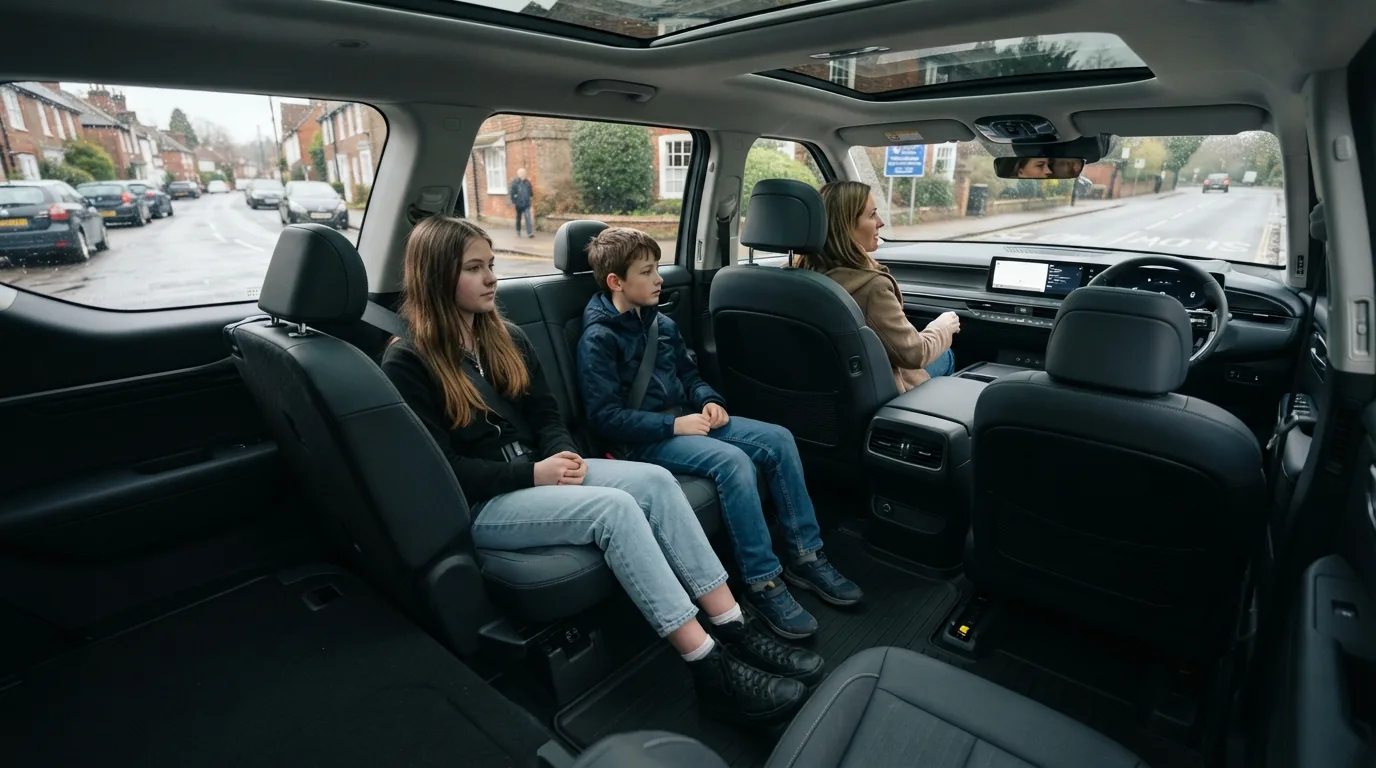
Seven-seat electric cars are no longer a novelty or a compromise. In 2026, the best examples genuinely seat seven adults (not three adults and four children squeezed in as an afterthought), offer competitive rapid charging, and deliver sufficient range for UK family road trips without requiring unrealistic planning.
The category divides into two clear tiers: purpose-built seven-seat platforms where the third row is an engineering priority (Kia EV9, Hyundai Ioniq 9, Volvo EX90), and converted five-seat platforms where the third row is functional but cramped (Mercedes EQB, Volkswagen ID. Buzz short wheelbase). We cover both, clearly.
What to look for in a seven-seat EV
Third-row genuinely for adults? The critical question. Many “seven-seaters” have a third row suitable only for children under 12. True adult-capacity third rows require a longer wheelbase and specific floor architecture.
Boot space with all seven seats occupied. A seven-seater with no boot when all seven seats are up is only theoretically a seven-seater. Look for at least 150 litres with all rows in use.
Real-world range with a full load. Seven occupants add roughly 500 kg of passenger weight. Expect range to drop 10 to 15% versus the solo driving figure.
Charging speed. For family road trips, you want at least 100 kW DC peak charging. 800V architecture (Kia EV9, Hyundai Ioniq 9) dramatically reduces stop time.
Best overall: Kia EV9
From £65,395 | 336 miles WLTP | 230 kW max DC | 828-litre boot (7 seats up)
The Kia EV9 is the benchmark for electric seven-seaters in 2026 and not a close contest at its price. Built on Kia’s E-GMP 800V platform, it combines:
- Three rows of genuinely adult-capable seating with second-row swivelling seats (on higher trims) that pivot to face the third row
- 828-litre boot with all seven seats in use (larger than most five-seat SUVs with their seats folded)
- 2,500 kg braked towing capacity, the highest of any EV currently available in the UK
- 230 kW peak DC charging for a 10 to 80% charge in approximately 25 minutes
- 336-mile WLTP range from the 99.8 kWh battery
- Kia’s seven-year, 100,000-mile warranty on the vehicle and battery
The EV9 is not cheap. At £65,395 for the entry Air specification, it sits above most family budgets. But for families that regularly need seven seats and have a genuine towing requirement, there is no equivalent alternative at any price.
Real-world note: The 336-mile WLTP becomes approximately 260 to 280 miles in mixed driving. With a full family load of seven, allow 240 to 250 miles. Plan charging stops accordingly.
Best value seven-seater: Peugeot E-5008
From £44,995 | 410 miles WLTP | 160 kW max DC | 259-litre boot (7 seats up)
The E-5008 is unusual: it has the longest claimed WLTP range of any seven-seater, at 410 miles, and is priced significantly below the EV9 or Ioniq 9. The third row folds flat into the floor when not in use, creating a 748-litre boot. With all seven seats up, boot space is a modest 259 litres.
The third row is best suited to adults under 5ft 8in and children. For families where the back row is primarily for older children and occasional adult use, this is entirely adequate. For families who genuinely need seven adult-capable seats, the EV9 or Ioniq 9 is the answer.
The 160 kW peak DC charging is adequate rather than impressive for the price. Real-world range of around 310 to 350 miles in mixed conditions is, however, genuinely impressive for a seven-seater at £44,995.
Best for: families with older children who need occasional seven-seat capacity and want the lowest price of entry.
Best premium choice: Hyundai Ioniq 9
From approximately £72,000 | 385 miles WLTP | 240 kW max DC | 120-litre boot (7 seats up)
The Ioniq 9 arrives in UK showrooms in 2026 as Hyundai’s largest and most capable EV. Its 110.3 kWh battery delivers 385 miles WLTP, making it the longest-range seven-seater under £80,000. The E-GMP 800V platform enables 240 kW peak charging.
Interior quality is genuinely premium, with three distinct cabin zones and lounge-style seating in the second row on higher trims. Third-row space is better than the E-5008 but not quite as generous as the EV9’s purpose-built architecture.
Boot space with all seven seats up is only 120 litres, which is a meaningful limitation for families planning luggage-loaded holidays. Six seats (with the middle second-row seat removed) provides far more useful space.
Best for: buyers who want the longest range, fastest charging and most premium interior in the seven-seat segment.
Best for versatility: Volkswagen ID. Buzz (Long Wheelbase)
From £62,575 (LWB) | 263 miles WLTP | 185 kW max DC | 117-litre boot (7 seats up)
The ID. Buzz Long Wheelbase adds a proper third row to the shorter-wheelbase five-seat model. The format is genuinely different from SUV rivals: a flat floor, a bus-like seating position that makes entry and exit easy for all ages, and an interior that feels uniquely open. Children love it.
The 263-mile WLTP range is the weakest of the dedicated seven-seaters, and real-world range of 200 to 230 miles means more frequent charge stops on long trips. The 185 kW peak DC charging rate is reasonable.
The ID. Buzz’s strongest advantage is the sliding rear doors, which make loading and unloading in tight car parks dramatically easier than any SUV equivalent. For school run and urban family use, this matters.
Best for: families who prioritise ease of entry and exit, urban practicality and a distinctive alternative to the SUV format.
Functional third row: Mercedes EQB
From £50,795 | 298 miles WLTP | 112 kW max DC
The EQB is compact by seven-seater standards (under 4.7m long) and offers two small rear seats that fold from the boot floor. These are suitable for children under 5ft 5in and provide useful occasional capacity without the running costs of a full large seven-seater.
The 112 kW peak DC charging is the slowest of any model in this guide, and the 298-mile WLTP range is modest for the price. However, if you need occasional seven-seat capacity in a compact footprint at a lower price than the EV9, the EQB is the logical option.
Seven-seat EV comparison
| Model | Price | WLTP range | Real-world range | Max DC | 3rd row adults | Boot (7 seats) | Towing |
|---|---|---|---|---|---|---|---|
| Kia EV9 | £65,395 | 336 miles | 260–280 miles | 230 kW | Yes | 828L | 2,500 kg |
| Peugeot E-5008 | £44,995 | 410 miles | 310–350 miles | 160 kW | Older children | 259L | 1,000 kg |
| Hyundai Ioniq 9 | ~£72,000 | 385 miles | 295–325 miles | 240 kW | Yes | 120L | TBC |
| VW ID. Buzz LWB | £62,575 | 263 miles | 200–230 miles | 185 kW | Older children | 117L | 1,000 kg |
| Mercedes EQB | £50,795 | 298 miles | 230–260 miles | 112 kW | Children only | ~50L | 750–1,800 kg |
| Volvo EX90 | £84,995 | 378 miles | 290–320 miles | 250 kW | Yes | 310L | 2,500 kg |
Budget option: Citroën e-Berlingo / Peugeot e-Rifter
From approximately £35,000 | Up to 171 miles WLTP | 100 kW max DC
For buyers who need seven seats at the lowest possible price and are prepared to accept a van-derived body, the Citroën e-Berlingo, Peugeot e-Rifter, Vauxhall Combo-e Life and Toyota ProAce City Verso Electric are near-identical mechanical twins starting around £35,000 with seven genuine seats and a massive flat-floor cabin.
The WLTP range of around 171 miles is modest but adequate for school runs and local family use with daily home charging. These are not motorway touring cars. They are practical, seven-seat workhorses for urban and suburban families.
What to read next
For electric SUVs with five seats, see our best electric SUVs for UK families. For towing capability specifically, see can you tow with an electric car. The full picture of EV buying is in the buying and owning guide and our best electric cars to buy in 2026.
How we test and where our numbers come from
Range figures are official WLTP combined values taken from manufacturer UK specification pages, with real-world estimates drawn from independent comparative testing. Prices are UK list prices at the time of the latest update. Tax, grant and charging-scheme figures come from GOV.UK and HMRC publications. We re-check every guide when pricing, specification or policy changes. Last checked 11 August 2026.

EV Compared
The EV Compared editorial team tracks the UK electric vehicle market full time: new model launches, list prices, WLTP and real-world range, public charging tariffs and the tax rules that decide what an EV actually costs to run. Every guide is checked against manufacturer specifications and official GOV.UK figures, and updated whenever the numbers move.
Related reading
View all
What Are the Biggest Myths About Switching to an EV?
The claims that put UK drivers off going electric, and what the evidence actually says
Should You Buy an EV in 2026 or Wait for Cheaper Models?
An honest look at where EV prices are heading and whether the wait is worth it for UK buyers
Buying and Owning an Electric Car in the UK: The Complete 2026 Guide
Everything you need to know about costs, charging, depreciation and day-to-day life with an EV