Can You Tow With an Electric Car? UK Towing Capacity Explained
Which EVs are rated for towing, how much they can pull, and what happens to range when you hitch up
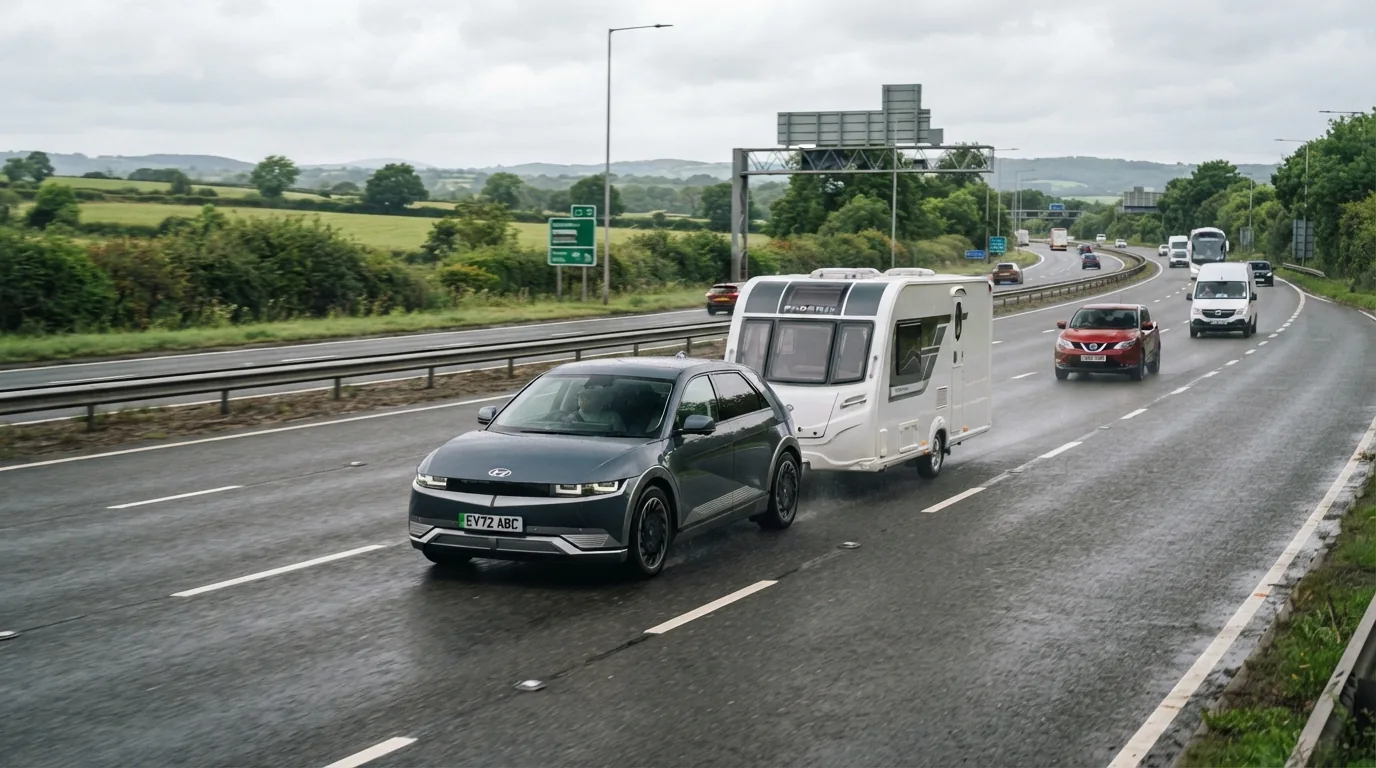
Quick answers
- Many EVs can tow, but capability is not universal: towing capacity is set at type approval and that process is optional, so models like the Nissan Leaf and Renault Zoe carry no rating.
- The strongest EV tow cars, the BMW iX, Kia EV9 and Hyundai Ioniq 9, pull up to 2,500kg braked, matching many diesel SUVs.
- Quoted figures are braked capacity; unbraked towing is capped far lower, typically around 750kg on these models.
- Expect towing to cut usable range by roughly 30-50%; an RAC test saw a Kia EV9 fall from 316 to about 150 miles when towing a 1.5-tonne caravan.
- On a post-1997 category B licence you can tow a trailer up to 3,500kg MAM, and UK towing speed limits are 50/60/60 mph on single carriageways, dual carriageways and motorways respectively.
Yes, many electric cars can tow. The strongest, including the BMW iX, Kia EV9 and Hyundai Ioniq 9, are each rated to 2,500kg braked, matching many diesel SUVs. However, towing capacity is set at type approval and that process is optional, so a number of EVs carry no tow rating whatsoever. This article covers how much different models can pull, what towing does to range, and the UK rules that apply.
Can you tow with an electric car?
The short answer is yes, but only if the specific model has been type-approved for towing and carries a manufacturer tow rating. Capability is not universal across the EV market.
Many EVs can tow a caravan or trailer without issue, but you must confirm the model has a tow rating before fitting a towbar. Towing capacity is set during type approval, and because that process is optional, plenty of smaller EVs, including the Nissan Leaf, Renault Zoe and Fiat 500e, have no tow rating at all. If a car is not type-approved to tow, attempting it is illegal and may void your insurance.
The same UK towing laws apply to electric cars as to petrol and diesel vehicles, covering licence categories, trailer weights and speed limits. Driving an EV does not change any of those obligations.
How much can an electric car tow?
Capacities span a wide range. Large EV SUVs at the top of the market match diesel tow cars, while small city EVs may have no rating.
The figures quoted by manufacturers and used for comparison are braked towing capacity, meaning the trailer has its own independent braking system. Unbraked towing capacity, for trailers without brakes, is far lower, typically around 750kg even on models rated to 2,500kg braked. Always use the braked figure when assessing whether an EV can pull a caravan.
The BMW iX and Kia EV9 are both rated to 2,500kg braked, and the Hyundai Ioniq 9 matches them at 2,500kg. The Audi Q6 e-tron comes in at 2,400kg. The Tesla Model X is rated to approximately 2,268kg, though figures vary slightly by trim, so check the spec for your variant. The Kia EV6 manages 1,800kg, the Audi Q8 e-tron 1,800kg, the Mercedes EQA in 4Matic twin-motor form 1,800kg, and the BMW i4 1,600kg. The Tesla Model Y sits at around 1,588kg, again depending on trim.
EV towing capacity by model (UK braked figures)
The table below covers the main models available in the UK. All figures are braked towing capacity. Ratings vary by trim and motor configuration, with single-motor variants often rated lower than dual-motor equivalents, so always confirm against the V5C or manufacturer specification before purchasing a towbar.
| Model | Braked towing capacity (kg) | Notes |
|---|---|---|
| BMW iX | 2,500 | Unbraked 750kg |
| Kia EV9 | 2,500 | Unbraked 750kg |
| Hyundai Ioniq 9 | 2,500 | |
| Audi Q6 e-tron | 2,400 | |
| Tesla Model X | ~2,268 | Figures vary by trim; verify current spec |
| Kia EV6 | 1,800 | |
| Mercedes EQS SUV | 1,800 | |
| Audi Q8 e-tron | 1,800 | |
| Mercedes EQA 4Matic | 1,800 | Single-motor EQA 250 rated to 750kg only |
| BMW i4 | 1,600 | |
| Tesla Model Y | ~1,588 | Figures vary by trim; verify current spec |
Figures vary by model year and trim level. Always confirm against the manufacturer specification or V5C before purchase.
Do electric cars make good tow cars?
On the mechanical side, EVs have genuine advantages over petrol and diesel alternatives for towing.
- Electric motors deliver near-instant torque at any speed, which mirrors a diesel’s low-end pulling power and helps move heavy loads smoothly, especially on gradients.
- The battery pack sits low in the floor, keeping the centre of gravity low and improving towing stability compared with a higher-mounted engine and fuel tank.
- Strong regenerative braking is the main handling caveat: the abrupt deceleration when you lift off can unsettle a trailer, so use a gentler touch on the throttle when towing and ease off gradually rather than lifting sharply.
These are genuine strengths, not minor details. The instant-torque characteristic means an EV rarely feels strained when pulling away from a standstill with a loaded caravan behind it.
How much does towing cut an EV’s range?
This is the main practical limitation of towing with an electric car, and it is a significant one.
As a general rule, towing reduces an EV’s usable range by roughly 30-50%, though figures vary and you should verify current data for your specific model and caravan combination. The load, gradient and wind resistance all increase energy consumption, and a caravan’s flat face adds considerable aerodynamic drag at motorway speeds.
Real-world testing bears this out. In RAC testing, a Kia EV9 towing a 1.5-tonne caravan dropped from 2.7 miles per kWh to 1.5 miles per kWh, cutting its range from a rated 316 miles to roughly 150 miles. That is a reduction of just over 50% in real-world conditions.
The other practical problem is charging with a trailer attached. Most public charging points are not designed to accommodate a car with a caravan, and manoeuvring into a bay or beside a charger is awkward at best. Plan your route around locations where you can pull through, or factor in time to unhitch before charging.
UK towing rules: licence, speed limits and the 85% guideline
These rules apply equally to EVs and any other vehicle. There is nothing EV-specific about the legal framework, but they are worth knowing clearly.
- Licence category: If you passed your driving test on or after 1 January 1997, you can tow a trailer up to 3,500kg MAM on a standard category B licence. If you passed before 1 January 1997, you can usually drive a vehicle and trailer with a combined weight of up to 8,250kg MAM.
- UK towing speed limits: 50 mph on single carriageways, 60 mph on dual carriageways, and 60 mph on motorways. These are lower than the standard limits and apply whenever you are towing.
- The 85% guideline: The caravan’s laden weight (its MTPLM, or Maximum Technically Permissible Laden Mass) should ideally be no more than 85% of the towing car’s kerbweight. This is guidance for stability issued by the Caravan and Motorhome Club, not a legal limit. The legal limit is the car’s stated braked towing capacity. Figures vary; verify current guidance before you travel.
- Noseweight: The downward force on the towball should be roughly 5-7% of the loaded caravan weight and must stay within the car’s stated noseweight limit. This is also guidance rather than law, and figures vary; verify current data for your specific car and outfit.
One point worth noting on EVs specifically: because batteries are heavy, many electric cars have a higher kerbweight than an equivalent petrol model. That can help the 85% match with a given caravan, but it also means the combined weight of car plus trailer can be significant, so check it against your licence category.
Which electric cars tow the most?
If towing capacity is your priority, the large EV SUVs are the only serious options.
The 2,500kg club, comprising the BMW iX, Kia EV9 and Hyundai Ioniq 9, matches many diesel SUV tow cars for outright braked capacity. At the other end of the scale, smaller EVs such as the Citroen e-C3 Aircross are rated for only 350-550kg, which is suitable for a small trailer or a light unbraked load but not for a caravan.
If towing is only part of your shortlist and you want an all-round pick, our guide to the best electric cars to buy ranks the strongest models on range, charging speed and ownership cost too.
Useful Resources
GOV.UK Towing with a car https://www.gov.uk/towing-with-car
GOV.UK Speed limits https://www.gov.uk/speed-limits
RAC: Can electric cars tow? https://www.rac.co.uk/drive/electric-cars/running/electric-cars-tow/
For more on owning and running an electric car, see our buying and owning guide.
How we test and where our numbers come from
Range figures are official WLTP combined values taken from manufacturer UK specification pages, with real-world estimates drawn from independent comparative testing. Prices are UK list prices at the time of the latest update. Tax, grant and charging-scheme figures come from GOV.UK and HMRC publications. We re-check every guide when pricing, specification or policy changes. Last checked 11 August 2026.
Frequently asked questions
Can you tow with an electric car?
Yes, provided the specific model is type-approved and rated to tow. Many EVs can, with the strongest rated to 2,500kg braked, but not all carry a tow rating. Models like the Nissan Leaf and Renault Zoe have no tow rating at all.
How much can an electric car tow?
It ranges widely. Large EV SUVs such as the BMW iX, Kia EV9 and Hyundai Ioniq 9 can each tow up to 2,500kg braked, while smaller EVs may be rated for only a few hundred kilograms or carry no rating at all. Figures quoted are braked capacity; unbraked towing is capped much lower, typically around 750kg even on high-capacity models.
Do electric cars make good towing vehicles?
Mechanically, yes. Instant torque helps pull heavy loads and climb gradients, and the low, battery-weighted floor aids stability. The main trade-offs are significantly reduced range and strong regenerative braking, which needs a gentler lift-off when towing to avoid unsettling the trailer.
Which electric cars can tow the heaviest trailers?
The current leaders are the BMW iX, Kia EV9 and Hyundai Ioniq 9, each rated to 2,500kg braked. The Audi Q6 e-tron is close behind at 2,400kg. These figures match many diesel tow cars for outright capacity.
Does towing reduce an electric car's range?
Yes, significantly. As a general rule, towing cuts range by roughly 30-50%, though figures vary and you should verify current data for your model. In RAC testing a Kia EV9 towing a 1.5-tonne caravan fell from a rated 316 miles to roughly 150 miles.
Sources and further reading
- gov.ukGOV.UKPrimary source referenced in this article.

EV Compared
The EV Compared editorial team tracks the UK electric vehicle market full time: new model launches, list prices, WLTP and real-world range, public charging tariffs and the tax rules that decide what an EV actually costs to run. Every guide is checked against manufacturer specifications and official GOV.UK figures, and updated whenever the numbers move.
Related reading
View all
What Are the Biggest Myths About Switching to an EV?
The claims that put UK drivers off going electric, and what the evidence actually says
Should You Buy an EV in 2026 or Wait for Cheaper Models?
An honest look at where EV prices are heading and whether the wait is worth it for UK buyers
Buying and Owning an Electric Car in the UK: The Complete 2026 Guide
Everything you need to know about costs, charging, depreciation and day-to-day life with an EV