Do You Really Save Money Switching From Diesel to Electric?
A detailed cost breakdown for UK drivers considering the switch from diesel to EV
Quick answers
- Yes, most UK drivers who switch from diesel to electric do save money, sometimes significantly. The saving comes primarily from lower energy costs per mile, reduced servicing, and for company car drivers, a dramatic reduction in Benefit in Kind tax.
- Why diesel needs specific attention: Diesel gets its own comparison because diesel drivers are often the hardest to convince.
- The energy cost comparison: At 10,000 miles per year, the annual fuel cost for a diesel (50mpg) is approximately £3,240 for the year.
- Servicing: where diesel gets expensive: Diesel engines are more mechanically complex than petrol engines, and significantly more so than electric motors.
- For drivers who pay Benefit in Kind tax on a company diesel, switching to an EV is financially transformative.
- The DPF problem: diesel's hidden cost: This is a genuine problem for drivers who have switched from motorway to urban use.
Yes, most UK drivers who switch from diesel to electric do save money, sometimes significantly. The saving comes primarily from lower energy costs per mile, reduced servicing, and for company car drivers, a dramatic reduction in Benefit in Kind tax. The main caveat is public charging: if you rely on rapid public chargers for everyday use, the energy cost advantage shrinks or disappears.
Why diesel needs specific attention
Diesel gets its own comparison because diesel drivers are often the hardest to convince. They chose diesel for a reason: fuel efficiency, long motorway range, and low running costs at high mileage. Those were entirely rational choices for a long time.
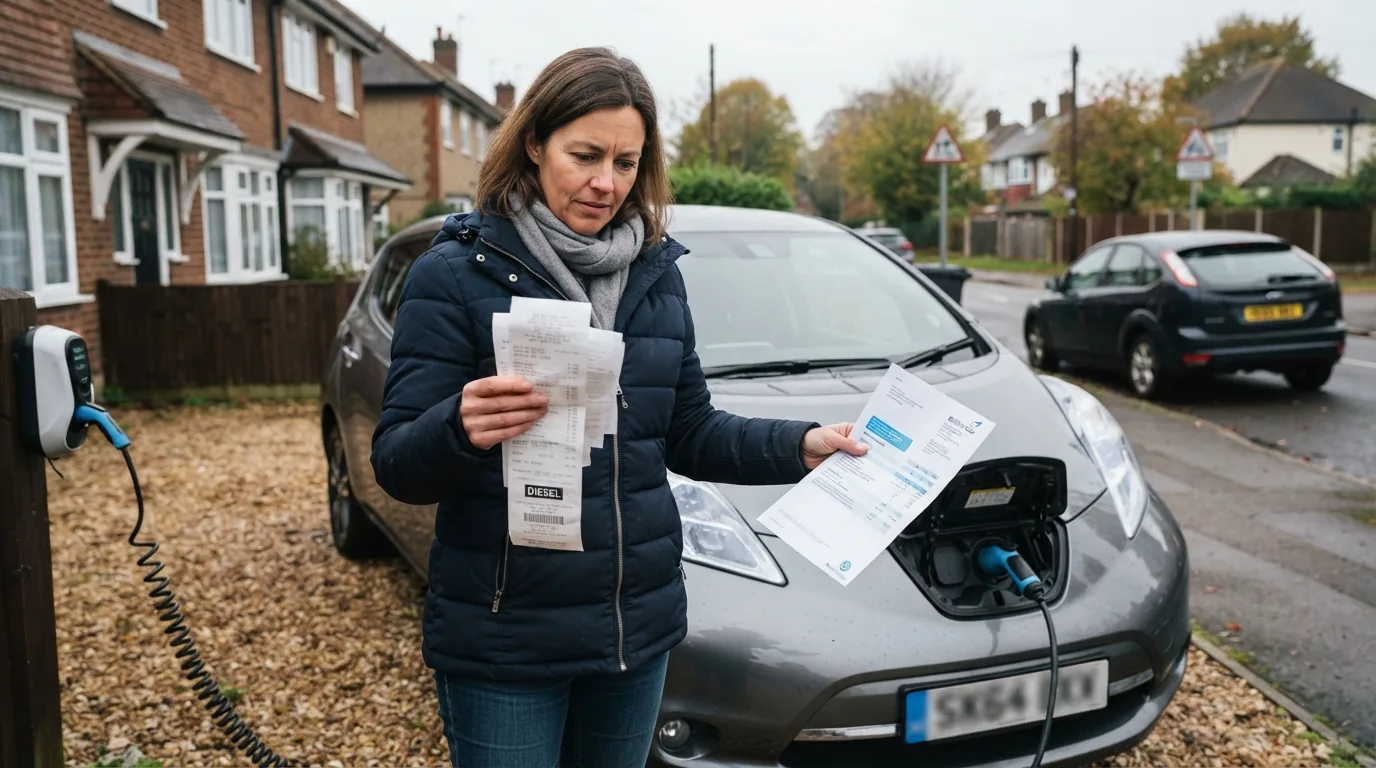
In 2026, diesel at the pump averages 184.9p per litre, a significant increase driven partly by geopolitical supply disruption in early 2026. At 50mpg, that is 16.2p per mile. An EV on home off-peak electricity costs around 2p per mile.
The running cost gap has never been wider.
The energy cost comparison
| Vehicle type | Typical efficiency | Energy cost | Cost per mile |
|---|---|---|---|
| Diesel (50mpg) | 50mpg | 184.9p/litre (May 2026) | ~16p |
| Diesel (60mpg) | 60mpg | 184.9p/litre | ~13.6p |
| EV (standard Ofgem rate) | 3.5 miles/kWh | 24.67p/kWh | ~7p |
| EV (off-peak EV tariff) | 3.5 miles/kWh | ~7p/kWh | ~2p |
| EV (public rapid charger) | 3.5 miles/kWh | ~79p/kWh | ~23p |
| EV (public slow/fast charger) | 3.5 miles/kWh | ~54p/kWh | ~15p |
At 10,000 miles per year, the annual fuel cost for a diesel (50mpg) is approximately £3,240 for the year. For an EV charging at home on an off-peak tariff, the equivalent annual energy cost is around £200. That is a saving of over £3,000 per year on energy alone.
Even on the standard Ofgem electricity rate, the annual energy cost is around £705, a saving of approximately £2,535.
Servicing: where diesel gets expensive
Diesel engines are more mechanically complex than petrol engines, and significantly more so than electric motors. Diesel-specific maintenance items include:
- Diesel particulate filter (DPF) cleaning or replacement: £100 to £1,500 depending on severity
- AdBlue system maintenance (on most post-2016 diesels): £20 to £50 per top-up, plus system failures that can be costly
- Turbocharger maintenance and replacement
- EGR valve cleaning or replacement
- Regular oil and filter changes: more frequent on high-mileage diesels
- Timing belt or chain service: £400 to £800
An EV has none of these. The annual maintenance for a typical EV covers brake fluid, tyres, wiper blades, and a cabin air filter. Cost: around £100 to £200 per year, typically £300 to £500 less than a diesel.
For a driver doing 15,000 miles per year, the combined saving from lower energy and servicing costs is often £2,500 to £4,000 annually. At 20,000 miles per year, the saving can exceed £5,000.
Company car drivers: the tax saving changes everything
For drivers who pay Benefit in Kind tax on a company diesel, switching to an EV is financially transformative.
The BiK rate for EVs is 4% for 2026/27. A diesel with typical CO2 emissions of 130g/km attracts a BiK rate of 32%. On a £40,000 company car:
| Diesel (32% BiK) | EV (4% BiK) | |
|---|---|---|
| BiK value | £12,800 | £1,600 |
| Tax per year (20% taxpayer) | £2,560 | £320 |
| Tax per year (40% taxpayer) | £5,120 | £640 |
| Annual saving (40% taxpayer) | , | £4,480 |
That saving applies every year of the company car agreement. Combined with lower fuel costs (often reimbursed by the employer as advisory electricity rate), the total financial advantage of an EV company car over a comparable diesel is often £5,000 to £8,000 per year for a higher-rate taxpayer.
The DPF problem: diesel’s hidden cost
The diesel particulate filter traps soot from the exhaust. It is supposed to self-clean through “regeneration” on regular motorway runs. If you drive predominantly short journeys at urban speeds, it cannot self-clean and can block, leading to warning lights, reduced performance, and repair costs of £500 to £1,500.
This is a genuine problem for drivers who have switched from motorway to urban use. Many diesel drivers in urban areas are operating cars designed for long-haul efficiency in exactly the wrong way. EVs have no equivalent problem. Urban driving on an EV is more efficient than motorway driving, not less.
Road tax (VED): now neutral
Until March 2025, EVs paid zero road tax. From April 2025, new EVs pay £190 per year, the same as most petrol and diesel cars. This change removes one previous advantage.
However, for drivers of older diesels in high-emission road tax bands, an EV may still be cheaper. Diesels registered between 2001 and 2017 with higher CO2 emissions can pay up to £695 per year in road tax. The standard diesel registered after 2017 pays £190, matching the EV rate exactly.
The purchase price gap
Diesel cars are no longer cheap. A well-specified diesel saloon or estate from a premium brand costs £35,000 to £55,000. The equivalent EV from the same brand is typically £3,000 to £10,000 more at list price.
The Electric Car Grant (reintroduced July 2025) provides up to £3,750 off eligible new EVs priced at £37,000 or under, closing much of this gap for mainstream models.
For a like-for-like comparison at the mid-market level, a diesel Volkswagen Passat estate versus a Volkswagen ID.7 Touring: the price gap is around £6,000 to £8,000. At a saving of £2,000 to £3,000 per year in running costs, that break-even lands in two to four years.
When do the savings not materialise?
- You rely on public rapid charging for everyday use. At 79p per kWh, the cost per mile approaches or exceeds diesel. The saving largely disappears.
- You drive very low annual mileage. At 5,000 miles per year, the annual fuel saving is proportionally smaller and the break-even extends beyond a typical ownership period.
- You keep changing cars every two years. Short ownership periods do not allow running cost savings to accumulate enough to offset the purchase premium.
The honest verdict
For a diesel driver with home charging doing 10,000 or more miles per year, switching to electric in 2026 saves real money. The headline savings are on energy (£2,000 to £3,000 per year at typical diesel prices versus home EV charging), with additional savings on servicing (£300 to £500 per year) and, for company car drivers, a dramatic reduction in BiK tax.
The only scenario where the saving does not materialise clearly is reliance on public rapid charging for everyday use.
Diesel at 184.9p per litre in May 2026 makes this the most persuasive moment in the history of the diesel-to-electric argument. If you were on the fence, the fuel price data from the pump does a good deal of the persuading.
For model recommendations suited to diesel switchers, see best first electric cars for switching from petrol and best EVs to replace a diesel estate. Return to the switching from petrol or diesel hub for the complete picture.
Sources: RAC fuel watch data May 2026, Ofgem energy price cap Q2 2026, GOV.UK Vehicle Excise Duty rates 2025/26, GOV.UK Electric Car Grant guidance, HMRC BiK rates 2026/27.
How we test and where our numbers come from
Range figures are official WLTP combined values taken from manufacturer UK specification pages, with real-world estimates drawn from independent comparative testing. Prices are UK list prices at the time of the latest update. Tax, grant and charging-scheme figures come from GOV.UK and HMRC publications. We re-check every guide when pricing, specification or policy changes. Last checked 11 August 2026.

EV Compared
The EV Compared editorial team tracks the UK electric vehicle market full time: new model launches, list prices, WLTP and real-world range, public charging tariffs and the tax rules that decide what an EV actually costs to run. Every guide is checked against manufacturer specifications and official GOV.UK figures, and updated whenever the numbers move.
Related reading
View all
What Are the Biggest Myths About Switching to an EV?
The claims that put UK drivers off going electric, and what the evidence actually says

Should You Buy an EV in 2026 or Wait for Cheaper Models?
An honest look at where EV prices are heading and whether the wait is worth it for UK buyers
Buying and Owning an Electric Car in the UK: The Complete 2026 Guide
Everything you need to know about costs, charging, depreciation and day-to-day life with an EV