Best OBD2 Apps and Adapters for Electric Cars
OBD2 adapters unlock the battery data your car's dashboard hides. Here are the best apps and adapters for UK EV owners in 2026, ranked by car model and use case
Quick answers
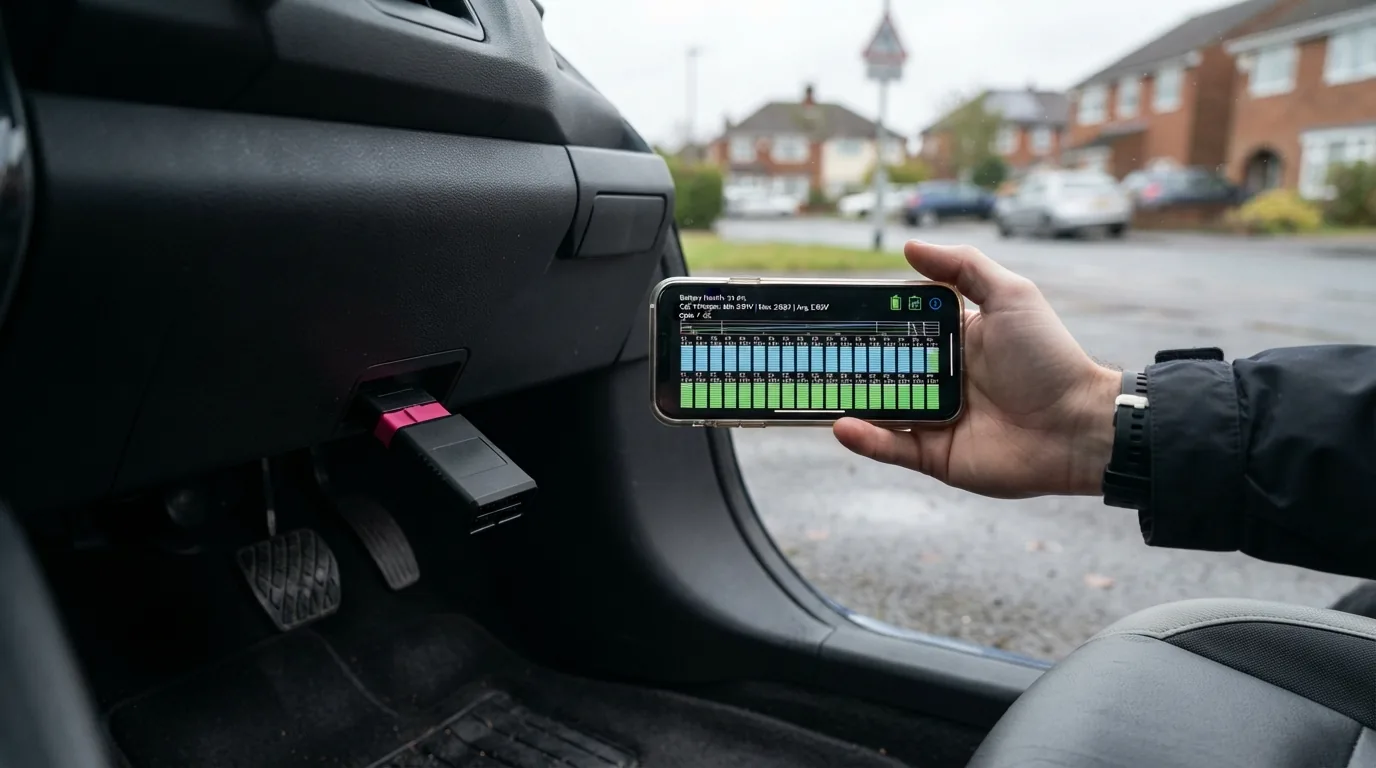
- Standard OBD2 adapters paired with the right apps can read the battery data that most EV dashboards hide: state of health percentage, individual cell voltages, temperature, charge cycle count and real energy consumption.
- The OBD2 apps worth using for EVs: LeafSpy Pro is the definitive app for Nissan Leaf (all generations) and the e-NV200 van.
- In 2026, with over 300,000 EVs expected to come off lease in the UK, the used EV market is growing rapidly.
- What do OBD2 adapters not do: For a definitive pre-purchase battery health check on an expensive used EV, a specialist EV garage using manufacturer-level diagnostic tools gives the most authoritative result.
Standard OBD2 adapters paired with the right apps can read the battery data that most EV dashboards hide: state of health percentage, individual cell voltages, temperature, charge cycle count and real energy consumption. For used EV buyers and detail-oriented owners, this is the most useful non-essential tool available. The challenge is matching the right adapter and app to your specific car, as EV diagnostics are far from universal.
Do all EV OBD2 setups work the same way?
No, and this is the critical point. OBD2 is a standardised diagnostic interface, but electric vehicle battery data is not part of the standard OBD2 specification. Manufacturers store battery management system data in proprietary protocols on top of the standard CAN bus. To read it, you need an adapter that supports those protocols and an app that knows how to decode your specific car’s data.
The result is a compatibility matrix. Some adapters and apps are perfectly matched to certain cars and useless on others. Before buying anything, check compatibility for your specific make, model and year.
The OBD2 adapters worth buying for EVs
| Adapter | Protocol support | Connectivity | Best for | Price (approx.) |
|---|---|---|---|---|
| OBDLink MX+ | All major + proprietary protocols | Bluetooth 4 | Maximum EV compatibility; Hyundai, Kia, VW, BMW | ~£100–£120 |
| Vgate vLinker MC+ | BLE; wide EV support | BLE (iOS + Android) | Nissan Leaf (LeafSpy), Hyundai, Kia, VW | ~£30–£40 |
| Veepeak OBDCheck BLE+ | BLE; good general | BLE | Budget entry point; basic monitoring | ~£28–£35 |
| OBDLink LX | Most protocols | Bluetooth | Good mid-range for Android | ~£55–£65 |
| LELink BLE | BLE | BLE (iOS) | Nissan Leaf + LeafSpy (developer-recommended for iOS) | ~£25–£35 |
| Carista OBD2 | Limited to Carista | BLE | VW Group coding and diagnostics (not battery health focus) | ~£20–£25 |
What to avoid: Generic ELM327 chipset adapters sold for £5 to £10 on Amazon. They have poor Bluetooth reliability, often lose connection mid-session, and frequently do not support the enhanced protocols needed for EV battery data. The frustration is not worth the saving.
The OBD2 apps worth using for EVs
LeafSpy Pro: essential for Nissan Leaf owners
LeafSpy Pro is the definitive app for Nissan Leaf (all generations) and the e-NV200 van. It reads data that the official Nissan app does not show:
- State of Health percentage (the most important single number for a used Leaf)
- All 96 cell pair voltages (in a colour-coded display showing imbalances)
- Battery AHr rating (capacity in amp-hours)
- Hx metric (internal resistance, an early degradation indicator)
- Total charge cycle count and quick-charge count
- Battery temperature history
For anyone buying a used Nissan Leaf, running a LeafSpy check before purchase is near-essential. A Leaf at 80% SoH after 8 years of use is a fair used EV; a Leaf at 70% SoH is a car that needs its battery priced into the deal.
Cost: LeafSpy Lite (free, limited features). LeafSpy Pro approximately £10 on iOS and Android. Best adapter: LELink BLE for iOS; Vgate vLinker MC+ for Android.
Car Scanner ELM OBD2: broad EV compatibility
Car Scanner is the most versatile EV diagnostic app available in 2026, with dedicated vehicle profiles for a wide range of EVs:
- Hyundai IONIQ 5 and IONIQ 6
- Kia EV6 and EV9
- Hyundai Kona Electric
- Kia Niro EV
- Volkswagen ID.3, ID.4 and ID.7
- Renault Zoe and Megane E-Tech
- Nissan Leaf (alongside LeafSpy)
- And others, with profile updates added regularly
On compatible models, Car Scanner shows battery cell voltages, state of health, state of charge (more precise than the dashboard), temperature, BMS fault codes and real energy consumption data.
Cost: Free for basic use. Extended vehicle profiles (covering EV-specific parameters) available as a one-off purchase of approximately £7 to £15 within the app. Best adapter: OBDLink MX+ or Vgate vLinker MC+.
Scan My Tesla: for Tesla owners
Standard OBD2 adapters do not work with Tesla’s proprietary communication system. Scan My Tesla (Android) connects to Tesla vehicles via a specialised interface, showing battery power, voltage, current, temperature, drive unit torque, 12V system health and more. It requires a Tesla OBD2 adapter specifically designed for Tesla’s CAN bus (not a generic ELM327 device).
Alternatively: For most Tesla data including state of health estimates, third-party API-based apps such as TeslaFi or Stats for Tesla are more practical and do not require a physical adapter.
EV-Check: simple SoH monitoring
EV-Check is a simpler app focused primarily on state of health monitoring across a range of EVs. Less granular than Car Scanner but very easy to use for a quick SoH check. Useful for a used car buyer who wants a fast readout without complex setup.
Torque Pro with custom PIDs: for the technically minded
Torque Pro (approximately £4 on Android) is a generic OBD2 app that supports custom PID (Parameter ID) files. The EV community has developed PID files for many specific models that unlock the same battery parameters that dedicated apps access through their built-in profiles. More technical effort to set up but highly flexible.
Which app for which car?
| Car | Primary app | Secondary app | Adapter recommendation |
|---|---|---|---|
| Nissan Leaf (all years) | LeafSpy Pro | Car Scanner | LELink BLE (iOS) / Vgate vLinker MC+ (Android) |
| Hyundai IONIQ 5 | Car Scanner | EV-Check | OBDLink MX+ or Vgate vLinker MC+ |
| Hyundai IONIQ 6 | Car Scanner | OBDLink MX+ | |
| Kia EV6 | Car Scanner | EV-Check | OBDLink MX+ or Vgate vLinker MC+ |
| Kia EV9 | Car Scanner | OBDLink MX+ | |
| VW ID.3 / ID.4 | Car Scanner | OBDLink MX+ | |
| Renault Zoe / Megane E-Tech | Car Scanner | Vgate vLinker MC+ | |
| Tesla Model 3 / Y / S / X | Scan My Tesla / Stats for Tesla | TeslaFi | Tesla-specific adapter or API (no standard OBD2) |
| BMW i4 / iX | Car Scanner (limited) | BimmerCode | OBDLink MX+ |
| MG4 | Car Scanner (check current profile) | Vgate vLinker MC+ |
What is the most useful data for a used EV buyer?
In 2026, with over 300,000 EVs expected to come off lease in the UK, the used EV market is growing rapidly. Battery health is the most important unknown in any used EV transaction. The dashboard gives you a range estimate; OBD2 gives you the actual state of health.
The most useful metrics, in order:
- State of Health %: The headline number. Below 80% should be priced into the deal; above 90% after five years is good.
- Cell voltage spread: More than 50 to 100 mV between the highest and lowest cell pair is a warning sign of imbalance.
- Quick-charge count: Nissan Leaf owners should check this; very high quick-charge counts (over 200 on a car with limited thermal management) correlate with faster degradation.
- Fault codes: Any active battery or BMS fault codes require investigation before purchase.
What do OBD2 adapters not do?
They cannot write to the BMS or alter any settings. They cannot override the manufacturer’s SoH calculation (the figure in the car’s own system may differ from what the app shows, due to different methodology). They cannot replace a formal battery health assessment using the manufacturer’s own diagnostics.
For a definitive pre-purchase battery health check on an expensive used EV, a specialist EV garage using manufacturer-level diagnostic tools gives the most authoritative result.
For more on understanding the data OBD2 adapters read, see our EV battery management system explainer and the EV tech and apps hub. For the full charging app landscape, see our best EV charging apps guide.
How we test and where our numbers come from
Range figures are official WLTP combined values taken from manufacturer UK specification pages, with real-world estimates drawn from independent comparative testing. Prices are UK list prices at the time of the latest update. Tax, grant and charging-scheme figures come from GOV.UK and HMRC publications. We re-check every guide when pricing, specification or policy changes. Last checked 11 August 2026.
Frequently asked questions
Do all EV OBD2 setups work the same way?
No, and this is the critical point. OBD2 is a standardised diagnostic interface, but electric vehicle battery data is not part of the standard OBD2 specification.
What is the most useful data for a used EV buyer?
In 2026, with over 300,000 EVs expected to come off lease in the UK, the used EV market is growing rapidly. Battery health is the most important unknown in any used EV transaction.
What do OBD2 adapters not do?
They cannot write to the BMS or alter any settings. They cannot override the manufacturer's SoH calculation (the figure in the car's own system may differ from what the app shows, due to different methodology).

EV Compared
The EV Compared editorial team tracks the UK electric vehicle market full time: new model launches, list prices, WLTP and real-world range, public charging tariffs and the tax rules that decide what an EV actually costs to run. Every guide is checked against manufacturer specifications and official GOV.UK figures, and updated whenever the numbers move.
Related reading
View all
Apple CarPlay vs Built In EV Software: Which Is Better?
Apple CarPlay is familiar and loved, but built-in EV software controls your battery, charging and range. We explain when each wins and which cars get the balance right.
Best Apps to Find EV Chargers in the UK
With over 120,000 public charge points in the UK, the right app makes the difference between a smooth charging stop and a wasted detour. Here are the options ranked
What Is Bidirectional Charging and Can It Power Your Home?
Bidirectional charging lets your electric car act as a home battery or feed the national grid. Here is how it works, what it costs and which UK cars support it in 2026