How Does an EV Battery Management System Work?
The battery management system is the brain of every electric car battery pack. Here is what it monitors, what it controls and why it matters for range and longevity
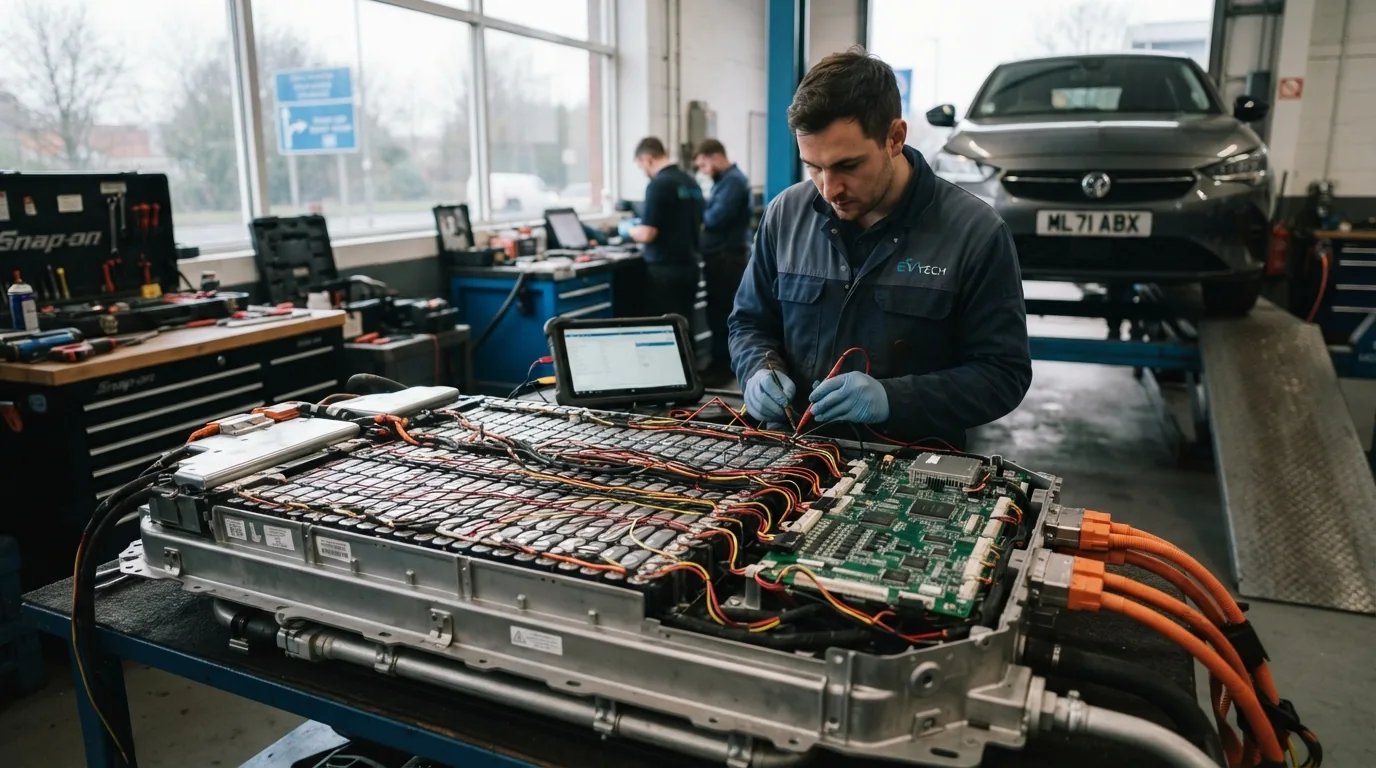
Quick answers
- A battery management system (BMS) is the dedicated electronics that continuously monitors, protects and optimises every cell in an EV battery pack.
- What is State of Charge (SoC): State of Charge is the percentage figure you see on your dashboard, equivalent to a fuel gauge.
- What is State of Health (SoH): State of Health is the capacity the pack retains relative to its original specification, expressed as a percentage.
- How does cell balancing work: If cells are not balanced, the usable capacity of the pack is effectively limited by the weakest cell, which hits its voltage floor first during discharge and its ceiling first during charging.
- How does thermal management work: Temperature is the single biggest variable in battery longevity and in-use performance.
- What happens when the BMS detects a fault: Fault codes are stored and can be read by a dealer's diagnostics equipment or, in many cases, by a consumer OBD2 adapter paired with a compatible app.
A battery management system (BMS) is the dedicated electronics that continuously monitors, protects and optimises every cell in an EV battery pack. It tracks voltage, temperature and current in real time, prevents overcharging and deep discharge, balances charge across cells, manages thermal control, and calculates the state of charge and state of health that appear on your dashboard. Without the BMS, a lithium-ion pack would degrade rapidly and could become dangerous.
What does a BMS measure?
A BMS samples a very large amount of data, thousands of times per second, from sensors distributed throughout the battery pack:
Cell voltage: Each lithium-ion cell operates safely within a defined voltage window, typically 2.5 V to 4.2 V depending on chemistry. The BMS measures every cell individually. If any cell exceeds the upper limit during charging, or drops below the lower limit during discharge, the BMS cuts off the relevant circuit to prevent damage.
Temperature: Sensors are placed at multiple points in the pack, at module interfaces and within the cooling channels. The BMS uses this data to determine whether to activate cooling (in hot conditions or during fast charging), activate heating (in very cold weather before driving or charging), and whether to limit charge or discharge rate to keep temperatures within safe bounds.
Current: The BMS measures the current flowing into and out of the pack. This is used for coulomb counting, a method of tracking how much charge has entered and left the battery, which underpins the state-of-charge calculation.
Internal resistance: More sophisticated BMS designs estimate the internal resistance of individual cells by observing how voltage responds to changes in current. Rising internal resistance is an early indicator of cell degradation.
What is State of Charge (SoC)?
State of Charge is the percentage figure you see on your dashboard, equivalent to a fuel gauge. An SoC of 80% means the battery currently holds 80% of its maximum usable capacity.
The BMS calculates SoC using two primary methods:
- Coulomb counting: Integrating current over time to track how much charge has entered or left the pack since the last known reference point.
- Open-circuit voltage (OCV) measurement: When the pack is at rest, the cell voltage correlates with SoC for a given chemistry. The BMS uses this as a calibration point.
The difficulty is that neither method is perfectly accurate in isolation, especially as the battery ages and its characteristics change. Modern BMS software uses algorithms (Kalman filters and, increasingly, machine learning models) to fuse multiple data sources and improve accuracy. This is one area where OTA updates can make a meaningful difference: Tesla, Hyundai and others have pushed SoC estimation improvements over the air to correct readings that drift over time.
What is State of Health (SoH)?
State of Health is the capacity the pack retains relative to its original specification, expressed as a percentage. A brand-new 77 kWh pack has SoH of 100%. After five years of use, the same pack might have 88% SoH, meaning it effectively holds about 68 kWh.
The BMS calculates SoH by tracking how much energy the pack accepts on full charges compared to its original specification, and by monitoring internal resistance trends. Most manufacturers reserve a small buffer (typically 5 to 10% of nominal capacity) at both ends of the charge range, which means real-world degradation to the driver-visible range figure is slower than the raw cell degradation rate.
| Typical SoH trajectory (NMC, UK typical use) | SoH |
|---|---|
| New (0 cycles) | 100% |
| 2 years / ~40,000 miles | 93–96% |
| 5 years / ~80,000 miles | 87–92% |
| 8 years / ~120,000 miles | 80–87% |
| 10 years / ~150,000 miles | 75–83% |
Most manufacturer warranties cover the battery to at least 70% SoH for 8 years. Kia and Hyundai warrant to 70% SoH for 8 years or 100,000 miles. Tesla warrants the Model 3 Long Range to 70% SoH for 8 years or 120,000 miles.
How does cell balancing work?
Cells within a pack do not age uniformly. Even cells from the same manufacturing batch will drift apart in capacity over time, due to tiny differences in chemistry, position (temperature varies across the pack) and the random nature of electrochemical degradation.
If cells are not balanced, the usable capacity of the pack is effectively limited by the weakest cell, which hits its voltage floor first during discharge and its ceiling first during charging. Cell balancing is the BMS’s method of minimising this effect.
Passive balancing is the simpler and more common approach: the BMS identifies cells that are more charged than their neighbours and bleeds off the excess energy through a resistor, converting it to waste heat. This is energy-inefficient but reliable and cheap.
Active balancing moves energy from stronger cells to weaker cells, using capacitors or inductors as intermediary storage. This wastes less energy but is more mechanically complex and expensive. Active balancing is used in some premium EV packs and is becoming more common as pack designs mature.
The practical effect of good cell balancing is that the pack ages more uniformly, the weakest-cell limitation is reduced, and usable capacity is preserved for longer.
How does thermal management work?
Temperature is the single biggest variable in battery longevity and in-use performance. Lithium-ion cells work optimally between roughly 15°C and 35°C. Outside this range, performance and longevity both suffer.
In cold weather: Internal resistance rises, which reduces available capacity (you see fewer miles available at a given SoC) and limits how quickly the battery can accept charge. Below about 5°C, the BMS will restrict DC fast-charge rate to prevent lithium plating, a form of degradation where lithium deposits form dendrite crystals on the anode surface. Preconditioning, in which the battery is warmed using the thermal management system while the car is still plugged in, addresses this without drawing on the battery.
During fast charging: High charge currents generate heat within the cells. The BMS monitors temperatures continuously and commands the cooling system to maintain the pack in a safe range. If temperatures rise too quickly, the BMS will taper the charge rate even if the charger is offering more power. This is why a car will sometimes charge at 100 kW rather than its 150 kW peak: the BMS is managing heat.
Cooling system types: Most modern EVs use liquid cooling, where coolant flows through channels in the pack structure. This is far more effective than air cooling. Some older EVs (earlier Nissan Leaf models) used air cooling only, which contributed to their reputation for above-average degradation in warm climates.
What happens when the BMS detects a fault?
The BMS operates in fault states that limit or prevent use if conditions are dangerous:
- Cell overvoltage or undervoltage: The BMS disconnects the pack or limits charging/discharge until conditions are safe.
- Overcurrent: Sudden high-current draw (such as a short circuit) triggers immediate disconnection via contactor relays.
- Overtemperature: The BMS limits charge or discharge rate and activates maximum cooling. In extreme cases, it disconnects the pack.
- Cell imbalance beyond threshold: The BMS may limit usable range or flag a warning requiring dealer investigation.
Fault codes are stored and can be read by a dealer’s diagnostics equipment or, in many cases, by a consumer OBD2 adapter paired with a compatible app.
Can the BMS be updated?
Yes. Because the BMS is firmware-controlled, manufacturers can update it over the air (on cars that support FOTA updates). OTA BMS updates can improve SoC accuracy, charging curve profiles, thermal limits and balancing algorithms. Research published in May 2026 found that an AI-driven charging algorithm that read the real-time state of health of each cell could extend battery life by around 23%, delivered as a software update. This is the direction mainstream BMS development is heading.
For OBD2 access to your car’s BMS data, see our guide to OBD2 adapters for electric cars, and for the full technology landscape, visit the EV tech and apps hub and our best EV charging apps roundup.
How we test and where our numbers come from
Range figures are official WLTP combined values taken from manufacturer UK specification pages, with real-world estimates drawn from independent comparative testing. Prices are UK list prices at the time of the latest update. Tax, grant and charging-scheme figures come from GOV.UK and HMRC publications. We re-check every guide when pricing, specification or policy changes. Last checked 11 August 2026.
Frequently asked questions
What is State of Charge (SoC)?
State of Charge is the percentage figure you see on your dashboard, equivalent to a fuel gauge. An SoC of 80% means the battery currently holds 80% of its maximum usable capacity.
What is State of Health (SoH)?
State of Health is the capacity the pack retains relative to its original specification, expressed as a percentage. A brand-new 77 kWh pack has SoH of 100%.
How does cell balancing work?
Cells within a pack do not age uniformly. Even cells from the same manufacturing batch will drift apart in capacity over time, due to tiny differences in chemistry, position (temperature varies across the pack) and the random nature of electrochemical degradation.
How does thermal management work?
Temperature is the single biggest variable in battery longevity and in-use performance. Lithium-ion cells work optimally between roughly 15°C and 35°C.
What happens when the BMS detects a fault?
Fault codes are stored and can be read by a dealer's diagnostics equipment or, in many cases, by a consumer OBD2 adapter paired with a compatible app.

EV Compared
The EV Compared editorial team tracks the UK electric vehicle market full time: new model launches, list prices, WLTP and real-world range, public charging tariffs and the tax rules that decide what an EV actually costs to run. Every guide is checked against manufacturer specifications and official GOV.UK figures, and updated whenever the numbers move.
Related reading
View all
Apple CarPlay vs Built In EV Software: Which Is Better?
Apple CarPlay is familiar and loved, but built-in EV software controls your battery, charging and range. We explain when each wins and which cars get the balance right.

Best Apps to Find EV Chargers in the UK
With over 120,000 public charge points in the UK, the right app makes the difference between a smooth charging stop and a wasted detour. Here are the options ranked
What Is Bidirectional Charging and Can It Power Your Home?
Bidirectional charging lets your electric car act as a home battery or feed the national grid. Here is how it works, what it costs and which UK cars support it in 2026