Do You Need an OBD2 Adapter for Your Electric Car?
OBD2 adapters unlock battery health data that most EV dashboards hide. Here is what they can read, the best options for UK drivers and which cars are compatible
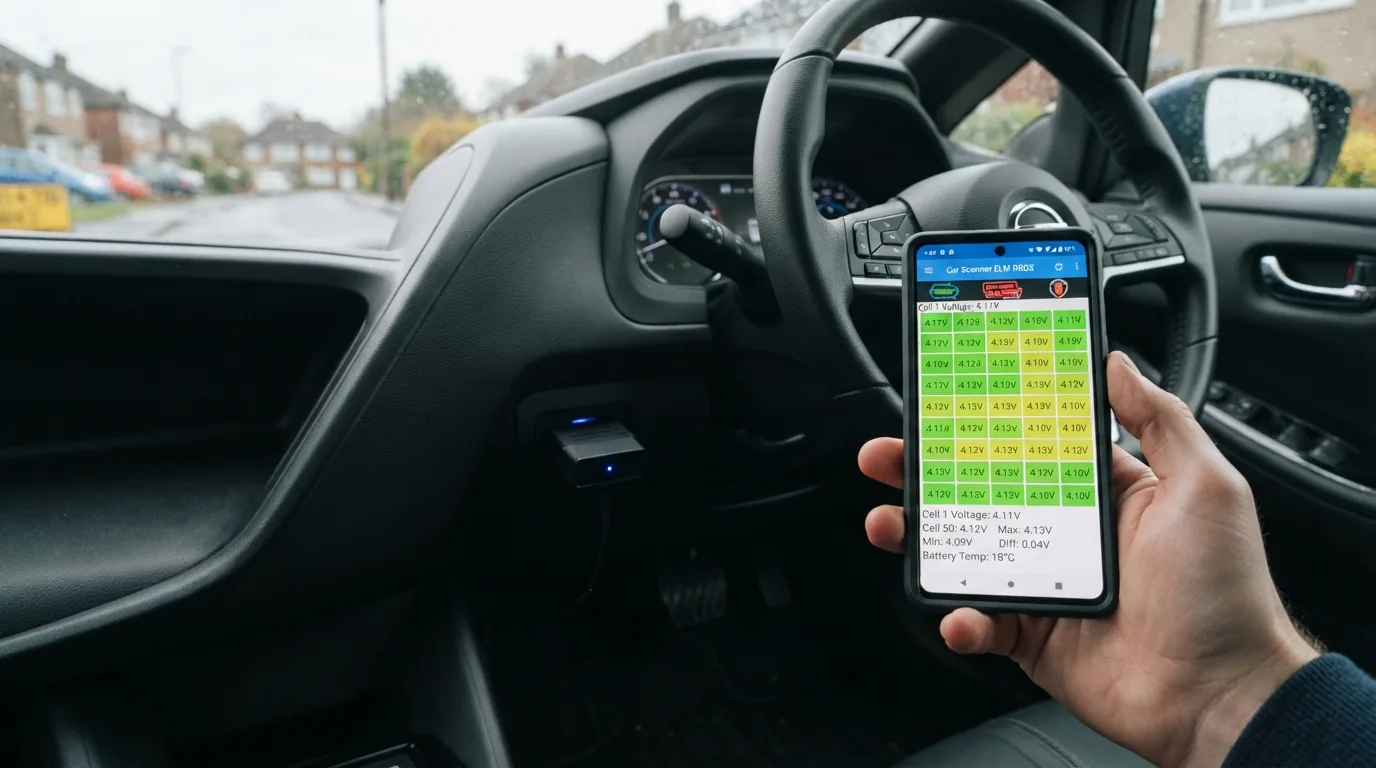
Quick answers
- An OBD2 adapter plugs into the diagnostic port found under the dashboard of virtually every car sold after 2001.
- The OBD2 (On-Board Diagnostics, version 2) port is a standardised 16-pin diagnostic connector, typically located under the steering column, just above the driver's footwell.
- This depends on two factors: how much data the car's ECUs broadcast on the CAN bus, and whether the adapter and app know how to request and decode manufacturer-specific parameters.
- Is OBD2 data useful for used EV buying: A LeafSpy readout on a used Nissan Leaf, for example, shows exact state of health percentage, charge cycle count and quick-charge count within two minutes of plugging in.
- Some manufacturers, notably Tesla, actively limit CAN bus data access.
- What is the common mistake: The most common mistake is buying a cheap generic OBD2 adapter and finding it only reads basic fault codes, not battery health.
An OBD2 adapter plugs into the diagnostic port found under the dashboard of virtually every car sold after 2001. On an electric car, paired with the right app, it can read battery state of health, individual cell voltages, temperature, charge cycle count and real energy consumption, data that most manufacturers’ own apps and dashboards do not show. For any UK driver buying a used EV or wanting to monitor battery health in detail, an OBD2 adapter is a useful tool.
What is an OBD2 port and does my electric car have one?
The OBD2 (On-Board Diagnostics, version 2) port is a standardised 16-pin diagnostic connector, typically located under the steering column, just above the driver’s footwell. UK law requires all petrol and diesel cars manufactured from 2001 to have one. Electric and plug-in hybrid vehicles also carry the port, though the specific data available through it varies by manufacturer.
The port connects to the car’s Controller Area Network (CAN bus), the communication backbone that links all the car’s electronic control units. An OBD2 adapter sits in the port and translates CAN bus messages into a format a smartphone app or laptop can read.
Most adapters communicate wirelessly via Bluetooth or Wi-Fi to a phone. Some plug-in scanners are purpose-built with their own screens.
What can an OBD2 adapter read on an electric car?
This depends on two factors: how much data the car’s ECUs broadcast on the CAN bus, and whether the adapter and app know how to request and decode manufacturer-specific parameters.
Standard OBD2 data (available on nearly all EVs):
- Fault codes (DTCs)
- Battery pack voltage
- Pack current
- Basic temperature readings
Manufacturer-specific (enhanced OBD2) data (available on many EVs with the right adapter and app):
- Individual cell voltages (all cells in the pack)
- State of Health (%) as calculated by the BMS
- State of Charge (more precise than the dashboard figure)
- Charge cycle count
- Minimum and maximum cell voltage (which reveal imbalances)
- Battery inlet and outlet coolant temperatures
- Motor speed and torque
The catch: accessing enhanced data requires the adapter to support the specific protocol the manufacturer uses (there are several), and the app to have the correct decoding profile for your car model.
Which OBD2 adapters work best for EVs in the UK?
| Adapter | Price (approx.) | Protocol support | Best for |
|---|---|---|---|
| OBDLink MX+ | ~£100–£120 | All major protocols including proprietary | Maximum compatibility; best for Hyundai, Kia, VW, BMW |
| Vgate vLinker MC+ | ~£30–£40 | BLE; supports GM, Ford, VW, Hyundai | Good value for mainstream EVs |
| Veepeak OBDCheck BLE+ | ~£30 | BLE; good general support | Budget entry point |
| OBDLink LX | ~£60 | Most protocols | Good mid-range option |
| Carista OBD2 | ~£20–£25 | Limited enhanced data | Better for dealer-level functions on VW Group |
Note on Tesla: Tesla does not support standard OBD2 communication in the same way as other manufacturers. Third-party Tesla data access uses either the Tesla API (via the phone app) or a Tesla-specific CAN bus interface. Standard OBD2 adapters do not read Tesla battery data meaningfully. Apps such as TeslaFi, Stats and the Tesla web API are the practical route for Tesla owners.
Which apps work best for EV battery data?
LeafSpy (Nissan Leaf, Nissan e-NV200): The definitive app for Nissan Leaf owners. Reads state of health, individual cell voltages, the Leaf’s capacity bars, charge cycle count, ambient temperature history and quick-charge count. Indispensable for used Leaf buyers. Available for iOS and Android; LeafSpy Pro costs around £10.
Car Scanner ELM OBD2: Wide compatibility with many EV and PHEV models including Hyundai, Kia, Renault, VW Group and others. Free tier covers basics; extended vehicle-specific profiles require a one-off purchase of around £7 to £15. Strong battery cell voltage display for compatible cars.
EV-Check / Torque Pro with EV profiles: Torque Pro (£3.99) with custom PID files for specific models gives access to raw battery data on many EVs. Requires some technical effort to configure but is very flexible.
ABRP OBD2 connection: A Better Routeplanner can connect to a compatible OBD2 adapter to read your car’s real-time state of charge and energy consumption, allowing it to give more accurate range predictions on route plans.
OBD Fusion: Well-regarded paid app (around £5.99) with good EV support, cleaner interface than Torque Pro and good custom dashboard capability.
Is OBD2 data useful for used EV buying?
Yes, significantly. In 2026, over 300,000 EVs are expected to come off lease in the UK, a 230% jump on recent years driven by the leasing boom of 2022 to 2024. Many will enter the used market with limited publicly available battery health data.
A LeafSpy readout on a used Nissan Leaf, for example, shows exact state of health percentage, charge cycle count and quick-charge count within two minutes of plugging in. A Leaf that has completed 200 rapid charges and 500 normal charges at 85% SoH is a different proposition from one at 91% SoH and 50 rapid charges, even if the asking price is similar.
For other models, an OBDLink MX+ with Car Scanner can show individual cell voltages. Significant imbalance (more than 50–100 mV between the strongest and weakest cell) is a warning sign of a pack that may be close to needing professional attention.
What can OBD2 adapters not do on electric cars?
OBD2 adapters are read-only on all consumer-grade devices. You cannot write to the BMS, change charge limits or alter parameters through an OBD2 adapter. Professional dealer tools (manufacturer-specific diagnostics) can do more, but these are not available to consumers.
Some manufacturers, notably Tesla, actively limit CAN bus data access. Others change their CAN bus architecture in new model years, which can break existing app compatibility until the app developer updates the decoding profiles.
OBD2 data also does not replace a manufacturer warranty check. A battery that reads 87% SoH through an OBD2 adapter may still be within warranty if the manufacturer’s own BMS calculates a different figure using a different methodology.
What is the common mistake?
The most common mistake is buying a cheap generic OBD2 adapter and finding it only reads basic fault codes, not battery health. The generic ELM327 chipset adapters sold for a few pounds on Amazon often work poorly with EVs, have Bluetooth connection issues and do not support the proprietary protocols needed for enhanced data. The OBDLink MX+ or Vgate vLinker MC+ are worth the extra cost for EV-specific monitoring.
For more EV tech explainers, visit the EV tech and apps hub. For app recommendations across all categories, see our best EV charging apps guide. For a deeper dive on OBD2 apps and adapters, read our OBD2 apps and adapters for electric cars article.
How we test and where our numbers come from
Range figures are official WLTP combined values taken from manufacturer UK specification pages, with real-world estimates drawn from independent comparative testing. Prices are UK list prices at the time of the latest update. Tax, grant and charging-scheme figures come from GOV.UK and HMRC publications. We re-check every guide when pricing, specification or policy changes. Last checked 11 August 2026.
Frequently asked questions
What is an OBD2 port and does my electric car have one?
The OBD2 (On-Board Diagnostics, version 2) port is a standardised 16-pin diagnostic connector, typically located under the steering column, just above the driver's footwell. UK law requires all petrol and diesel cars manufactured from 2001 to have one.
What can an OBD2 adapter read on an electric car?
This depends on two factors: how much data the car's ECUs broadcast on the CAN bus, and whether the adapter and app know how to request and decode manufacturer-specific parameters.
Is OBD2 data useful for used EV buying?
Yes, significantly. In 2026, over 300,000 EVs are expected to come off lease in the UK, a 230% jump on recent years driven by the leasing boom of 2022 to 2024.
What can OBD2 adapters not do on electric cars?
OBD2 adapters are read-only on all consumer-grade devices. You cannot write to the BMS, change charge limits or alter parameters through an OBD2 adapter.
What is the common mistake?
The most common mistake is buying a cheap generic OBD2 adapter and finding it only reads basic fault codes, not battery health. The generic ELM327 chipset adapters sold for a few pounds on Amazon often work poorly with EVs, have Bluetooth connection issues and do not support the proprietary protocols needed for enhanced data.

EV Compared
The EV Compared editorial team tracks the UK electric vehicle market full time: new model launches, list prices, WLTP and real-world range, public charging tariffs and the tax rules that decide what an EV actually costs to run. Every guide is checked against manufacturer specifications and official GOV.UK figures, and updated whenever the numbers move.
Related reading
View all
Apple CarPlay vs Built In EV Software: Which Is Better?
Apple CarPlay is familiar and loved, but built-in EV software controls your battery, charging and range. We explain when each wins and which cars get the balance right.

Best Apps to Find EV Chargers in the UK
With over 120,000 public charge points in the UK, the right app makes the difference between a smooth charging stop and a wasted detour. Here are the options ranked
What Is Bidirectional Charging and Can It Power Your Home?
Bidirectional charging lets your electric car act as a home battery or feed the national grid. Here is how it works, what it costs and which UK cars support it in 2026