Mercedes EQE vs BMW i5: Long Range Executive EV Comparison
Which luxury electric saloon is the better choice for UK business drivers who cover serious mileage?
Quick answers
- The Mercedes EQE and BMW i5 compete directly in the executive electric saloon market, at around £57,600 and £60,800 respectively. Both target business drivers with serious mileage requirements, plush interiors and long-range capability.
- Range: EQE has the official advantage: The EQE 350+'s 96 kWh battery (full; around 90 kWh usable depending on variant) delivers approximately 394 miles WLTP, compared with the i5 eDrive40's 84 kWh battery and around 362 miles WLTP.
- The BMW i5 eDrive40 is rated at 14.7 kWh/100 km; the EQE at 15.8 kWh/100 km.
- Charging: i5 charges faster: The i5 supports 205 kW peak DC charging, meaning 28 to 32 minutes from 10 to 80 per cent.
- Interior and practicality: The BMW i5 seats five in a traditional executive saloon shape with 490 litres of boot space.
- Company car and fleet considerations: The difference of around £53 per year in BiK is negligible at this level.
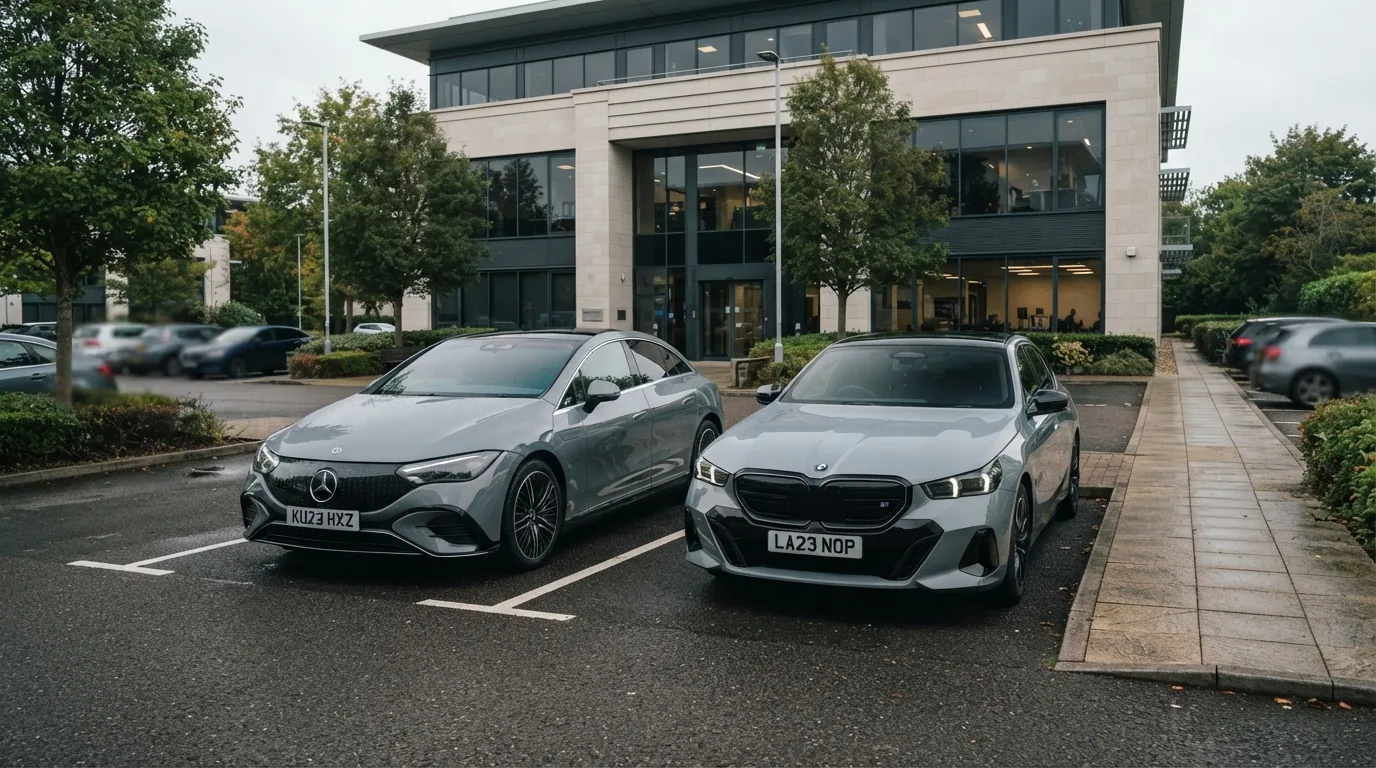
The Mercedes EQE and BMW i5 compete directly in the executive electric saloon market, at around £57,600 and £60,800 respectively. Both target business drivers with serious mileage requirements, plush interiors and long-range capability. The EQE offers more range and slightly more power; the BMW i5 is more efficient per kWh, lighter, more comfortable to drive and provides more boot space.
For most UK executive buyers, the BMW i5 is the more well-rounded car. The EQE’s range advantage is real but modest at this level, and the i5’s driving refinement and practicality make it the stronger daily tool.
Head-to-head specification
| Specification | Mercedes EQE 350+ | BMW i5 eDrive40 |
|---|---|---|
| WLTP Range | ~394 miles | ~362 miles |
| Real World (mixed est.) | ~295-320 miles | ~270-300 miles |
| Motorway 70 mph (est.) | ~275-305 miles | ~255-285 miles |
| Battery (usable) | 96 kWh | 84 kWh |
| Power | 292 hp | 340 hp |
| 0-62 mph | 6.4 seconds | 6.0 seconds |
| Peak DC Charging | 170 kW | 205 kW |
| 10-80% charge time | ~35-40 min | ~28-32 min |
| Boot space | 430 litres | 490 litres |
| Weight | ~2,375 kg | ~2,195 kg |
| Starting Price (UK) | ~£57,600 | ~£60,800 |
| BiK rate (2026/27) | 4% | 4% |
| Efficiency | ~15.8 kWh/100 km | ~14.7 kWh/100 km |
Range: EQE has the official advantage
The EQE 350+‘s 96 kWh battery (full; around 90 kWh usable depending on variant) delivers approximately 394 miles WLTP, compared with the i5 eDrive40’s 84 kWh battery and around 362 miles WLTP. In real-world mixed conditions, the EQE typically achieves around 295 to 320 miles versus the i5’s 270 to 300 miles. On a sustained 70 mph motorway run, the gap narrows: the EQE’s heavier body and less efficient drivetrain partially offset the larger battery.
Both cars are comfortably beyond 250 miles of real-world range in mixed conditions, which is what most executive UK drivers need for a full day’s business driving without a charge stop.
Efficiency: BMW i5 is the more efficient car
The BMW i5 eDrive40 is rated at 14.7 kWh/100 km; the EQE at 15.8 kWh/100 km. The i5 consumes approximately 7 per cent less energy per kilometre, which is a meaningful difference in running costs over 20,000 to 30,000 miles per year.
At 30p per kWh (a typical mid-2026 home overnight tariff), the i5 saves around £200 to £250 per year in energy costs compared with the EQE on equivalent mileage. Over a three-year company car cycle, that is £600 to £750 in energy savings that partially offset the i5’s slightly higher list price.
Charging: i5 charges faster
The i5 supports 205 kW peak DC charging, meaning 28 to 32 minutes from 10 to 80 per cent. The EQE 350+ peaks at 170 kW, making its 10 to 80 per cent time approximately 35 to 40 minutes. For a business driver making multiple motorway charge stops per week, the i5 is consistently faster at the charger. Across a year of regular rapid charging, the difference adds up to hours of productive time recovered.
Both cars use CCS charging and are compatible with the full UK rapid charging network, including BP Pulse, Pod Point, Osprey and the now-open Tesla Supercharger network.
Interior and practicality
The BMW i5 seats five in a traditional executive saloon shape with 490 litres of boot space. The Mercedes EQE is based on the EQS’s longer wheelbase platform, which gives more rear legroom but actually less boot space (430 litres) due to the fastback rear end and no traditional boot opening; instead, the whole rear end lifts. The i5’s conventional boot is more practically accessible for regular business use.
Both cars have exceptional interior quality. The EQE features Mercedes’ MBUX Hyperscreen (available as an option, standard on some trim levels) with a continuous 56-inch display spanning the full dashboard. It is visually dramatic but can be distracting and complex to navigate. The BMW i5’s curved iDrive display is less showy but widely praised as more intuitive and driver-focused.
The EQE weighs approximately 2,375 kg versus the i5’s 2,195 kg: a 180 kg difference that reflects the larger battery and EQE’s platform dimensions. The i5’s lower weight contributes to better handling agility and slightly better efficiency.
Driving character
The i5 is the more driver-focused car. BMW’s rear-wheel-drive layout, sport-tuned adaptive air suspension and well-weighted steering give it a responsiveness that the EQE’s more comfort-oriented setup does not fully match. For an executive car, both are comfortable, but the i5 involves the driver more and is more rewarding on longer routes.
The EQE prioritises waftability. Its air suspension is very well damped for UK roads, and noise isolation is exceptional. For passengers and chauffeur-driven use, the EQE is arguably the more cosseting experience.
Company car and fleet considerations
Both attract a 4 per cent BiK rate in 2026/27. The EQE’s lower list price (£57,600 vs £60,800) means a marginally lower annual BiK charge for the employee. For a 40 per cent taxpayer:
- EQE 350+: approximately £920 annual BiK tax
- BMW i5 eDrive40: approximately £973 annual BiK tax
The difference of around £53 per year in BiK is negligible at this level. The employer’s NIC saving from the lower P11D on the EQE is similarly modest. At this price point, personal preference and running cost efficiency are more meaningful than the BiK arithmetic.
The i5’s better energy efficiency translates to lower electricity reimbursement claims for drivers charging on the road, and lower cost-per-mile for employers who reimburse at HMRC advisory rates.
Verdict: which executive EV should UK business drivers choose?
Choose the BMW i5 if: you value driving dynamics and engagement, you need the fastest DC charging in this class, you do high mileage and want the most energy-efficient option, or you prefer the i5’s more intuitive infotainment.
Choose the Mercedes EQE if: you prioritise maximum in-cabin comfort and refinement for rear passengers, you want slightly more range from a single charge in return for slightly slower charging, or you want the most visually impactful interior in the segment.
Our view: the i5 eDrive40 is the more capable business tool. Its faster charging, better real-world efficiency and more driver-focused character make it the stronger choice for the high-mileage UK executive market. The EQE is an excellent car, but its slower charging rate is a recurring practical disadvantage for drivers who stop at rapid chargers regularly.
For our full ranking of long-range EVs in the UK, including models across all segments, see longest range electric cars. For more on what shapes executive EV range in UK conditions, visit the range and performance hub.
Sources: DriveDuel UK comparative data, Mercedes EQE UK pricing, BMW i5 UK pricing, EV Database UK specifications, What Car? EQE review, Autoblog i5 vs EQE analysis, HMRC BiK rate tables 2026/27.
How we test and where our numbers come from
Range figures are official WLTP combined values taken from manufacturer UK specification pages, with real-world estimates drawn from independent comparative testing. Prices are UK list prices at the time of the latest update. Tax, grant and charging-scheme figures come from GOV.UK and HMRC publications. We re-check every guide when pricing, specification or policy changes. Last checked 11 August 2026.
Frequently asked questions
Verdict: which executive EV should UK business drivers choose?
Our view: the i5 eDrive40 is the more capable business tool. Its faster charging, better real-world efficiency and more driver-focused character make it the stronger choice for the high-mileage UK executive market.

EV Compared
The EV Compared editorial team tracks the UK electric vehicle market full time: new model launches, list prices, WLTP and real-world range, public charging tariffs and the tax rules that decide what an EV actually costs to run. Every guide is checked against manufacturer specifications and official GOV.UK figures, and updated whenever the numbers move.
Related reading
View all
Do Bigger Wheels Reduce Electric Car Range?
Yes, significantly. Here is the data on how much wheel size costs in miles and why it happens
BMW i4 vs Tesla Model 3: UK Range and Efficiency Test
The BMW costs more and goes less far, but is it worth it? A data-led head to head for UK buyers
How Far Can an Electric Car Really Go on One Charge?
Real-world range figures for UK drivers: what the numbers mean and which cars go furthest