Hybrid vs Full Electric: Which Should You Switch To?
Thinking of leaving petrol behind? We compare hybrids and full electric cars for UK drivers switching from ICE, including running costs, range and what the 2035 ban means for your choice.
Quick answers
- If you are thinking about leaving petrol or diesel behind, the first question you face is whether to step into a hybrid or go straight to a full electric car. Hybrids feel like a safer, more gradual transition.
- The 2035 consideration upfront: The UK government plans to ban the sale of new petrol and diesel cars from 2035.
- The psychological shift from a petrol car to a full electric is different from switching to a hybrid.
- The case for a hybrid as a stepping stone: There is a legitimate case for choosing a PHEV if you are genuinely uncertain about full electric ownership.
- We use 10,000 miles per year, petrol at £1.50/litre, and home electricity at 8p/kWh (Intelligent Octopus Go from April 2026).
- Range: what you actually need: The fear of running out of charge is the most common reason people choose a hybrid over a full electric car.
If you are thinking about leaving petrol or diesel behind, the first question you face is whether to step into a hybrid or go straight to a full electric car. Hybrids feel like a safer, more gradual transition. Full electric cars feel like a bigger leap. In practice, the right choice comes down to a handful of specific questions about your life, not your feelings about technology.
The direct answer: for most UK drivers switching from petrol in 2026, a full battery electric car is the better long-term choice. The exceptions are drivers who regularly cover 300-plus miles in a single day, those who genuinely cannot charge at home or near work, and drivers who are buying primarily for motorway long-haul driving. For everyone else, full electric is cheaper, simpler and increasingly the more practical option.
The 2035 consideration upfront
The UK government plans to ban the sale of new petrol and diesel cars from 2035. New hybrid cars will also be phased out under the same legislation. If you buy a new full hybrid in 2026, it will be one of the last generations of that type of car available to buy new. Battery electric technology, on the other hand, is the direction of travel for all manufacturers, all infrastructure and all government policy.
This matters for residual values and long-term practicality. Hybrid cars bought today will be in an increasingly petrol-infrastructure-dependent world as charging network coverage grows and petrol station economics change. Full electric cars bought today will benefit from improving infrastructure year by year.
Head to head comparison
| Full hybrid (HEV) | Plug-in hybrid (PHEV) | Full electric (BEV) | |
|---|---|---|---|
| You need to charge | No | Yes (to get full benefit) | Yes |
| Electric-only range | 0-2 miles | 30-60 miles | 150-400+ miles |
| Best for | Motorway commuters | Short commute + occasional longer trips | Most UK drivers with home charging |
| BIK rate 2026/27 | 20-28% | 8-14% | 4% |
| Running cost per mile | ~10p (55 mpg) | ~3-5p (if charged regularly) | ~2p (home, 8p/kWh) |
| Annual VED (2026) | £195 | £195 | £195 |
| Servicing complexity | High (two drivetrains) | Highest (two drivetrains + larger battery) | Lowest (one drivetrain, no oil) |
| Impact of 2035 ban | Will be banned | Will be banned | Not affected |
What the switch from petrol actually feels like
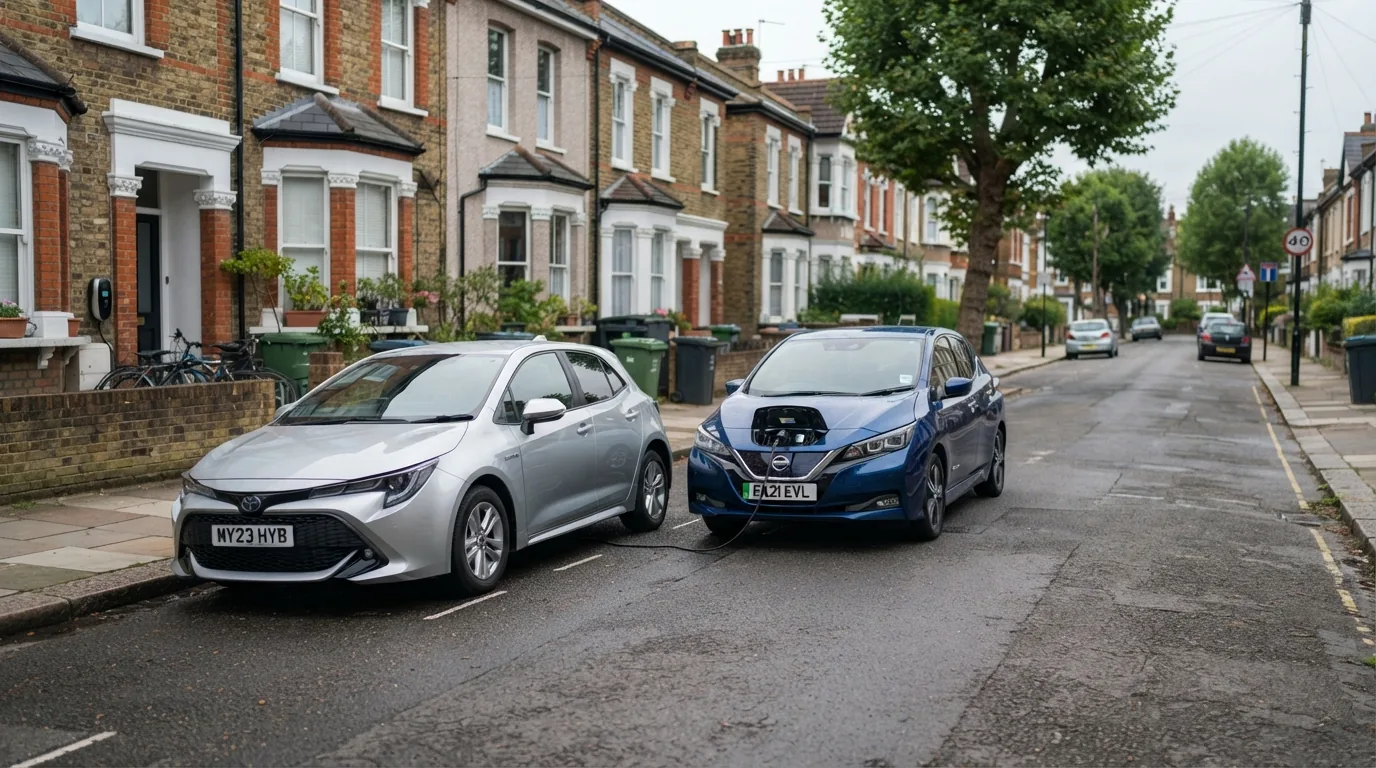
The psychological shift from a petrol car to a full electric is different from switching to a hybrid. With a hybrid, the driving experience is largely unchanged: you fill up at a petrol station, the car manages the battery automatically, and the only difference is better fuel economy. It feels like driving a more efficient petrol car, because it is.
With a full electric car, the change is more significant: you charge at home or publicly rather than at petrol stations. You develop a sense of how far you can go. You learn to use regenerative braking. You start thinking about charging network availability on longer trips. For most drivers, this adjustment takes a few weeks. After that, most former petrol drivers report that they do not want to go back.
The transition is easiest for drivers who can charge at home. If you can plug in overnight, you start every day with a full battery. The concept of “running low” largely disappears from daily life because you top up while you sleep, just as you charge your phone.
The case for a hybrid as a stepping stone
There is a legitimate case for choosing a PHEV if you are genuinely uncertain about full electric ownership. If you have a 35-mile electric range on a PHEV and your daily commute is 20 miles each way, you can do your commute entirely on electricity while still having the petrol engine available for anything unexpected. You get to experience electric driving, learn your patterns and build confidence, without the psychological pressure of having no combustion backup.
The risk: if you subsequently find that the electric range covers 90 per cent of your driving, you will wish you had gone full electric and saved on the PHEV premium price and the more complex servicing.
Full hybrids (HEVs that do not plug in) offer less benefit. You do not get meaningful electric-only driving. You get better fuel economy in town and a self-charging battery that assists the petrol engine. The fuel savings are real but modest (perhaps 20 to 30 per cent over a pure petrol car in mixed driving), and the BIK tax rate for a 40% taxpayer is dramatically worse than a full electric car.
The running cost comparison: real UK numbers
We use 10,000 miles per year, petrol at £1.50/litre, and home electricity at 8p/kWh (Intelligent Octopus Go from April 2026).
Full hybrid (55 mpg): approximately £1,042 per year in fuel PHEV (charged regularly, 60% electric): approximately £450-£600 per year combined Full electric (home charging at 8p/kWh): approximately £160 per year in electricity
Over five years:
- Hybrid fuel cost: ~£5,210
- PHEV (charged) fuel/electricity: ~£2,500
- Full electric: ~£800
The BIK tax difference compounds on top of this for company car drivers, where the EV advantage is over £3,000 per year more than a typical hybrid for a 40% taxpayer.
Range: what you actually need
The fear of running out of charge is the most common reason people choose a hybrid over a full electric car. In almost all cases, this fear overstates the real risk.
The average UK car journey is under 10 miles. The average UK driver covers under 8,000 miles per year. Most modern full electric cars have at least 200 miles of real-world range. UK public rapid charging coverage has expanded significantly, with over 65,000 public chargers now operating nationwide.
For a driver doing regular commuting with home charging, range anxiety is a non-issue. The cases where it is a real practical concern are:
- Regular single-day journeys of 250 miles or more with no opportunity to charge
- Living in a rural area far from any rapid charger and without home charging
- Having a very unpredictable schedule that makes planning charge stops impractical
If none of those describe you, the range concern is likely fear rather than fact.
Which should you switch to?
Switch to full electric if:
- You can charge at home (the single most important factor)
- Your daily driving is under 150 miles
- You want the lowest possible running costs and BIK tax
- You are buying a company car
- You want to future-proof your purchase against the 2035 ICE ban
Start with a PHEV if:
- You genuinely cannot charge at home and public charging in your area is sparse
- You regularly do unpredictable long journeys that would be stressful to plan around charging
- You want to experience electric driving before committing fully
- Your employer offers workplace charging but you are not yet sure of your home situation
Avoid a full hybrid (HEV) if:
- Tax efficiency is a priority (the BIK rate is dramatically worse than full electric)
- You want meaningful electric-only driving
- You are comparing on a five-year cost basis (the full electric advantage compounds quickly)
The myth to correct
The most common myth is that hybrids are the “responsible middle ground” that makes environmental and financial sense for drivers not ready for full electric. In most UK cases, a full hybrid costs more to run than a full electric car, produces significantly more emissions over its life, and will be increasingly disadvantaged in policy terms as the 2035 deadline approaches.
The genuinely responsible middle ground, if you are not ready to go full electric, is a PHEV that you commit to charging every day. A PHEV that is charged regularly delivers running costs close to a BEV and meaningful emissions reductions. A PHEV that is rarely charged is simply a petrol car with a heavy battery.
What to read next
For the full guide to making the switch from petrol or diesel, visit our Switching from Petrol or Diesel guide. For our pick of the best first EVs for new switchers, see our first electric cars for switching from petrol page.
How we test and where our numbers come from
Range figures are official WLTP combined values taken from manufacturer UK specification pages, with real-world estimates drawn from independent comparative testing. Prices are UK list prices at the time of the latest update. Tax, grant and charging-scheme figures come from GOV.UK and HMRC publications. We re-check every guide when pricing, specification or policy changes. Last checked 11 August 2026.

EV Compared
The EV Compared editorial team tracks the UK electric vehicle market full time: new model launches, list prices, WLTP and real-world range, public charging tariffs and the tax rules that decide what an EV actually costs to run. Every guide is checked against manufacturer specifications and official GOV.UK figures, and updated whenever the numbers move.
Related reading
View all
What Are the Biggest Myths About Switching to an EV?
The claims that put UK drivers off going electric, and what the evidence actually says
Should You Buy an EV in 2026 or Wait for Cheaper Models?
An honest look at where EV prices are heading and whether the wait is worth it for UK buyers
Buying and Owning an Electric Car in the UK: The Complete 2026 Guide
Everything you need to know about costs, charging, depreciation and day-to-day life with an EV