What Is a Good Real World Range for a UK EV in 2026?
Setting realistic expectations: the range benchmarks that matter for different types of UK drivers
Quick answers
- A good real-world range for a UK EV depends on how you drive. For most drivers, 150 to 200 miles of genuine real-world range is enough for everyday use.
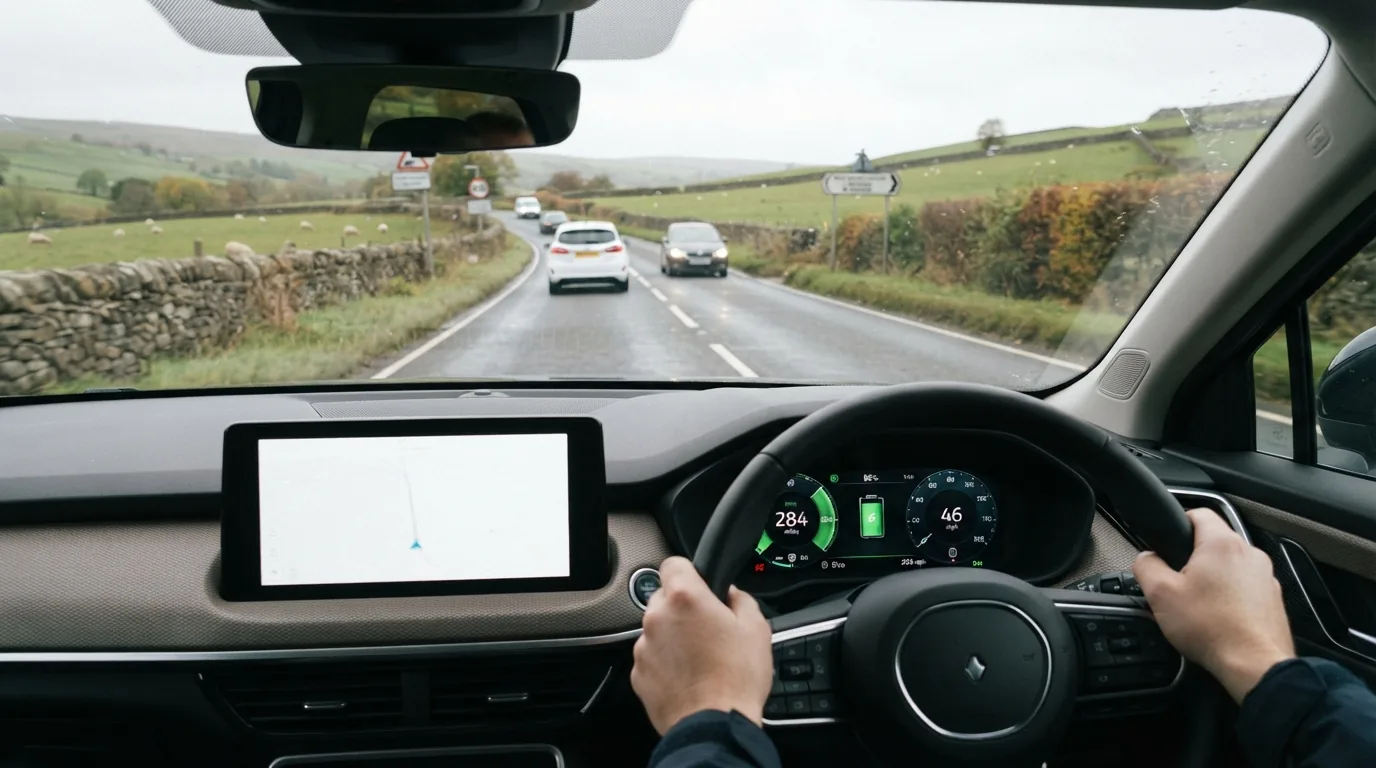
- What counts as real-world range: Real-world range is what your car delivers across a mix of typical UK driving: some urban stop-and-go, some A-roads at 50 to 60 mph, and some motorway cruising at 70 mph.
- The Department for Transport National Travel Survey data shows that the average UK driver covers around 20 miles per day.
- The category of driver who genuinely needs more range is the regular long-distance motorway driver.
- For most buyers, a car with 250 to 320 miles of WLTP range (roughly 175 to 240 miles real-world) hits the practical sweet spot.
- Is more range always better: The rule: buy the range you need, not the range you might theoretically want.
A good real-world range for a UK EV depends on how you drive. For most drivers, 150 to 200 miles of genuine real-world range is enough for everyday use. For those who regularly drive long motorway distances, 250 to 300 real-world miles is the more comfortable target. For towing or extreme cold weather, you need more headroom still.
The key point: do not buy on WLTP. A 300-mile WLTP car typically delivers around 210 to 240 miles in mixed UK conditions. A 400-mile WLTP car delivers roughly 280 to 320 miles. Apply a 75 per cent multiplier to WLTP as your working estimate for real conditions.
What counts as real-world range?
Real-world range is what your car delivers across a mix of typical UK driving: some urban stop-and-go, some A-roads at 50 to 60 mph, and some motorway cruising at 70 mph. It accounts for weather, accessories and normal driving style, not the controlled lab conditions of the WLTP test.
Independent testing consistently finds that UK EVs return 70 to 80 per cent of their WLTP figure in this kind of mixed use. At a sustained 70 mph on the motorway, the figure drops to 65 to 75 per cent of WLTP. In a cold British winter with the heater running, the real-world figure falls further still, to 60 to 70 per cent of WLTP.
How much range does the typical UK driver actually need?
The Department for Transport National Travel Survey data shows that the average UK driver covers around 20 miles per day. The median single journey is under 10 miles. Around 95 per cent of all car trips in England are under 25 miles.
Based on that data, a car with 150 miles of real-world range can handle nearly a week of typical UK daily driving on one charge. A car with 200 miles of real-world range provides even more comfortable margins, particularly if you charge at home overnight.
The anxiety about range tends to outpace the reality of everyday usage significantly. Most UK drivers who make the switch to electric find their daily needs comfortably met by mainstream EVs with 200 to 250 miles of real-world range.
Where does “good enough” start to fall short?
The category of driver who genuinely needs more range is the regular long-distance motorway driver. Someone covering 200-mile motorway legs frequently needs a car that can comfortably do that distance at 70 mph on a single charge, with a margin for safety and variation.
At 70 mph, a car delivers roughly 70 per cent of its WLTP figure. To achieve 200 miles of motorway range, you need a WLTP rating of around 285 miles or higher. For a 250-mile motorway leg in comparable conditions, you need roughly 350 miles WLTP.
Cold weather tightens these margins further. A regular cross-country driver who expects to make winter journeys should target at least 350 miles WLTP to have comfortable headroom.
Range by driver type: a practical guide
| Driver Profile | Typical Daily Miles | Recommended Real World Range | Minimum WLTP to Target |
|---|---|---|---|
| Urban/suburban commuter | 15-30 miles | 150-180 miles | 200-230 miles WLTP |
| Mixed use, occasional long runs | 30-60 miles | 200-250 miles | 260-320 miles WLTP |
| Regular motorway driver | 100-200 miles | 250-320 miles | 340-420 miles WLTP |
| Frequent long-distance | 200+ miles | 300-400 miles | 400-500+ miles WLTP |
| Towing user | Variable | 300+ miles (untowed) | 400+ miles WLTP |
What is the sweet spot in the UK market for 2026?
For most buyers, a car with 250 to 320 miles of WLTP range (roughly 175 to 240 miles real-world) hits the practical sweet spot. This range bracket includes some of the UK’s most popular EVs, including the Tesla Model 3 Standard Range (around 305 miles WLTP), the Hyundai Ioniq 5 Standard Range (around 238 miles WLTP), and the MG4 in its 64 kWh variant (around 281 miles WLTP).
At this level, you can handle most UK daily driving, cover many A-to-B road trips without a charge stop, and manage motorway journeys with one planned charge break on longer routes.
If you regularly drive more than 150 miles in a day, stepping up to the 350 to 450 miles WLTP bracket (roughly 245 to 340 miles real-world) makes sense. This covers the Tesla Model 3 Long Range (466 miles WLTP, around 350 miles real-world in mixed conditions), the Volkswagen ID.7 Pro (381 miles WLTP), and the Kia EV6 Long Range (361 miles WLTP).
Is more range always better?
Not necessarily. Larger battery packs cost more to buy, add weight (which slightly reduces efficiency), and take longer to charge. A 100 kWh battery takes longer to reach 80 per cent than a 60 kWh battery at the same charging rate. For drivers who primarily use their car for short commutes and occasional longer trips with public charging available, a smaller battery at a lower price point makes more financial sense.
The rule: buy the range you need, not the range you might theoretically want. If you drive 30 miles a day and visit family 120 miles away four times a year, a 200-mile real-world car works fine with one charge stop on those longer trips.
The common mistake
The biggest error buyers make is buying for edge cases rather than typical use. They imagine the worst-case scenario (full load of passengers, winter, motorway, headwind, low battery on the outskirts of civilisation) and use that to justify buying the maximum range car available. In practice, the average use case is far more benign, and a moderate-range car is a better financial decision for most people.
The second mistake is not accounting for home charging. A driver who charges at home overnight starts every day on a full (or near-full) battery. For them, the journey range matters less than the daily top-up; a car with 200 miles of real-world range, charged to 80 per cent daily, provides 160 miles of usable range every single morning.
How does the UK’s charging infrastructure affect range requirements?
The expansion of the UK’s rapid charging network changes the range calculation for many buyers. With over 11,000 rapid connectors now available nationally (Zap-Map data, mid-2026), and growing coverage at motorway services, retail parks and destination charging locations, the need for maximum on-board range is lower than it was when charging stops meant a two-hour wait at a slow AC post.
At a 150 kW rapid charger, adding 100 miles of real-world range takes approximately 25 to 30 minutes. At a 50 kW charger (still the most common type at many UK locations), the same 100 miles takes around 45 to 60 minutes. These charge times are long enough to be worth minimising for frequent long-distance drivers, but perfectly reasonable for occasional longer trips.
The practical implication: for buyers who drive mainly in urban areas and have home charging, a car with 200 miles of real-world range is entirely adequate. For buyers who frequently drive motorway distances of 150-plus miles and rely partly on public rapid charging, 280 to 320 miles of real-world range is the more comfortable target.
The UK public charging network’s reliability is still improving. For the most up-to-date picture on charging infrastructure, Zap-Map’s live map and the RAC’s charging network reports are the best current sources.
For our full comparison of current UK models ranked by real-world range, see the longest range electric cars guide. More on what drives range differences is covered in the range and performance hub.
Sources: Department for Transport National Travel Survey, EV Database UK specifications, WLTP methodology, independent test data from Which? and Autocar.
How we test and where our numbers come from
Range figures are official WLTP combined values taken from manufacturer UK specification pages, with real-world estimates drawn from independent comparative testing. Prices are UK list prices at the time of the latest update. Tax, grant and charging-scheme figures come from GOV.UK and HMRC publications. We re-check every guide when pricing, specification or policy changes. Last checked 11 August 2026.
Frequently asked questions
What counts as real-world range?
Real-world range is what your car delivers across a mix of typical UK driving: some urban stop-and-go, some A-roads at 50 to 60 mph, and some motorway cruising at 70 mph. It accounts for weather, accessories and normal driving style, not the controlled lab conditions of the WLTP test.
How much range does the typical UK driver actually need?
The Department for Transport National Travel Survey data shows that the average UK driver covers around 20 miles per day. The median single journey is under 10 miles.
Where does "good enough" start to fall short?
The category of driver who genuinely needs more range is the regular long-distance motorway driver. Someone covering 200-mile motorway legs frequently needs a car that can comfortably do that distance at 70 mph on a single charge, with a margin for safety and variation.
What is the sweet spot in the UK market for 2026?
For most buyers, a car with 250 to 320 miles of WLTP range (roughly 175 to 240 miles real-world) hits the practical sweet spot.
Is more range always better?
Not necessarily. Larger battery packs cost more to buy, add weight (which slightly reduces efficiency), and take longer to charge.

EV Compared
The EV Compared editorial team tracks the UK electric vehicle market full time: new model launches, list prices, WLTP and real-world range, public charging tariffs and the tax rules that decide what an EV actually costs to run. Every guide is checked against manufacturer specifications and official GOV.UK figures, and updated whenever the numbers move.
Related reading
View all
Do Bigger Wheels Reduce Electric Car Range?
Yes, significantly. Here is the data on how much wheel size costs in miles and why it happens
BMW i4 vs Tesla Model 3: UK Range and Efficiency Test
The BMW costs more and goes less far, but is it worth it? A data-led head to head for UK buyers
How Far Can an Electric Car Really Go on One Charge?
Real-world range figures for UK drivers: what the numbers mean and which cars go furthest