Best EVs for Vehicle to Load Power in the UK
Vehicle-to-Load lets you power appliances directly from your car battery. These are the best UK EVs for V2L in 2026, ranked by power output, battery size and value
Quick answers
- Vehicle-to-Load (V2L) lets you plug standard appliances directly into your electric car's battery, running them as if from a mains socket.
- How does V2L work: A V2L system uses the car's onboard inverter, the same device that converts DC battery power to AC for internal systems, to produce 230V AC power accessible to external devices.
- What can 3.6 kW actually power: You cannot run a 3 kW kettle and a 2 kW induction hob simultaneously at 3.6 kW total.
- For cars with an external V2L socket (Hyundai, Kia, some others), you need a V2L adapter cable: this plugs into the car's charging port and provides standard domestic sockets at the other end.
- A portable power station (such as an EcoFlow Delta or Jackery) is a self-contained battery with built-in sockets.
- What is the common mistake with V2L: The most common mistake is running high-power appliances continuously without monitoring the battery level.
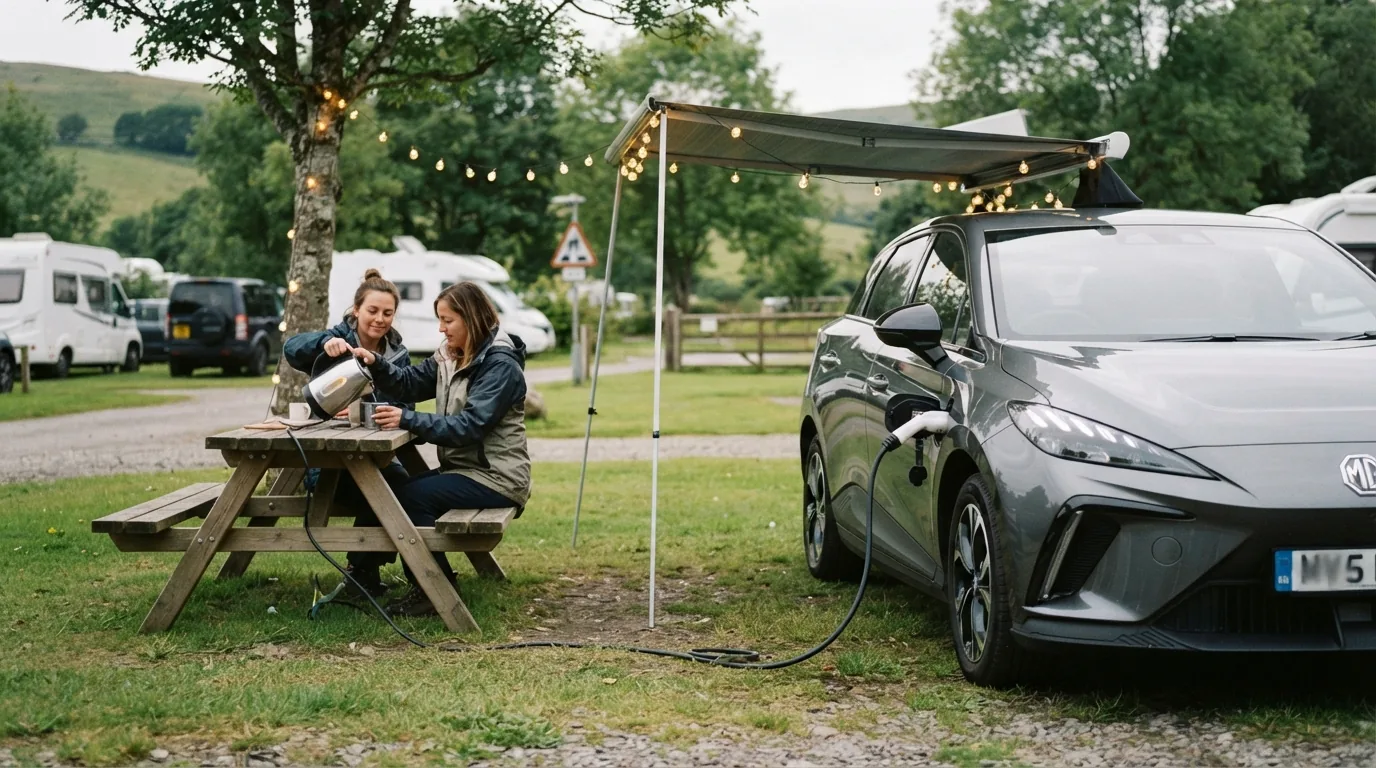
Vehicle-to-Load (V2L) lets you plug standard appliances directly into your electric car’s battery, running them as if from a mains socket. Most V2L-equipped cars deliver 2.3 kW to 3.6 kW of AC power, enough to run a kettle, a laptop, a power tool, a portable induction hob, LED lighting or a portable fridge. Unlike V2H or V2G, V2L requires no home installation: you plug an adapter into the charging socket or into a socket built into the car and your appliances work.
How does V2L work?
A V2L system uses the car’s onboard inverter, the same device that converts DC battery power to AC for internal systems, to produce 230V AC power accessible to external devices. The car’s battery management system monitors the drain and can cut power if the battery falls below a preset threshold (usually 20% to 30%) to ensure you can still drive away.
Most V2L implementations in current UK models work in one of two ways:
- External V2L socket on the charging port: A V2L adapter cable plugs into the CCS or Type 2 charging socket on the car and provides a standard 13-amp or 16-amp socket. Used by Hyundai, Kia and others.
- Built-in interior socket: Some models (particularly BYD and some Kia models) have a standard 230V socket integrated into the interior, useful for running devices inside the car.
Which UK cars have V2L in 2026?
| Car | V2L power output | Battery (usable) | V2L location | Notes |
|---|---|---|---|---|
| Hyundai IONIQ 5 | 3.6 kW | 58 kWh / 74 kWh | External adapter + interior socket | Standard across all trims |
| Hyundai IONIQ 6 | 3.6 kW | 53 kWh / 77.4 kWh | External adapter | Standard |
| Kia EV6 | 3.6 kW | 58.3 kWh / 77.4 kWh | External adapter | Standard |
| Kia EV9 | 3.6 kW | 76.1 kWh / 88.1 kWh | External adapter + interior | Standard all trims |
| Kia EV3 | 3.6 kW | ~59 kWh | External adapter | Available from 2026 under £30k |
| BYD Atto 3 | 3.3 kW | 58.56 kWh | Interior socket | Standard; useful interior socket position |
| BYD Dolphin | 2.2 kW | 44.9 kWh / 60.4 kWh | Interior socket | Lower power than Atto 3 |
| BYD Seal | 3.3 kW | 61.4 kWh / 82.56 kWh | Interior socket | |
| MG4 (Trophy and above) | 3.3 kW | 51 kWh / 64 kWh | Interior socket | Not on base trims; check spec sheet |
| Volvo EX30 | 3.7 kW | 49 kWh | External adapter | Standard; highest output in class |
| Hyundai IONIQ 9 | 3.6 kW | ~100 kWh | External + interior | Large family SUV; excellent V2L capacity |
| Genesis GV70 EV | 3.6 kW | 77.4 kWh | External adapter | Premium option |
| Genesis GV80 Coupe EV | 3.6 kW | ~100 kWh | External adapter | |
| Renault Scenic E-Tech | 3.6 kW | 60 kWh / 87 kWh | External adapter |
What can 3.6 kW actually power?
3.6 kW is meaningful power. Here is what you can run simultaneously within this limit:
| Appliance | Typical power draw |
|---|---|
| Portable induction hob (single) | 0.8–2 kW |
| Standard kettle | 2.5–3 kW |
| Coffee machine | 0.8–1.5 kW |
| Laptop and phone charging | 0.1–0.3 kW |
| LED lighting (full camp setup) | 0.05–0.2 kW |
| Portable car fridge | 0.04–0.1 kW |
| Electric hand drill | 0.3–0.8 kW |
| Portable fan heater | 1–2 kW |
| Small electric lawnmower | 1–1.5 kW |
You cannot run a 3 kW kettle and a 2 kW induction hob simultaneously at 3.6 kW total. But you can run the hob with lights, a fridge and laptop charging comfortably. If you turn the kettle on briefly and then switch back to the hob, 3.6 kW is sufficient for most outdoor and camping use cases.
Which is the best EV for V2L overall?
The answer depends on what else the car needs to do for you, but if V2L capacity and utility are primary considerations:
Best V2L for camping and outdoor use: Kia EV9 The EV9 has 88 kWh of usable battery, V2L at 3.6 kW via an external adapter and an internal socket, and the interior space to sleep in (if required) or store equipment. Drawing down from 100% to 30% leaves approximately 60 kWh of energy available for V2L use, which could power a camp fridge (0.1 kW continuous) for 600 hours or run a 2 kW induction hob for 30 hours. For family camping, it is the most capable option in the UK market in 2026.
Best V2L for value: Hyundai IONIQ 5 Standard Range The IONIQ 5 Standard Range (58 kWh) offers 3.6 kW V2L with an external adapter, a reasonably large battery and strong all-round performance as a family car. Available used from around £25,000 to £30,000 for earlier builds, it represents the most accessible V2L-capable car in the UK.
Best V2L for a compact car: Volvo EX30 The EX30 is the only sub-£40,000 compact EV to offer 3.7 kW V2L (marginally above the typical ceiling). Its 49 kWh usable battery is smaller than larger models, but for occasional power use away from home it works well. The external V2L adapter is available as an accessory.
Best budget V2L: Kia EV3 Launching in the UK from 2026 at under £30,000, the EV3 includes V2L at 3.6 kW across all trims. This makes it one of the most affordable new cars in the UK with V2L standard, without compromising on a 59 kWh usable battery and a real-world range of around 250 miles.
Do you need a V2L adapter and where do you get one?
For cars with an external V2L socket (Hyundai, Kia, some others), you need a V2L adapter cable: this plugs into the car’s charging port and provides standard domestic sockets at the other end. Some manufacturers include the adapter in the box; others sell it as an accessory.
Hyundai V2L adapter: approximately £80 to £100 from Hyundai or authorised accessories suppliers. Kia V2L adapter: approximately £75 to £100 from Kia dealers or accessories. Third-party adapters: compatible alternatives are available online for £50 to £80; check compatibility carefully for your car model and connector type.
For cars with built-in interior sockets (BYD, MG), no adapter is needed: plug straight in.
What is the difference between V2L and a portable power station?
A portable power station (such as an EcoFlow Delta or Jackery) is a self-contained battery with built-in sockets. These cost £300 to £1,500 and hold 0.5 to 2 kWh typically.
A V2L-equipped EV gives you 30 to 80 kWh of accessible energy, far more than any portable station, at no additional cost if you already own the car. The only limitation is that you need the car to be present and its battery to be charged.
V2L is not a replacement for a proper home battery system (which operates even when the car is away) but it replaces portable power stations comprehensively for on-site and camping use.
What is the common mistake with V2L?
The most common mistake is running high-power appliances continuously without monitoring the battery level. If you run a 2 kW induction hob for an extended period, you will draw down the battery surprisingly quickly. At 2 kW continuous from a 60 kWh usable battery (drawing from 80% to 30%), you have 30 kWh available, enough for 15 hours. That sounds like a lot, but it is also 15 hours less range when you drive home.
The practical habit: check the battery percentage before cooking, plan to leave at least 30% for the drive home, and use the car’s app to monitor the drain if your model supports it.
For more on bidirectional EV technology, see our V2G and V2H charging guide and the full EV tech and apps hub. For the best EV charging apps, see our best EV charging apps roundup.
How we test and where our numbers come from
Range figures are official WLTP combined values taken from manufacturer UK specification pages, with real-world estimates drawn from independent comparative testing. Prices are UK list prices at the time of the latest update. Tax, grant and charging-scheme figures come from GOV.UK and HMRC publications. We re-check every guide when pricing, specification or policy changes. Last checked 11 August 2026.
Frequently asked questions
How does V2L work?
A V2L system uses the car's onboard inverter, the same device that converts DC battery power to AC for internal systems, to produce 230V AC power accessible to external devices.
What can 3.6 kW actually power?
You cannot run a 3 kW kettle and a 2 kW induction hob simultaneously at 3.6 kW total. But you can run the hob with lights, a fridge and laptop charging comfortably.
Do you need a V2L adapter and where do you get one?
For cars with an external V2L socket (Hyundai, Kia, some others), you need a V2L adapter cable: this plugs into the car's charging port and provides standard domestic sockets at the other end. Some manufacturers include the adapter in the box; others sell it as an accessory.
What is the difference between V2L and a portable power station?
A portable power station (such as an EcoFlow Delta or Jackery) is a self-contained battery with built-in sockets. These cost £300 to £1,500 and hold 0.5 to 2 kWh typically.
What is the common mistake with V2L?
The most common mistake is running high-power appliances continuously without monitoring the battery level. If you run a 2 kW induction hob for an extended period, you will draw down the battery surprisingly quickly.

EV Compared
The EV Compared editorial team tracks the UK electric vehicle market full time: new model launches, list prices, WLTP and real-world range, public charging tariffs and the tax rules that decide what an EV actually costs to run. Every guide is checked against manufacturer specifications and official GOV.UK figures, and updated whenever the numbers move.
Related reading
View all
Apple CarPlay vs Built In EV Software: Which Is Better?
Apple CarPlay is familiar and loved, but built-in EV software controls your battery, charging and range. We explain when each wins and which cars get the balance right.

Best Apps to Find EV Chargers in the UK
With over 120,000 public charge points in the UK, the right app makes the difference between a smooth charging stop and a wasted detour. Here are the options ranked
What Is Bidirectional Charging and Can It Power Your Home?
Bidirectional charging lets your electric car act as a home battery or feed the national grid. Here is how it works, what it costs and which UK cars support it in 2026