Best EVs for Low Total Cost of Ownership in the UK
Which electric cars actually cost the least to own over three to five years -- purchase, fuel, insurance and depreciation included
Quick answers
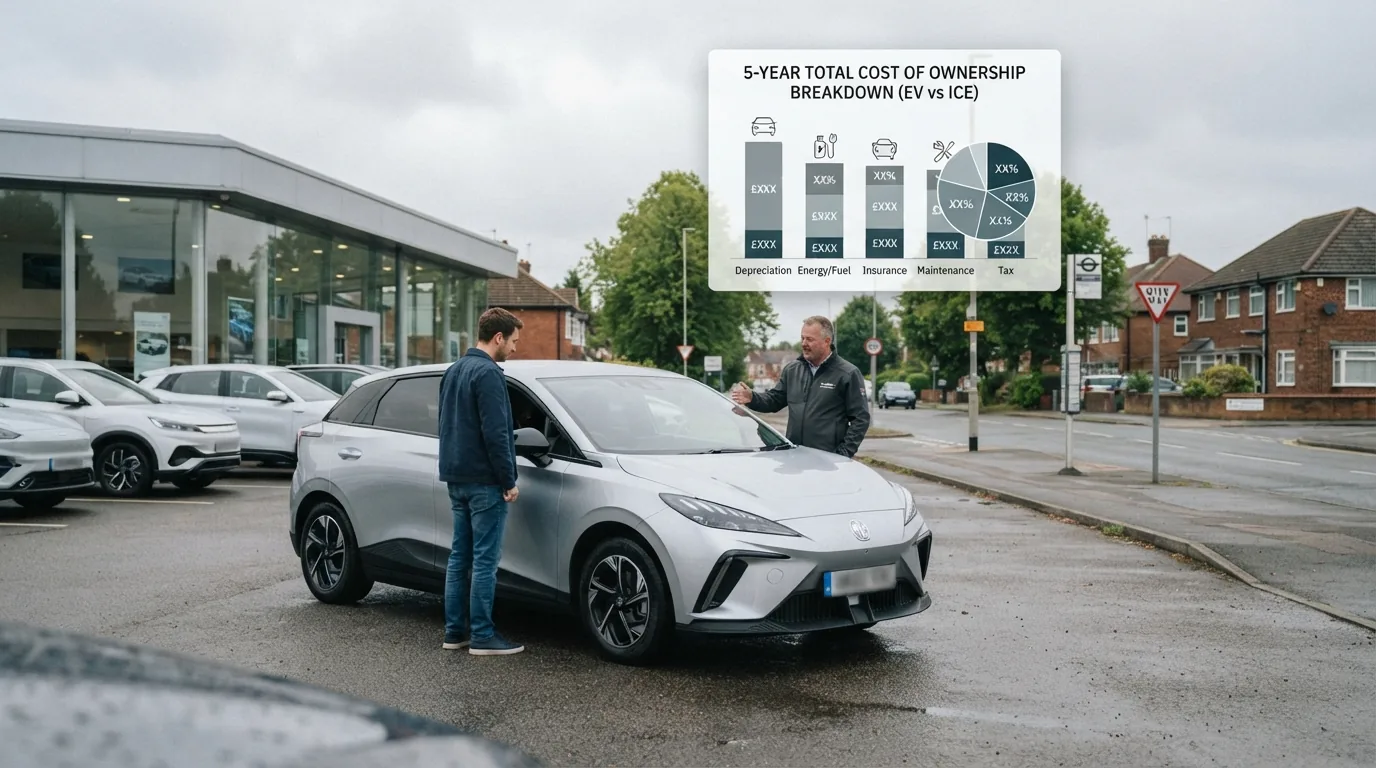
- Total cost of ownership (TCO) is the honest measure of what a car actually costs. It adds up everything: purchase price (or monthly lease payment), fuel, insurance, tax, servicing, tyres, and the car's depreciation over your ownership period.
- Depreciation typically accounts for 40 to 60% of total ownership cost for outright buyers.
- At £23,000 purchase price, strong ~55% three-year residual values, the UK's lowest EV insurance premium (average £418), and 4.0 mi/kWh real-world efficiency, the Renault R5 E-Tech delivers the lowest absolute three-year TCO of any mainstream new EV in the UK in 2026.
- In the £40,000 to £45,000 bracket, the Ioniq 6 and EV6 deliver the best TCO of any EV in their class.
- The Tesla Model 3 RWD has higher insurance costs (average around £720 per year) than Korean equivalents, but its exceptional 4.5 mi/kWh efficiency and strong 58% three-year residuals keep total TCO competitive.
- Does depreciation really matter if I lease: On a personal contract hire (PCH) or personal contract purchase (PCP), the monthly payment is essentially the depreciation priced in and spread over the term.
Total cost of ownership (TCO) is the honest measure of what a car actually costs. It adds up everything: purchase price (or monthly lease payment), fuel, insurance, tax, servicing, tyres, and the car’s depreciation over your ownership period. When you run these numbers for 2026, the best EVs for low TCO over three to five years are those that combine competitive purchase prices, strong residual values, high efficiency and low insurance — not simply the cheapest sticker price.
For most UK drivers who can charge at home and cover at least 8,000 miles per year, EVs already deliver a lower three-year TCO than equivalent petrol cars. The crossover point depends on how you finance the purchase.
What is included in total cost of ownership?
| Cost component | How it is measured |
|---|---|
| Purchase price / finance payments | OTR price or monthly PCP/PCH payments over ownership period |
| Depreciation | Difference between purchase price and residual value at point of sale |
| Fuel / charging | Based on annual mileage, efficiency, and tariff (home vs public) |
| Road tax (VED) | £200 standard rate; £640 for models over £50,000 |
| Insurance | Annual premium based on model and driver profile |
| Servicing and maintenance | Annual service cost plus any repair history |
| Tyres | Annual tyre wear costs |
Depreciation typically accounts for 40 to 60% of total ownership cost for outright buyers. For PCP or PCH buyers, the monthly payment already incorporates the expected depreciation — it is priced in.
Best EVs for low TCO: comparison table
| Model | Purchase price | 3yr residual | Fuel cost/yr (10k mi) | Insurance/yr | Servicing/yr | Est. 3yr TCO |
|---|---|---|---|---|---|---|
| Renault R5 E-Tech (52 kWh) | £23,000 | £137 | £418 | £150 | ~£26,000 | |
| MG4 Standard Range | £27,000 | £145 | £530 | £150 | ~£30,000 | |
| Hyundai Ioniq 6 RWD (53 kWh) | £42,000 | £122 | £650 | £165 | ~£41,000 | |
| Kia EV6 (Standard Range, RWD) | £42,000 | £141 | £640 | £165 | ~£41,500 | |
| Tesla Model 3 RWD | £42,000 | £122 | £720 | £140 | ~£42,000 | |
| Volkswagen ID.3 (58 kWh) | £35,000 | £141 | £520 | £165 | ~£35,500 | |
| BMW i4 eDrive40 | £57,000 | £145 | £1,100 | £200 | ~£59,000 |
3yr TCO = (purchase price - residual value) + (fuel + insurance + servicing) x 3, plus £200 VED x 3. Excludes finance costs and tyres for comparability. Home off-peak tariff (5.49p/kWh) assumed.
The Renault R5: lowest TCO in mainstream EVs
At £23,000 purchase price, strong ~55% three-year residual values, the UK’s lowest EV insurance premium (average £418), and 4.0 mi/kWh real-world efficiency, the Renault R5 E-Tech delivers the lowest absolute three-year TCO of any mainstream new EV in the UK in 2026.
Three-year total cost estimate: around £26,000 (depreciation £10,350, fuel £411, insurance £1,254, servicing £450, VED £600).
A comparable petrol supermini (Renault Clio 1.0 TCe at £19,000) with similar depreciation:
- Depreciation: ~£8,550 (55% retained)
- Fuel (40 mpg, 10k miles, £1.57/litre): ~£5,340
- VED: ~£600
- Insurance: ~£1,200
- Servicing: ~£615
- Three-year total: ~£16,305
The petrol Clio’s lower purchase price still gives it a lower absolute three-year TCO than the R5 on these figures. For the R5 to win on outright TCO, the residual value assumption needs to be higher or the driver’s mileage needs to be higher (amplifying fuel savings). At 15,000 miles per year, the R5’s fuel saving over the Clio grows to around £1,500 per year, pushing it to a near-equivalent or better TCO over three years.
This illustrates the key dynamic: EVs tend to reach TCO parity or advantage faster at higher annual mileage.
The Hyundai Ioniq 6 and Kia EV6: best TCO for higher-budget buyers
In the £40,000 to £45,000 bracket, the Ioniq 6 and EV6 deliver the best TCO of any EV in their class. Both benefit from:
- Strong residual values (58 to 60% at three years) supported by well-regarded brand, battery warranty and driver satisfaction scores
- High efficiency (4.5 mi/kWh for the Ioniq 6, 3.9 for the EV6)
- Moderate insurance (groups 28 to 35)
- Hyundai/Kia’s 5-year unlimited warranty reducing repair cost risk
Compared to a BMW 5 Series 520i (around £50,000 OTR), the Ioniq 6 at £42,000 with better residuals and a fraction of the fuel cost delivers a meaningfully better three-year TCO, even before accounting for company-car BIK savings for eligible drivers.
Why the Tesla Model 3 scores well despite higher insurance
The Tesla Model 3 RWD has higher insurance costs (average around £720 per year) than Korean equivalents, but its exceptional 4.5 mi/kWh efficiency and strong 58% three-year residuals keep total TCO competitive. Tesla’s track record of over-the-air software updates that add features and maintain satisfaction also supports residuals.
The risk is in servicing: Tesla’s approved body shop network is narrower than established European manufacturers, and repair wait times after accidents can be longer. For most owners who do not have accidents, this is invisible. For those who do, it is a relevant consideration.
Does depreciation really matter if I lease?
On a personal contract hire (PCH) or personal contract purchase (PCP), the monthly payment is essentially the depreciation priced in and spread over the term. You do not experience the depreciation as a one-off cost — it is embedded in your payment.
However, the monthly payment is still priced from the residual value assumption. Cars with strong residuals (Hyundai, Kia, Tesla) have lower monthly payments than equivalently priced cars with weaker residuals (some Chinese brands in early UK market phases). Checking the guaranteed minimum future value (GMFV) on a PCP tells you what the manufacturer believes the car will be worth at the end of the term.
Salary sacrifice: the TCO game-changer for employees
A 40% taxpayer using salary sacrifice to access an EV pays income tax at 4% BIK plus National Insurance on the BIK value, rather than on the salary sacrificed. The effective monthly cost can be 35 to 50% lower than buying the same car on a personal PCP.
An Ioniq 6 or EV6 via salary sacrifice can cost a 40% taxpayer around £350 to £450 per month inclusive of insurance, servicing and all costs — comparable to a mid-range petrol car on PCP. This makes salary sacrifice the dominant route to EV access for employed buyers and changes the TCO comparison dramatically in the EV’s favour.
Common mistake: ignoring depreciation on budget EVs
The cheapest EVs to buy — Dacia Spring, Leapmotor T03, BYD Dolphin Surf — can have weaker residual values than established brands, particularly as Chinese EV supply continues to grow and new models are introduced at lower prices. A Spring bought for £12,440 might be worth £4,000 to £5,000 in three years — a 60 to 65% depreciation rate. In absolute pounds lost, this is modest (£7,500 to £8,500). But it illustrates that the very cheapest EVs do not always deliver the best TCO when depreciation is included alongside the other categories.
Summary: best EVs by ownership scenario
| Ownership scenario | Best TCO choice |
|---|---|
| Outright buyer, low mileage (<8,000/yr) | Renault R5 or MG4 |
| Outright buyer, high mileage (15,000+/yr) | Hyundai Ioniq 6 or Kia EV6 |
| PCP/PCH buyer | Ioniq 6, EV6, or VW ID.3 (strong residuals) |
| Salary sacrifice | Ioniq 6, EV6, Tesla Model 3 (BIK savings compound) |
| Company car | Tesla Model 3, Ioniq 6, EV6 (BIK rate 4%) |
For a full breakdown of EV running costs by category, see the EV running costs and tax hub.
To see the overall ranking of models by annual running cost (excluding depreciation), visit the cheapest electric cars to run page.
How we test and where our numbers come from
Range figures are official WLTP combined values taken from manufacturer UK specification pages, with real-world estimates drawn from independent comparative testing. Prices are UK list prices at the time of the latest update. Tax, grant and charging-scheme figures come from GOV.UK and HMRC publications. We re-check every guide when pricing, specification or policy changes. Last checked 11 August 2026.
Frequently asked questions
What is included in total cost of ownership?
Depreciation typically accounts for 40 to 60% of total ownership cost for outright buyers. For PCP or PCH buyers, the monthly payment already incorporates the expected depreciation -- it is priced in.
Does depreciation really matter if I lease?
On a personal contract hire (PCH) or personal contract purchase (PCP), the monthly payment is essentially the depreciation priced in and spread over the term. You do not experience the depreciation as a one-off cost -- it is embedded in your payment.

EV Compared
The EV Compared editorial team tracks the UK electric vehicle market full time: new model launches, list prices, WLTP and real-world range, public charging tariffs and the tax rules that decide what an EV actually costs to run. Every guide is checked against manufacturer specifications and official GOV.UK figures, and updated whenever the numbers move.
Related reading
View all
What Are the Biggest Myths About Switching to an EV?
The claims that put UK drivers off going electric, and what the evidence actually says
Should You Buy an EV in 2026 or Wait for Cheaper Models?
An honest look at where EV prices are heading and whether the wait is worth it for UK buyers
Buying and Owning an Electric Car in the UK: The Complete 2026 Guide
Everything you need to know about costs, charging, depreciation and day-to-day life with an EV