EV Running Cost Calculator: Electric vs Petrol Cost Per Mile
Enter your mileage and charging tariff to see exactly how much you save switching to electric
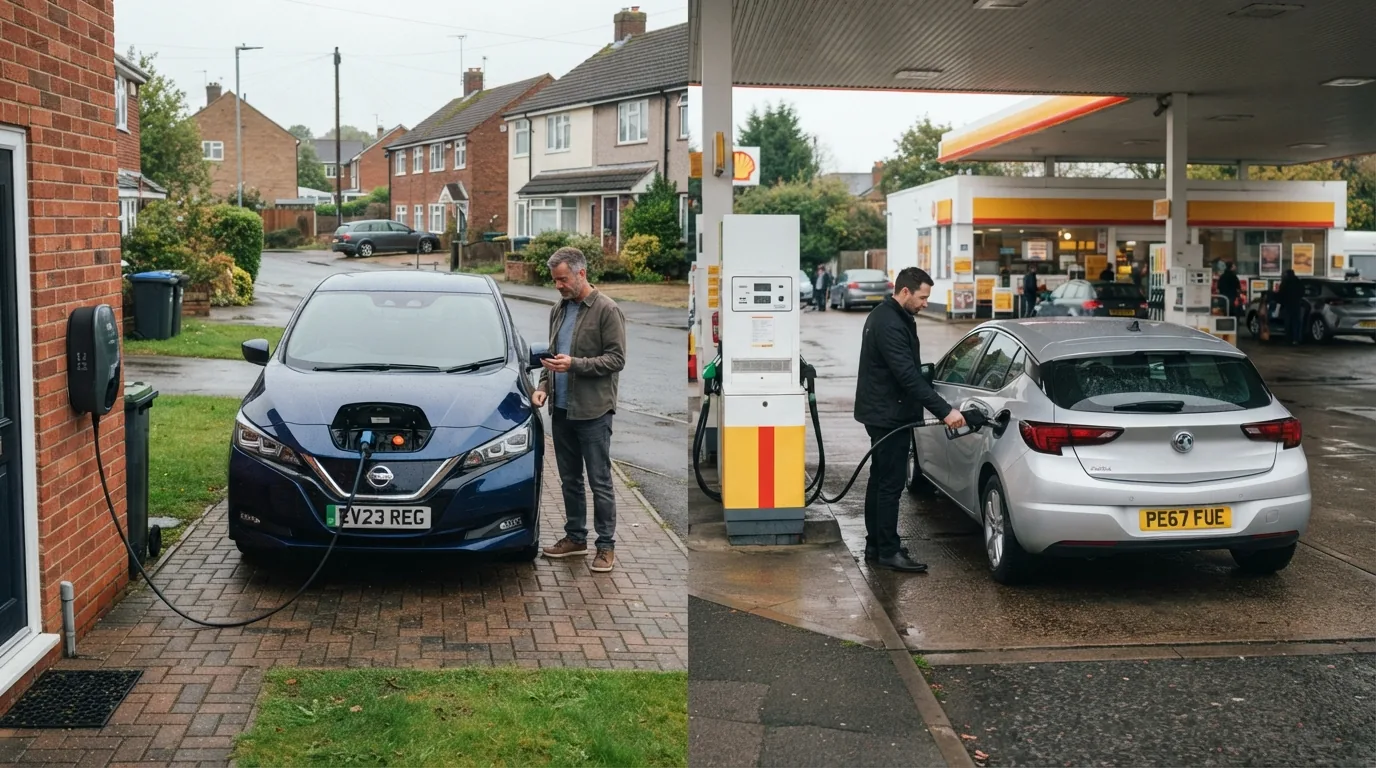
Quick answers
- The short answer, for a typical UK driver covering 10,000 miles per year with home charging on an overnight tariff: about £700 to £900 cheaper per year in fuel alone, plus roughly £200 to £400 less in servicing costs.
- How the calculator works: The calculator then shows you your current estimated fuel spend (petrol) and projected EV fuel spend, broken down per mile, per month and per year.
- Results table: sample scenarios: Assumptions: petrol at 158.8p/litre, 38mpg real-world; EV at 3.5 miles/kWh, 15% charging loss; home tariff 7p/kWh, public tariff 70p/kWh.
- Fuel is the headline, but running costs include several other items.
- A narrative that reappears periodically is that because public charging is now expensive (70-85p/kWh at many rapid chargers), the cost advantage of EVs has gone.
- What changes when you drive more miles: The more miles you drive, the bigger the annual saving from home charging, because the fuel cost difference compounds with mileage while fixed costs (insurance, road tax) stay roughly the same.
How much cheaper is an EV to run than a petrol car?
The short answer, for a typical UK driver covering 10,000 miles per year with home charging on an overnight tariff: about £700 to £900 cheaper per year in fuel alone, plus roughly £200 to £400 less in servicing costs. That is a total annual saving of somewhere between £900 and £1,300.
The longer answer depends on three things: what you pay for electricity, whether you can charge at home, and how many miles you drive. Use the calculator above to personalise the figures. The sections below explain what the results mean and where the numbers come from.
How the calculator works
Enter:
-
Annual mileage. The UK average is around 8,000 to 9,000 miles per year. Use your own odometer data or fuel spend divided by your car’s fuel cost per mile.
-
EV charging rate (p/kWh). If you are on an overnight EV tariff such as Intelligent Octopus Go or EDF GoElectric, enter 7p. If you are on a standard variable tariff, enter 24.67p (the April 2026 Ofgem price cap rate). If you mostly charge at public rapid chargers, enter 70p as a reasonable average.
-
EV efficiency (miles per kWh). A reasonable default for most modern EVs is 3.3-3.5 miles/kWh in mixed UK driving. Small, aerodynamic cars like the Tesla Model 3 and Hyundai Ioniq 6 can do 4+ miles/kWh. Larger SUVs typically return 2.8-3.2 miles/kWh.
-
Petrol car MPG. Use the real-world figure, not WLTP. The average UK petrol car returns around 36-40mpg in mixed driving.
-
Petrol price. The UK average unleaded price as of 25 May 2026 is 158.8p per litre. The calculator converts this to cost per mile automatically.
The calculator then shows you your current estimated fuel spend (petrol) and projected EV fuel spend, broken down per mile, per month and per year. It also shows combined running costs including road tax, average servicing and tyre costs.
Results table: sample scenarios
The table shows the output for three driver profiles. Your personalised figures appear in the calculator above.
| Driver profile | Annual miles | Petrol cost/year | EV cost/year (home 7p/kWh) | EV cost/year (public 70p/kWh) | Annual saving (home) |
|---|---|---|---|---|---|
| Light city commuter | 6,000 | £1,050 | £206 | £2,060 | £844 |
| Average UK driver | 10,000 | £1,750 | £343 | £3,430 | £1,407 |
| High-mileage driver | 20,000 | £3,500 | £686 | £6,860 | £2,814 |
Assumptions: petrol at 158.8p/litre, 38mpg real-world; EV at 3.5 miles/kWh, 15% charging loss; home tariff 7p/kWh, public tariff 70p/kWh.
Note the dramatic difference between home and public charging. EV ownership is financially compelling if you can charge at home overnight. If you rely entirely on public rapid charging, the fuel cost advantage largely disappears or reverses. This is the most important number many people miss when evaluating the switch.
Full running cost breakdown: EV vs petrol in 2026
Fuel is the headline, but running costs include several other items. Here is how the full picture compares.
Fuel
At 10,000 miles per year:
- Petrol (38mpg, 158.8p/litre): approximately £1,750 per year
- EV on home overnight tariff (3.5 miles/kWh, 7p/kWh): approximately £300-£350 per year
- EV on standard tariff (3.5 miles/kWh, 24.67p/kWh): approximately £1,080 per year
The cost per mile for home-charged EV is around 3-4p. For petrol at 158.8p/litre and 38mpg, it is approximately 18-19p per mile.
Road tax (VED)
From April 2025, EVs are no longer exempt from Vehicle Excise Duty. The current rates for 2026-27:
- First year: £10
- Years 2 to 6: £200 per year
- Cars with a list price over £50,000 also pay an additional £425 per year for the first five years (the “luxury car supplement”)
A petrol car registered in 2026 with emissions of around 120g/km CO2 pays roughly £185 in year one, then £200 per year. For a high-emission petrol at 160g/km, first-year VED is £885. The advantage of EVs here is mainly in the first year and for any petrol car above 90g/km.
The government has confirmed a pay-per-mile road pricing scheme for EVs from April 2028, initially at 3p per mile. For 10,000 miles, that adds £300 to the annual bill. It has not yet been implemented and the detail may change before it is introduced.
Servicing
EVs have no cambelt, oil, spark plugs, exhaust, clutch or gearbox oil to replace. Services are simpler: brake fluid, cabin filter, tyre rotation and software updates. Annual servicing cost for a typical EV is £100 to £200. A comparable petrol car costs £200 to £400 per year.
The saving is real but narrower than some advocates claim. EVs do wear tyres faster than equivalent petrol cars because of the additional weight (batteries add 200-400kg to the kerb weight) and higher torque delivery. Budget approximately £50-£100 per year more for tyres than you would on a petrol car of the same size.
Insurance
EV insurance currently costs around 10-15% more than for an equivalent petrol car. The average annual EV premium in 2026 is around £562 versus £487 for a petrol equivalent. This premium exists because:
- Battery replacement costs are high (£5,000 to £15,000 depending on model and age)
- Specialist repair technicians are fewer, pushing up labour costs and repair times
- Parts availability is still improving but not yet at petrol-car levels
The gap is narrowing as the market matures, but plan for slightly higher insurance for now. Some insurers offer EV-specific policies with better terms for battery cover; worth comparing before renewal.
Breakdowns
EVs break down less often than petrol cars, according to the RAC’s own data: EVs have a lower breakdown rate per journey than petrol equivalents. When they do break down, the most common causes are tyres (same as petrol cars) and 12V battery failure (not the main drive battery). The main drive battery has never been a common breakdown cause.
The myth about EV running costs being equal to petrol
A narrative that reappears periodically is that because public charging is now expensive (70-85p/kWh at many rapid chargers), the cost advantage of EVs has gone. Some even argue EVs are more expensive to run than petrol.
This argument is correct for one specific group: people who have no access to home or workplace charging and who charge exclusively at rapid public chargers. For that group, the fuel cost per mile is around 20-25p, comparable to or slightly above petrol.
But that group is a minority. Around 80% of EV charging in the UK happens at home or at work. For the majority, the overnight home charging rate of 7p/kWh produces a fuel cost of 2-4p per mile, which no petrol car can match.
The better question to ask before buying is: “Can I charge at home or at work?” If yes, the economics are strongly favourable. If no, they are much less clear, and you should factor public charging costs into your calculation carefully.
What changes when you drive more miles?
The more miles you drive, the bigger the annual saving from home charging, because the fuel cost difference compounds with mileage while fixed costs (insurance, road tax) stay roughly the same.
For a driver covering 20,000 miles per year:
- Petrol car fuel: approximately £3,500
- EV on 7p/kWh home tariff: approximately £686
- Annual fuel saving: approximately £2,814
For higher-mileage drivers, the EV case is overwhelming. Company car drivers, fleet managers, couriers and anyone who regularly covers more than 15,000 miles per year will see the largest savings.
How to reduce your EV running costs further
Switch to a dedicated EV overnight tariff. If you are on a standard variable tariff, this is the highest-return action available. Octopus Intelligent Go and EDF GoElectric are currently the sharpest overnight rates at around 7p/kWh.
Use preconditioning. Most EVs let you warm or cool the cabin while still plugged in, using grid electricity rather than battery power. In winter, this reduces the range hit from cabin heating and effectively lowers your cost per mile.
Charge to 80% not 100%. For daily driving, charging to 80% rather than 100% is better for battery longevity. Most manufacturers recommend 100% only before long journeys.
Use regenerative braking. Driving in the highest regenerative braking mode maximises energy recovery under deceleration. In city driving, this can improve efficiency by 15-25%.
Ready to compare specific models?
See our full guide to electric car running costs and tax for a deeper look at how VED, company car tax, salary sacrifice and depreciation affect the total cost picture. If you want to find the lowest-cost EV to run across all categories, our cheapest electric cars to run page ranks current models by real cost per mile, factoring in charging efficiency and real-world range.
At 10,000 miles per year with home charging, most EV drivers save £900 to £1,300 per year compared to a petrol equivalent. The calculator above gives you the precise figure for your situation.
How we test and where our numbers come from
Range figures are official WLTP combined values taken from manufacturer UK specification pages, with real-world estimates drawn from independent comparative testing. Prices are UK list prices at the time of the latest update. Tax, grant and charging-scheme figures come from GOV.UK and HMRC publications. We re-check every guide when pricing, specification or policy changes. Last checked 11 August 2026.
Frequently asked questions
How much cheaper is an EV to run than a petrol car?
The short answer, for a typical UK driver covering 10,000 miles per year with home charging on an overnight tariff: about £700 to £900 cheaper per year in fuel alone, plus roughly £200 to £400 less in servicing costs. That is a total annual saving of somewhere between £900 and £1,300.
What changes when you drive more miles?
The more miles you drive, the bigger the annual saving from home charging, because the fuel cost difference compounds with mileage while fixed costs (insurance, road tax) stay roughly the same.
Ready to compare specific models?
See our full guide to electric car running costs and tax for a deeper look at how VED, company car tax, salary sacrifice and depreciation affect the total cost picture.

EV Compared
The EV Compared editorial team tracks the UK electric vehicle market full time: new model launches, list prices, WLTP and real-world range, public charging tariffs and the tax rules that decide what an EV actually costs to run. Every guide is checked against manufacturer specifications and official GOV.UK figures, and updated whenever the numbers move.
Related reading
View all
What Are the Biggest Myths About Switching to an EV?
The claims that put UK drivers off going electric, and what the evidence actually says

Should You Buy an EV in 2026 or Wait for Cheaper Models?
An honest look at where EV prices are heading and whether the wait is worth it for UK buyers
Buying and Owning an Electric Car in the UK: The Complete 2026 Guide
Everything you need to know about costs, charging, depreciation and day-to-day life with an EV