EV Real World Range Estimator for UK Conditions
See how far your electric car will actually go in British weather, at motorway speeds, and in winter
Quick answers
- How far will your EV actually go in the UK: The WLTP figure printed on the window sticker is not a promise.
- This table shows how the four factors compound on a car with a 300-mile WLTP rating.
- Why does motorway speed matter so much: Aerodynamic drag is the dominant energy consumer at motorway speeds.
- How much does cold weather really cost: UK winters sit mostly between -2°C and 10°C, with occasional colder spells.
- A common shorthand is that real-world range is "80% of WLTP." This is a reasonable approximation for mixed UK driving in autumn or spring, but it is not a fixed law.
- Say you are driving from Bristol to Edinburgh in January: approximately 380 miles.
How far will your EV actually go in the UK?
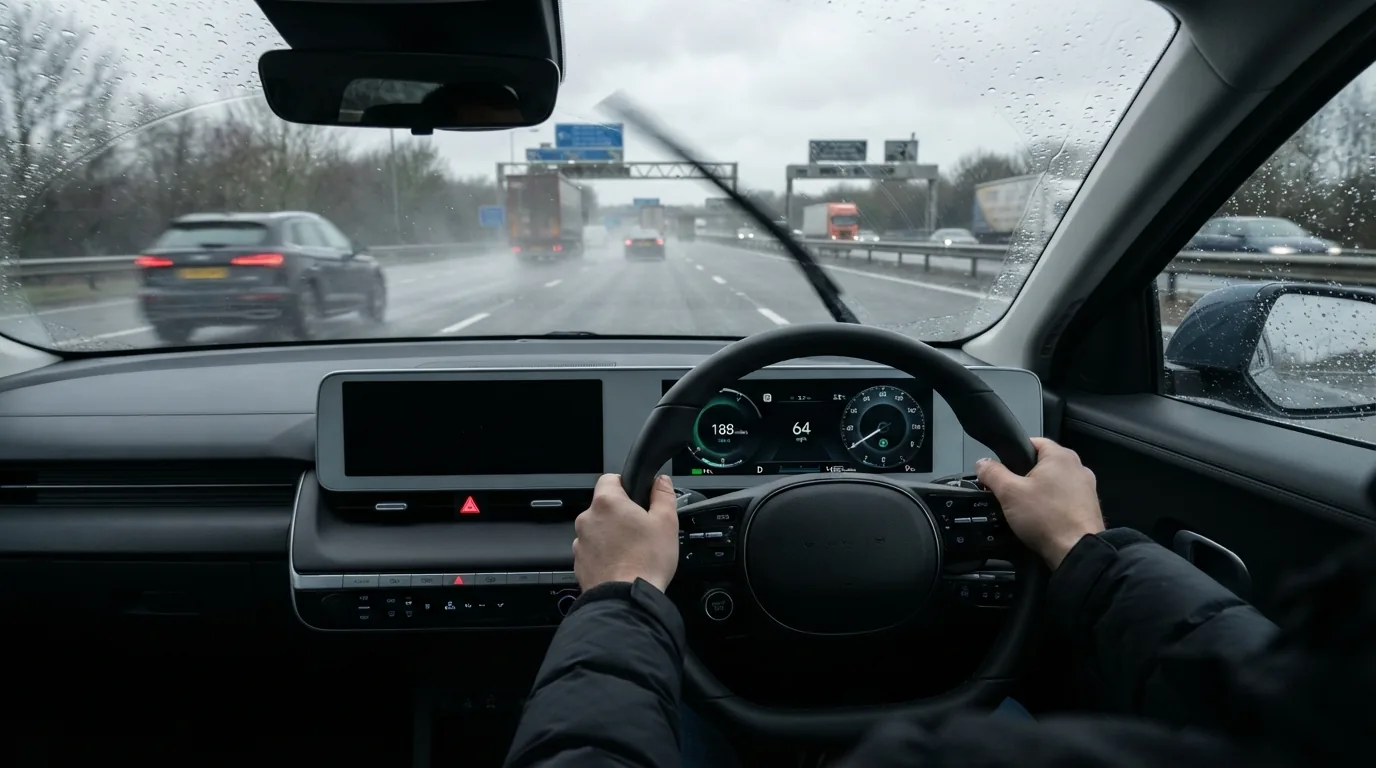
The WLTP figure printed on the window sticker is not a promise. It is a number measured in a laboratory under controlled conditions: 23 degrees Celsius, moderate speed cycling between slow urban and faster extra-urban sections, no air conditioning, flat terrain. Real UK driving involves motorways at 70mph, January temperatures of 2-5 degrees Celsius, the heater running constantly, and hills. The gap between WLTP and real-world can be significant.
The range estimator above lets you input your car’s WLTP figure, the temperature, your average speed, and whether you are using heating or air conditioning. It applies research-backed adjustment factors and returns an estimated real-world range for your specific conditions.
Use it before a long journey to decide whether you need a charge stop, or use it when comparing cars to understand which ones are genuinely efficient under UK driving patterns.
How the estimator works
The tool applies four adjustment factors to the WLTP figure:
-
Speed factor. Aerodynamic drag rises with the square of speed. At 50mph, drag is manageable. At 70mph (UK motorway limit), it rises sharply. At 80mph, it is dramatically higher again. The tool applies a 20-25% reduction for sustained 70mph motorway driving versus the WLTP cycle, and around 30-35% at 80mph.
-
Temperature factor. Battery chemistry slows at low temperatures, reducing both capacity and the rate at which the battery can deliver energy. At 10°C (a mild UK autumn day), the reduction is approximately 5-10%. At 0°C, it is around 15-20%. Below -5°C, you can see 25-35% range loss from battery performance alone, before heating load is added.
-
Cabin heating/cooling. Heating takes a significant share of range in cold weather. A resistive electric heater draws 2-4kW continuously, which on a 60kWh battery is a meaningful load. Heat pump systems, now standard on most new EVs sold in the UK in 2025-26, are roughly three times more efficient than resistive heaters and dramatically cut this penalty. The tool applies an 8-12% additional reduction for resistive heating in cold weather, and 4-6% for heat pump equipped cars. Air conditioning in summer is a smaller penalty: typically 2-5%.
-
Driving style factor. Smooth, anticipatory driving with gentle acceleration and coasting in regenerative braking mode can improve real-world range by 15-25% compared to aggressive motorway driving. The tool defaults to a typical mixed-style setting; adjust the slider for your own habits.
Results table: adjustment factors by condition
This table shows how the four factors compound on a car with a 300-mile WLTP rating.
| Condition | Adjustment | Estimated range |
|---|---|---|
| Mild summer, 50mph, no AC | 95% of WLTP | 285 miles |
| Mild summer, 70mph, AC on | 72% of WLTP | 216 miles |
| Autumn, 10°C, 70mph, heat pump | 68% of WLTP | 204 miles |
| Winter, 0°C, 70mph, heat pump | 60% of WLTP | 180 miles |
| Winter, 0°C, 70mph, resistive heat | 54% of WLTP | 162 miles |
| Cold winter, -5°C, 70mph, resistive heat | 48% of WLTP | 144 miles |
| City driving, 10°C, heat pump, gentle style | 85% of WLTP | 255 miles |
The critical takeaway: a car with 300 miles WLTP delivers roughly 216 miles on a mild summer motorway run and around 162 miles on a cold winter motorway run with older resistive heating. For planning long winter journeys, use the lower figure.
Why does motorway speed matter so much?
Aerodynamic drag is the dominant energy consumer at motorway speeds. It increases with the square of speed, so going from 60mph to 70mph does not increase drag by one-sixth; it increases it by almost 36%. Going from 60mph to 80mph doubles the drag force.
This is why efficiency figures measured on low-speed urban cycles bear little relation to motorway performance. A car that achieves 4.0 miles/kWh on a 30-40mph urban cycle might deliver only 2.7 miles/kWh at a sustained 70mph.
The aerodynamic shape of a car therefore matters enormously for real-world range at speed. The Hyundai Ioniq 6, with its 0.21 Cd drag coefficient (one of the lowest of any production car), retains range much better at motorway speeds than a bluff-fronted SUV with a 0.28-0.32 Cd. On a 400-mile WLTP car in each shape, the difference at 70mph can be 30-50 miles of real-world range.
How much does cold weather really cost?
UK winters sit mostly between -2°C and 10°C, with occasional colder spells. Using average UK winter data:
At 5°C with a heat pump and 70mph motorway driving, expect approximately 62-65% of WLTP range. At 0°C with resistive heating, this falls to around 52-56% of WLTP. In genuinely cold snaps below -5°C, range can drop to 48-50% of WLTP.
The difference between a heat pump and a resistive heater is therefore worth paying attention to when buying. Heat pumps became standard on most new EVs from around 2022-23 onwards: the Kia EV6, Hyundai Ioniq 5 and 6, Volkswagen ID. range, BMW iX3, Mercedes CLA Electric and most premium models all include them. Older Nissan Leafs and first-generation Zoe models use resistive heaters and suffer more in winter.
You can check whether your specific car has a heat pump in its technical specification sheet or by searching the EV Database UK.
The myth that WLTP is “optimistic” by a fixed amount
A common shorthand is that real-world range is “80% of WLTP.” This is a reasonable approximation for mixed UK driving in autumn or spring, but it is not a fixed law. The actual percentage varies from around 48% (cold motorway winter driving, older resistive heater) to over 90% (mild weather, gentle city driving).
The consequence is that two cars with identical WLTP figures can deliver very different real-world ranges depending on conditions. A Tesla Model 3 Long Range with excellent thermal management retains range much better in cold, sustained motorway driving than an older car with the same WLTP figure but inferior battery thermal management. Tesla’s active liquid cooling system keeps the battery in its optimal temperature window, which is why cold-weather range retention is relatively strong.
Similarly, the BMW iX3 Neue Klasse class-leading efficiency of around 4.0-4.1 miles/kWh under ideal conditions drops less sharply at motorway speeds than most rivals because of superior aerodynamics, even though both the iX3 and most SUV rivals meet the same WLTP test cycle.
Applying the estimator: planning a long UK journey
Say you are driving from Bristol to Edinburgh in January: approximately 380 miles. Your car has a 450-mile WLTP rating.
The naive plan is: one full charge, set off, arrive.
The estimator says: winter conditions at 70mph with a heat pump give approximately 60% of WLTP, so your realistic range is around 270 miles from a full charge. You will need at least one charging stop.
Planning with a 10-15% buffer (do not arrive at a charger on 2%), that means stopping when you have 40-50 miles of indicated range remaining. From Bristol, that is roughly at Carlisle or just south of the border, which maps well onto motorway service charging at junction 44 of the M6.
The estimator removes guesswork. Put in your WLTP figure, select January conditions at 70mph, and the range figure it returns is a realistic planning number, not an advertising claim.
Models with the best real-world range in UK conditions, 2026
These models score consistently well in real-world UK range tests, particularly in mixed and cold conditions:
Best overall real-world efficiency: Hyundai Ioniq 6 Long Range (RWD). WLTP 337 miles. Real-world mixed: approximately 275-295 miles. Strong thermal management, heat pump standard, 0.21 Cd drag coefficient.
Best cold-weather retention: Tesla Model 3 Long Range. WLTP 390 miles. Real-world winter motorway: approximately 240-260 miles. Active liquid thermal management keeps the battery temperature stable.
Best large SUV range: BMW iX3 Long Range. WLTP up to 500 miles. Real-world mixed: approximately 360-380 miles. Neue Klasse architecture delivers class-leading efficiency for an SUV.
Best budget real-world range: Renault 5 E-Tech 52kWh. WLTP 248 miles. Real-world mixed: approximately 195-210 miles. Good heat pump integration for its price point.
For the full ranked list by real-world range, see our longest range electric cars page, where we apply consistent real-world adjustments across the current UK market.
How to maximise your range in UK conditions
Use preconditioning. Start warming the cabin while still plugged in before departure. The car uses grid electricity rather than battery power, so you start a cold journey with a full battery and a warm cabin.
Drive smoothly. Anticipating junctions, roundabouts and queues to coast gently rather than braking hard maximises regeneration. In mixed urban driving, smooth technique can add 15-25% real-world range compared to aggressive braking.
Set regenerative braking to maximum. Most modern EVs allow you to select the level of regeneration. Maximum regen effectively gives you one-pedal driving in stop-start traffic and returns more energy to the battery.
Reduce speed on long trips. On a long motorway run where range is tight, dropping from 70mph to 60mph increases range by approximately 15-20%. It extends journey time but avoids an unexpected charge stop.
Charge to 100% before long winter trips. For daily driving, 80% is recommended for battery longevity. Before a long journey in winter, charge to 100% so you begin with maximum possible range.
Ready to plan your next journey?
Use the estimator at the top of this page for your specific car and conditions. For a broader comparison of how different EVs perform in the real world across the UK market, our guide to range and performance covers efficiency ratings, thermal management and charging curve data for the models currently on sale.
If you are choosing between cars and range is the deciding factor, our longest range electric cars page ranks them with consistent real-world adjustments applied, not just WLTP.
How we test and where our numbers come from
Range figures are official WLTP combined values taken from manufacturer UK specification pages, with real-world estimates drawn from independent comparative testing. Prices are UK list prices at the time of the latest update. Tax, grant and charging-scheme figures come from GOV.UK and HMRC publications. We re-check every guide when pricing, specification or policy changes. Last checked 11 August 2026.
Frequently asked questions
How far will your EV actually go in the UK?
The WLTP figure printed on the window sticker is not a promise. It is a number measured in a laboratory under controlled conditions: 23 degrees Celsius, moderate speed cycling between slow urban and faster extra-urban sections, no air conditioning, flat terrain.
Why does motorway speed matter so much?
Aerodynamic drag is the dominant energy consumer at motorway speeds. It increases with the square of speed, so going from 60mph to 70mph does not increase drag by one-sixth; it increases it by almost 36%.
How much does cold weather really cost?
At 5°C with a heat pump and 70mph motorway driving, expect approximately 62-65% of WLTP range. At 0°C with resistive heating, this falls to around 52-56% of WLTP.
Ready to plan your next journey?
Use the estimator at the top of this page for your specific car and conditions. For a broader comparison of how different EVs perform in the real world across the UK market, our guide to range and performance covers efficiency ratings, thermal management and charging curve data for the models currently on sale.

EV Compared
The EV Compared editorial team tracks the UK electric vehicle market full time: new model launches, list prices, WLTP and real-world range, public charging tariffs and the tax rules that decide what an EV actually costs to run. Every guide is checked against manufacturer specifications and official GOV.UK figures, and updated whenever the numbers move.
Related reading
View all
Do Bigger Wheels Reduce Electric Car Range?
Yes, significantly. Here is the data on how much wheel size costs in miles and why it happens
BMW i4 vs Tesla Model 3: UK Range and Efficiency Test
The BMW costs more and goes less far, but is it worth it? A data-led head to head for UK buyers
How Far Can an Electric Car Really Go on One Charge?
Real-world range figures for UK drivers: what the numbers mean and which cars go furthest