Why Does Your EV Range Drop on the Motorway?
The physics and numbers behind why motorway driving cuts your electric car's range more than any other factor
Quick answers
- At a sustained 70 mph on a UK motorway, most electric cars deliver 20 to 30 per cent less range than their official WLTP figure. At 80 mph, the penalty rises to 30 to 35 per cent.
- The physics: why speed hits EVs hard: Aerodynamic drag force increases with the square of velocity.
- The gap between mixed-condition real-world range and sustained 70 mph motorway range varies by model.
- The WLTP test average speed problem: The specific issue with WLTP is that its average speed of 29 mph bears little resemblance to UK motorway driving.
- Winter on the motorway: the double hit: In cold weather, two range-reducing factors stack on top of each other.
- What can you do about it: On smart motorways and when traffic allows, 60 mph uses substantially less energy than 70 mph.
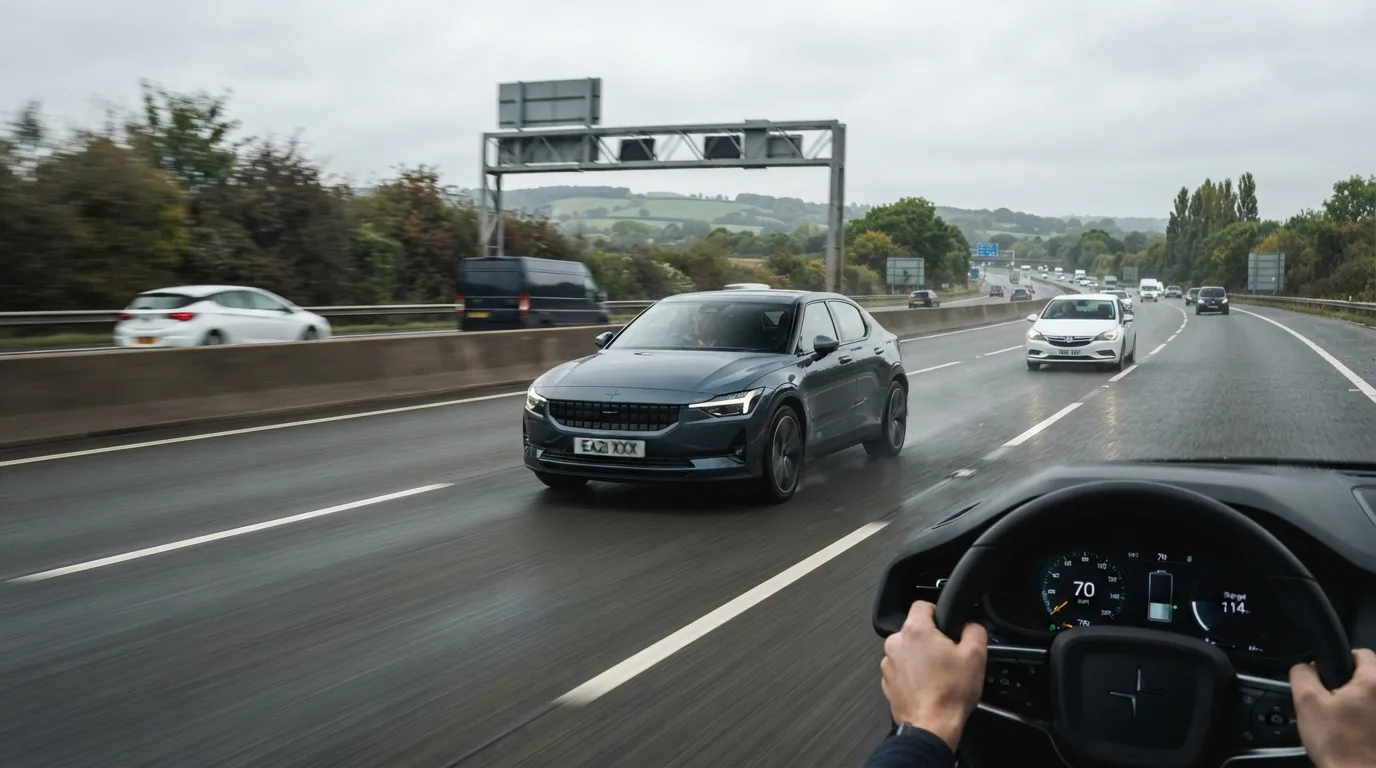
At a sustained 70 mph on a UK motorway, most electric cars deliver 20 to 30 per cent less range than their official WLTP figure. At 80 mph, the penalty rises to 30 to 35 per cent. This is the biggest real-world gap most EV drivers experience, and it comes down almost entirely to aerodynamic drag.
The WLTP test cycle averages just 29 mph. At that speed, aerodynamic forces are modest. At 70 mph, the car must work against drag forces that are roughly six times greater than at 29 mph, per unit distance travelled. The battery empties faster, and the range you see on the motorway is consistently and significantly lower than the figure on the sticker.
The physics: why speed hits EVs hard
Aerodynamic drag force increases with the square of velocity. Double your speed, and drag quadruples. But the energy required to overcome that drag at speed increases with the cube of velocity. In plain terms: going twice as fast takes around eight times as much energy to overcome air resistance per unit of time.
In practice, moving from 50 mph to 70 mph on a UK road increases energy consumption per mile by roughly 30 per cent for a typical modern EV. Move from 50 mph to 80 mph, and the increase is around 45 per cent per mile.
The same physics applies to petrol cars, but EV buyers are more acutely aware of it because the WLTP figure makes a specific promise about range, and the motorway figure is so noticeably lower.
How much range do specific cars lose at 70 mph?
The gap between mixed-condition real-world range and sustained 70 mph motorway range varies by model. Aerodynamically optimised cars lose proportionally less; boxy SUVs lose more.
| Car | WLTP Range | 70 mph Motorway Range (est.) | % of WLTP |
|---|---|---|---|
| Hyundai Ioniq 6 RWD | 338 miles | ~255-270 miles | 75-80% |
| Tesla Model 3 Long Range | 466 miles | ~348-373 miles | 75-80% |
| BMW i4 eDrive40 | 367 miles | ~275-310 miles | 75-85% |
| Volkswagen ID.7 Pro S | 434 miles | ~325-368 miles | 75-85% |
| Kia EV6 Long Range RWD | 361 miles | ~265-295 miles | 73-82% |
| Hyundai Ioniq 5 Long Range | 354 miles | ~250-280 miles | 71-79% |
| BMW iX xDrive50 | 381 miles | ~265-300 miles | 70-79% |
| Volkswagen ID.4 Pro | 323 miles | ~220-255 miles | 68-79% |
The Hyundai Ioniq 6, with its class-leading drag coefficient of 0.21 (better than a Porsche Taycan), is consistently among the most efficient cars at motorway speeds relative to its WLTP figure. The Tesla Model 3’s Cd of 0.23 similarly limits the high-speed penalty.
The WLTP test average speed problem
The specific issue with WLTP is that its average speed of 29 mph bears little resemblance to UK motorway driving. The test does include an “extra high” speed segment reaching up to 130 km/h (about 81 mph), but that segment is brief. The weighted average of the full cycle is only 46.5 km/h (29 mph). A car can score an excellent WLTP figure while still being relatively poor at sustained high-speed driving.
This is not a flaw that manufacturers exploit deliberately; it is a limitation of any single standardised test cycle trying to represent diverse driving patterns. But it is a real source of surprise for motorway-heavy drivers who assumed their car’s WLTP figure was a motorway range.
Winter on the motorway: the double hit
In cold weather, two range-reducing factors stack on top of each other. The aerodynamic drag at 70 mph is already draining the battery faster than WLTP suggests. Add a 4 to 5 kW cabin heater, and a cold battery operating below its peak efficiency, and the effective motorway range on a cold January day can be 35 to 45 per cent below WLTP.
A rough rule: for cold-weather motorway driving at 70 mph, use 60 to 65 per cent of WLTP as your planning figure.
| Condition | Planning Multiplier (vs WLTP) |
|---|---|
| Mild day, 70 mph | ~75% |
| Cold day (below 5°C), 70 mph | ~65-68% |
| Cold day (below 5°C), 70 mph, no heat pump | ~58-63% |
| Mild day, 80 mph | ~70% |
| Cold day (below 5°C), 80 mph | ~58-62% |
What can you do about it?
Drive at 60 mph where possible
On smart motorways and when traffic allows, 60 mph uses substantially less energy than 70 mph. The energy saving from dropping 10 mph is roughly 15 per cent per mile. On a 200-mile motorway journey, this could add 25 to 35 miles of range.
Use Eco mode
Most EVs have an Eco or efficiency mode that limits maximum power, adjusts regen braking aggressively, and sometimes restricts climate control. Eco mode on the motorway can improve range by 5 to 10 per cent in typical conditions.
Pre-heat the car while charging
If you can warm the cabin before disconnecting at your departure point, the heater load during the motorway run is much reduced. This is especially valuable on cold mornings.
Plan charge stops based on motorway range, not WLTP
If your car is rated at 300 miles WLTP, plan motorway charge stops as if the real range is 210 to 225 miles. Charge to 80 per cent for fast charging (not 100 per cent, which takes disproportionately longer at many chargers), and target leaving each charge stop with a sensible buffer to your next stop.
Choose an aerodynamic car if motorways dominate
If your daily driving is predominantly motorway, the drag coefficient of your chosen EV matters more than the WLTP headline. A car with a Cd under 0.25 will hold its range far better at speed than a Cd of 0.30 or above. The Hyundai Ioniq 6 (0.21), Tesla Model 3 (0.23) and Polestar 2 (0.25) are standouts in the mid-market. The Mercedes EQS (0.20) leads the premium segment.
What is the key myth to correct?
Many buyers assume that a car’s motorway range is roughly equivalent to its WLTP range. It is not. WLTP is a mixed-speed test that flatters the high-speed performance of every model. The actual motorway range at 70 mph is consistently 20 to 30 per cent lower than the WLTP figure, sometimes more.
A car listed at 300 miles WLTP does not do 300 miles on a motorway. It does roughly 210 to 225 miles at 70 mph in mild conditions. Building this correction into your expectations before you buy will prevent disappointment.
For more on the factors that shape EV range, visit the range and performance hub. To see which cars hold their range best at speed, check our longest range electric cars guide and the efficiency rankings within it.
Sources: WLTP test cycle methodology documentation, EV Database aerodynamic data, independent road test efficiency figures from Autocar and What Car?, manufacturer specifications.
How we test and where our numbers come from
Range figures are official WLTP combined values taken from manufacturer UK specification pages, with real-world estimates drawn from independent comparative testing. Prices are UK list prices at the time of the latest update. Tax, grant and charging-scheme figures come from GOV.UK and HMRC publications. We re-check every guide when pricing, specification or policy changes. Last checked 11 August 2026.
Frequently asked questions
How much range do specific cars lose at 70 mph?
The gap between mixed-condition real-world range and sustained 70 mph motorway range varies by model. Aerodynamically optimised cars lose proportionally less; boxy SUVs lose more.
What can you do about it?
On smart motorways and when traffic allows, 60 mph uses substantially less energy than 70 mph. The energy saving from dropping 10 mph is roughly 15 per cent per mile.
What is the key myth to correct?
Many buyers assume that a car's motorway range is roughly equivalent to its WLTP range. It is not.

EV Compared
The EV Compared editorial team tracks the UK electric vehicle market full time: new model launches, list prices, WLTP and real-world range, public charging tariffs and the tax rules that decide what an EV actually costs to run. Every guide is checked against manufacturer specifications and official GOV.UK figures, and updated whenever the numbers move.
Related reading
View all
Do Bigger Wheels Reduce Electric Car Range?
Yes, significantly. Here is the data on how much wheel size costs in miles and why it happens
BMW i4 vs Tesla Model 3: UK Range and Efficiency Test
The BMW costs more and goes less far, but is it worth it? A data-led head to head for UK buyers
How Far Can an Electric Car Really Go on One Charge?
Real-world range figures for UK drivers: what the numbers mean and which cars go furthest