How Does EV Charging Cost Compare to Petrol Per Mile?
Home charging wins clearly -- public charging is closer than you might think. UK figures for 2026.
Quick answers
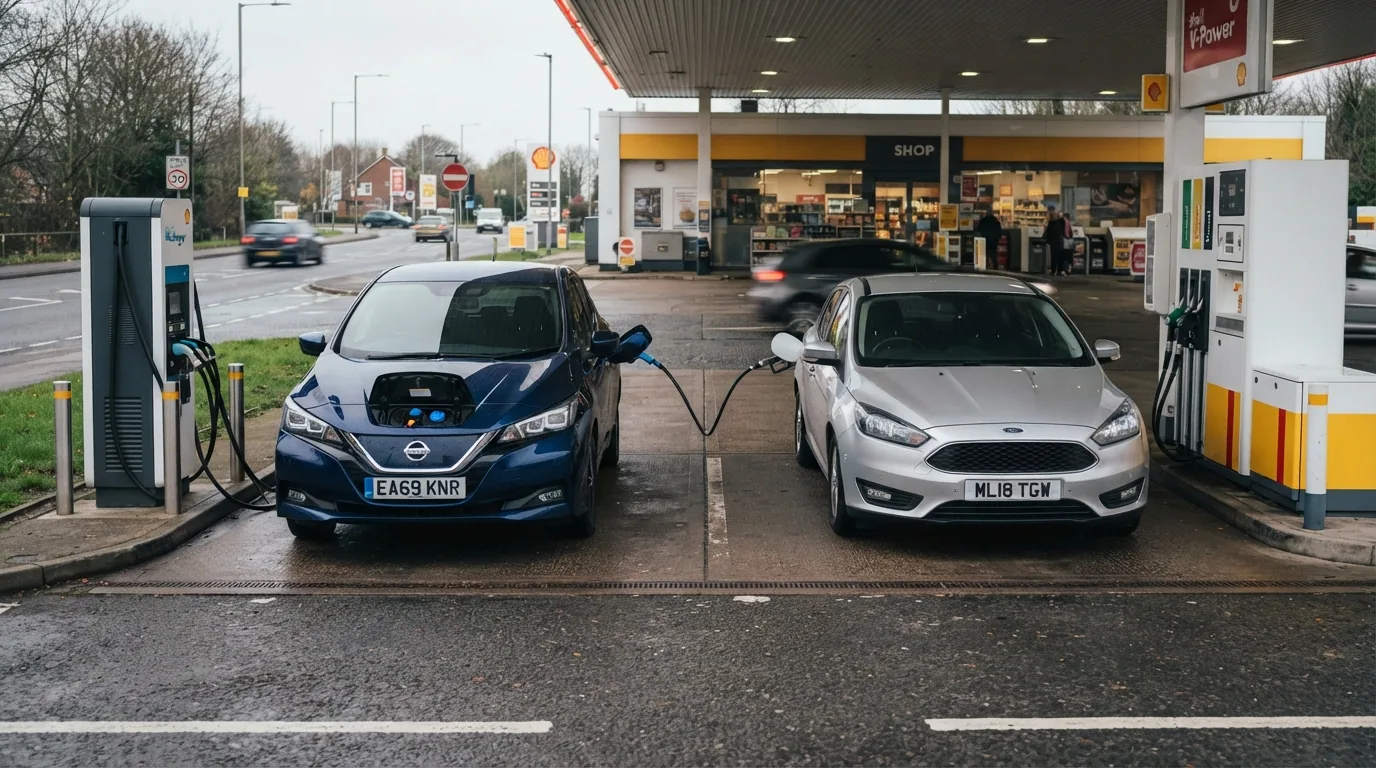
- An electric car charged at home costs around 2 to 7 pence per mile depending on your tariff -- compared to roughly 14 to 18 pence per mile for a petrol car at current UK pump prices. On the cheapest home EV tariffs, you pay less than a third of what petrol costs per mile.
- What does petrol cost per mile in 2026: For a petrol car doing 40 mpg -- roughly what a Volkswagen Golf, Ford Focus or Toyota Corolla achieves in real-world UK driving -- the fuel cost is 17 to 18p per mile.
- EV cost per mile is driven by two things: the electricity rate you pay and how efficiently your car uses it.
- Head-to-head: EV vs petrol by scenario: This table is the clearest possible illustration of why charging behaviour matters more than which car you buy.
- The crossover breaks down on rapid and ultra-rapid DC chargers.
- Why does 80% of EV charging happen at home: The Zap-Map annual survey consistently finds that around 80% of EV charging occurs at home or at work.
An electric car charged at home costs around 2 to 7 pence per mile depending on your tariff — compared to roughly 14 to 18 pence per mile for a petrol car at current UK pump prices. On the cheapest home EV tariffs, you pay less than a third of what petrol costs per mile. But charge exclusively on public rapid chargers and the gap narrows to almost nothing, and can even reverse.
What does petrol cost per mile in 2026?
UK petrol averaged around £1.57 per litre in May 2026. The cost per mile depends on your car’s real-world fuel economy:
| Petrol car MPG (real world) | Cost per mile at £1.57/litre |
|---|---|
| 35 mpg (large SUV, average) | ~20p |
| 40 mpg (typical family car) | ~17.8p |
| 45 mpg (efficient saloon) | ~15.8p |
| 55 mpg (hybrid or small car) | ~12.9p |
For a petrol car doing 40 mpg — roughly what a Volkswagen Golf, Ford Focus or Toyota Corolla achieves in real-world UK driving — the fuel cost is 17 to 18p per mile. Diesel is broadly similar at current pump prices.
What does EV charging cost per mile in 2026?
EV cost per mile is driven by two things: the electricity rate you pay and how efficiently your car uses it. Most modern EVs achieve 3.5 to 4.5 miles per kWh in UK real-world conditions.
| Charging source | Rate (p/kWh) | Cost per mile at 4 mi/kWh |
|---|---|---|
| Home off-peak EV tariff (Octopus Go, OVO Drive) | ~7—9p | ~1.8—2.3p |
| Home standard tariff (Ofgem Q2 2026) | 24.67p | ~6.2p |
| Public slow/AC (Zap-Map average, April 2026) | 54p | ~13.5p |
| Public rapid/DC (Zap-Map average, April 2026) | 79p | ~19.8p |
| Public ultra-rapid (150 kW+, pay as you go) | 85—99p | ~21—25p |
The spread is enormous: from under 2p per mile on a night tariff to over 25p per mile on an ultra-rapid charger without a subscription.
Head-to-head: EV vs petrol by scenario
| Scenario | Cost per mile | Cheaper option |
|---|---|---|
| EV on home off-peak tariff | ~2p | EV by 9x |
| EV on standard home tariff | ~6.2p | EV by 3x |
| EV on public slow charger | ~13.5p | EV marginally cheaper |
| Petrol car, 40 mpg, £1.57/litre | ~17.8p | — |
| EV on public rapid charger | ~19.8p | Petrol marginally cheaper |
| EV on ultra-rapid without subscription | ~23p | Petrol cheaper |
This table is the clearest possible illustration of why charging behaviour matters more than which car you buy.
Does public charging ever beat petrol on cost?
Sometimes. According to Zap-Map’s April 2026 data, slow AC public chargers at an average of 54p per kWh deliver electricity at roughly 13.5p per mile — cheaper than the 17 to 18p per mile for a 40-mpg petrol car. Transport & Energy analysis published in April 2026 confirmed that public EV charging is cheaper than petrol for most drivers using standard-speed chargers.
The crossover breaks down on rapid and ultra-rapid DC chargers. At 79p per kWh and above, you are paying 19 to 25p per mile — more than petrol in most cases. Drivers who can pick and choose their chargers, mixing slow destination charging with occasional rapids, can still keep their per-mile cost competitive.
Why does 80% of EV charging happen at home?
The Zap-Map annual survey consistently finds that around 80% of EV charging occurs at home or at work. This is rational: home charging is by far the cheapest option, most EV batteries are large enough to cover typical daily driving from a single overnight charge, and home charging is more convenient than stopping at a public point.
The implication for cost comparisons is that most EV drivers pay closer to the home tariff numbers than the public charging numbers. A driver who charges 80% at home on a standard tariff and 20% on slow public chargers pays a weighted average of roughly 28p per kWh — giving a per-mile cost of about 7p. That is still less than half of petrol.
What about the annual savings across the board?
For a driver doing 10,000 miles per year:
| Scenario | Annual fuel/charging cost | vs. 40 mpg petrol (£1,780/yr) |
|---|---|---|
| 100% home, off-peak tariff | ~£218 | Save £1,562 |
| 100% home, standard tariff | ~£620 | Save £1,160 |
| 80% home / 20% public slow | ~£720 | Save £1,060 |
| 80% home / 20% public rapid | ~£820 | Save £960 |
| 50% home / 50% public rapid | ~£1,100 | Save £680 |
| 100% public rapid | ~£1,980 | Break even or worse |
What is the common myth about EV charging costs?
That rapid public charging costs represent what most EV drivers actually pay. Media coverage of 99p-per-kWh ultra-rapid pricing creates a misleading impression. These rates apply to pay-as-you-go users at specific premium networks. Network subscription plans, slower chargers, and above all home charging mean the real-world average is substantially lower.
The other myth is that EV running costs are always cheaper regardless of circumstances. They are not — for drivers without home charging who rely entirely on rapids, the economics can be neutral or mildly worse than a comparable efficient petrol car.
How do subscriptions affect the comparison?
Several networks offer monthly subscription plans that unlock lower per-kWh rates. BP Pulse, for example, offers a monthly membership that reduces its rapid charging rate significantly from the pay-as-you-go price. For a driver who regularly uses a specific network, the maths can shift meaningfully. Run the sums: if you pay £8 per month and save 15p per kWh on 100 kWh of monthly charging, you save £15 per month in energy costs minus the £8 subscription — a net gain of £7. The break-even point depends entirely on how much you charge at that particular network.
What changes are coming?
From April 2028, a government-proposed pay-per-mile EV levy of around 3p per mile would add directly to the charging comparison, pushing effective EV cost per mile up by 3p. This would reduce but not eliminate the advantage over petrol in most home-charging scenarios. It would put public-rapid-charging EV drivers at a clear disadvantage compared to petrol.
Electricity prices remain tied to the Ofgem price cap cycle. Petrol prices track global oil markets. Both are volatile, which means the per-mile comparison will shift over the years of any car ownership cycle.
Where to go next
For a full breakdown of all costs — not just fuel — see our EV running costs and tax hub.
To see which cars are cheapest to run overall, including efficiency, tax and insurance, visit our cheapest electric cars to run page.
How we test and where our numbers come from
Range figures are official WLTP combined values taken from manufacturer UK specification pages, with real-world estimates drawn from independent comparative testing. Prices are UK list prices at the time of the latest update. Tax, grant and charging-scheme figures come from GOV.UK and HMRC publications. We re-check every guide when pricing, specification or policy changes. Last checked 11 August 2026.
Frequently asked questions
What does petrol cost per mile in 2026?
For a petrol car doing 40 mpg -- roughly what a Volkswagen Golf, Ford Focus or Toyota Corolla achieves in real-world UK driving -- the fuel cost is 17 to 18p per mile. Diesel is broadly similar at current pump prices.
What does EV charging cost per mile in 2026?
EV cost per mile is driven by two things: the electricity rate you pay and how efficiently your car uses it. Most modern EVs achieve 3.5 to 4.5 miles per kWh in UK real-world conditions.
Does public charging ever beat petrol on cost?
Sometimes. According to Zap-Map's April 2026 data, slow AC public chargers at an average of 54p per kWh deliver electricity at roughly 13.5p per mile -- cheaper than the 17 to 18p per mile for a 40-mpg petrol car.
Why does 80% of EV charging happen at home?
The Zap-Map annual survey consistently finds that around 80% of EV charging occurs at home or at work. This is rational: home charging is by far the cheapest option, most EV batteries are large enough to cover typical daily driving from a single overnight charge, and home charging is more convenient than stopping at a public point.
What is the common myth about EV charging costs?
That rapid public charging costs represent what most EV drivers actually pay. Media coverage of 99p-per-kWh ultra-rapid pricing creates a misleading impression.

EV Compared
The EV Compared editorial team tracks the UK electric vehicle market full time: new model launches, list prices, WLTP and real-world range, public charging tariffs and the tax rules that decide what an EV actually costs to run. Every guide is checked against manufacturer specifications and official GOV.UK figures, and updated whenever the numbers move.
Related reading
View all
What Are the Biggest Myths About Switching to an EV?
The claims that put UK drivers off going electric, and what the evidence actually says
Should You Buy an EV in 2026 or Wait for Cheaper Models?
An honest look at where EV prices are heading and whether the wait is worth it for UK buyers
Buying and Owning an Electric Car in the UK: The Complete 2026 Guide
Everything you need to know about costs, charging, depreciation and day-to-day life with an EV