What Happens to an EV Battery at the End of Its Life?
Second-life energy storage, recycling processes and what UK infrastructure exists for end-of-life EV batteries
Quick answers
- When an electric car battery is no longer suitable for automotive use, it does not go straight to landfill. Modern EV batteries follow a structured end-of-life pathway that typically includes a second life as stationary energy storage, followed by recycling to recover valuable raw materials.
- When does an EV battery reach end of life: The 70% threshold used in manufacturer warranties is also used by the industry as the practical definition of end of automotive life.
- Before recycling, most retired EV batteries are redirected into stationary energy storage applications.
- Stage 2: Recycling: After the second life is exhausted, or in cases where batteries are too damaged or non-uniform to repurpose, they enter the recycling stream.
- The EU Battery Regulation and UK alignment: The EU Battery Regulation, which came into force in 2023 and is being phased in through 2026 to 2030, introduces battery passports for industrial and EV batteries.
- What does this mean for EV buyers: The environmental case for EVs has always depended partly on what happens at battery end of life.
When an electric car battery is no longer suitable for automotive use, it does not go straight to landfill. Modern EV batteries follow a structured end-of-life pathway that typically includes a second life as stationary energy storage, followed by recycling to recover valuable raw materials. Both stages are now commercially established in the UK.
The direct answer: an EV battery is considered at end of automotive life when its capacity falls below roughly 70 to 80% of original. At that point, it is typically repurposed as a stationary energy storage unit for homes, businesses or grid support, extending its useful life by another 5 to 10 years. After that, it enters a recycling stream where modern facilities can recover up to 95% of battery materials including lithium, cobalt, nickel and copper.
When does an EV battery reach end of life?
The 70% threshold used in manufacturer warranties is also used by the industry as the practical definition of end of automotive life. Below 70% of original capacity, the battery provides insufficient range for most driving use cases, and the economics of continued EV use begin to break down.
In practice, reaching this threshold under normal driving conditions takes much longer than most people assume. Real-world degradation data from over 22,000 vehicles shows an average of 2.3% capacity loss per year. At that rate:
- Reaching 80% capacity takes approximately 8 to 9 years
- Reaching 70% capacity takes approximately 13 to 15 years
For the majority of UK owners, the battery will outlast their ownership of the vehicle. When they sell the car, the battery becomes the next owner’s asset and is likely still well within warranty.
Stage 1: Second life as stationary energy storage
Before recycling, most retired EV batteries are redirected into stationary energy storage applications. At 70% of original automotive capacity, a battery may retain 40 to 50 kWh of usable energy, which is more than enough for home or commercial energy storage.
Second-life applications in the UK include:
Home energy storage. Companies including Connected Energy and UK-based startups are refurbishing retired EV modules into home battery units. These store solar energy generated during the day for use in the evening, or allow homeowners to charge from the grid during off-peak hours. The cost of second-life batteries is substantially lower than new cells, making home storage economically viable for more households.
Commercial and industrial storage. Larger retired battery packs are deployed in commercial settings: smoothing electricity demand peaks, storing renewable energy from solar or wind installations, and providing backup power for facilities. The Volkswagen Group partnered with several energy companies to create industrial-scale second-life storage systems using retired ID.3 and ID.4 battery packs.
Grid support. National Grid and distribution network operators are increasingly interested in large-format second-life storage as a buffer for renewable intermittency. The economics depend on battery cost and cycle efficiency, but second-life cells are increasingly competitive for low-cycle applications.
The typical second life of an automotive battery in stationary storage extends 5 to 10 years, significantly improving the whole-life environmental and economic return on the materials used.
Stage 2: Recycling
After the second life is exhausted, or in cases where batteries are too damaged or non-uniform to repurpose, they enter the recycling stream. The UK now has an established battery recycling infrastructure. Estimates suggest the UK will have 28,000 tonnes of batteries requiring recycling by 2030.
The recycling process:
-
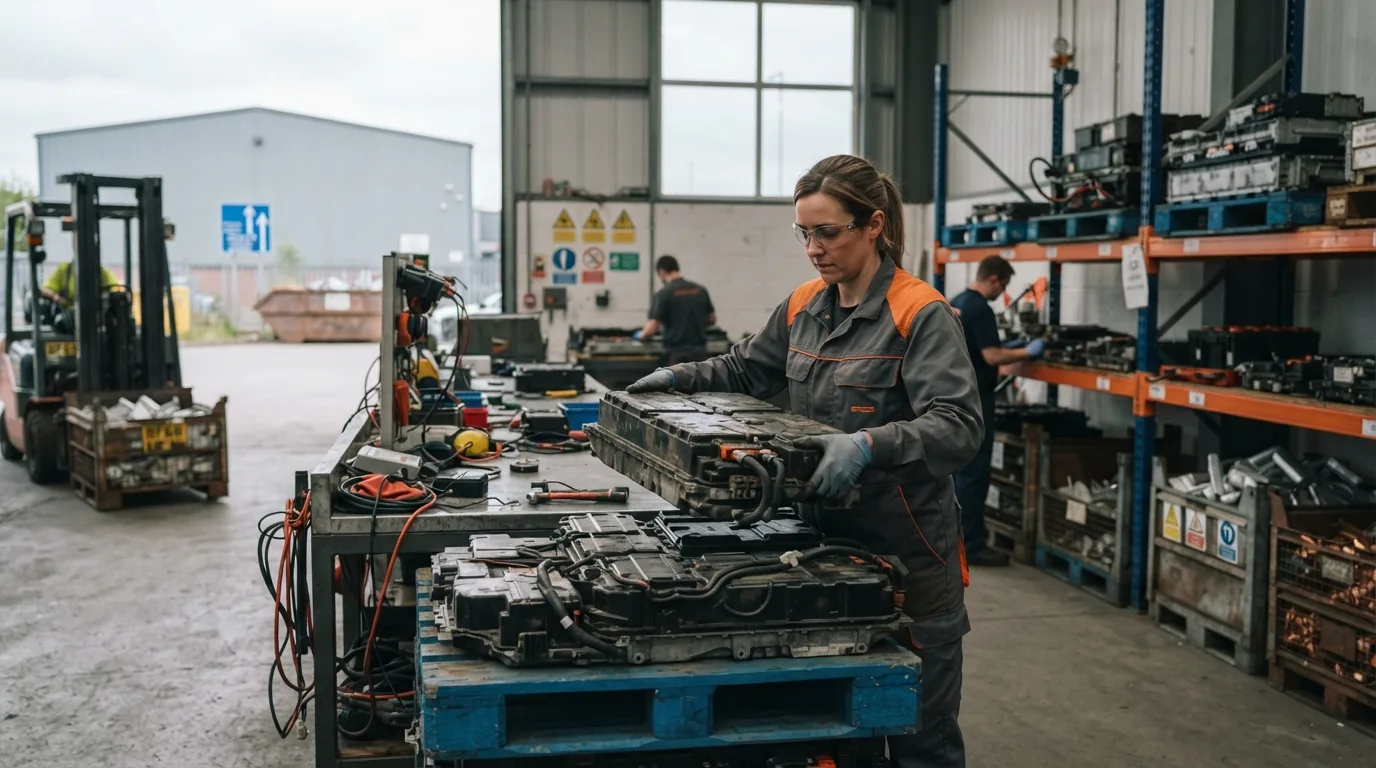
Collection and discharge. Batteries are collected under strict safety regulations, and any remaining electrical charge is safely discharged before handling.
-
Disassembly. Packs are broken down into modules and cells. This step is largely manual at present due to the variation in battery designs; automation is advancing but not yet widespread.
-
Material separation. Mechanical and hydrometallurgical (chemical) processes separate the valuable materials. Modern facilities can recover:
- Lithium (used in new batteries)
- Cobalt (still used in NMC cells, though proportions are declining)
- Nickel
- Copper (from wiring and current collectors)
- Aluminium and steel from the casing
-
Black mass processing. The remaining electrode material, known as black mass, is processed to extract lithium, cobalt and nickel salts for reuse in battery manufacturing.
By 2026, leading UK and European recycling facilities can recover up to 95% of battery materials by weight. The recovered materials re-enter the supply chain for new battery manufacturing, reducing dependence on newly mined materials.
The EU Battery Regulation and UK alignment
The EU Battery Regulation, which came into force in 2023 and is being phased in through 2026 to 2030, introduces battery passports for industrial and EV batteries. A battery passport is a digital record containing information about the battery’s composition, state of health, chain of custody and recycling requirements. UK legislation has not yet fully mirrored this, but many manufacturers selling in both markets are adopting it anyway.
Battery passports make it easier to track batteries through their entire lifecycle, improving the economics of both second-life deployment and recycling by providing accurate data on remaining capacity and composition.
What does this mean for EV buyers?
The environmental case for EVs has always depended partly on what happens at battery end of life. The answer in 2026 is significantly more positive than it was five years ago: second-life use is established, recycling rates are high, and the infrastructure is growing.
For buyers, the practical implications are:
- The residual value of an EV battery is not zero at end of automotive life; second-life programmes from manufacturers (Renault, Volkswagen, Nissan) offer routes to sell retired packs
- The environmental impact of EV battery production is amortised over a much longer period when second life is counted
- Battery passports will eventually make it much easier to verify a used EV battery’s history, improving transparency in the used car market
What about replacing a battery rather than retiring it?
Not all batteries at end of automotive life are retired. Some are refurbished (individual degraded modules replaced), extending their life in the original vehicle at lower cost than a full replacement. The growing UK market in independent EV specialists is making this option more accessible. A Nissan Leaf battery refurbishment, for example, replacing two or three degraded modules, might cost £1,500 to £2,500 rather than £8,000 for a full OEM replacement.
What should you read next?
For how long batteries last in service before reaching end of life, see our guide on how long electric car batteries last. For model recommendations including battery warranty terms, visit best electric cars to buy in 2026. The full picture of EV ownership is in the buying and owning guide.
How we test and where our numbers come from
Range figures are official WLTP combined values taken from manufacturer UK specification pages, with real-world estimates drawn from independent comparative testing. Prices are UK list prices at the time of the latest update. Tax, grant and charging-scheme figures come from GOV.UK and HMRC publications. We re-check every guide when pricing, specification or policy changes. Last checked 11 August 2026.
Frequently asked questions
When does an EV battery reach end of life?
The 70% threshold used in manufacturer warranties is also used by the industry as the practical definition of end of automotive life. Below 70% of original capacity, the battery provides insufficient range for most driving use cases, and the economics of continued EV use begin to break down.
What does this mean for EV buyers?
The environmental case for EVs has always depended partly on what happens at battery end of life. The answer in 2026 is significantly more positive than it was five years ago: second-life use is established, recycling rates are high, and the infrastructure is growing.
What about replacing a battery rather than retiring it?
Not all batteries at end of automotive life are retired. Some are refurbished (individual degraded modules replaced), extending their life in the original vehicle at lower cost than a full replacement.
What should you read next?
For how long batteries last in service before reaching end of life, see our guide on how long electric car batteries last. For model recommendations including battery warranty terms, visit best electric cars to buy in 2026.

EV Compared
The EV Compared editorial team tracks the UK electric vehicle market full time: new model launches, list prices, WLTP and real-world range, public charging tariffs and the tax rules that decide what an EV actually costs to run. Every guide is checked against manufacturer specifications and official GOV.UK figures, and updated whenever the numbers move.
Related reading
View all
What Are the Biggest Myths About Switching to an EV?
The claims that put UK drivers off going electric, and what the evidence actually says
Should You Buy an EV in 2026 or Wait for Cheaper Models?
An honest look at where EV prices are heading and whether the wait is worth it for UK buyers
Buying and Owning an Electric Car in the UK: The Complete 2026 Guide
Everything you need to know about costs, charging, depreciation and day-to-day life with an EV