How to Cut Your EV Charging Costs to Under 5p Per Mile
The tariffs, techniques and habits that get home charging below 5p per mile -- and sometimes well below
Quick answers
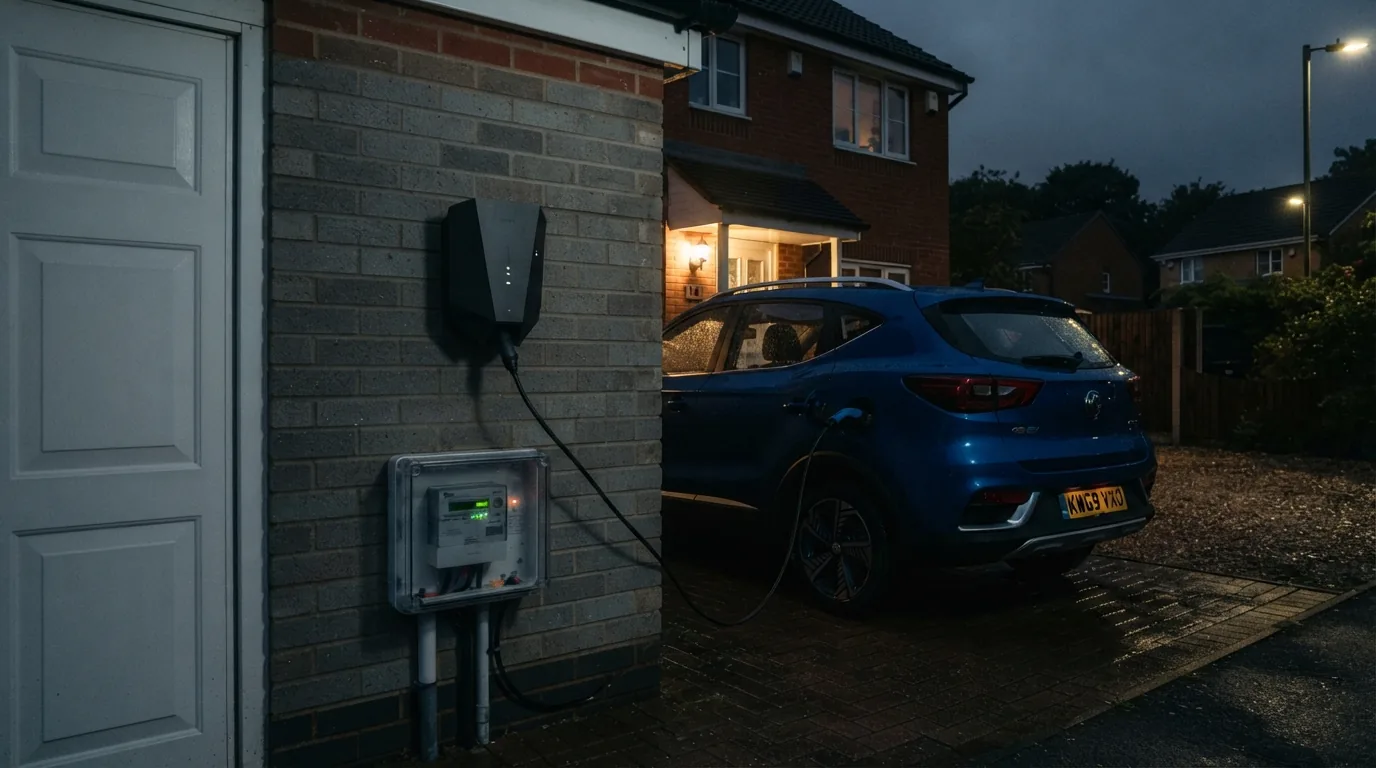
- Charging an EV at home to under 5p per mile is achievable for most drivers who have access to a home charger and are willing to switch to a dedicated EV energy tariff. On Octopus Intelligent Go's reduced April 2026 rate of 5.49p per kWh, a car doing 4 miles per kWh costs 1.37p per mile to charge.
- What does sub-5p per mile require: Two things: a home charger, and an EV-specific or time-of-use energy tariff.
- Which tariff is best for achieving sub-5p: As of April 2026, the off-peak rate is 5.49p/kWh between approximately 23:30 and 05:30, though the exact window shifts to optimise grid use.
- You can still access off-peak rates on any time-of-use tariff by setting your car or charger to begin charging at the start of the off-peak window using the built-in scheduler.
- The other variable in the per-mile equation is the car's real-world efficiency.
- What about the standard rate: If you stay on a standard variable tariff at the Ofgem rate (around 24.67p/kWh in Q2 2026), home charging costs roughly 6.2p per mile at 4 mi/kWh.
Charging an EV at home to under 5p per mile is achievable for most drivers who have access to a home charger and are willing to switch to a dedicated EV energy tariff. On Octopus Intelligent Go’s reduced April 2026 rate of 5.49p per kWh, a car doing 4 miles per kWh costs 1.37p per mile to charge. Even on Octopus Agile during typical overnight windows, rates of 2p to 5p per kWh are common — delivering per-mile costs below 2p. These are not exceptional cases; they are the standard experience for UK EV drivers on the right tariff.
What does sub-5p per mile require?
Two things: a home charger, and an EV-specific or time-of-use energy tariff. Without a home charger, you cannot access overnight off-peak rates, and you will be paying public charging prices of 54p to 99p per kWh — far above the threshold.
The maths is simple:
Cost per mile = electricity rate (p/kWh) ÷ real-world efficiency (miles per kWh)
To hit 5p per mile with a car achieving 4 miles per kWh, you need electricity at 20p/kWh or below. To hit 2p per mile at 4 mi/kWh, you need electricity at 8p/kWh or below. The dedicated EV tariffs all deliver that overnight.
| Tariff | Off-peak rate (approx. May 2026) | Cost per mile at 4 mi/kWh |
|---|---|---|
| Octopus Intelligent Go | 5.49p/kWh | ~1.4p |
| Octopus Go | 6.99p/kWh | ~1.75p |
| British Gas Electric Drivers (midnight—5am) | ~7.9p/kWh | ~2.0p |
| Octopus Agile (overnight lows) | 2p — 8p/kWh | ~0.5p — 2p |
| E.ON Next Drive Smart | ~8p/kWh | ~2p |
| Standard Ofgem rate (no EV tariff) | 24.67p/kWh | ~6.2p |
Which tariff is best for achieving sub-5p?
Octopus Intelligent Go
The most popular EV tariff in the UK. The off-peak window applies to your entire home (not just EV charging), and importantly, Intelligent Octopus Go manages your charger automatically — it sends charge commands to compatible chargers and vehicles to fill up during the cheapest overnight period without you needing to set a timer.
As of April 2026, the off-peak rate is 5.49p/kWh between approximately 23:30 and 05:30, though the exact window shifts to optimise grid use. At this rate, a 60 kWh battery costs about £3.29 to charge from near-empty overnight. A driver doing 10,000 miles per year at 4 mi/kWh needs roughly 2,500 kWh annually, costing around £137 — under £140 per year in fuel.
Compatible vehicles include most modern EVs with smart charging capability — Tesla, Volkswagen Group, Hyundai, Kia, BMW, Mercedes and others. A compatible home charger (Ohme, Indra, Zappi, or certain Pod Point units) is required.
Octopus Agile
The more advanced option for drivers willing to engage with dynamic pricing. Agile is a half-hourly variable tariff tracking wholesale electricity prices. Overnight rates regularly fall to 2 to 5p per kWh, and occasionally go negative — meaning Octopus pays you to use electricity. A car charged during negative-rate periods achieves a negative cost per mile: you are paid to charge.
The catch is variability. High-demand periods can push rates above the standard cap, so you need to schedule charging carefully (or use automations and smart chargers) to ensure you only charge during cheap windows. For technically engaged drivers, Agile can achieve the lowest charging costs available in the UK.
British Gas Electric Drivers
British Gas offers a whole-home off-peak rate of around 7.9p per kWh between midnight and 5am for Electric Drivers tariff customers. At this rate, a 4 mi/kWh car costs about 2p per mile. This is a simpler tariff than Octopus Agile — a consistent overnight rate without variable pricing — that suits drivers who want predictability without having to manage pricing windows.
What if my car is not compatible with Intelligent Octopus?
You can still access off-peak rates on any time-of-use tariff by setting your car or charger to begin charging at the start of the off-peak window using the built-in scheduler. Every modern EV (and most chargers) allows scheduled charging to a set time. You do not need smart-grid integration to benefit from overnight rates — you simply need to set a departure time or a start time via the car’s app or on the charger screen.
How does a more efficient car lower the cost further?
The other variable in the per-mile equation is the car’s real-world efficiency. At 5.49p per kWh (Octopus Intelligent Go):
| Efficiency (mi/kWh) | Cost per mile | Annual fuel cost (10,000 miles) |
|---|---|---|
| 3.5 (heavier SUV) | ~1.57p | £157 |
| 4.0 (typical family EV) | ~1.37p | £137 |
| 4.5 (efficient saloon/hatch) | ~1.22p | £122 |
| 5.0 (Ioniq 6, Tesla Model 3 RWD) | ~1.10p | £110 |
Choosing an efficient EV and a cheap tariff together is the combination that produces genuinely transformative fuel costs. A Hyundai Ioniq 6 on Octopus Intelligent Go costs around £110 per year in charging for 10,000 miles — less than two typical petrol fill-ups.
What about the standard rate?
If you stay on a standard variable tariff at the Ofgem rate (around 24.67p/kWh in Q2 2026), home charging costs roughly 6.2p per mile at 4 mi/kWh. That is still well below petrol (17 to 18p per mile for a 40-mpg car), but it is three to four times more expensive than an off-peak EV tariff. The annual difference for 10,000 miles is roughly £480 — over the life of a car, a meaningful sum.
Is there anything to watch out for with EV tariffs?
Day-rate: EV tariffs typically have a higher day-rate than the off-peak rate to fund the cheap overnight window. British Gas Electric Drivers, for example, has a higher day unit rate than some standard tariffs. If your household uses a lot of electricity during the day (electric heating, working from home, etc.), you need to check whether the total household bill is lower or higher than a standard tariff before switching.
Standing charges: Compare the standing charge as well as the unit rate. Some tariffs with attractive unit rates carry higher daily standing charges.
Charger compatibility: Octopus Intelligent Go requires a compatible smart charger. If you have an older or dumb charger, you can still use Go (the standard version) with a timer, but you miss the automated scheduling and the slightly lower rate available on Intelligent.
Tariff changes: All energy tariffs can change with notice. Rates quoted here are as of April/May 2026 and will be updated by providers in response to wholesale market conditions. Check your provider’s current pricing before switching.
Can you charge below 5p per mile on a public charger?
Rarely. The lowest-priced public AC chargers in 2026 average around 35 to 40p per kWh, giving a per-mile cost of around 9 to 10p. Some workplace chargers and destination chargers (hotels, supermarkets) are free, which obviously beats home charging on cost. But for regular paid public charging, sub-5p per mile is not achievable in 2026 outside of free infrastructure.
Summary: the route to sub-5p per mile
- Install a home wallbox charger (7 kW)
- Switch to a dedicated EV energy tariff (Octopus Intelligent Go, Octopus Go, British Gas Electric Drivers)
- Set charging to overnight via car timer or smart charger scheduling
- Choose an efficient EV where possible (3.8 mi/kWh or above)
Follow all four steps and your charging cost drops to 1 to 2p per mile as a matter of routine. That is around £100 to £200 per year in charging for 10,000 miles — compared to £1,780 in petrol for a 40-mpg car.
Where to go next
For a full picture of EV running costs beyond charging, see the EV running costs and tax hub.
For the models that achieve the best real-world efficiency and lowest overall running costs, visit our cheapest electric cars to run rankings.
How we test and where our numbers come from
Range figures are official WLTP combined values taken from manufacturer UK specification pages, with real-world estimates drawn from independent comparative testing. Prices are UK list prices at the time of the latest update. Tax, grant and charging-scheme figures come from GOV.UK and HMRC publications. We re-check every guide when pricing, specification or policy changes. Last checked 11 August 2026.
Frequently asked questions
What does sub-5p per mile require?
Two things: a home charger, and an EV-specific or time-of-use energy tariff. Without a home charger, you cannot access overnight off-peak rates, and you will be paying public charging prices of 54p to 99p per kWh -- far above the threshold.
Which tariff is best for achieving sub-5p?
The most popular EV tariff in the UK. The off-peak window applies to your entire home (not just EV charging), and importantly, Intelligent Octopus Go manages your charger automatically -- it sends charge commands to compatible chargers and vehicles to fill up during the cheapest overnight period without you needing to set a timer.
What if my car is not compatible with Intelligent Octopus?
You can still access off-peak rates on any time-of-use tariff by setting your car or charger to begin charging at the start of the off-peak window using the built-in scheduler. Every modern EV (and most chargers) allows scheduled charging to a set time.
How does a more efficient car lower the cost further?
Choosing an efficient EV and a cheap tariff together is the combination that produces genuinely transformative fuel costs. A Hyundai Ioniq 6 on Octopus Intelligent Go costs around £110 per year in charging for 10,000 miles -- less than two typical petrol fill-ups.
What about the standard rate?
If you stay on a standard variable tariff at the Ofgem rate (around 24.67p/kWh in Q2 2026), home charging costs roughly 6.2p per mile at 4 mi/kWh. That is still well below petrol (17 to 18p per mile for a 40-mpg car), but it is three to four times more expensive than an off-peak EV tariff.

EV Compared
The EV Compared editorial team tracks the UK electric vehicle market full time: new model launches, list prices, WLTP and real-world range, public charging tariffs and the tax rules that decide what an EV actually costs to run. Every guide is checked against manufacturer specifications and official GOV.UK figures, and updated whenever the numbers move.
Related reading
View all
What Are the Biggest Myths About Switching to an EV?
The claims that put UK drivers off going electric, and what the evidence actually says
Should You Buy an EV in 2026 or Wait for Cheaper Models?
An honest look at where EV prices are heading and whether the wait is worth it for UK buyers
Buying and Owning an Electric Car in the UK: The Complete 2026 Guide
Everything you need to know about costs, charging, depreciation and day-to-day life with an EV