How to Check an Electric Car Battery Before Buying Used
A practical, step-by-step guide for UK buyers on checking battery state of health before you hand over any money
Quick answers
- Before you buy a used electric car, check the battery. This single step separates a smart purchase from a costly mistake.
- What does battery state of health mean: State of health (SoH) is a percentage that represents how much usable capacity the battery retains compared to when it was new.
- How to check the battery before buying: Several manufacturers provide an official app that displays SoH directly.
- Inspect the charging port for bent pins, corrosion or damage.
- Yes, and this is now standard practice in the used EV market.
- Battery technology and longevity are both improving with each model generation.
Before you buy a used electric car, check the battery. This single step separates a smart purchase from a costly mistake. A used EV with a degraded battery can offer 30% less range than its original specification, and a replacement pack can cost anywhere from £5,000 to £12,000 depending on the model.
The good news is that battery health is measurable, and in 2026 you have more tools and services available to do it than ever before.
What does battery state of health mean?
State of health (SoH) is a percentage that represents how much usable capacity the battery retains compared to when it was new. A car with 95% SoH still delivers 95% of its original range under the same conditions. At 80% SoH the range is reduced by a fifth. Below 70%, the battery is widely considered to have reached the end of its practical automotive life.
Modern EV batteries degrade slowly. Large-scale studies across thousands of vehicles put average degradation at around 1.5% to 2.3% of capacity per year in typical use. In the UK’s temperate climate, a well-maintained car should retain well above 80% capacity after eight years. Analysis published in early 2026 found an average SoH of 95.15% across tested used EVs, with cars aged eight to nine years still showing a median capacity around 85%.
That is reassuring, but it does not mean you should skip the check. A minority of cars have been subjected to heavy DC rapid charging, extreme temperatures or previous damage that accelerates degradation well beyond the average.
What is a good state of health for a used EV?
| SoH range | Condition | Implication for price |
|---|---|---|
| 95% or above | Excellent | Full market rate |
| 85% to 95% | Good | 3% to 5% below standard rate |
| 75% to 85% | Fair | 10% to 15% discount justified |
| 65% to 75% | Poor | 20% to 30% discount; negotiate carefully |
| Below 65% | Very poor | Battery replacement likely imminent; factor full cost |
How to check the battery before buying
Method 1: The manufacturer app
Several manufacturers provide an official app that displays SoH directly. Ask the seller to log in during the viewing. This is the quickest and most trustworthy check for compatible models.
- Tesla: The Tesla app shows battery capacity, and the car’s energy screen shows full pack capacity in kWh alongside the current charge level.
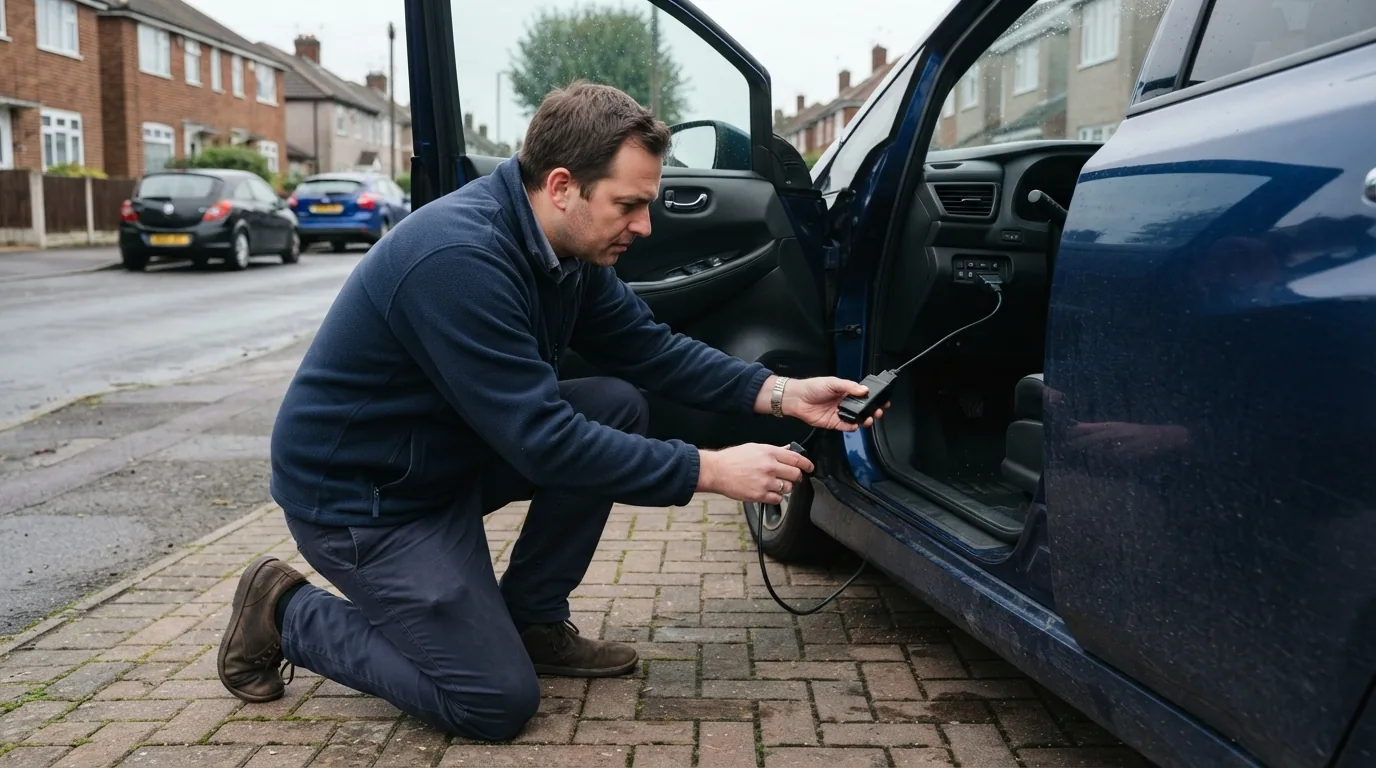
- Nissan Leaf: The dashboard displays a capacity bar with 12 segments. Each segment lost represents roughly 15% degradation. The LeafSpy app (with a compatible Bluetooth OBD2 dongle, available from around £15) gives a precise percentage.
- Hyundai and Kia: The Hyundai Bluelink and Kia Connect apps display battery health information for connected vehicles.
- Renault Zoe: My Renault app provides battery status data.
- Volkswagen Group (ID.3, ID.4, e-Golf): The myVolkswagen app provides battery health via the car’s connected services.
Method 2: OBD2 diagnostic tool
An OBD2 dongle plugged into the car’s diagnostic port allows third-party apps to read battery data. Cost is typically £15 to £40 for the dongle. Apps including Car Scanner, EVBatMon and model-specific tools such as LeafSpy or BimmerCode can display usable capacity, number of charge cycles and thermal management data.
This method requires a little technical confidence, but it is free beyond the dongle cost and gives you data the seller cannot easily manipulate.
Method 3: Professional pre-purchase inspection
The AA and RAC both offer used EV inspections that include a battery health check. Prices range from around £99 to £175 depending on the service level. A specialist EV inspection from a brand-approved workshop will typically issue a written report including SoH percentage, charging history data and a general condition assessment.
This is the option to choose if you are buying a more expensive car, buying privately, or buying a model where you do not have app access during a viewing.
Method 4: Battery health certificate
Increasingly common in the approved used sector, a battery health certificate is a formal document issued by a trained technician using manufacturer-approved diagnostic equipment. It states the SoH and is often tied to a limited warranty on the battery.
As of 2026, there is no UK law requiring a battery health certificate for private sales, but many franchised used EV dealers now include them as standard. Volvo, Polestar, Hyundai and several others include certificates in their approved used schemes. An independent certificate from a specialist typically costs £60 to £100. See our guide to getting a battery health certificate for a used EV for a full breakdown.
What else should you check while you are there?
Charging port and connector
Inspect the charging port for bent pins, corrosion or damage. A damaged port can cost several hundred pounds to repair. Test that the car accepts a charge during the viewing if possible, confirming both AC and DC charging if the car supports it.
Charging speed
If the listing claims rapid DC charging capability, check the maximum kW rate against the manufacturer specification. Some older models only support slower AC charging, and misrepresentation in listings is not unheard of.
Regenerative braking
Test regen braking at various settings. Abnormal clunking or juddering can indicate drivetrain problems separate from the battery.
Thermal management system
Active liquid cooling (found on Tesla, Kia EV6, Hyundai Ioniq 5 and others) does a better job of protecting the battery during rapid charging and in hot or cold weather than passive air cooling (older Nissan Leaf). Check which system the car uses and factor this into your risk assessment. Air-cooled batteries in high-mileage Leafs are significantly more likely to show accelerated degradation.
Software version
Check that the car is running current software. An outdated software version can mask issues with charging limits or battery management.
What is the most common mistake buyers make?
Confusing age and mileage with battery condition. A 30,000-mile car is not automatically in better battery shape than a 70,000-mile car. Charging habits, thermal management quality and whether the car spent years in a very hot or cold climate all matter more than the odometer reading in many cases.
Always insist on an SoH check. If a seller refuses to allow a diagnostic inspection or cannot demonstrate the battery health via the manufacturer app, treat that as a serious warning sign and walk away.
Can you negotiate on price based on battery health?
Yes, and this is now standard practice in the used EV market. Use the table above as a starting point. If you have an independent report showing 78% SoH on a car listed at full market rate, a 10% to 15% discount is entirely reasonable to request. Sellers who understand the market will expect this.
If the battery is below 70% SoH, factor in the likely cost of a replacement pack before agreeing any price. For many models this makes the car uneconomical compared to alternatives at the same price point with healthy batteries.
What does the future look like for used EV batteries?
Battery technology and longevity are both improving with each model generation. Cars built from 2020 onwards use more sophisticated battery management systems, better thermal regulation and higher-quality cells that degrade more slowly. Data from 2026 suggests degradation rates for newer models are measurably lower than for cars built before 2018.
The used EV battery story is broadly positive for buyers. The horror stories of rapid degradation that circulated around early Nissan Leaf examples (which used air cooling, were sold without a proper degradation disclosure framework, and hit US markets in hot climates) are not representative of the modern used EV market in the UK.
Still, check before you buy. The data is there; use it.
Where to next?
Return to the used EVs guide for a full overview of the UK used EV market, or browse our best used electric cars shortlist for ranked recommendations across every budget.
How we test and where our numbers come from
Range figures are official WLTP combined values taken from manufacturer UK specification pages, with real-world estimates drawn from independent comparative testing. Prices are UK list prices at the time of the latest update. Tax, grant and charging-scheme figures come from GOV.UK and HMRC publications. We re-check every guide when pricing, specification or policy changes. Last checked 11 August 2026.
Frequently asked questions
What does battery state of health mean?
State of health (SoH) is a percentage that represents how much usable capacity the battery retains compared to when it was new. A car with 95% SoH still delivers 95% of its original range under the same conditions.
What else should you check while you are there?
Inspect the charging port for bent pins, corrosion or damage. A damaged port can cost several hundred pounds to repair.
What is the most common mistake buyers make?
Confusing age and mileage with battery condition. A 30,000-mile car is not automatically in better battery shape than a 70,000-mile car.
Can you negotiate on price based on battery health?
Yes, and this is now standard practice in the used EV market. Use the table above as a starting point.
What does the future look like for used EV batteries?
Battery technology and longevity are both improving with each model generation. Cars built from 2020 onwards use more sophisticated battery management systems, better thermal regulation and higher-quality cells that degrade more slowly.

EV Compared
The EV Compared editorial team tracks the UK electric vehicle market full time: new model launches, list prices, WLTP and real-world range, public charging tariffs and the tax rules that decide what an EV actually costs to run. Every guide is checked against manufacturer specifications and official GOV.UK figures, and updated whenever the numbers move.
Related reading
View all
What Are the Biggest Myths About Switching to an EV?
The claims that put UK drivers off going electric, and what the evidence actually says

Should You Buy an EV in 2026 or Wait for Cheaper Models?
An honest look at where EV prices are heading and whether the wait is worth it for UK buyers
Buying and Owning an Electric Car in the UK: The Complete 2026 Guide
Everything you need to know about costs, charging, depreciation and day-to-day life with an EV