Cheapest EVs to Maintain in the UK
Service costs, warranty coverage and what actually needs maintaining on an electric car in 2026
Quick answers
- Electric cars cost around 20 to 30% less to service than equivalent petrol cars. The average annual EV service runs £130 to £175, compared to £180 to £250 for a petrol car of similar size.
- What does an EV service actually include: The items removed from a petrol service save approximately £50 to £80 per service in parts and labour compared to a petrol car of equivalent size.
- How does brake maintenance work on an EV: Regenerative braking recaptures kinetic energy as the car decelerates, feeding it back to the battery.
- Are Tesla servicing costs really low: For routine servicing and mechanical maintenance, Tesla's costs are genuinely among the lowest available.
- What about independent EV specialists: Independent garages with EV-trained technicians are an increasingly viable alternative to main dealers for routine servicing.
- Annual servicing cost summary: A comparable petrol car adds engine oil (£50 to £80), spark plugs (£80 to £120 every 30,000 miles), exhaust inspection and potential repair, and more frequent brake pad replacement -- adding £150 to £250 per year.
Electric cars cost around 20 to 30% less to service than equivalent petrol cars. The average annual EV service runs £130 to £175, compared to £180 to £250 for a petrol car of similar size. The saving comes from what EVs do not have: no engine oil to change, no exhaust system to inspect, no cambelt or timing chain, no clutch. What EVs do still need is different but genuinely cheaper to maintain.
The cheapest EVs to maintain in the UK are small, mainstream models from manufacturers with well-established UK dealer and service networks — Renault, MG, Hyundai, Kia, and Volkswagen Group. Budget for £130 to £165 per year for annual servicing, with brake fluid changes every two years adding around £50 to £80.
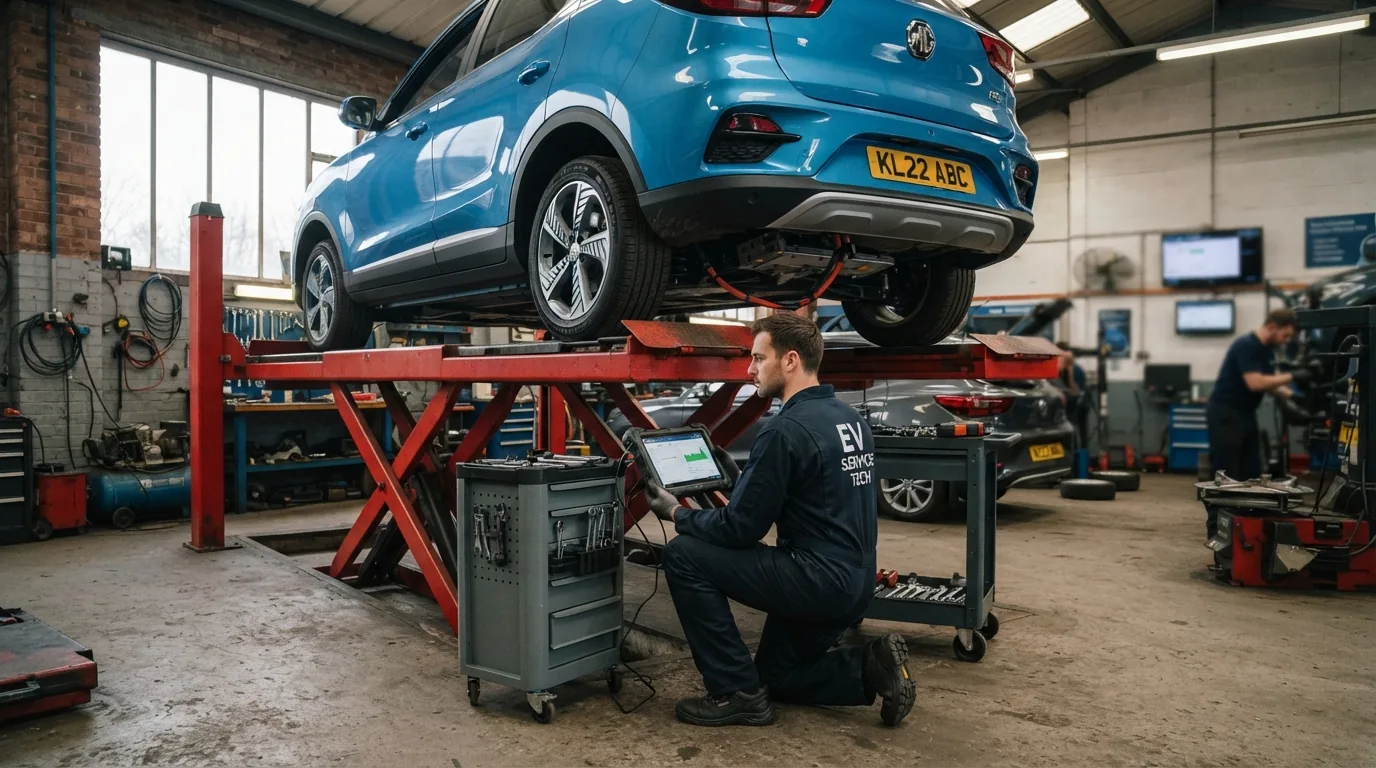
What does an EV service actually include?
An EV annual service is typically completed in under an hour and covers:
- Brake system inspection (physical brakes plus regenerative braking system)
- Tyre inspection and rotation
- Cabin air filter inspection and replacement
- Battery coolant system and thermal management check
- High-voltage system safety inspection
- Software diagnostic scan and updates
- Wipers, lights and general safety checks
What is not included, because EVs do not have these components:
- Engine oil change
- Spark plug replacement
- Exhaust system inspection
- Fuel filter replacement
- Cambelt/timing chain inspection
The items removed from a petrol service save approximately £50 to £80 per service in parts and labour compared to a petrol car of equivalent size.
Cheapest EVs to maintain: ranked table
| Model | Annual service cost | Warranty (vehicle) | Battery warranty | Service plan available |
|---|---|---|---|---|
| Dacia Spring | ~£100 — £140 | 3 years / 60,000 miles | 8 years / 100,000 miles | Yes |
| MG4 | ~£130 — £155 | 7 years / 80,000 miles | 7 years / 80,000 miles | Yes |
| Renault R5 E-Tech | ~£130 — £160 | 3 years / 100,000 miles | 8 years / 100,000 miles | Yes |
| Fiat 500e | ~£130 — £160 | 3 years / unlimited | 8 years / 100,000 miles | Yes |
| Nissan Leaf | ~£130 — £165 | 3 years / 60,000 miles | 8 years / 100,000 miles | Yes |
| Hyundai Ioniq 6 | ~£140 — £175 | 5 years / unlimited miles | 8 years / 125,000 miles | Yes |
| Kia EV6 | ~£140 — £175 | 7 years / 100,000 miles | 8 years / 100,000 miles | Yes (e-Care) |
| Volkswagen ID.3 | ~£150 — £175 | 3 years / 60,000 miles | 8 years / 160,000 km | Yes |
| Tesla Model 3 | ~£120 — £150 | 4 years / 50,000 miles | 8 years / 150,000 miles | Yes (annual) |
| BMW i4 | ~£200 — £300 | 3 years / unlimited | 8 years / 100,000 miles | Yes (full service included 3yrs) |
The cost items people forget about
Brake fluid: This is a genuine regular cost for EVs. Even though regenerative braking dramatically reduces physical brake use, the brake fluid still requires replacement every two years due to moisture absorption — a property of glycol-based hydraulic fluid that is independent of how often the brakes are used. Typical cost: £50 to £80.
Tyres: EVs wear tyres faster than petrol cars due to extra weight (200 to 400 kg heavier) and instant torque delivery. EV-specific tyres from Michelin, Continental, Bridgestone and Pirelli carry load ratings suited to heavier EVs. Budget £200 to £400 per year depending on model weight and driving style.
Wiper blades: Replaced annually or when needed. £20 to £40. The same as any car.
Cabin air filter: Replaced every 12 to 24 months depending on environment and manufacturer schedule. £15 to £40 for the part.
Battery coolant: Some manufacturers require periodic coolant system flushes, typically at 5 to 8 years or 60,000 to 100,000 miles. This is a less frequent but meaningful service item when it arrives.
How does brake maintenance work on an EV?
Regenerative braking recaptures kinetic energy as the car decelerates, feeding it back to the battery. In everyday driving with strong regen settings, the physical brake pads and discs may barely engage. On some EVs with strong one-pedal driving capability, owners have driven 40,000 to 50,000 miles before needing new pads.
The practical benefit: pad replacement is much less frequent. Budget for brake pads perhaps once every 40,000 to 60,000 miles rather than the 20,000 to 30,000 miles typical for a petrol car.
The risk: brake components that are rarely used can seize. Rear calipers in particular benefit from periodic manual brake application to exercise the mechanisms. Regular inspections at service catch any binding or corrosion before it becomes a costly repair.
Which manufacturers offer the best warranty protection?
Kia: The strongest warranty package of any mainstream manufacturer. Seven years or 100,000 miles on the vehicle, plus eight years or 100,000 miles on the battery. Kia’s e-Care service plan covers all routine EV maintenance. The EV6 and Kia EV9 are covered under this.
Hyundai: Five years unlimited mileage on the vehicle (one of the few unlimited-mileage warranties in the mainstream market), eight years or 125,000 miles on the battery. Strong for high-mileage drivers who would otherwise exceed typical warranty distance caps.
MG: Seven years or 80,000 miles — longer than most European manufacturers. The limit of 80,000 miles means very high mileage drivers may exhaust the warranty in four to five years of driving. Battery warranty matches the vehicle warranty at seven years.
Tesla: Four years or 50,000 miles on the vehicle (the shortest of any mainstream EV), but eight years or 150,000 miles on the battery (among the longest available). Tesla’s over-the-air updates mean many software faults are resolved remotely without a service visit, keeping servicing requirements genuinely low.
Volkswagen Group (VW, Audi, Skoda, SEAT): Three years or 60,000 miles on the vehicle; eight years or 160,000 km on the battery. Standard European warranty, strong battery coverage.
Are Tesla servicing costs really low?
Yes, for straightforward servicing. Tesla publishes annual service schedules and the costs are competitive — typically £120 to £150 per year. The complexity arises with accident damage: Tesla’s approved body shop network is smaller than mainstream manufacturers, which can mean longer wait times and higher costs for bodywork repairs.
For routine servicing and mechanical maintenance, Tesla’s costs are genuinely among the lowest available. For accident repair, it is one of the more expensive brands to put right.
What about independent EV specialists?
Independent garages with EV-trained technicians are an increasingly viable alternative to main dealers for routine servicing. Many EVs have no technical reason for main dealer servicing (unlike petrol cars with complex diagnostic requirements in the first few years). Saving £30 to £60 per service by using a reputable independent is reasonable, provided they have the diagnostic software for your car’s make.
Warranty implications: routine maintenance at a non-franchised repairer does not void the vehicle or battery warranty, provided the work meets manufacturer specifications and is documented. The “main dealer only” myth is not legally enforced in the UK for warranty purposes.
Annual servicing cost summary
For a driver owning a mainstream EV for five years at 10,000 miles per year:
| Maintenance item | Annual cost (estimate) | 5-year total |
|---|---|---|
| Annual service | £150 | £750 |
| Brake fluid (every 2 years) | £30 (averaged) | £150 |
| Tyres (mid-range EV) | £300 | £1,500 |
| Wiper blades | £30 | £150 |
| Brake pads (once in 5 years) | £50 (averaged) | £250 |
| Total maintenance | ~£560/yr | ~£2,800 |
A comparable petrol car adds engine oil (£50 to £80), spark plugs (£80 to £120 every 30,000 miles), exhaust inspection and potential repair, and more frequent brake pad replacement — adding £150 to £250 per year.
Where to go next
For the full picture of EV running costs including fuel, tax and insurance alongside maintenance, see the EV running costs and tax hub.
To find the models with the lowest overall annual cost including all categories, visit the cheapest electric cars to run rankings.
How we test and where our numbers come from
Range figures are official WLTP combined values taken from manufacturer UK specification pages, with real-world estimates drawn from independent comparative testing. Prices are UK list prices at the time of the latest update. Tax, grant and charging-scheme figures come from GOV.UK and HMRC publications. We re-check every guide when pricing, specification or policy changes. Last checked 11 August 2026.
Frequently asked questions
What does an EV service actually include?
The items removed from a petrol service save approximately £50 to £80 per service in parts and labour compared to a petrol car of equivalent size.
How does brake maintenance work on an EV?
Regenerative braking recaptures kinetic energy as the car decelerates, feeding it back to the battery. In everyday driving with strong regen settings, the physical brake pads and discs may barely engage.
Are Tesla servicing costs really low?
Yes, for straightforward servicing. Tesla publishes annual service schedules and the costs are competitive -- typically £120 to £150 per year.
What about independent EV specialists?
Independent garages with EV-trained technicians are an increasingly viable alternative to main dealers for routine servicing. Many EVs have no technical reason for main dealer servicing (unlike petrol cars with complex diagnostic requirements in the first few years).

EV Compared
The EV Compared editorial team tracks the UK electric vehicle market full time: new model launches, list prices, WLTP and real-world range, public charging tariffs and the tax rules that decide what an EV actually costs to run. Every guide is checked against manufacturer specifications and official GOV.UK figures, and updated whenever the numbers move.
Related reading
View all
What Are the Biggest Myths About Switching to an EV?
The claims that put UK drivers off going electric, and what the evidence actually says
Should You Buy an EV in 2026 or Wait for Cheaper Models?
An honest look at where EV prices are heading and whether the wait is worth it for UK buyers
Buying and Owning an Electric Car in the UK: The Complete 2026 Guide
Everything you need to know about costs, charging, depreciation and day-to-day life with an EV