ULEZ vs Clean Air Zones: How UK Charges Compare for Drivers
ULEZ covers all of London and charges daily; most Clean Air Zones target commercial vehicles only. Here is what each scheme actually costs and who pays what.
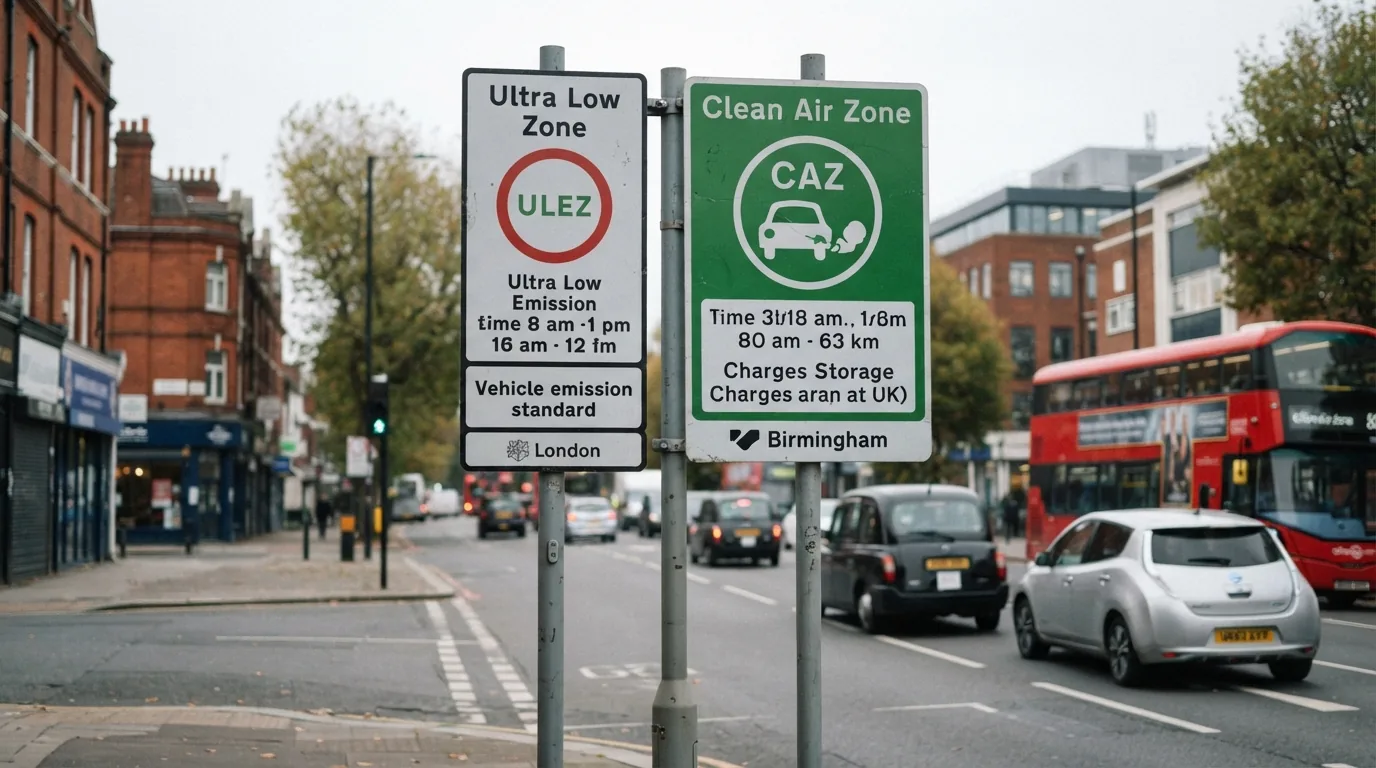
Quick answers
- ULEZ and Clean Air Zones (CAZs) both charge non-compliant vehicles a daily fee, but they are structurally different schemes with different geographic coverage, different charging structures and different consequences for the same driver.
- What is ULEZ: The Ultra Low Emission Zone is operated by Transport for London (TfL) under London-specific legislation.
- What are Clean Air Zones: Clean Air Zones (CAZs) are locally operated schemes in English cities outside London, established under the Environment Act.
- The same applies to Bradford, Sheffield, Portsmouth and most other English cities with CAZs.
- The Scottish LEZ difference: Scotland's Low Emission Zone scheme is fundamentally different from the English CAZ approach in one important respect: there is no option to pay a daily rate to enter.
- For a London commuter with a non-compliant diesel, ULEZ is easily the most expensive scheme in the UK.
ULEZ and Clean Air Zones (CAZs) both charge non-compliant vehicles a daily fee, but they are structurally different schemes with different geographic coverage, different charging structures and different consequences for the same driver. The short version: ULEZ is a London-wide daily charge of £12.50 for non-compliant cars; Clean Air Zones are city-specific schemes that only charge private cars in a handful of locations, but which also cover commercial vehicles more broadly. Both schemes fully exempt battery electric vehicles.
The fundamental difference
| Feature | ULEZ (London) | Clean Air Zones (England) | Scottish LEZs |
|---|---|---|---|
| Legal basis | London-specific legislation (TfL) | Environment Act (DfT framework) | Scottish Government legislation |
| Coverage | All 32 London boroughs + City | City-specific zones (varies) | Aberdeen, Dundee, Edinburgh, Glasgow |
| Private car charge | £12.50 per day (non-compliant) | Only in Class D zones (Birmingham £8, Bristol £9) | Penalty fine (not a daily rate) |
| Operating hours | 24/7, all year | 24/7, all year (most zones) | 24/7, all year |
| Payment method | Pre-paid daily charge | Pre-paid daily charge | Penalty notice |
| EV exemption | Full and permanent | Full and permanent | Full and permanent |
What is ULEZ?
The Ultra Low Emission Zone is operated by Transport for London (TfL) under London-specific legislation. It covers all 32 London boroughs plus the City of London, 24 hours a day, 365 days a year. Drivers of non-compliant cars pay £12.50 per day; larger non-compliant vehicles pay £100 per day.
Emission standards for ULEZ compliance:
- Petrol cars: Euro 4 standard (broadly, registered from January 2006 onward)
- Diesel cars: Euro 6 standard (broadly, registered from September 2015 onward)
ULEZ is enforced through ANPR cameras; no physical barriers. If your vehicle fails the standard, you receive a penalty charge notice unless you have pre-paid the daily fee.
Battery electric vehicles are completely and permanently exempt from ULEZ. There is no end date and no application required.
What are Clean Air Zones?
Clean Air Zones (CAZs) are locally operated schemes in English cities outside London, established under the Environment Act. Central government sets four class levels; local authorities choose which class to implement based on their air quality obligations. Scotland operates equivalent schemes called Low Emission Zones (LEZs) under separate legislation.
The four CAZ classes determine which vehicles pay:
| Class | Who pays |
|---|---|
| A | Buses, coaches and taxis only |
| B | Class A vehicles plus PHVs (private hire vehicles) and HGVs |
| C | Class B vehicles plus vans, minibuses and cars (private cars only charged if they fail the standard) |
| D | Class C vehicles plus all private cars that fail the emission standard |
In Class C zones, private petrol and diesel cars that meet Euro 4 (petrol) or Euro 6 (diesel) standards are not charged. Only non-compliant cars pay. In Class D zones (Birmingham and Bristol), any private car that fails the emission standard pays the daily charge.
City-by-city: who charges private cars?
Cities where private cars pay:
| City | Daily charge (non-compliant private car) |
|---|---|
| Birmingham (Class D) | £8 per day |
| Bristol (Class D) | £9 per day |
| Edinburgh (Scottish LEZ) | Penalty fine |
| Glasgow (Scottish LEZ) | Penalty fine |
| Aberdeen (Scottish LEZ) | Penalty fine |
| Dundee (Scottish LEZ) | Penalty fine |
Cities where private cars are NOT charged (commercial vehicles only):
| City | Class | What pays |
|---|---|---|
| Bath | C | Buses, coaches, taxis, vans, HGVs |
| Bradford | C | Buses, coaches, taxis, vans |
| Sheffield | B | Taxis, PHVs, HGVs |
| Portsmouth | B | Taxis, PHVs, HGVs |
| Newcastle/Gateshead | B | HGVs and taxis |
The key misconception: “Clean Air Zones charge all cars”
This is wrong for most UK cities. Bath’s CAZ, for example, was one of the first introduced (March 2021) and is frequently cited as a reason for concern among drivers. But Bath is a Class C zone; private cars are not charged regardless of their emissions. Only buses, coaches, taxis, vans and HGVs that fail the emission standard pay.
The same applies to Bradford, Sheffield, Portsmouth and most other English cities with CAZs. Private car drivers in these cities do not pay a daily CAZ charge unless they are driving a vehicle registered to a taxi or commercial operator.
The Scottish LEZ difference
Scotland’s Low Emission Zone scheme is fundamentally different from the English CAZ approach in one important respect: there is no option to pay a daily rate to enter. Non-compliant vehicles are simply not permitted to enter the zone. If you drive a non-compliant vehicle into a Scottish LEZ, you receive a penalty notice (starting at £60 for a first offence, rising to £500 for repeat offences). There is no pre-payment mechanism.
This makes the Scottish LEZ more restrictive in enforcement terms, though the same emission standards apply (Euro 4 petrol, Euro 6 diesel) and all electric vehicles are fully exempt.
Head-to-head: ULEZ vs CAZ costs for a regular driver
Scenario: Non-compliant diesel car registered in 2012 (pre-Euro 6)
| Scheme | Daily charge | Annual cost (250 days) | Annual cost (100 days) |
|---|---|---|---|
| ULEZ (London, daily commuter) | £12.50 | £3,125 | £1,250 |
| Birmingham CAZ (Class D) | £8.00 | £2,000 | £800 |
| Bristol CAZ (Class D) | £9.00 | £2,250 | £900 |
| Bath CAZ (Class C, private car) | £0 | £0 | £0 |
| Sheffield CAZ (Class B, private car) | £0 | £0 | £0 |
For a London commuter with a non-compliant diesel, ULEZ is easily the most expensive scheme in the UK. For a regular commuter into Birmingham or Bristol, the CAZ charge is the primary concern. For drivers in most other UK cities, private cars are not charged at all.
Emission standards: what both schemes use
Both ULEZ and English CAZs apply the same emission standards:
- Petrol cars: Euro 4. Broadly applies to petrol cars registered from January 2006 onward. Most petrol cars bought since 2006 are compliant.
- Diesel cars: Euro 6. Broadly applies to diesel cars registered from September 2015 onward. Many diesel cars registered between 2010 and 2015 are non-compliant; this is the group most affected by charges.
- Electric cars: Automatically exempt in all schemes.
One useful data point: TfL estimated at the time of ULEZ expansion in 2023 that around 90% of vehicles in Greater London already met the emission standard, meaning only about 10% of cars were being charged. Compliance rates in English CAZ cities are similar.
What about plug-in hybrids?
PHEVs are not automatically exempt from ULEZ or CAZ charges. Their compliance depends on their specific emission rating:
- A PHEV that meets Euro 6 (diesel) or Euro 4 (petrol) standards is compliant and pays nothing
- Most modern PHEVs registered from 2015 are Euro 6-compliant
- Check your specific model on TfL’s vehicle checker or the gov.uk CAZ checker
Only battery electric vehicles (and hydrogen fuel cell vehicles) have a blanket, unconditional exemption from all UK clean air charges.
Who pays the most under each scheme?
ULEZ is worst for:
- London-based drivers in pre-2015 diesel cars
- Any non-compliant vehicle regularly driven anywhere in Greater London
English CAZs are worst for:
- Birmingham and Bristol-based drivers in non-compliant cars who commute daily
- Van operators and taxi drivers in non-compliant vehicles across multiple cities
Scottish LEZs are worst for:
- Drivers of non-compliant vehicles who regularly enter Aberdeen, Dundee, Edinburgh or Glasgow city centres
The EV solution: no daily charge in any zone
A battery electric car eliminates every daily charge discussed above, in every scheme, permanently. No ULEZ charge, no CAZ charge, no LEZ charge, no penalty notice. The financial saving for a regular Birmingham commuter in a non-compliant diesel who switches to an EV is approximately £2,000 per year. For a London commuter, it is up to £3,125 per year.
Set against the cost of buying an EV, these savings provide a concrete payback calculation. A Renault 5 at around £19,250 after the Electric Car Grant has an annual running cost reduction (ULEZ saving alone) of over £3,000 for a daily London driver. That is a payback in under seven years from ULEZ charges alone, before accounting for fuel savings.
The key things to check before your next journey
- Is the city you are entering operating a CAZ? Check at the gov.uk clean air zone checker.
- Is the zone Class C, B or D? If B or C, private cars may not be charged.
- Does your vehicle meet Euro 4 (petrol) or Euro 6 (diesel)? Check your V5C or the gov.uk checker.
- For London: check TfL’s vehicle checker for ULEZ compliance and register for Congestion Charge Auto Pay if driving into the central zone.
For a city-by-city guide with detailed charge information, see our article on which UK cities have Clean Air Zones. For the full impact of ULEZ on London EV drivers specifically, see our guide to how ULEZ affects electric car owners in London.
For the best EVs that eliminate all clean air zone charges, see our guide to best value EVs that qualify for UK grants. For the full policy context, return to the grants, policy and legislation hub.
How we test and where our numbers come from
Range figures are official WLTP combined values taken from manufacturer UK specification pages, with real-world estimates drawn from independent comparative testing. Prices are UK list prices at the time of the latest update. Tax, grant and charging-scheme figures come from GOV.UK and HMRC publications. We re-check every guide when pricing, specification or policy changes. Last checked 11 August 2026.
Frequently asked questions
What is ULEZ?
The Ultra Low Emission Zone is operated by Transport for London (TfL) under London-specific legislation. It covers all 32 London boroughs plus the City of London, 24 hours a day, 365 days a year.
What are Clean Air Zones?
Clean Air Zones (CAZs) are locally operated schemes in English cities outside London, established under the Environment Act. Central government sets four class levels; local authorities choose which class to implement based on their air quality obligations.
What about plug-in hybrids?
Only battery electric vehicles (and hydrogen fuel cell vehicles) have a blanket, unconditional exemption from all UK clean air charges.
Sources and further reading
- gov.ukGOV.UK DfTPrimary source referenced in this article.

EV Compared
The EV Compared editorial team tracks the UK electric vehicle market full time: new model launches, list prices, WLTP and real-world range, public charging tariffs and the tax rules that decide what an EV actually costs to run. Every guide is checked against manufacturer specifications and official GOV.UK figures, and updated whenever the numbers move.
Related reading
View all
What Does the 2030 Petrol and Diesel Ban Actually Mean?
Separating the facts from the myths: what changes in 2030, what does not, and what it means for your next car
Best Affordable EVs Under the Electric Car Grant
The electric cars that combine a government grant with the lowest purchase prices in the UK market right now

What Is the Benefit in Kind Rate for Electric Cars?
The electric car BiK rate is 4% for 2026/27, rising to 9% by 2029/30 on a confirmed schedule. Here is what that means for your tax bill, with worked examples and a full multi-year projection.