How Will Solid State Batteries Change Electric Cars?
Solid state batteries promise longer range, faster charging and better safety. Here is where the technology actually stands in 2026 and what it means for UK buyers
Quick answers
- Solid state batteries replace the liquid electrolyte in a conventional lithium-ion cell with a solid material, enabling higher energy density, faster charging and improved safety compared with current lithium-ion technology.
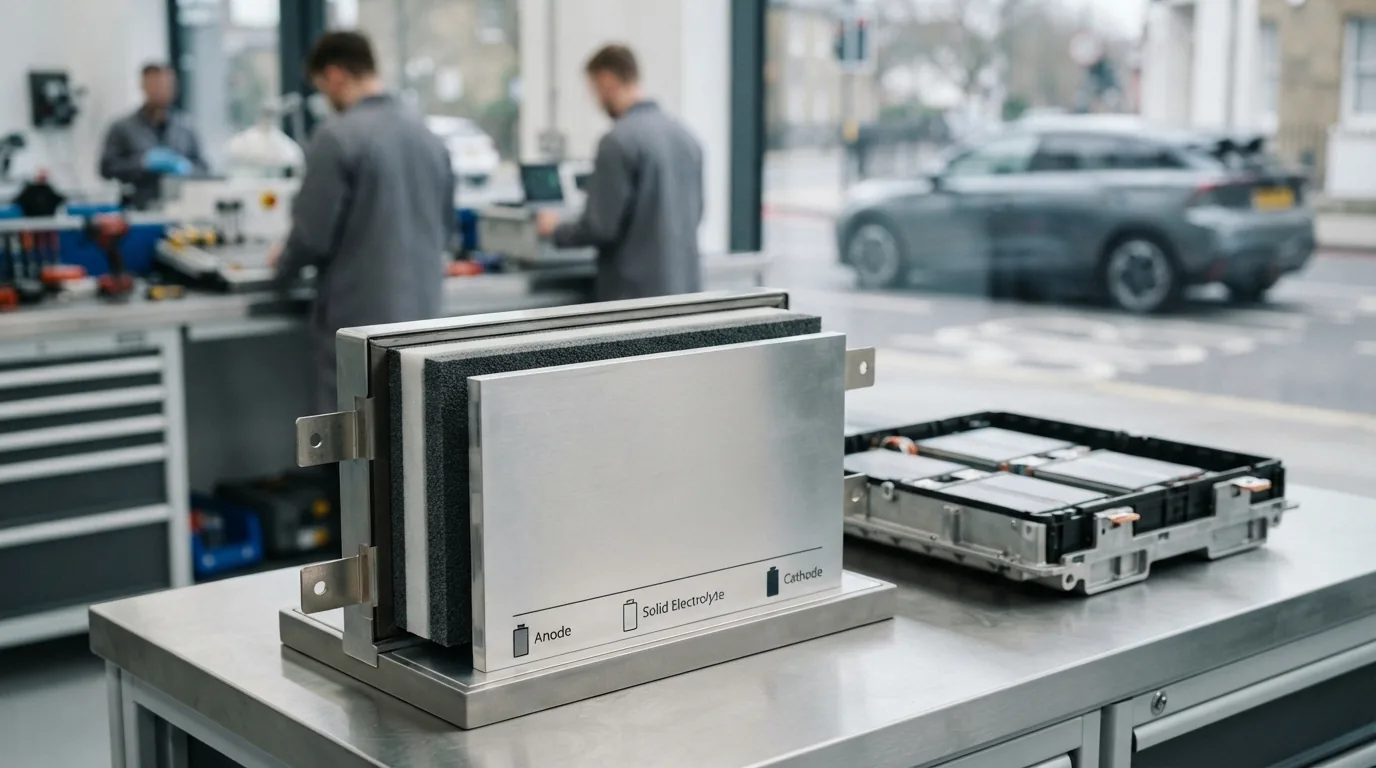
- What is a solid state battery: In a conventional lithium-ion cell, the electrolyte, the medium through which lithium ions travel between the anode and cathode during charging and discharging, is a liquid.
- No, and this is an important perspective for any UK driver thinking about buying an EV now versus waiting.
- No, unless you have a specific reason to wait until 2030 or beyond for your next car.
- What is the UK regulatory context: The UK's 2030 ban on new petrol and diesel car sales and the ZEV mandate requiring manufacturers to sell an increasing proportion of zero-emission vehicles apply regardless of battery chemistry.
Solid state batteries replace the liquid electrolyte in a conventional lithium-ion cell with a solid material, enabling higher energy density, faster charging and improved safety compared with current lithium-ion technology. Toyota plans limited production vehicles using solid state batteries by 2027, targeting a 621-mile range and 10 to 80 per cent charging in under 10 minutes. Samsung SDI, QuantumScape and CATL are at similar or slightly later stages. No solid state battery EV is commercially available to UK buyers today, and mass-market availability is unlikely before 2029 to 2030.
What is a solid state battery?
In a conventional lithium-ion cell, the electrolyte, the medium through which lithium ions travel between the anode and cathode during charging and discharging, is a liquid. This liquid electrolyte is functional but has drawbacks: it is flammable, it can leak or degrade, it limits the cell’s operating temperature range and it places constraints on energy density.
A solid state battery uses a solid electrolyte instead. This could be a ceramic (such as lithium garnet or NASICON-type materials), a glass, a sulphide or a polymer, depending on the developer. The solid electrolyte is non-flammable, more stable across a wider temperature range and allows the use of a lithium metal anode instead of the graphite anode in current cells.
The lithium metal anode is the key to higher energy density: lithium metal can store roughly ten times as much charge per gram as graphite. This is why solid state batteries can theoretically offer significantly higher energy density at the cell level.
What are the claimed advantages of solid state batteries?
Higher energy density: Current premium lithium-ion cells (NMC) achieve around 250 to 280 Wh/kg at the cell level. Solid state cells in prototype form have demonstrated 400 to 500 Wh/kg and beyond. Samsung SDI has shown prototypes at 900 Wh/L volumetric energy density. This translates to either much longer range for the same pack weight, or the same range from a much lighter pack.
Faster charging: Solid electrolytes can in theory support faster ion transport and can handle higher current densities without the side reactions (such as lithium plating) that limit fast charging in liquid-electrolyte cells. Toyota’s target for its solid state pack is 10 to 80 per cent in under 10 minutes.
Improved safety: Liquid electrolytes in current lithium-ion cells are flammable and can contribute to thermal runaway in the event of damage or overcharging. Solid electrolytes are non-flammable, which significantly reduces the risk of fire. This could allow lighter or simpler battery enclosures.
Longer cycle life: Solid electrolytes can in principle suppress the dendrite growth that degrades lithium metal anodes in liquid cells, potentially allowing more charge cycles before significant capacity fade.
Better cold weather performance: Some solid electrolyte types maintain ionic conductivity better at low temperatures than liquid electrolytes, which could reduce the winter range penalty that affects current EVs.
What is the current state of development?
| Company | Technology | Status (2026) | Commercial timeline |
|---|---|---|---|
| Toyota | Sulphide solid electrolyte | Limited production samples; vehicle prototypes running | 2027 for limited production; mass market 2028–2030 |
| Samsung SDI | Sulphide solid electrolyte | Pilot line; targeting premium automotive customers | 2027 limited production; mass market later |
| QuantumScape | Lithium-metal / ceramic separator | Qualification samples for VW Group (QSE-5 cells) from late 2026 | Vehicle integration 2028 |
| CATL | Multiple solid state programmes | Semi-solid state cell in limited production (Freevoy); all-solid targeted later | Semi-solid available 2026; all-solid 2027–2028 |
| ProLogium | Oxide solid electrolyte | Partnership with Mercedes-Benz; pilot line | 2028 target |
| Solid Power | Sulphide solid electrolyte | BMW and Ford partnership | 2026 pilot; vehicle integration 2027+ |
“Limited production” in this context means tens of thousands of cells for select premium vehicles, not the tens of millions needed to supply the mainstream EV market.
What are the obstacles to mass-market solid state batteries?
Several significant engineering challenges remain unresolved at production scale:
Manufacturing complexity: Solid electrolyte layers must be extremely thin (sometimes just a few microns) and free of defects. Achieving this at the speed and yield needed for mass production is very difficult. Liquid electrolyte cells can be filled and sealed in a relatively simple process; solid state cells require precision deposition techniques.
Interface instability: Where the solid electrolyte meets the electrode, physical stresses from the expansion and contraction of the lithium metal during charge and discharge cycles can create micro-cracks and degrade the interface over time. Managing this at the atomic level, while maintaining performance across thousands of cycles, remains a major research challenge.
Cost: Solid electrolyte materials and the precision manufacturing required are currently far more expensive than liquid electrolyte production. Premium pricing for initial solid state EV models is inevitable.
Temperature sensitivity: Some solid electrolyte materials (particularly ceramic types) perform poorly at low temperatures, which is directly relevant for UK winter use.
Will solid state batteries make current EVs obsolete?
No, and this is an important perspective for any UK driver thinking about buying an EV now versus waiting.
First, the best current lithium-ion technology, particularly the latest LFP and high-nickel NMC cells, is already very capable. Real-world ranges of 250 to 380 miles, rapid charging to 80 per cent in 20 to 30 minutes and long battery life under UK conditions are available today.
Second, solid state batteries will enter the market at the premium end first. If Toyota’s 2027 launch vehicle follows a similar pattern to other premium EV introductions, it will be a high-specification, high-price model. Mass-market pricing will follow perhaps five to seven years later.
Third, lithium-ion is not standing still. CATL’s Shenxing Plus cells already deliver 10 to 80 per cent in around 10 minutes. The latest LFP Blade cells from BYD have energy density competitive with earlier NMC. The gap between current and future technology is narrowing even before solid state batteries enter production.
Should you wait for solid state batteries before buying an EV?
No, unless you have a specific reason to wait until 2030 or beyond for your next car. The expected first commercial solid state EV (Toyota, 2027) will likely be a premium model at premium pricing, not a direct replacement for the mainstream EVs most UK buyers consider. Mass-market solid state availability at competitive prices is a 2030 to 2035 timeframe at best.
The practical advice: a well-chosen EV bought now, with a good LFP or NMC battery and a solid manufacturer OTA update commitment, is a very capable vehicle. Its battery will retain good capacity for ten years or more under normal UK use. By the time solid state batteries are in mass-market cars at competitive prices, that EV will have long since paid for itself in running cost savings versus petrol.
What is the UK regulatory context?
The UK’s 2030 ban on new petrol and diesel car sales and the ZEV mandate requiring manufacturers to sell an increasing proportion of zero-emission vehicles apply regardless of battery chemistry. Solid state batteries do not change the regulatory direction; they are a potential improvement within it, not a prerequisite for the transition.
For more on EV battery technology, see our how EV batteries work guide and the EV tech and apps hub. For today’s best charging apps, see our best EV charging apps roundup.
How we test and where our numbers come from
Range figures are official WLTP combined values taken from manufacturer UK specification pages, with real-world estimates drawn from independent comparative testing. Prices are UK list prices at the time of the latest update. Tax, grant and charging-scheme figures come from GOV.UK and HMRC publications. We re-check every guide when pricing, specification or policy changes. Last checked 11 August 2026.
Frequently asked questions
What is a solid state battery?
In a conventional lithium-ion cell, the electrolyte, the medium through which lithium ions travel between the anode and cathode during charging and discharging, is a liquid.
Will solid state batteries make current EVs obsolete?
No, and this is an important perspective for any UK driver thinking about buying an EV now versus waiting.
Should you wait for solid state batteries before buying an EV?
No, unless you have a specific reason to wait until 2030 or beyond for your next car. The expected first commercial solid state EV (Toyota, 2027) will likely be a premium model at premium pricing, not a direct replacement for the mainstream EVs most UK buyers consider.
What is the UK regulatory context?
The UK's 2030 ban on new petrol and diesel car sales and the ZEV mandate requiring manufacturers to sell an increasing proportion of zero-emission vehicles apply regardless of battery chemistry. Solid state batteries do not change the regulatory direction; they are a potential improvement within it, not a prerequisite for the transition.

EV Compared
The EV Compared editorial team tracks the UK electric vehicle market full time: new model launches, list prices, WLTP and real-world range, public charging tariffs and the tax rules that decide what an EV actually costs to run. Every guide is checked against manufacturer specifications and official GOV.UK figures, and updated whenever the numbers move.
Related reading
View all
Apple CarPlay vs Built In EV Software: Which Is Better?
Apple CarPlay is familiar and loved, but built-in EV software controls your battery, charging and range. We explain when each wins and which cars get the balance right.

Best Apps to Find EV Chargers in the UK
With over 120,000 public charge points in the UK, the right app makes the difference between a smooth charging stop and a wasted detour. Here are the options ranked
What Is Bidirectional Charging and Can It Power Your Home?
Bidirectional charging lets your electric car act as a home battery or feed the national grid. Here is how it works, what it costs and which UK cars support it in 2026