Best Smart Home Apps for EV Charging With Octopus
Smart home charging apps let you charge your EV at the cheapest rates automatically. Here are the best options for UK drivers in 2026, from Octopus Intelligent Go to solar integration
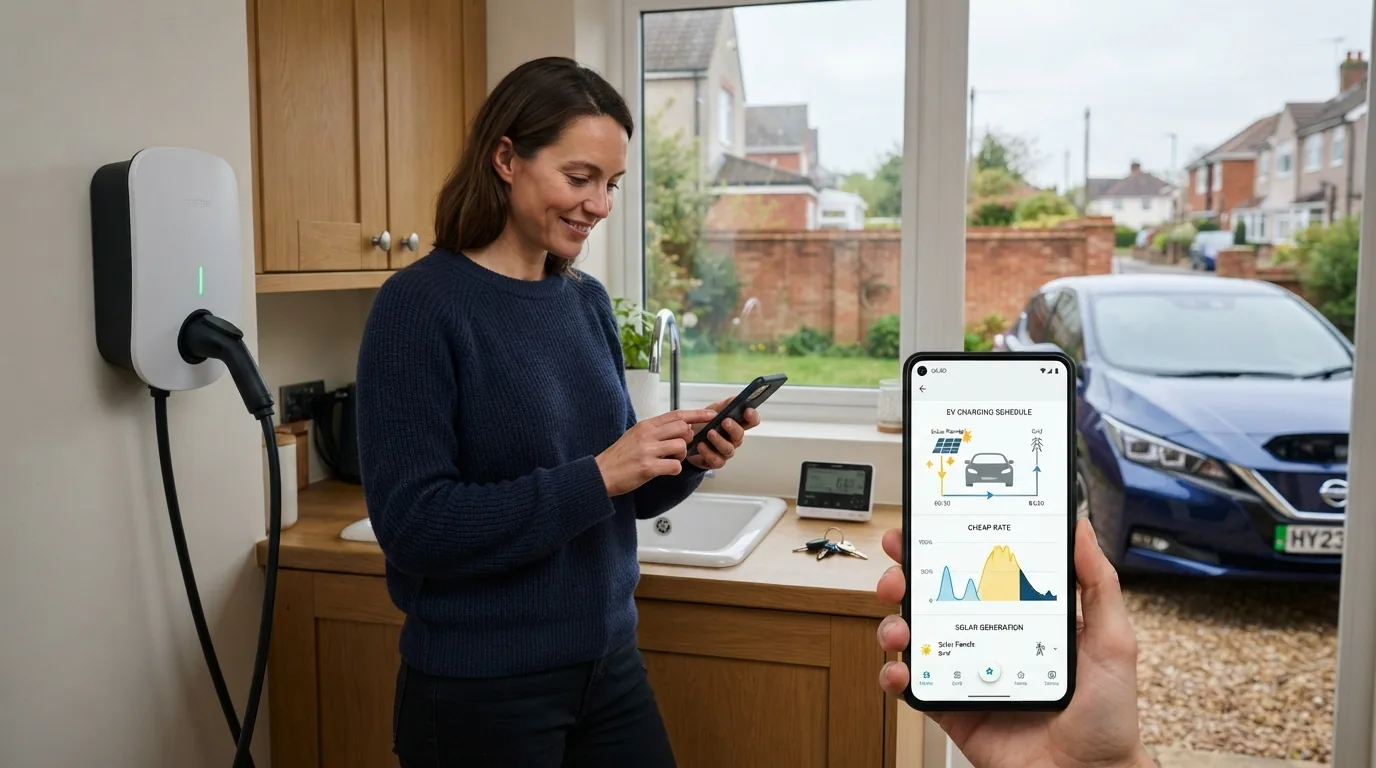
Quick answers
- Smart home charging for your EV means automatically shifting your charging to the cheapest hours of the day, typically overnight when grid demand is low and electricity costs a fraction of peak rates.
- What is smart home EV charging: Smart charging means your home charger communicates with either your car, your energy supplier or both, to schedule charging during low-price windows rather than starting immediately when you plug in.
- How does Octopus Intelligent Go work: Intelligent Octopus Go is a time-of-use EV tariff with a flat cheap rate of 8p/kWh during a guaranteed 6-hour overnight window (currently 23:00 to 05:00, though the specific window can vary).
- If you have solar panels, the Zappi is the clear recommendation.
- If you do not have solar, the Ohme Home Pro is widely regarded as the most seamlessly integrated charger with Octopus's smart dispatch system.
- Octopus Agile is a dynamic tariff where prices change every 30 minutes based on wholesale electricity costs.
Smart home charging for your EV means automatically shifting your charging to the cheapest hours of the day, typically overnight when grid demand is low and electricity costs a fraction of peak rates. Octopus Intelligent Go, the UK’s most popular smart EV tariff, charges at 8p/kWh overnight compared to standard rates of 25 to 35p/kWh. Customers who used it over the 12 months to April 2026 saved an average of £771 compared with a standard variable tariff. Getting there requires the right combination of app, charger and tariff.
What is smart home EV charging?
Smart charging means your home charger communicates with either your car, your energy supplier or both, to schedule charging during low-price windows rather than starting immediately when you plug in.
There are two main approaches:
Schedule-based charging: You (or the charger’s app) set a charging window, for example 00:30 to 05:30 on Octopus Go, and the charger starts automatically at that time. Simple and reliable, but does not respond dynamically to changing prices.
Dynamic smart dispatch: The energy supplier or charger decides in real time when to charge, based on current grid conditions, wholesale prices or renewable availability. Octopus Intelligent Go uses this model: it negotiates directly with your charger or your car to start and stop sessions based on when electricity is cheapest, within your constraints (minimum charge level before a given departure time).
Both approaches save money. Smart dispatch is more efficient and requires less manual management.
How does Octopus Intelligent Go work?
Intelligent Octopus Go is a time-of-use EV tariff with a flat cheap rate of 8p/kWh during a guaranteed 6-hour overnight window (currently 23:00 to 05:00, though the specific window can vary). Outside this window, the standard rate applies (around 25–30p/kWh at time of writing).
For drivers with a compatible charger or car, Octopus’s smart dispatch system controls charging automatically. You set your departure time and minimum required battery level in the app, and the system figures out when to charge within the cheap window to meet those requirements.
From 2026, Intelligent Octopus Go enforces a maximum smart-charging cap of 6 hours per day: if you need more than 6 hours of cheap charging in a day (which requires a very large battery and very low starting SoC), the excess charges at the standard rate.
Compatible chargers for Intelligent Octopus Go (2026):
- Ohme Home Pro and Ohme ePod
- Indra Smart Pro and Indra Smart Lux
- Hypervolt Home 3 Pro
- MyEnergi Zappi (via Ohme integration or direct)
- Easee One
- Andersen A3 and Andersen Quartz
- Pod Point Solo 3S
- VCHRGD Seven Pro
Compatible EVs for smart dispatch (car-level integration): Teslas, BMW i-series, select Hyundai and Kia models and some VW Group EVs can be dispatched directly without a smart charger (using the car’s API). Check the Intelligent Octopus Go website for the current supported vehicle list, as it expands regularly.
Comparison table: smart home EV charging apps and chargers
| Charger / App | Intelligent Octopus Go | Agile compatible | Solar integration | OZEV grant eligible | Price (installed, approx.) |
|---|---|---|---|---|---|
| Ohme Home Pro | Yes | Yes | Via Ohme app | Yes | ~£900–£1,100 |
| Ohme ePod | Yes | Yes | Limited | Yes | ~£700–£900 |
| Indra Smart Pro | Yes | Yes | Yes (solar divert) | Yes | ~£900–£1,200 |
| MyEnergi Zappi | Yes (via IOG integration) | Yes | Excellent (designed for it) | Yes | ~£900–£1,100 |
| Hypervolt Home 3 Pro | Yes | Yes | Via Hypervolt app | Yes | ~£900–£1,100 |
| Andersen A3 | Yes | Limited | No | Yes | ~£1,100–£1,400 |
| Pod Point Solo 3S | Yes | No | No | Yes | ~£700–£900 |
| Easee One | Yes | Yes | Limited | Yes | ~£700–£900 |
Best charger for solar integration: MyEnergi Zappi
If you have solar panels, the Zappi is the clear recommendation. It was designed from the ground up to divert surplus solar generation into your car rather than exporting it to the grid at a low export rate. In ECO or ECO+ mode, the Zappi reads your home’s generation and consumption in real time and channels excess solar directly to charging.
In practice, on a typical UK summer day with a 4 kWp solar array, this can add 10 to 20 miles of free solar range before the Zappi switches to overnight grid charging. Over a year, the combination of Zappi solar diversion and Intelligent Octopus Go overnight charging is one of the cheapest total EV charging setups available in the UK.
Cost: Zappi hardware and installation approximately £900 to £1,100 (before the EV Chargepoint Grant of £350, which applies to OZEV-approved chargers).
Best charger for straightforward Octopus integration: Ohme Home Pro
If you do not have solar, the Ohme Home Pro is widely regarded as the most seamlessly integrated charger with Octopus’s smart dispatch system. Ohme was built around tariff integration and the pairing with Octopus Intelligent Go is the smoothest of any compatible charger.
The app shows exactly when charging is scheduled, lets you override if your plans change, and displays the cost of each session. The RFID card lets you override the schedule manually at the charger without opening the app.
Cost: Ohme Home Pro hardware and installation approximately £900 to £1,100 before the EVCP Grant.
What is Octopus Agile and does it suit EV charging?
Octopus Agile is a dynamic tariff where prices change every 30 minutes based on wholesale electricity costs. On overnight periods of low demand, prices can drop to 1 to 5p/kWh and occasionally go negative (you are paid to consume). During high-demand periods, prices can spike to 35p/kWh or above.
Agile suits EV charging well in principle: the cheapest periods are typically overnight, exactly when most drivers charge. The challenge is that Agile requires either manual scheduling (watching the next day’s prices and setting a charge window) or an automation tool to manage it.
Compatible chargers and apps can automate Agile charging. The Ohme Home Pro can read Agile prices directly and schedule accordingly. The MyEnergi Zappi with a compatible hub can also automate Agile charging. Octopus’s own app allows you to set price thresholds: charge only when electricity costs below, say, 10p/kWh.
Agile is best suited to drivers who want to minimise their electricity spend and are comfortable with some complexity. Intelligent Octopus Go is simpler and sufficient for most drivers.
What about home energy management systems (HEMS)?
If you have solar, a home battery (such as a GivEnergy or SolarEdge system) and an EV, a home energy management system can coordinate all three. Apps such as GivEnergy’s own app, SolarEdge Energy Hub or MyEnergi’s myenergi app manage the full system: prioritising solar to the home, then to the car, then to the battery, then exporting, and drawing from the battery before the grid during peak prices.
This level of integration is genuinely effective but requires compatible hardware across all three systems (inverter, battery, charger) and some setup effort. For households with all the elements in place, annual savings of £1,000 to £1,500 on energy bills combined are credibly achievable in 2026.
What is the common mistake?
The most common mistake is buying a home charger before checking Intelligent Octopus Go compatibility. A charger that is not on the compatible list will still charge your car, but it cannot participate in smart dispatch and you lose the main financial benefit of the tariff.
The second mistake is not claiming the OZEV Electric Vehicle Chargepoint Grant (£350 off an approved charger installation for eligible homeowners with off-street parking). All the chargers in the table above are OZEV-approved.
What is the recommended setup for a UK homeowner with an EV?
- Switch to Octopus Energy and apply for Intelligent Octopus Go
- Choose a compatible charger (Ohme Home Pro for simplicity; Zappi if you have or plan solar)
- Claim the OZEV EV Chargepoint Grant (£350) during installation
- Set your departure time and minimum charge level in the Octopus app
- If you have solar, configure the Zappi’s ECO+ mode to divert surplus generation to the car during the day
This setup delivers the cheapest home charging available in the UK with minimal ongoing management.
For the full EV app landscape, see the EV tech and apps hub and our best EV charging apps roundup.
How we test and where our numbers come from
Range figures are official WLTP combined values taken from manufacturer UK specification pages, with real-world estimates drawn from independent comparative testing. Prices are UK list prices at the time of the latest update. Tax, grant and charging-scheme figures come from GOV.UK and HMRC publications. We re-check every guide when pricing, specification or policy changes. Last checked 11 August 2026.
Frequently asked questions
What is smart home EV charging?
Smart charging means your home charger communicates with either your car, your energy supplier or both, to schedule charging during low-price windows rather than starting immediately when you plug in.
How does Octopus Intelligent Go work?
Intelligent Octopus Go is a time-of-use EV tariff with a flat cheap rate of 8p/kWh during a guaranteed 6-hour overnight window (currently 23:00 to 05:00, though the specific window can vary). Outside this window, the standard rate applies (around 25–30p/kWh at time of writing).
What is Octopus Agile and does it suit EV charging?
Octopus Agile is a dynamic tariff where prices change every 30 minutes based on wholesale electricity costs. On overnight periods of low demand, prices can drop to 1 to 5p/kWh and occasionally go negative (you are paid to consume).
What about home energy management systems (HEMS)?
If you have solar, a home battery (such as a GivEnergy or SolarEdge system) and an EV, a home energy management system can coordinate all three.
What is the common mistake?
The most common mistake is buying a home charger before checking Intelligent Octopus Go compatibility. A charger that is not on the compatible list will still charge your car, but it cannot participate in smart dispatch and you lose the main financial benefit of the tariff.

EV Compared
The EV Compared editorial team tracks the UK electric vehicle market full time: new model launches, list prices, WLTP and real-world range, public charging tariffs and the tax rules that decide what an EV actually costs to run. Every guide is checked against manufacturer specifications and official GOV.UK figures, and updated whenever the numbers move.
Related reading
View all
Apple CarPlay vs Built In EV Software: Which Is Better?
Apple CarPlay is familiar and loved, but built-in EV software controls your battery, charging and range. We explain when each wins and which cars get the balance right.

Best Apps to Find EV Chargers in the UK
With over 120,000 public charge points in the UK, the right app makes the difference between a smooth charging stop and a wasted detour. Here are the options ranked
What Is Bidirectional Charging and Can It Power Your Home?
Bidirectional charging lets your electric car act as a home battery or feed the national grid. Here is how it works, what it costs and which UK cars support it in 2026