Best First Electric Car for New EV Drivers in the UK
The EVs that make the switch from petrol easiest, ranked for first-time buyers in 2026
Quick answers
- The best first electric car is not necessarily the one with the most range or the most features. It is the one that removes friction from day-to-day ownership, fits naturally into your routine, and does not punish you for the mistakes that every new EV driver makes.
- Under £25,000: The ë-C3 Extended Range is our top recommendation for first-time EV buyers under £25,000.
- £25,000 to £35,000: The 52 kWh Renault 5 is the sweet spot in the range and the clearest recommendation for a first EV in its price band.
- £35,000 to £50,000: For first-time buyers with a higher budget, the Ioniq 5 is outstanding.
The best first electric car is not necessarily the one with the most range or the most features. It is the one that removes friction from day-to-day ownership, fits naturally into your routine, and does not punish you for the mistakes that every new EV driver makes. Charging in the wrong place, misjudging range on a cold day, not understanding public charging networks: these are all forgivable in a car designed with first-timers in mind.
This guide recommends the best first EVs for UK buyers in 2026, across three budgets: under £25,000, £25,000 to £35,000, and £35,000 to £50,000.
What makes an EV good for first-time drivers?
Sufficient real-world range for your daily use, with headroom. For a first EV, buy more range than you think you need. Anxiety about range is real and distracting. A car with 200 to 250 miles of real-world range gives you enough buffer that you rarely think about it.
Clear, simple software. The most advanced software is not always the easiest. For first-timers, a navigation system that integrates with the charging network and plans routes with stops included is more valuable than raw performance.
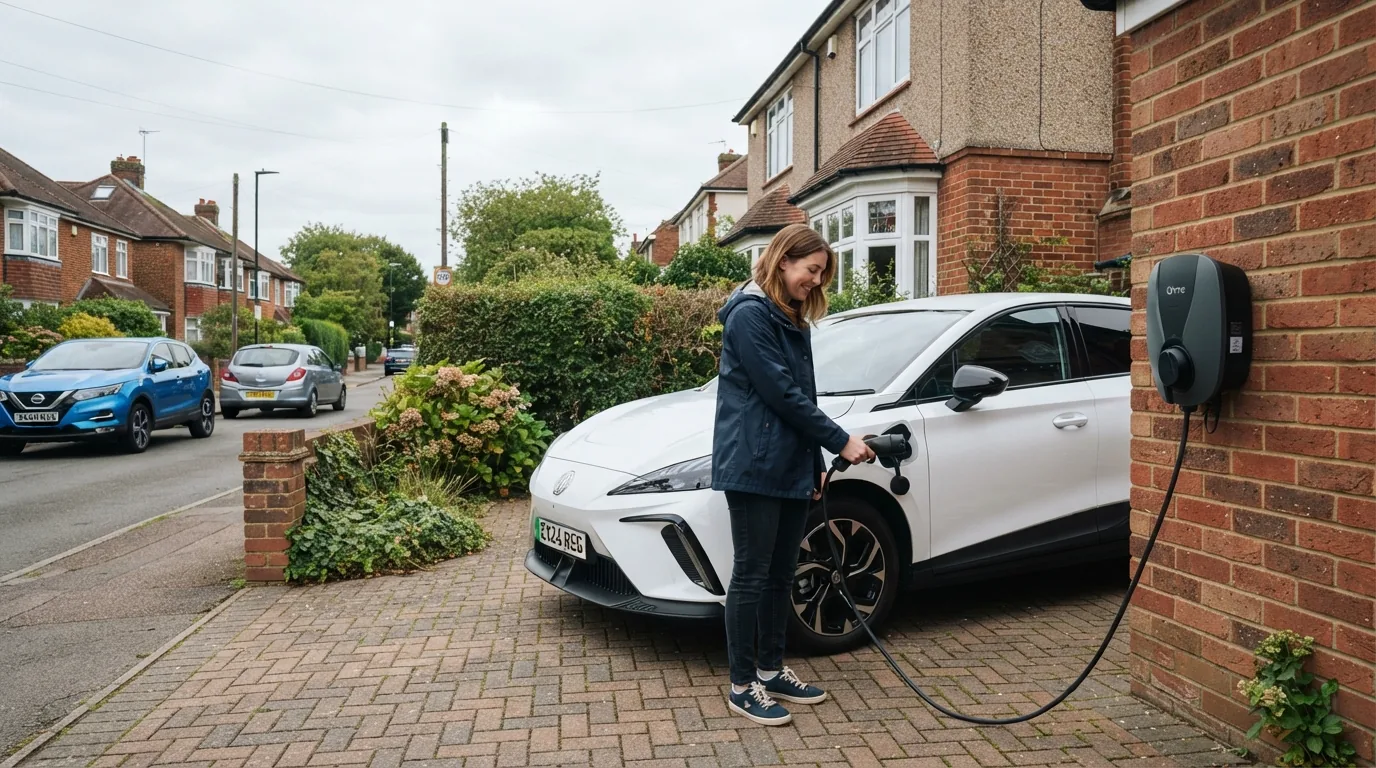
Home charging compatibility. Ideally, install a 7 kW wallbox before the car arrives. If you cannot, confirm that the car’s on-board charger works with the type of public charging available near you.
Strong dealer or support network. A first-time EV buyer benefits from being able to walk into a dealer and ask questions. Brands with comprehensive UK dealer networks (Hyundai, Kia, Volkswagen Group, BMW) have an advantage here over direct-only or newer market entrants.
A sensible mileage range. For a first EV, around 150 to 250 miles of real-world range is the sweet spot. More range means bigger battery, which means higher price and more weight. For a first car, you will rarely use the extra range but you will always pay for it.
Under £25,000
1. Citroën ë-C3 Extended Range
From £23,495 (£19,745 after Electric Car Grant) | 249 miles WLTP | 100 kW DC
The ë-C3 Extended Range is our top recommendation for first-time EV buyers under £25,000. The reasons: it is genuinely easy to drive, the ride comfort on UK roads is excellent (the best in this class), the 249-mile WLTP range means a full battery covers most UK weekly driving without needing a top-up, and the 100 kW DC rapid charging is modern and capable.
After the £3,750 Electric Car Grant, the effective price is under £20,000 for a new car with 249 miles of WLTP range. Nothing else at this net price is as well-rounded.
First-timer note: the Citroën My Ami electric app is very simple. Navigation integration with charging is basic but functional. If you charge primarily at home, this is less of a concern.
2. Renault 5 E-Tech (40 kWh)
From £22,995 | 188 miles WLTP | 80 kW DC
The 40 kWh Renault 5 is slightly less capable than the 52 kWh version on range, but at £22,995 it is an extremely attractive price for a genuinely charming, well-designed small car. For first-time buyers who are primarily city or suburban drivers covering under 150 miles per day, 188 miles WLTP (approximately 145 to 170 miles real-world) is adequate with daily home charging.
Built-in Google Maps with charging station integration is a genuine first-timer benefit: the car knows where chargers are, which ones are compatible, and factors them into route planning. This removes a significant source of new EV anxiety.
£25,000 to £35,000
3. Renault 5 E-Tech (52 kWh)
From £25,495 | 255 miles WLTP | 100 kW DC | 22 kW AC
The 52 kWh Renault 5 is the sweet spot in the range and the clearest recommendation for a first EV in its price band. The extra £2,500 over the 40 kWh buys meaningfully more real-world range (190 to 225 miles) and faster DC charging. The 22 kW AC charger is uniquely useful for public AC chargers in town centres, office parks and destinations.
The Parkers Best First Car Award winner for 2026, which validates the real-world usability rather than just the spec sheet.
4. Hyundai Kona Electric
From £32,995 | 319 miles WLTP | 100 kW DC
The Kona Electric is a well-considered, practical small SUV that is considerably easier to live with as a first EV than many alternatives. The 319-mile WLTP range is generous for the price and gives first-time drivers plenty of buffer. Hyundai’s five-year unlimited-mileage warranty covers the vehicle, and the battery carries 8-year, 125,000-mile warranty protection.
The Hyundai BlueLink connected services app is functional and includes real-time charge point information. The dealer network is comprehensive. For first-timers who want an SUV format with generous range and strong manufacturer support, the Kona Electric is our recommendation.
5. Volkswagen ID.3 (77 kWh)
From £36,895 | 357 miles WLTP | 170 kW DC
The ID.3 is slightly above this price band but worth including because its combination of 357-mile WLTP range, 170 kW peak charging and Volkswagen Group dealer support makes it genuinely compelling for first-time buyers who want certainty and a familiar brand. The 77 kWh battery’s generous capacity means real-world range of 270 to 310 miles: plenty of headroom.
The interior software has been improved significantly since the original 2020 launch. It is still not the best in class, but it is functional and familiar to Volkswagen drivers.
£35,000 to £50,000
6. Hyundai Ioniq 5 (Standard Range)
From £40,995 | 267 miles WLTP | 220 kW DC
For first-time buyers with a higher budget, the Ioniq 5 is outstanding. The 800V architecture’s 220 kW rapid charging is genuinely transformative for first-timers: a 10 to 80% charge in under 18 minutes means public charging stops are a brief interruption rather than a significant event. The flat floor and unusual interior design make it one of the most distinctive and practical cars in any class.
First-timer specific advantage: the Hyundai charging pass gives you simple access to multiple UK charging networks through a single account, reducing the complexity of learning the UK charging landscape.
7. Tesla Model Y (Standard Range)
From £39,990 | 311 miles WLTP | 250 kW DC
The Model Y is the best-selling electric car in the UK for good reason. For first-time buyers, the strongest argument is the Supercharger network: reliable, fast, easy to use, and integrated directly into the car’s navigation. When the car routes you to a charge stop, you trust it. That trust is particularly valuable when you are new to EV life and uncertain about range.
The large central touchscreen controls most functions. Some first-timers find this initially challenging (there are no buttons for windscreen wipers or the indicator stalk), but most adjust within two to three weeks.
First EV comparison table
| Model | Price | WLTP range | Real-world range | Max DC | Dealer network |
|---|---|---|---|---|---|
| Citroën ë-C3 Extended Range | £23,495 | 249 miles | 185–215 miles | 100 kW | Good (Stellantis) |
| Renault 5 E-Tech 40 kWh | £22,995 | 188 miles | 145–170 miles | 80 kW | Good |
| Renault 5 E-Tech 52 kWh | £25,495 | 255 miles | 190–225 miles | 100 kW | Good |
| Hyundai Kona Electric | £32,995 | 319 miles | 250–280 miles | 100 kW | Excellent |
| VW ID.3 (77 kWh) | £36,895 | 357 miles | 270–310 miles | 170 kW | Excellent |
| Hyundai Ioniq 5 | £40,995 | 267 miles | 205–235 miles | 220 kW | Excellent |
| Tesla Model Y | £39,990 | 311 miles | 240–270 miles | 250 kW | Direct only |
What first-time buyers get wrong
Underbuying on range. Buying the shortest-range car available to save money is the most common mistake. The extra monthly cost to step up from a 188-mile WLTP car to a 255-mile WLTP car on a PCP deal is often under £30 per month. The benefit to daily ownership confidence is enormous.
Not installing a home charger first. Order the charger before the car, if possible. Many wallbox installations can be arranged in 2 to 3 weeks. Arriving home with a new EV and no charger means relying on a three-pin plug (slow, inefficient) or public charging from day one.
Overcomplicating public charging. For first-timers who charge primarily at home, you will use public charging rarely. Download Zap-Map, register for one network (Osprey, bp pulse or Pod Point cover most scenarios), and that is sufficient to start. You can add more networks as you learn your own patterns.
What to read next
For the broader EV market including higher-budget options, see our best electric cars to buy in 2026. For budget-specific options, the electric cars under £30,000 guide covers the affordable end in full. Everything about ownership costs and the switch from petrol is in the buying and owning guide.
How we test and where our numbers come from
Range figures are official WLTP combined values taken from manufacturer UK specification pages, with real-world estimates drawn from independent comparative testing. Prices are UK list prices at the time of the latest update. Tax, grant and charging-scheme figures come from GOV.UK and HMRC publications. We re-check every guide when pricing, specification or policy changes. Last checked 11 August 2026.

EV Compared
The EV Compared editorial team tracks the UK electric vehicle market full time: new model launches, list prices, WLTP and real-world range, public charging tariffs and the tax rules that decide what an EV actually costs to run. Every guide is checked against manufacturer specifications and official GOV.UK figures, and updated whenever the numbers move.
Related reading
View all
What Are the Biggest Myths About Switching to an EV?
The claims that put UK drivers off going electric, and what the evidence actually says
Should You Buy an EV in 2026 or Wait for Cheaper Models?
An honest look at where EV prices are heading and whether the wait is worth it for UK buyers
Buying and Owning an Electric Car in the UK: The Complete 2026 Guide
Everything you need to know about costs, charging, depreciation and day-to-day life with an EV