EV Jargon Buster: 50 Electric Car Terms Explained
From AC and BMS to WLTP and ZEV mandate: clear definitions for the 50 EV terms UK drivers encounter most often
Quick answers
- Electric vehicle ownership comes with a new vocabulary. Many of the terms are acronyms (BMS, WLTP, SoC) and some are used inconsistently across manufacturers, networks and media.
- Charging network and policy terms: For more detail on any of these topics, explore the EV tech and apps hub or browse our best EV charging apps to find the tools that work hardest for UK drivers.
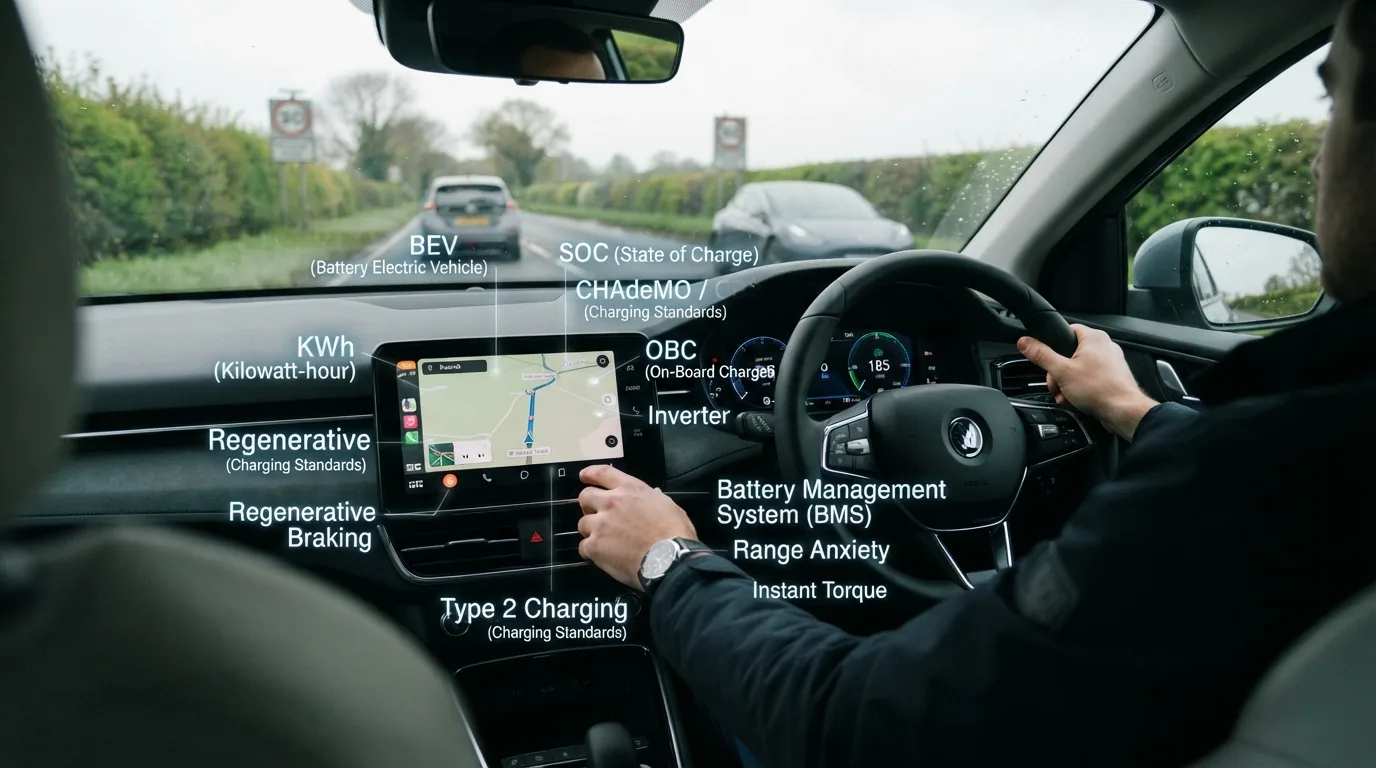
Electric vehicle ownership comes with a new vocabulary. Many of the terms are acronyms (BMS, WLTP, SoC) and some are used inconsistently across manufacturers, networks and media. This glossary cuts through the confusion: 50 terms, clearly defined for a UK driver, with honest context on why each one matters in practice.
Battery and chemistry terms
Anode: The negative electrode in a lithium-ion cell. During discharge, lithium ions leave the anode. In most current cells, the anode is graphite. In solid state batteries, it is metallic lithium.
Cathode: The positive electrode in a lithium-ion cell. The cathode chemistry determines much of the battery’s character. NMC, NCA and LFP are all cathode chemistries.
Cell: The basic electrochemical unit of a battery. An EV battery pack contains hundreds or thousands of cells, grouped into modules and then into the complete pack.
Module: A group of cells assembled together with their connections and local sensors. Modules slot into the battery pack.
Pack: The complete assembled battery, including all modules, the BMS electronics, cooling channels and structural casing. Pack capacity is measured in kWh.
kWh (kilowatt-hour): The unit of energy storage and consumption. One kWh is enough to drive a typical EV roughly 3 to 4 miles under mixed conditions, varying significantly by car, speed and temperature.
LFP (Lithium Iron Phosphate): A battery cathode chemistry offering high thermal stability, long cycle life and the ability to charge to 100% daily without significant degradation. Lower energy density than NMC. Used in Tesla Model 3 Standard Range, BYD Dolphin, Citroën ë-C3 and others.
NMC (Nickel Manganese Cobalt): The dominant premium EV battery chemistry. Higher energy density than LFP; benefits from staying between 20% and 80% for daily charging. Used in Hyundai IONIQ 5, BMW iX, Kia EV6 and most long-range EVs.
NCA (Nickel Cobalt Aluminium): A variant of NMC used by Tesla in some Long Range and Performance models. Similar characteristics to NMC; very high energy density.
Solid State Battery: A battery design replacing the liquid electrolyte with a solid material. Promises higher energy density, faster charging and better safety. Not yet in mass-market EVs; limited production expected from Toyota from 2027.
Energy density: The amount of energy stored per kilogram (Wh/kg) or per litre (Wh/L). Higher density means more range for the same weight.
Degradation: The gradual loss of battery capacity over time and use cycles. A normal and expected process. Most EV batteries retain 85 to 90% capacity after five years of typical UK use.
Battery management terms
BMS (Battery Management System): The electronics that monitor and control every cell in the battery pack. Manages voltage, temperature, state of charge, cell balancing and thermal control. The BMS protects the battery and calculates the figures shown on your dashboard.
SoC (State of Charge): The current charge level of the battery, expressed as a percentage. Equivalent to a fuel gauge. Calculated by the BMS using voltage measurements and current tracking.
SoH (State of Health): The remaining capacity of the battery relative to its original specification, expressed as a percentage. 100% is new. 80% SoH means the battery holds 80% of its original capacity.
Cell balancing: The BMS process of ensuring all cells in the pack have similar charge levels. Imbalanced cells reduce usable capacity and accelerate degradation of the weakest cells.
Thermal management: The systems that heat or cool the battery pack to keep it in its optimal operating temperature range (roughly 15°C to 35°C for most lithium-ion chemistries).
Thermal runaway: A dangerous self-sustaining exothermic reaction in a battery cell, where heat causes further reactions that generate more heat. Modern BMS systems and cell chemistry choices are designed to prevent this.
Preconditioning: Warming or cooling the battery (and often the cabin) before driving or rapid charging, while the car is still plugged in, so the energy comes from the mains rather than the battery.
Charging terms
AC (Alternating Current): The form of electricity supplied by the mains grid. Home wallboxes and most lamp post and workplace chargers are AC. The car’s onboard charger converts AC to DC.
DC (Direct Current): The form of electricity a battery stores. DC rapid chargers bypass the car’s onboard charger and deliver DC directly to the battery, enabling much faster charging rates.
kW (kilowatt): The unit of charging power. A 7 kW wallbox charges at 7 kilowatts. A 150 kW rapid charger delivers 150 kilowatts.
Type 2: The standard AC charging connector in the UK and Europe. Used for home wallboxes, workplace chargers and most public AC chargers. Can handle up to 22 kW AC.
CCS (Combined Charging System): The dominant DC rapid charging standard in the UK and Europe. Uses a Type 2 connector with two additional DC pins below for rapid charging.
CHAdeMO: An older Japanese DC rapid charging standard. Used by older Nissan Leaf models and some Mitsubishi vehicles. Being phased out; CHAdeMO rapid chargers are rare on new UK installations.
NACS (North American Charging Standard): Tesla’s proprietary connector, becoming a US standard. Not yet adopted in the UK; UK charging remains CCS and Type 2.
Plug and Charge (ISO 15118): A standard that enables a car to authenticate and start a charging session automatically when plugged in, without an app or RFID card. Live at IONITY in the UK.
RFID card: A contactless card used to start charging sessions at public chargers. Most UK charging networks issue one.
Rapid charger: An informal term for a DC fast charger. Typically delivers 50 kW or above. Ultra-rapid is commonly used for 150 kW and above.
Ultra-rapid charger: DC charger delivering 150 kW or more. Over 13,000 ultra-rapid chargers now exist on the UK public network (Zap-Map, April 2026).
Charge curve: The profile of charge rate versus state of charge during a DC rapid-charge session. Most EVs taper charge rate above 80% SoC to protect the battery. A good charge curve stays high for longer.
Trickle charging: Charging at 3 kW or below, typically using a standard 13-amp household socket via a three-pin lead. Slow and not recommended as a primary home charging method.
Smart charging: Charging that responds to grid signals or tariff prices, shifting consumption to off-peak periods automatically.
Range terms
WLTP (Worldwide Harmonised Light Vehicle Test Procedure): The EU and UK standard for measuring official EV range and energy consumption. More realistic than the old NEDC standard but still typically 15 to 25% above real-world range under UK conditions.
Real-world range: The actual distance achievable on a full charge under real driving conditions. Typically 20 to 30% below WLTP in summer and 30 to 45% below WLTP in winter.
Usable capacity: The portion of total battery capacity the BMS allows the driver to access. Manufacturers reserve a buffer at both ends to protect battery longevity. A 77 kWh total pack might have 74 kWh usable.
Regenerative braking: Using the electric motor as a generator to recover kinetic energy during deceleration, feeding it back into the battery. Reduces energy consumption and replaces much of the brake pedal’s work.
One-pedal driving: A driving mode in which strong regenerative braking brings the car almost to a stop when you lift off the accelerator, minimising use of the friction brakes.
Efficiency (Wh/km or mi/kWh): A measure of how much energy the car uses per unit of distance. Lower Wh/km or higher mi/kWh is better. Useful for comparing cars on a like-for-like basis.
Vehicle terms
BEV (Battery Electric Vehicle): A fully electric car with no internal combustion engine, running entirely on battery power.
PHEV (Plug-in Hybrid Electric Vehicle): A car with both an electric battery (charged from the mains) and a petrol or diesel engine. Can run on electric power for a limited range, typically 20 to 50 miles.
MHEV (Mild Hybrid Electric Vehicle): A car with a small battery that assists the combustion engine but cannot drive the car on electricity alone. Cannot be plugged in.
e-4WD / AWD: All-wheel drive on an EV, typically delivered by separate front and rear motors rather than a mechanical differential.
OTA (Over The Air): Software updates delivered wirelessly to the car, without a dealer visit. Can update infotainment, navigation, battery management and other vehicle systems.
V2G (Vehicle to Grid): Technology that allows the car’s battery to export energy back to the national electricity grid, earning money for the driver.
V2H (Vehicle to Home): Technology that allows the car’s battery to power a household, drawing stored charge from the battery rather than the grid during expensive peak-rate periods.
V2L (Vehicle to Load): A socket on the car that allows appliances to be powered directly from the battery, as if from a generator. Typically 2.3 to 3.6 kW.
Heat pump: An efficient cabin and battery heating system that extracts ambient heat rather than generating it from electricity alone. Delivers 2 to 4 kWh of heat per kWh consumed, compared to 1 kWh for a resistance heater.
Charging network and policy terms
DNO (Distribution Network Operator): The regional electricity network company responsible for distributing power from the national grid to homes and businesses. Relevant for V2H/V2G installations requiring G99 approval.
G99 approval: Grid approval required from your DNO for any home installation that exports more than 3.68 kW to the grid. Required for most V2H and V2G setups. Typically takes 30 to 60 working days.
Smart tariff: An electricity tariff with variable pricing by time of day. Octopus Agile, Octopus Go and similar tariffs offer cheap overnight rates ideal for EV charging.
ZEV mandate: The UK policy requiring car manufacturers to sell an increasing proportion of zero-emission vehicles each year, rising to 80% of new car sales by 2030 and 100% by 2035.
OZEV (Office for Zero Emission Vehicles): The UK government body overseeing EV policy, grants and charging infrastructure strategy.
ULEZ (Ultra Low Emission Zone): A charging zone for vehicles not meeting emissions standards, operating in London and some other UK cities. Full EVs are exempt.
For more detail on any of these topics, explore the EV tech and apps hub or browse our best EV charging apps to find the tools that work hardest for UK drivers.
How we test and where our numbers come from
Range figures are official WLTP combined values taken from manufacturer UK specification pages, with real-world estimates drawn from independent comparative testing. Prices are UK list prices at the time of the latest update. Tax, grant and charging-scheme figures come from GOV.UK and HMRC publications. We re-check every guide when pricing, specification or policy changes. Last checked 11 August 2026.

EV Compared
The EV Compared editorial team tracks the UK electric vehicle market full time: new model launches, list prices, WLTP and real-world range, public charging tariffs and the tax rules that decide what an EV actually costs to run. Every guide is checked against manufacturer specifications and official GOV.UK figures, and updated whenever the numbers move.
Related reading
View all
Apple CarPlay vs Built In EV Software: Which Is Better?
Apple CarPlay is familiar and loved, but built-in EV software controls your battery, charging and range. We explain when each wins and which cars get the balance right.

Best Apps to Find EV Chargers in the UK
With over 120,000 public charge points in the UK, the right app makes the difference between a smooth charging stop and a wasted detour. Here are the options ranked
What Is Bidirectional Charging and Can It Power Your Home?
Bidirectional charging lets your electric car act as a home battery or feed the national grid. Here is how it works, what it costs and which UK cars support it in 2026