What Is an EV Heat Pump and Why Does It Matter in the UK?
A heat pump can add 10 to 30 per cent to your winter range. Here is how it works, which EVs have one and whether it is worth specifying
Quick answers
- An EV heat pump is a refrigeration-cycle heating system that extracts warmth from the outside air (and from the car's own powertrain components) to heat the cabin and battery.
- How does an EV heat pump work: A heat pump works on the same principle as a domestic heat pump or a refrigerator running in reverse.
- The UK's climate sits almost perfectly in the sweet spot for heat pump efficiency.
- Which EVs have a heat pump in the UK: The absence of a heat pump is increasingly a budget-category decision.
- Does the heat pump also help the battery: In winter, warming the battery before driving or rapid charging improves both range and charge rate.
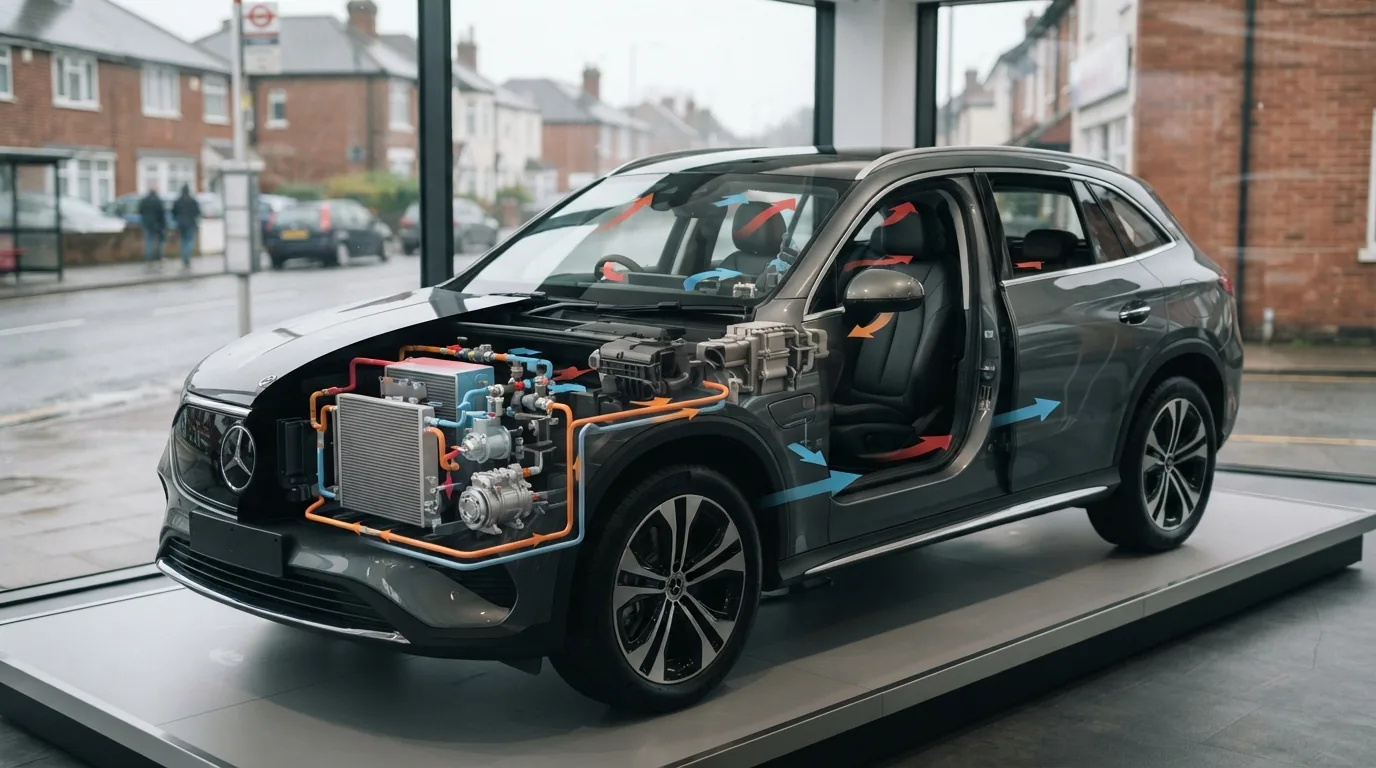
- Some manufacturers use what are called "octopus" or multi-valve thermal management architectures, where a single heat pump system simultaneously manages cabin temperature, battery temperature and powertrain heat recovery through a network of valves and heat exchangers.
An EV heat pump is a refrigeration-cycle heating system that extracts warmth from the outside air (and from the car’s own powertrain components) to heat the cabin and battery. It typically delivers 2 to 4 kWh of heat for every 1 kWh of electricity it consumes, making it dramatically more efficient than the resistance heater it replaces. In the UK, where winter temperatures regularly fall to 2 to 8°C, a heat pump can recover 10 to 30 per cent of the range lost to cabin heating.
How does an EV heat pump work?
A heat pump works on the same principle as a domestic heat pump or a refrigerator running in reverse. A refrigerant fluid circulates through a closed loop, cycling between a low-pressure evaporator and a high-pressure condenser.
- The refrigerant, at low pressure, absorbs heat from the outside air through the evaporator. Even at 0°C, there is enough energy in the air for this to work effectively.
- A compressor, powered by the car’s battery, increases the pressure of the refrigerant, raising its temperature significantly.
- The hot refrigerant passes through a condenser, where it releases heat into the cabin air or into the battery thermal management system.
- The refrigerant expands through an expansion valve, dropping back to low pressure and temperature, and the cycle repeats.
The coefficient of performance (COP) measures how much heat you get per unit of electricity. A resistance heater has a COP of exactly 1. A modern EV heat pump achieves a COP of 2 to 4 at typical UK winter temperatures (0°C to 10°C), meaning every kilowatt of electricity generates 2 to 4 kW of useful heat. At 5°C, a good heat pump runs at around COP 3.
Why does it matter for UK drivers specifically?
The UK’s climate sits almost perfectly in the sweet spot for heat pump efficiency. Heat pumps work at their best between approximately -5°C and +15°C, which covers the majority of British winters. They become less efficient below -15°C, but UK temperatures rarely approach that.
A resistance heater in a typical 60 kWh EV might consume 3 to 4 kW to maintain a warm cabin in cold weather, cutting into range meaningfully over a two-hour motorway drive. That is 6 to 8 kWh consumed just on heating over 100 miles, reducing effective range by 10 to 15 per cent before road and thermal losses are considered.
A heat pump covering the same job at COP 3 uses only 1 to 1.3 kW for the same heating output, consuming roughly 2 to 2.6 kWh over the same journey. The range penalty from cabin heating drops from 10 to 15 per cent to 3 to 5 per cent.
Real-world testing by What Car? found that EVs with heat pumps missed their official winter range figure by around 25 per cent on average, compared to 34 per cent for those without. For a car with a 300-mile WLTP rating, that is the difference between 225 miles and 198 miles of practical winter range.
Which EVs have a heat pump in the UK?
| Car | Heat pump | Notes |
|---|---|---|
| Tesla Model 3 (2021 onwards) | Yes | Standard across all variants from 2021 refresh |
| Tesla Model Y | Yes | Standard from launch in UK |
| Hyundai IONIQ 5 | Yes | Standard across all trim levels |
| Hyundai IONIQ 6 | Yes | Standard |
| Kia EV6 | Yes | Standard across the range |
| Kia EV9 | Yes | Standard |
| Volkswagen ID.3 (facelift) | Yes | Standard on all UK variants from 2023 facelift |
| Volkswagen ID.4 | Yes | Standard |
| BMW iX | Yes | Standard |
| BMW i4 | Yes | Standard |
| Peugeot e-308 / e-3008 | Yes | Standard |
| Renault Megane E-Tech | Yes | Standard |
| Renault 5 E-Tech | Yes | Standard |
| Nissan Ariya | Yes | Standard |
| Volvo EX30 | Yes | Standard |
| Audi Q4 e-tron | Optional/Standard depends on trim | Check individual specification |
| Nissan Leaf (older models) | No | Uses resistance heating |
| MG4 (base trim) | No | Standard on higher trims depending on variant |
| Dacia Spring | No | Budget model; resistance heater |
The absence of a heat pump is increasingly a budget-category decision. Virtually all new mainstream and premium EVs sold in the UK from 2022 onwards include one as standard.
Does the heat pump also help the battery?
Yes. Modern heat pump systems in EVs are multi-function: the same refrigerant loop that heats the cabin can also warm or cool the battery pack, depending on conditions.
In winter, warming the battery before driving or rapid charging improves both range and charge rate. A cold lithium-ion cell (below about 10°C) has higher internal resistance, which means it accepts charge more slowly and delivers less usable capacity. Preconditioning using the heat pump brings the battery into its optimal operating window before you need it, without drawing on the battery itself if the car is still plugged in.
In summer, the heat pump runs in the other direction: it cools the battery by extracting heat and rejecting it through the vehicle’s front heat exchanger, preventing the thermal degradation that heat causes in battery cells.
What about octopus arms heat pump systems in EVs?
Some manufacturers use what are called “octopus” or multi-valve thermal management architectures, where a single heat pump system simultaneously manages cabin temperature, battery temperature and powertrain heat recovery through a network of valves and heat exchangers. Tesla’s heat pump system, introduced on the Model Y and then the refreshed Model 3, works this way: it can harvest heat from the motor and inverter as well as the outside air, making it particularly effective.
Hyundai and Kia use a similar integrated approach on the IONIQ 5, IONIQ 6 and EV6, using what they call an integrated thermal management system. These more sophisticated designs can sustain better COP values even at lower temperatures.
What is the common mistake?
The mistake to avoid is assuming that a heat pump is only relevant in very cold weather. In the UK, temperatures between November and March are typically 2 to 10°C for most of the country. This is exactly where a heat pump delivers its best value: not at -20°C (where no heat pump is great), but at the mundane 5°C of a typical January morning commute.
Drivers who dismiss the heat pump specification on the grounds that “the UK doesn’t get that cold” are missing the point. The heat pump is not primarily about coping with extreme cold; it is about recovering the 30 to 40 per cent range penalty that a resistance heater imposes during the ordinary British winter.
Is a heat pump worth specifying?
If a heat pump is an optional extra on the model you are considering, and it costs less than about £500 to £1,000, yes. The range benefit over five years of UK winter driving is substantial. The specification also adds resale value, as buyers have become aware of the difference.
On most current UK-market EVs, this question is moot: the heat pump is standard. The more useful exercise is checking whether a budget model you are considering omits one, and factoring in the range implications if it does.
Does a heat pump affect servicing or reliability?
Heat pumps add mechanical complexity compared to a simple resistance heater. They have a compressor (an electric motor driven compressor, not the engine-driven belt type in a conventional car), refrigerant circuits and multiple valves. Compressor failures have occurred on some models, most notably early Tesla Model 3 units, though Tesla addressed this through its standard warranty and subsequent design revisions.
In general, the heat pump circuits in modern EVs have proven reliable. The long-term servicing cost is primarily refrigerant checks and compressor replacement if required, both of which are within the scope of standard EV servicing intervals.
For more on EV technology, see our EV tech and apps hub. For apps to help manage your charging and range, see our best EV charging apps.
How we test and where our numbers come from
Range figures are official WLTP combined values taken from manufacturer UK specification pages, with real-world estimates drawn from independent comparative testing. Prices are UK list prices at the time of the latest update. Tax, grant and charging-scheme figures come from GOV.UK and HMRC publications. We re-check every guide when pricing, specification or policy changes. Last checked 11 August 2026.
Frequently asked questions
How does an EV heat pump work?
A heat pump works on the same principle as a domestic heat pump or a refrigerator running in reverse. A refrigerant fluid circulates through a closed loop, cycling between a low-pressure evaporator and a high-pressure condenser.
Why does it matter for UK drivers specifically?
The UK's climate sits almost perfectly in the sweet spot for heat pump efficiency. Heat pumps work at their best between approximately -5°C and +15°C, which covers the majority of British winters.
Which EVs have a heat pump in the UK?
The absence of a heat pump is increasingly a budget-category decision. Virtually all new mainstream and premium EVs sold in the UK from 2022 onwards include one as standard.
Does the heat pump also help the battery?
Yes. Modern heat pump systems in EVs are multi-function: the same refrigerant loop that heats the cabin can also warm or cool the battery pack, depending on conditions.
What about octopus arms heat pump systems in EVs?
Some manufacturers use what are called "octopus" or multi-valve thermal management architectures, where a single heat pump system simultaneously manages cabin temperature, battery temperature and powertrain heat recovery through a network of valves and heat exchangers.

EV Compared
The EV Compared editorial team tracks the UK electric vehicle market full time: new model launches, list prices, WLTP and real-world range, public charging tariffs and the tax rules that decide what an EV actually costs to run. Every guide is checked against manufacturer specifications and official GOV.UK figures, and updated whenever the numbers move.
Related reading
View all
Apple CarPlay vs Built In EV Software: Which Is Better?
Apple CarPlay is familiar and loved, but built-in EV software controls your battery, charging and range. We explain when each wins and which cars get the balance right.

Best Apps to Find EV Chargers in the UK
With over 120,000 public charge points in the UK, the right app makes the difference between a smooth charging stop and a wasted detour. Here are the options ranked
What Is Bidirectional Charging and Can It Power Your Home?
Bidirectional charging lets your electric car act as a home battery or feed the national grid. Here is how it works, what it costs and which UK cars support it in 2026