Best Electric Cars for Long Distance Driving in the UK
The EVs that make motorway miles genuinely stress-free in 2026, ranked by real-world range and charging network access
Quick answers
- Long-distance driving is the use case where EVs are most scrutinised and most frequently misunderstood. The questions are valid: what is the real-world range on a motorway at 70 mph?
- Top picks for long-distance driving: The Model 3 Long Range is the benchmark for long-distance EV travel in 2026.
- Long-distance in the UK also includes A-road journeys, rural driving and cross-country routes where motorway services with ultra-rapid chargers may not be available.
- Treating WLTP range as real-world range and not planning stops.
Long-distance driving is the use case where EVs are most scrutinised and most frequently misunderstood. The questions are valid: what is the real-world range on a motorway at 70 mph? How long does a charge stop take? Is the charging network reliable enough? In 2026, the honest answers are considerably more encouraging than they were three years ago.
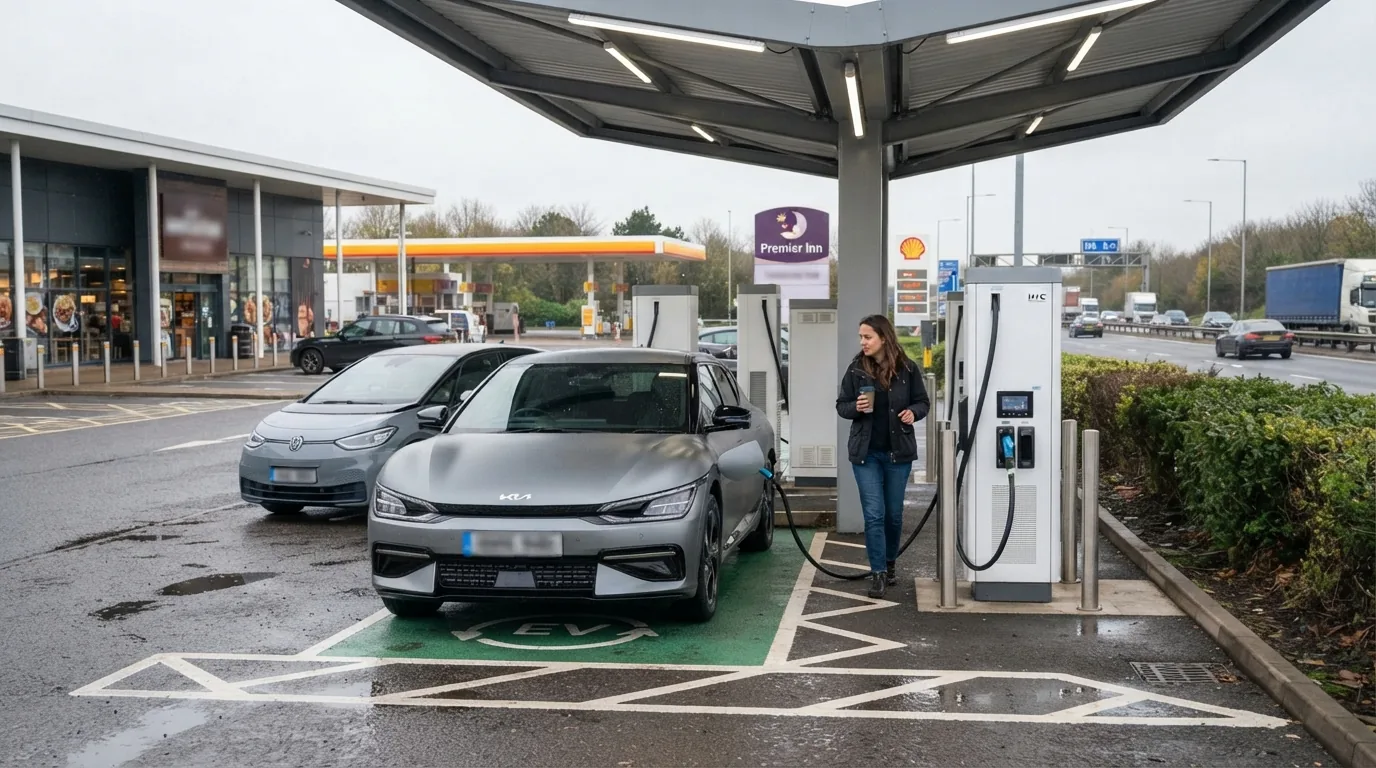
The UK now has 92,000 public charge points across 46,000 locations. The motorway network is served by Gridserve, Tesla Superchargers, Pod Point, Osprey and others, with ultra-rapid hubs at most motorway services. For drivers who plan, the experience is reliable. For those who do not, it remains stressful.
This guide covers the best electric cars for long-distance driving in the UK, with honest real-world range figures and an assessment of which charging networks each model can access.
What matters for long-distance EV driving?
Three factors, in order of importance:
1. Real-world motorway range. WLTP figures are tested at mixed speeds; motorway range at 70 mph is typically 20 to 25% lower. A car with 400 miles WLTP delivers roughly 300 to 320 miles on a motorway run. Always apply this discount before trusting a quoted range for long-trip planning.
2. Peak DC charging speed. At a 150 kW rapid charger, a car with a 100 kW peak rate fills at 100 kW; a car with 200 kW peak fills faster and gets you back on the road sooner. For regular long-trip drivers, a 150 kW or faster peak charging rate meaningfully reduces stop duration.
3. Charging network compatibility. Tesla Superchargers are the most reliable network in the UK. All non-Tesla EVs now support CCS rapid charging, and most Tesla Supercharger sites in the UK are now open to non-Tesla vehicles (on the Supercharger network app). Access to the Supercharger network is no longer a Tesla-exclusive advantage.
Top picks for long-distance driving
1. Tesla Model 3 Long Range
From £44,990 | 466 miles WLTP | Real-world motorway: 350–380 miles | Max DC: 250 kW
The Model 3 Long Range is the benchmark for long-distance EV travel in 2026. Its 466-mile WLTP range (the highest of any Model 3 variant) translates to approximately 350 to 380 miles in real-world motorway conditions, making it the only car in the mainstream price range that can realistically complete London to Edinburgh (403 miles) on a single charge in optimal summer conditions.
The 250 kW peak charging rate via Tesla’s V3 Supercharger network adds roughly 200 miles of range in 15 minutes. The Supercharger network’s reliability, density and payment simplicity are its own argument: no separate app required, charge and go.
The caveat: Tesla’s four-year, 50,000-mile vehicle warranty is the shortest in its peer group. Some buyers find this insufficient reassurance for a nearly £45,000 car.
2. Mercedes-Benz CLA (2026)
From approximately £42,000 | 461 miles WLTP | Real-world motorway: 355–385 miles | Max DC: 320 kW
The new Mercedes CLA launched in 2026 with a genuinely class-leading 320 kW peak charging rate on its top 400V architecture (the 800V configuration charges at 200 kW for the longer range version). Its slippery aerodynamics are a key factor: the 0.22 Cd drag coefficient is among the lowest of any production car, which means the WLTP range holds up unusually well on a motorway run.
Wind noise is minimal and the long-distance ride quality is excellent. For buyers who want maximum real-world range with the fastest available charging, the CLA is the most compelling 2026 arrival.
The caveat: availability is limited in early 2026 as production ramps up. Waiting lists apply for most variants.
3. Volkswagen ID.7
From £52,815 | 441 miles WLTP | Real-world motorway: 325–360 miles | Max DC: 200 kW
The ID.7 is VW’s flagship saloon and delivers the long-distance experience you would expect: very quiet at motorway speeds, well-controlled ride, genuinely spacious boot (532 litres), and a 441-mile WLTP figure that genuinely holds up on the motorway. The 86 kWh battery (usable) provides a real-world buffer that means most UK intercity routes are comfortably achievable without stopping.
The 200 kW peak charging rate is not the fastest in class, but the ID.7’s combination of genuine range, on-board comfort and competitive pricing against premium rivals makes it one of the strongest long-trip choices at its price point.
4. Audi A6 e-tron
From approximately £59,000 | 470 miles WLTP | Real-world motorway: 360–390 miles | Max DC: 270 kW
The A6 e-tron brings Audi’s build quality and interior refinement to the long-range EV segment. The 800V architecture enables 270 kW peak charging (10 to 80% in under 25 minutes), real-world motorway range approaches 380 miles in optimal conditions, and the interior is genuinely premium without the spartan aesthetic of some rivals.
For buyers who regularly drive 200-plus mile legs and want premium cabin quality during the journey, the A6 e-tron is the strongest choice among the Volkswagen Group’s premium long-range offerings.
5. BMW iX3 (Neue Klasse, 2026)
From £58,755 | 421–500 miles WLTP | Real-world motorway: 330–400 miles | Max DC: 185 kW
The new BMW iX3 on the Neue Klasse platform represents a significant step forward. The top-specification version claims up to 500 miles WLTP, which would make it the longest-range non-Tesla mainstream EV in the UK market. Real-world motorway range in the 330 to 400 mile region is plausible for the 89.2 kWh battery specification.
BMW’s dealer network is the most comprehensive of any premium EV brand in the UK, which provides practical reassurance for long-distance drivers. The 185 kW peak charging rate is respectable but not class-leading at this price.
Long-distance comparison table
| Model | Price | WLTP range | Real-world motorway | Max DC charge | 10–80% time (est) |
|---|---|---|---|---|---|
| Tesla Model 3 LR | £44,990 | 466 miles | 350–380 miles | 250 kW | ~22 min |
| Mercedes CLA (800V) | ~£42,000 | 461 miles | 355–385 miles | 320 kW | ~16 min |
| Volkswagen ID.7 | £52,815 | 441 miles | 325–360 miles | 200 kW | ~26 min |
| Audi A6 e-tron | ~£59,000 | 470 miles | 360–390 miles | 270 kW | ~18 min |
| BMW iX3 (Neue Klasse) | £58,755 | 421–500 miles | 330–400 miles | 185 kW | ~28 min |
| Polestar 3 LR | £68,000 | 379 miles | 285–320 miles | 250 kW | ~20 min |
| Hyundai Ioniq 6 LR | £44,995 | 381 miles | 295–330 miles | 233 kW | ~18 min |
| Tesla Model Y LR | £47,990 | 373 miles | 285–315 miles | 250 kW | ~22 min |
What about non-motorway long-distance driving?
Long-distance in the UK also includes A-road journeys, rural driving and cross-country routes where motorway services with ultra-rapid chargers may not be available. In these situations, planning for 100 kW or slower chargers is important. All of the models above are fully compatible with 50 kW and 100 kW chargers, which are more widely distributed across the UK road network than ultra-rapid 150 kW+ options.
For rural areas specifically, the Zap-Map app shows real-time charge point availability. As of mid-2026, there are over 5,000 charge points outside motorway corridors accessible via CCS. Gaps remain in parts of Scotland, Wales and rural England, but major A-road routes are now adequately served.
What is the most common long-distance mistake?
Treating WLTP range as real-world range and not planning stops. A car with 450 miles WLTP is not a 450-mile car on a motorway. Apply the 20 to 25% motorway discount, then plan a charge stop at around 60 to 65% of the resulting figure to give yourself buffer. For a car with 350 miles of real-world motorway range, that means planning a stop every 200 to 220 miles.
What to read next
For the best electric cars overall, including models suited to both urban and long-distance use, see best electric cars to buy in 2026. For everything about charging on long trips, the buying and owning guide has the full picture.
How we test and where our numbers come from
Range figures are official WLTP combined values taken from manufacturer UK specification pages, with real-world estimates drawn from independent comparative testing. Prices are UK list prices at the time of the latest update. Tax, grant and charging-scheme figures come from GOV.UK and HMRC publications. We re-check every guide when pricing, specification or policy changes. Last checked 11 August 2026.
Frequently asked questions
What about non-motorway long-distance driving?
Long-distance in the UK also includes A-road journeys, rural driving and cross-country routes where motorway services with ultra-rapid chargers may not be available. In these situations, planning for 100 kW or slower chargers is important.
What is the most common long-distance mistake?
Treating WLTP range as real-world range and not planning stops. A car with 450 miles WLTP is not a 450-mile car on a motorway.

EV Compared
The EV Compared editorial team tracks the UK electric vehicle market full time: new model launches, list prices, WLTP and real-world range, public charging tariffs and the tax rules that decide what an EV actually costs to run. Every guide is checked against manufacturer specifications and official GOV.UK figures, and updated whenever the numbers move.
Related reading
View all
What Are the Biggest Myths About Switching to an EV?
The claims that put UK drivers off going electric, and what the evidence actually says

Should You Buy an EV in 2026 or Wait for Cheaper Models?
An honest look at where EV prices are heading and whether the wait is worth it for UK buyers
Buying and Owning an Electric Car in the UK: The Complete 2026 Guide
Everything you need to know about costs, charging, depreciation and day-to-day life with an EV