Kia EV3 review: the small electric SUV that finally gets the basics right
A 375-mile claimed range, a genuinely usable interior and a price that makes sense. We put Kia's compact SUV through a week of British weather to see if the real world matches the spec sheet.
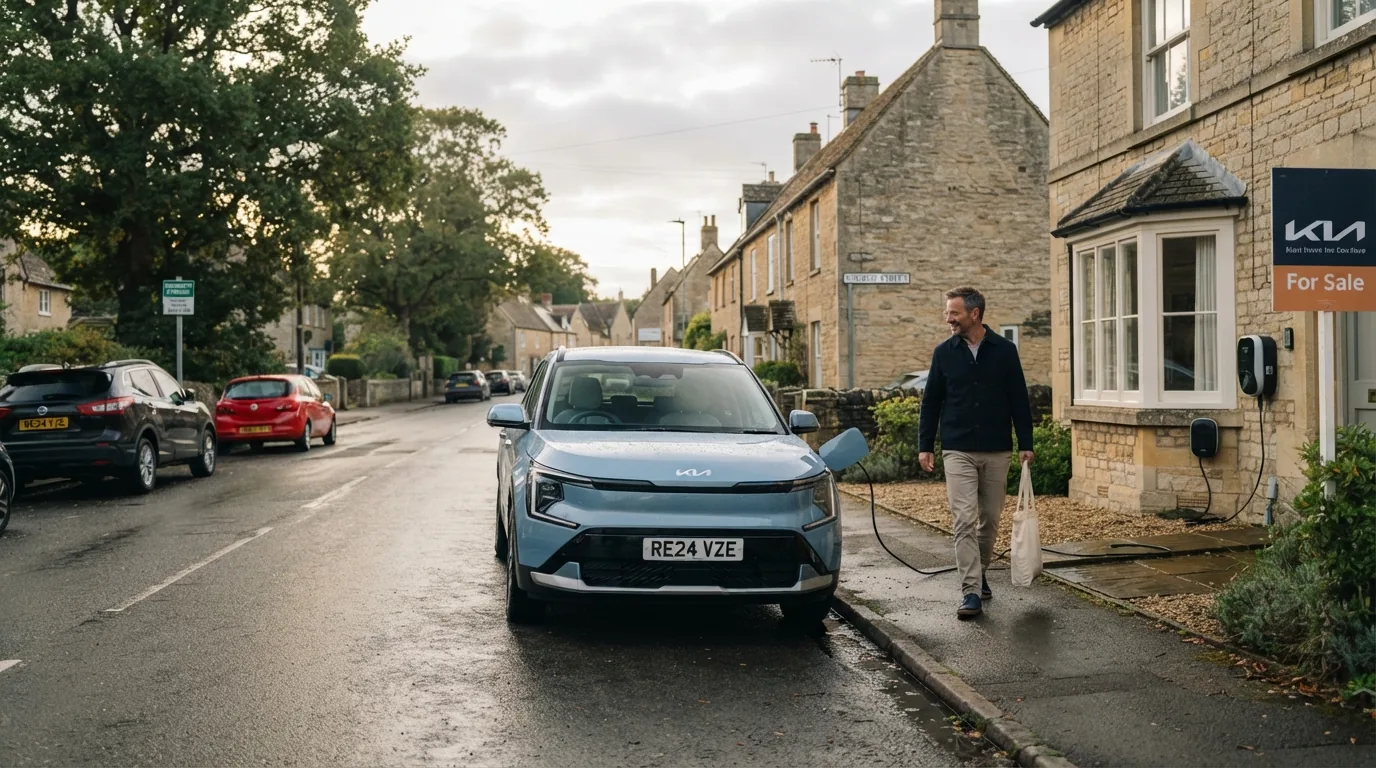
Quick answers
- The Kia EV3 Air Long Range (£36,055 OTR) offers 375 miles WLTP range and 10-80% DC charging in 33 minutes, which is the best combination of range and charging speed in the class at this price.
- Real-world range in cold UK conditions (below 0C) falls to approximately 200-235 miles based on modelled estimates; the heat pump, standard on the GT-Line S and optional on the Air SR at approximately £900, limits the cold-weather drop.
- Boot space of 460 litres beats the Volvo EX30 (318 litres) by a significant margin and is broadly on a par with the Skoda Elroq (470 litres).
- BIK company car tax sits at 4% in 2026/27, making the GT-Line a competitive choice for fleet drivers below the £40,000 P11D threshold.
- A five-star Euro NCAP rating (83% adult occupant, 84% child occupant) and a 7-year/100,000-mile warranty provide a strong ownership proposition.
- V2L (Vehicle to Load) is available on the GT-Line S only; buyers who want this feature need to budget for the £43,055 top trim.
Kia EV3 review: a practical, well-priced small electric SUV with genuinely usable range
Getting range, interior space and asking price right at the same time has been the small electric SUV’s hardest trick. The Kia EV3 manages all three. Starting from £33,055 OTR for the Air SR (58.3 kWh, 270 miles WLTP) and rising to £36,055 for the Air Long Range (81.4 kWh, 375 miles WLTP), it arrives with a 204 hp motor, a five-star Euro NCAP rating and Kia’s 7-year warranty. That is a strong opening hand. For our full collection of small electric SUV reviews, see the EV Compared reviews hub.
We tested the Air Long Range and GT-Line Long Range across a mix of motorway, A-road and urban driving. This review covers every trim from the entry Air SR to the top-spec GT-Line S, with real-world range data, a frank look at charging speeds, a straight comparison against the Volvo EX30 and Skoda Elroq, and an honest assessment of where the EV3 falls short. If you are deciding whether to buy one, this is the review to read first.
What you get for the money: trim levels and pricing
Four trims, a clear value ladder, and one obvious sweet spot. That is the EV3 lineup in summary. The entry point is perfectly respectable; the top trim adds features that most private buyers will not need. Here is how the range breaks down.
| Trim | Battery | OTR price | Key additions |
|---|---|---|---|
| Air SR | 58.3 kWh | £33,055 | Dual 12.3-inch displays, adaptive cruise, wireless Android Auto/Apple CarPlay, highway drive assist |
| Air Long Range | 81.4 kWh | £36,055 | 105 extra miles of range for £3,000 more; otherwise the same trim level as Air SR |
| GT-Line Long Range | 81.4 kWh | £39,455 | 19-inch alloys, leather upholstery, wireless charging pad, 367-mile WLTP range |
| GT-Line S Long Range | 81.4 kWh | £43,055 | V2L socket, heat pump (standard on this trim), panoramic sunroof, 362-mile WLTP range |
All four trims carry the same 7-year/100,000-mile main warranty and an 8-year/100,000-mile battery warranty guaranteeing at least 70% capacity. Insurance groups run from 34D for the Air SR to 38D for the GT-Line S.
One point worth flagging immediately: the heat pump is not standard across the range. It comes as standard only on the GT-Line S. On the Air SR it is an optional extra at approximately £900. The Air Long Range and GT-Line Long Range do not include it as standard. In a British climate, that matters for winter range; more on that in the range section below.
Which trim should you buy? The Air Long Range is the clear value pick for most buyers. Three thousand pounds over the entry model buys you 105 extra miles of WLTP range and meaningfully more confidence on long trips. The gap to the GT-Line is another £3,400, and what you gain is largely cosmetic: leather seats and bigger wheels. Unless those matter to you, the Air Long Range is the sensible choice. For company car drivers working below a £40,000 P11D ceiling, the GT-Line at £39,455 is worth considering given the BIK rate advantage. The GT-Line S at £43,055 is for buyers who specifically want V2L or the panoramic roof; it is hard to justify on pure value grounds for private buyers.
Range: what the numbers actually mean on UK roads
The 375-mile WLTP headline figure is real under the right conditions. In cold British winters, the reality is quite different. Both things can be true simultaneously, and understanding the gap between them is what makes the difference between a good buying decision and a disappointing one.
WLTP figures come from controlled test cycles. For the EV3 Long Range (81.4 kWh gross, approximately 78 kWh usable), the certified figure is 375 miles. The standard-range Air SR (58.3 kWh gross, approximately 55 kWh usable) is certified at 270 miles. The GT-Line trims return 367 miles and 362 miles respectively on the long-range battery, slightly lower due to heavier 19-inch wheels.
EV Database’s independently modelled real-world combined estimate puts the long-range EV3 at approximately 280 miles in typical mixed driving. That is significantly less than the WLTP figure, but it is still more than the Volvo EX30’s full WLTP claim of 209 miles on its standard-range battery.
Real-world range at three temperature ranges (EV Database modelled estimates, long-range variant):
- Cold weather (around -10C): approximately 200-235 miles. Figures vary; verify current data.
- Mild weather (around 23C): approximately 325-415 miles depending on speed and load. Figures vary; verify current data.
- Real-world combined: approximately 280 miles.
These are modelled estimates, not tested UK figures, and should be treated as indicative. A third-party winter range test conducted by CarExplorers in Sweden (at around -3C) recorded consumption of 19.2 kWh/100 km at 80 km/h, which projects to approximately 252 miles. At 120 km/h in 5C conditions the same test recorded 23.8 kWh/100 km, projecting to approximately 204 miles. That test was not conducted in the UK, so treat the numbers as a directional guide rather than a precise forecast.
From the owner side: one UK driver with an Air Long Range reported 310 miles of real-world range from an 80% charge. That is a single data point from early in ownership, so it is not representative of every driver’s experience, but it does suggest the long-range battery can deliver genuinely impressive distances in favourable conditions.
Cold-weather performance improves materially if you have the heat pump fitted. Without it, the car uses resistive heating, which draws significantly more energy from the battery. In a cold British winter, a standard-range Air SR without the heat pump will feel the range squeeze more acutely. The approximately £900 optional extra for the heat pump on the Air SR is money well spent for drivers in colder parts of the country or anyone who will drive regularly through winter.
Charging: how fast, and is it genuinely rapid-charge friendly?
The 33-minute 10-80% figure on the long-range model is the number that matters most for motorway driving. It means a coffee stop is genuinely enough time to add significant range, which changes how you think about longer journeys.
| Charging type | Max rate | Time |
|---|---|---|
| DC rapid (long range, CCS) | 135 kW peak / 105 kW average | 10-80% in 33 minutes, adds approximately 195 miles |
| DC rapid (standard range, CCS) | 100 kW | 10-80% in approximately 29-30 minutes |
| AC home (11 kW, 3-phase) | 11 kW | Full charge in approximately 8.5 hours |
| AC home (7.4 kW, single phase, typical UK home) | 7.4 kW | Full charge in approximately 12.5 hours |
Most UK homes supply single-phase 7.4 kW as standard, making the 12.5-hour figure the more relevant one for most buyers. That is perfectly manageable overnight. If you have access to three-phase supply, the 11 kW rate brings it down to 8.5 hours.
Annual home charging cost, based on 7,500 miles per year at 25p/kWh, comes to approximately £462 according to sust-it.net’s running cost modelling. That figure varies with your actual tariff. On an off-peak EV-specific tariff such as Octopus Intelligent Go, overnight rates are considerably lower, and real annual costs for average-mileage drivers could be well beneath that figure. One UK owner described running costs as “very low compared to petrol or diesel.” Treat the £462 as an indicative ceiling to adjust against your own tariff, not as what you will pay.
Public charging is a different matter. Ionity and InstaVolt pricing increased notably in 2025, and UK owners have flagged that frequent public rapid charging adds up quickly. If you have home charging access, that should be your primary method, with rapid chargers used for longer journeys.
Flat owners and renters who install a home charger can now access a grant again, which changes the cost calculation for EV ownership.
One detail competitors often overlook: V2L (Vehicle to Load) is available on the GT-Line S only in the UK. It provides a 230V, 3-pin socket capable of approximately 3.6 kW output, useful for powering tools on a site, running a camping setup or emergency home backup. If V2L is a feature you want, you need to budget for the £43,055 GT-Line S. The lower three trims do not have it.
Interior and technology: genuinely good or just lots of screens?
There are three screens. Kia has not lost the plot in the race for display real estate, though. Physical climate controls remain, and that is a deliberate and sensible decision.
The setup spans a 12.3-inch instrument cluster, a 12.3-inch infotainment display and a 5.3-inch climate control panel below, totalling approximately 30 inches of combined display. The climate panel retains physical buttons and dials alongside the screen, meaning you can adjust the temperature without hunting through menus while driving. Compared to the Volvo EX30, which routes climate functions through the main touchscreen, this is a significant practical advantage. Day-to-day, it makes the EV3 considerably less distracting to operate.
Standout features across all trims:
- Wireless Android Auto and Apple CarPlay standard on every trim
- Four USB-C ports distributed across the cabin (two front, two rear)
- OTA software updates included, delivered automatically over Wi-Fi
- Highway Drive Assist (lane centring combined with adaptive cruise control) standard on all trims
- ChatGPT voice control integration reported on the infotainment system; figures vary, and you should verify this feature against the Kia UK spec sheet for your trim at the time of purchase
Boot space is 460 litres with the seats up, expanding to 1,251 litres with seats folded. A 25-litre under-bonnet storage compartment (frunk) is exactly the right size for a charging cable, keeping the main boot clear. The Volvo EX30 offers 318 litres and no frunk; the Skoda Elroq edges ahead at 470 litres. For most families, the EV3’s numbers are well within the practical range.
The flat floor is a benefit that is easy to underestimate. The EV3’s wheelbase matches that of the larger Kia Sportage, which means rear seat space is unusual for a car of this footprint. Three adults can sit in the back in reasonable comfort; the middle rear seat is genuinely usable rather than a nominal concession to five-seat status.
On materials: Motoring Research note the EV3 “punches above the price,” and we broadly agree, but it would be dishonest to ignore that some interior surfaces suggest cost savings were made. The dashboard top and lower door card sections use hard plastic that you would not find in a similarly priced Volkswagen or Skoda. At £33,055 to £36,055, the overall quality level is acceptable rather than impressive. Buyers moving up from a petrol hatchback will likely find it a step forward; buyers stepping down from a premium brand may notice the difference.
Driving: smooth, relaxed and undemanding, in a good way
The EV3 does not pretend to be a driver’s car. That is the right call for its audience, and Kia has executed it well.
Power comes from a single 204 hp (150 kW) front-wheel-drive motor producing 209 lb-ft of torque. The 0-62 mph time is 7.5 to 7.9 seconds depending on trim, and the top speed is 106 mph. Those figures place it as brisk rather than quick, which is exactly the right calibration for a family SUV. Power delivery is linear and predictable, making it relaxed in traffic and on faster roads alike.
The suspension is tuned soft, and over the kinds of surfaces typical UK roads serve up daily, that pays off. Speed bumps, patched tarmac and rough A-road sections are absorbed without drama. Motoring Research describe the ride as “smooth, relaxed,” and that matches our experience. Steering is light and accurate, with adjustable one-pedal regenerative braking available for those who want it.
Where the EV3 falls short is cornering. What Car? note it “fails to engage when tackling bends with gusto,” and Electrifying echo the same point. The soft suspension means body roll appears in sharper corners, and the light steering gives little feedback about what the front wheels are doing. For most EV3 buyers, this will not matter. It is calibrated for covering ground efficiently and comfortably, and at that job it is genuinely capable.
For context: the Volvo EX30 single motor produces 268 hp against the EV3’s 204 hp and reaches 62 mph in 5.7 seconds. The EX30 is quicker and more involving to drive. Whether that trade-off is worth the shorter range and smaller boot depends entirely on what you need the car to do.
Highway Drive Assist is standard across all trims, combining adaptive cruise control with lane centring. On a long motorway journey it reduces fatigue noticeably. It is not hands-free driving, but it handles the repetition of motorway miles better than many systems at this price point.
Practicality and safety: the figures that matter for family use
The EV3 earned a five-star Euro NCAP rating in 2025, and the sub-scores are strong enough to merit spelling out in full.
Euro NCAP 2025 scores:
- Adult occupant protection: 83%
- Child occupant protection: 84%
- Vulnerable road users: 78%
- Safety assist: 78%
The DriveWise ADAS Pack, including the camera and radar systems that underpin those safety assist scores, is standard on all UK-market EV3 models. You do not need to choose a higher trim to get the full active safety suite.
Physical dimensions: 4,300mm long, 1,850mm wide, 1,565mm tall, with a 2,680mm wheelbase. That places it firmly in the compact SUV class without being too large for urban parking or multi-storey car parks. The long wheelbase relative to overall length is what creates the generous rear legroom, and the flat floor makes the rear bench more usable than most cars of this size.
On reliability: What Car? cited the Kia EV3 as the most reliable SUV in its 2025 survey; figures vary, and you should verify this against What Car?’s current reliability pages. The 7-year/100,000-mile main warranty and 8-year/100,000-mile battery warranty at a 70% minimum capacity threshold provide a strong ownership safety net regardless of survey rankings.
One concern worth acknowledging: ICCU (integrated charging control unit) failures have been reported on early cars built on the E-GMP platform shared by Kia and Hyundai, affecting AC charging functionality. This comes from owner forums including SpeakEV and the Kia Owners Club, not from confirmed Kia service data, and should be treated as a reported concern on early platform cars rather than a confirmed widespread defect. The 7-year warranty provides cover if it does arise. We flag it because it appears in owner communities and buyers deserve to know, not because we believe it represents a systemic problem.
How it compares: Kia EV3 vs Volvo EX30, Skoda Elroq and Renault 5
The EV3 is the practical choice in its class. That does not make it the right choice for everyone.
| Model | Price from | WLTP range | Boot | 0-62 mph | DC charging |
|---|---|---|---|---|---|
| Kia EV3 Long Range | £36,055 | 375 miles | 460 litres | 7.5-7.9 sec | 135 kW |
| Volvo EX30 (standard range) | ~£33,060 | 209 miles | 318 litres | 5.7 sec (single motor) | 153 kW (figures vary; verify current data) |
| Skoda Elroq | Similar range | Similar price bracket | 470 litres | Varies by variant | Varies by variant |
| Renault 5 E-Tech | From ~£23,000 | Shorter range | Smaller | Varies | Varies |
The Volvo EX30 is the most direct rival and the most interesting comparison. Entry prices are close at approximately £33,060 for the EX30 versus £33,055 for the EV3 Air SR. But the EX30’s standard-range WLTP figure of 209 miles compared to the EV3’s 270 miles (standard range) or 375 miles (long range) is a substantial gap. The EX30’s boot at 318 litres is 142 litres smaller than the EV3’s 460 litres. The EX30 does charge slightly faster at 153 kW peak versus the EV3’s 135 kW (figures vary; verify current data from Volvo UK before making a purchase decision), and it is considerably more engaging to drive. If driving pleasure matters to you and range is secondary, the EX30 is the stronger car. If daily usability, range confidence and carrying capacity are your priorities, the EV3 wins.
The Skoda Elroq offers a slightly larger boot at 470 litres and competes in a similar price bracket. It is a strong alternative for buyers who prioritise cargo space and want a brand associated with solid value.
The Renault 5 E-Tech, which we covered when it launched below £23,000, is the sharper-looking rival at a lower entry price. It is smaller and offers shorter range, making it better suited to urban buyers with modest mileage than to families covering longer distances regularly.
For buyers comparing primarily on range and practicality, the EV3 leads the class. For buyers who want driving engagement or a more premium interior, rivals are worth a longer look.
Running costs and company car appeal
For private buyers charging at home, the EV3 is genuinely cheap to run. For company car drivers, the BIK rates make it a standout choice through 2026 and 2027.
Home charging at 25p/kWh over 7,500 miles annually costs approximately £462 per year, according to sust-it.net’s modelling. That figure assumes a flat unit rate; on an off-peak tariff such as Octopus Intelligent Go, overnight rates are lower and real annual costs will be less. One UK owner described running costs as very low compared to their previous petrol car. Treat the £462 as an indicative ceiling rather than a likely average.
BIK rates for electric cars are currently:
- 2025/26: 3%
- 2026/27: 4%
- 2027/28: 5%
To illustrate the practical impact: a 20% taxpayer running a GT-Line Long Range (£39,455 P11D) in 2026/27 at 4% BIK would pay approximately £315 per year in company car tax. That calculation applies the HMRC BIK rate directly to the list price. Verify the exact figure using Kia’s tax calculator at kia.com/uk/business or the Comcar BIK tool before making a fleet decision, as your personal circumstances will affect the outcome.
On VED (road tax): new EVs registered from April 2025 are subject to a zero first-year rate, then the standard rate from year two onwards. Verify the current VED schedule from GOV.UK at the time you are reading this; rates changed in April 2025 and may change again.
Flat owners and renters who install a home charger can now access a grant again, which changes the cost calculation for EV ownership. If you previously ruled out an EV because home charging seemed out of reach, it is worth revisiting that assumption.
Insurance groups from 34D to 38D are mid-range for this class and should not produce unpleasant surprises at renewal.
Verdict: should you buy the Kia EV3?
Yes, for most UK family EV buyers. The caveat is that you should choose the Air Long Range at £36,055, not the entry standard-range at £33,055.
The EV3 earned Best Electric Car at the 2025 Autocar Awards and was Highly Commended at the Carwow Car of the Year 2026. Those recognition points reflect what the car gets right: a coherent package that solves the problems this class has historically struggled with. Range you can actually use. A boot that fits family life. A rapid-charge speed that makes long trips genuinely manageable. Standard safety kit among the best in class. A seven-year warranty that removes much of the ownership uncertainty around a newer platform.
Buy it if: you are a family needing genuine long-range confidence on longer journeys; you drive without off-street charging and need public rapid-charge capability you can rely on; you are a company car driver with a P11D ceiling below £40,000.
Look elsewhere if: you want a more engaging drive (the Volvo EX30 is the answer here, or the Peugeot e-2008 for a more driver-focused French alternative); you need a smaller car for tight urban parking; a more premium interior feel is important to you.
The EV3 is not the most exciting car in its class. It is almost certainly the most sensible one.
Comparing the Kia EV3 against other family electric SUVs? Browse all our independently tested electric car reviews at the EV Compared reviews hub.
How we test and where our numbers come from
Range figures are official WLTP combined values taken from manufacturer UK specification pages, with real-world estimates drawn from independent comparative testing. Prices are UK list prices at the time of the latest update. Tax, grant and charging-scheme figures come from GOV.UK and HMRC publications. We re-check every guide when pricing, specification or policy changes. Last checked 11 August 2026.
Frequently asked questions
Charging: how fast, and is it genuinely rapid-charge friendly?
The 33-minute 10-80% figure on the long-range model is the number that matters most for motorway driving. It means a coffee stop is genuinely enough time to add significant range, which changes how you think about longer journeys.
Interior and technology: genuinely good or just lots of screens?
There are three screens. Kia has not lost the plot in the race for display real estate, though.
Verdict: should you buy the Kia EV3?
Yes, for most UK family EV buyers. The caveat is that you should choose the Air Long Range at £36,055, not the entry standard-range at £33,055.
Sources and further reading
- kia.comKia EV3 official UK specificationsPrimary source for current range, charging and warranty figures; always check here for the latest spec before purchasing.
- ev-database.orgEV Database UK: Kia EV3 Long RangeIndependent modelled estimates for real-world range, efficiency and charging speeds across different conditions.
- comcar.co.ukComcar company car tax calculator (Kia EV3)Calculate your personal BIK liability based on your tax band and the specific trim you are considering.

EV Compared
The EV Compared editorial team tracks the UK electric vehicle market full time: new model launches, list prices, WLTP and real-world range, public charging tariffs and the tax rules that decide what an EV actually costs to run. Every guide is checked against manufacturer specifications and official GOV.UK figures, and updated whenever the numbers move.
Related reading
View all
Inside Britain's £1.2bn gigafactory gamble, and the EVs it will power
The UK's largest battery plant breaks ground this summer. We report on who is building it, which carmakers are lined up, and whether the industrial bet can pay off.
National Grid confirms 6,000 new rapid chargers for motorway network by 2027
A major expansion of high-power charging promises to end the queues at motorway services. We break down where the new units are going, which networks are involved, and what it means for long trips.
Treasury reviews road-pricing plans as fuel-duty receipts fall
With petrol and diesel sales sliding, the Treasury is quietly weighing how to replace billions in lost fuel duty. Pay-per-mile is back on the table, and EV drivers need to understand what comes next.