Treasury reviews road-pricing plans as fuel-duty receipts fall
With petrol and diesel sales sliding, the Treasury is quietly weighing how to replace billions in lost fuel duty. Pay-per-mile is back on the table, and EV drivers need to understand what comes next.
Quick answers
- From April 2028, fully electric car drivers in the UK will pay 3 pence per mile in a new mileage-based charge called eVED, administered through the DVLA alongside existing road tax.
- Plug-in hybrid drivers pay half the rate: 1.5 pence per mile. No GPS tracker is required; mileage is declared annually and verified at MOT.
- The OBR forecasts eVED will raise £1.1 billion in its first year, covering only around one-quarter of the fuel duty revenue the Treasury expects to lose by the 2030s.
- Rural drivers stand to pay up to three times more per year than city-centre drivers, due to longer journeys and fewer transport alternatives, with no geographic discount currently proposed.
- The OBR has warned eVED could reduce EV sales by approximately 440,000 through 2031, putting it in direct tension with the government's own ZEV mandate requiring 80% electric sales by 2030.
- EV drivers will still pay significantly less per mile in road tax than petrol or diesel drivers pay in fuel duty, meaning total running costs for electric cars remain lower even after eVED is introduced.
UK pay-per-mile EV tax: what eVED means for your costs from 2028
From April 2028, if you drive a fully electric car in the UK, you will pay a new mileage-based charge called eVED (electric Vehicle Excise Duty) at 3 pence per mile, administered by the DVLA alongside your existing road tax. Plug-in hybrid drivers will pay 1.5 pence per mile. The Treasury, under Chancellor Rachel Reeves, confirmed this at Budget 2025 after years of warnings from the Office for Budget Responsibility (OBR) that the fuel duty revenue base was quietly collapsing.
The logic is straightforward. Fuel duty raised approximately £24.7 billion in 2024/25. As EV adoption accelerates and petrol and diesel sales fall, the OBR projects that figure will roughly halve to around £12 billion a year by the 2030s. The government’s answer to that shortfall is eVED. The problem is that the very policy designed to plug the tax gap has been forecast by the OBR itself to reduce EV sales by approximately 440,000 through March 2031, putting it in direct tension with the Zero Emission Vehicle mandate that requires 80% of new car sales to be electric by 2030. The DVLA will administer the charge; the ZEV mandate sits with the Department for Transport. So far, neither department has resolved the contradiction.
For all the latest changes to EV policy in the UK, visit our EV policy hub.
Why fuel duty is no longer a reliable revenue source
The Treasury does not have a discretionary problem here; it has a structural one. Fuel duty has been one of the government’s most consistent revenue streams for decades. In 2019/20 it represented nearly 7% of total tax receipts, according to RSM UK analysis (figures vary, verify current data against ONS public sector finances). By 2025/26, that share is projected to fall to roughly 2%.
The numbers behind that decline are stark:
- UK fuel duty raised approximately £24.7 billion in 2024/25, already down from around £25 billion the previous year.
- HM Treasury’s own eVED consultation document forecasts fuel duty falling to approximately £12 billion a year by the 2030s.
- The OBR forecasts fuel duty rising short-term to around £26 billion in 2027-28, once the temporary 5p/litre cut ends, before declining sharply as EV volumes grow.
- In February 2022, the Transport Committee warned that without reform, the UK faced a £35 billion hole in public finances by the time petrol and diesel sales end from 2030.
- The government has kept the 5p/litre fuel duty cut in place until 31 August 2026, with phased increases of 1p in September 2026, 2p in December 2026, and 2p in March 2027.
It is worth being clear about what this means in practice. The government has framed the projected lost revenue as equivalent to funding “265 million GP appointments”, that is the government’s own political framing, not an independent assessment. But stripped of the rhetoric, the underlying direction is not in dispute. By 2030, the OBR estimates roughly one in five car drivers will pay no fuel duty equivalent at all. Whoever is in government at that point will face the same arithmetic. The debate is not whether to act, but how.
What eVED is and exactly how it works
eVED is not a replacement for your existing Vehicle Excise Duty (VED, commonly called road tax). It is an additional, mileage-based charge paid on top of VED, and it applies specifically to electric and plug-in hybrid cars registered in the UK. The rates confirmed in Budget 2025 are:
- Fully electric cars: 3 pence per mile
- Plug-in hybrids: 1.5 pence per mile
- Start date: 1 April 2028
- Annual adjustment: rates increase each year in line with the Consumer Price Index
The mechanism is simpler than many people expect. Here is how it works in practice:
- When you renew your VED through the DVLA, you declare your expected annual mileage for the coming year.
- You pay the estimated eVED charge upfront, or choose to spread it via monthly direct debit.
- For cars over three years old, actual mileage is checked at the MOT.
- For newer cars (under three years), mileage is verified through a designated government-funded provider.
- At year-end, there is a reconciliation: if you drove fewer miles than estimated, you receive a refund; if you drove more, you receive an invoice for the underpayment.
No GPS tracker is required. The government confirmed explicitly that “there will be no requirement to report where and when miles are driven.” The system is odometer-based, not location-based. Your privacy is retained.
eVED applies only to cars. Vans, HGVs, motorcycles and buses are excluded from the scheme as currently proposed; the government indicated those categories would be considered separately. Disabled drivers who already qualify for VED exemptions will continue to be exempt.
To put eVED in context against fuel duty, the comparison at average mileage looks like this:
| Driver type | Tax per mile | Annual cost at 8,000 miles |
|---|---|---|
| Electric car (eVED) | 3p | ~£240 |
| Plug-in hybrid (eVED) | 1.5p | ~£120 |
| Petrol car (fuel duty element) | ~5p | ~£400 |
The petrol driver is paying more per mile in road-related tax, even before eVED arrives. That context matters, even if it will not make the new bill feel any less unwelcome.
How much will eVED actually cost you?
The answer depends on how far you drive, and it is worth running the numbers for your own situation rather than relying on averages.
Based on the confirmed 3p/mile rate:
- 6,000 miles/year: approximately £180
- 8,000 miles/year: approximately £240
- 10,000 miles/year: approximately £300
- 12,000 miles/year: approximately £360
The average UK car covers around 7,400 miles per year (figures vary, verify current data against the latest DfT National Travel Survey). At that mileage, an EV driver would pay approximately £222 in eVED annually, compared with around £370 that an equivalent petrol driver pays in fuel duty alone.
The broader per-mile running cost picture is worth understanding, though electricity prices change frequently so treat these figures as illustrative at current energy prices. Based on Auto Express analysis, a typical EV charged at home on an off-peak tariff costs around 2 pence per mile in electricity. Add the 3p eVED charge and the total road-tax-plus-energy cost comes to roughly 5 pence per mile. A petrol VW Golf costs around 12 pence per mile, and a diesel Golf around 10 pence per mile. EV running costs remain substantially lower even with eVED included.
That said, the reaction from drivers is not simply a matter of the numbers. An AA and EVA England survey of 12,000 respondents in December 2025 found that 55% said pay-per-mile charging would discourage them from buying an EV. And in an Auto Express reader survey, 37% considered eVED fair, 23% said it was unfair, and 32% said the timing was wrong (Auto Express self-commissioned survey; methodology not published, so treat as indicative rather than nationally representative). The new charge lands on top of existing VED, which EV drivers only began paying from April 2025. The cumulative sense of shifting goalposts matters to consumer confidence, even if the individual amounts are manageable.
On the revenue side, the OBR projects eVED will raise £1.1 billion in its first year (2028-29), rising to £1.9 billion by 2030-31. That covers only around one-quarter of the fuel duty shortfall the Treasury expects to face by the 2030s. eVED is a down-payment on a larger problem, not a solution to it.
The rural penalty problem
A flat per-mile charge looks neutral on paper. In practice, it lands very differently depending on where you live.
New constituency-level analysis by WhichEV (May 2026) quantifies the geographic disparity in precise terms. Rural constituencies in areas such as Caithness, Sutherland and Easter Ross, and South West Norfolk face annual eVED costs of £247-£260 per EV driver. In Cities of London and Westminster, the equivalent figure is £79. That is a gap of more than three to one, from a charge that makes no distinction between the two.
The underlying driver is mileage necessity:
- Rural constituencies average approximately 6,827 annual EV miles per driver.
- London constituencies average under 4,000 miles per driver.
- The gap reflects access to public transport, density of amenities, and commuting distances rather than lifestyle preferences.
As one industry expert quoted in the WhichEV analysis put it: “If you live in a rural area, driving isn’t a lifestyle choice, it’s a necessity.” The problem is not just that rural drivers pay more; it is that eVED as currently designed has no mechanism to recognise that difference.
The charging infrastructure disparity compounds the problem. Westminster contains 2,746 public chargepoints, more than Liverpool, Leeds, Manchester, Newcastle and Sheffield combined, despite those five cities serving a combined population of 2.7 million people. EVA England argues eVED should not land before public charging is more equitable, a concern underlined by the pledge of 100,000 on-street chargers for terraced-house drivers, which is still years from delivery.
EVA England’s consultation response in March 2026 set out three specific demands: delay eVED until at least 2030, redesign the payment process to pay in arrears rather than upfront, and introduce exemptions for international mileage. On the upfront estimation burden, 70% of EV drivers surveyed by EVA England said they had “real and significant concerns” about paying mileage in advance. That concern was higher still among lower-income households: 76% of those earning under £26,000 shared the same worry.
Fleet operators face their own version of the problem. The BVRLA estimates eVED would cost the UK fleet and leasing sector approximately £260 million a year, of which around £185 million would come from administration and vehicle downtime costs rather than the charge itself. The compliance overhead falls disproportionately on businesses running large, diverse fleets.
The ZEV mandate tension: can eVED and EV targets co-exist?
The government has committed to two things that sit uncomfortably alongside each other. It wants to raise revenue from EV drivers through eVED, and it wants EV sales to hit the ZEV mandate milestones: 33% of new car sales zero-emission in 2026, 80% by 2030, and 100% by 2035. The OBR has directly quantified the tension.
The OBR’s Budget 2025 documentation estimated that eVED will result in approximately 440,000 fewer EV sales through to March 2031. Around 130,000 of those lost sales may be partly offset by the government’s associated support package, leaving a net reduction of roughly 310,000 vehicles. The OBR specifically warned that reduced EV demand from eVED “will make it harder for car makers to satisfy the government’s ZEV mandate.”
The OBR’s concern is particularly pointed given the revised ZEV mandate targets already under pressure from manufacturers. To meet the 80% target by 2030, manufacturers face escalating fines if their sales mix falls short. Adding a consumer-facing charge that the OBR says will deter hundreds of thousands of purchases does not make that task easier.
The government’s response is the £3.6 billion support package announced alongside eVED:
- A £2 billion Electric Car Grant extended to 2029-30
- The Expensive Car Supplement threshold raised from £40,000 to £50,000 for EVs, removing many models from the surcharge
- £200 million in additional public chargepoint funding
The Association of Fleet Professionals (AFP) has called for eVED to be pushed back to 2030 to allow the market to mature before an additional cost is introduced. The BVRLA has argued for what it calls “fuel duty logic”: the per-mile rate should remain permanently lower than the petrol equivalent, rather than converging toward parity over time as CPI-linked increases compound. Both positions reflect the same underlying concern: an EV tax that undermines EV adoption creates problems for the targets that justified the EV transition in the first place.
There is no clean answer here. The fiscal pressure is real. So is the risk to the ZEV mandate. The government has chosen to proceed with April 2028 as planned, on the basis that the support package provides adequate offset. Whether that judgement proves correct will depend heavily on how consumer confidence holds in the years leading up to launch.
What happens between now and April 2028
The consultation is closed, but the policy is not yet settled. Here is where things stand:
- The eVED consultation ran from 26 November 2025 to 18 March 2026 and is now closed. A government response is expected but had not been published as of 29 May 2026.
- EV drivers have been paying standard VED (road tax) since April 2025, with first-year rates and standard rates now applying.
- The 5p/litre fuel duty cut remains in place until 31 August 2026, followed by phased increases of 1p (September 2026), 2p (December 2026), and 2p (March 2027).
- eVED launches on 1 April 2028, with rates uprated by CPI annually thereafter.
- The government has indicated it will publish its consultation response and draft secondary legislation before 2028.
Several elements remain subject to change in the final legislation, so “as currently proposed” should be kept in mind when reading about the details. The government has not yet confirmed its position on international mileage (whether miles driven abroad count toward the odometer total), fleet-specific administrative arrangements, or any form of rural exemption or discount. EVA England’s call for a pay-in-arrears redesign is the most substantive outstanding request and has not been formally rejected.
What to watch in the coming months: the government’s consultation response, which may include amendments on the three contested areas above; any secondary legislation laid before Parliament; and the OBR’s updated EV sales forecasts, which will track whether consumer demand is holding up ahead of the 2028 start date.
eVED will keep evolving as the government publishes its consultation response and works through the legislation. For ongoing analysis of UK EV policy, including the ZEV mandate and road pricing developments, keep an eye on our EV policy hub.
How we test and where our numbers come from
Range figures are official WLTP combined values taken from manufacturer UK specification pages, with real-world estimates drawn from independent comparative testing. Prices are UK list prices at the time of the latest update. Tax, grant and charging-scheme figures come from GOV.UK and HMRC publications. We re-check every guide when pricing, specification or policy changes. Last checked 11 August 2026.
Frequently asked questions
How much will eVED actually cost you?
The answer depends on how far you drive, and it is worth running the numbers for your own situation rather than relying on averages.
The ZEV mandate tension: can eVED and EV targets co-exist?
The government has committed to two things that sit uncomfortably alongside each other. It wants to raise revenue from EV drivers through eVED, and it wants EV sales to hit the ZEV mandate milestones: 33% of new car sales zero-emission in 2026, 80% by 2030, and 100% by 2035.
Sources and further reading
- gov.ukGOV.UK eVED consultation documentthe primary official source for all eVED rates, payment process, eligibility, and implementation timeline
- commonslibrary.parliament.ukHouse of Commons Library: Electric vehicle excise duty (eVED)independent parliamentary research briefing with balanced analysis of the policy, revenue projections, and political context
- obr.ukOBR fuel duties forecastofficial OBR data on the long-term fuel duty trajectory and the fiscal impact of the EV transition

EV Compared
The EV Compared editorial team tracks the UK electric vehicle market full time: new model launches, list prices, WLTP and real-world range, public charging tariffs and the tax rules that decide what an EV actually costs to run. Every guide is checked against manufacturer specifications and official GOV.UK figures, and updated whenever the numbers move.
Related reading
View all
ZEV mandate 2026: what the revised targets mean for car buyers
Carmakers must hit higher electric sales quotas this year. Here is how the rules translate into discounts, waiting lists and model availability for UK buyers.
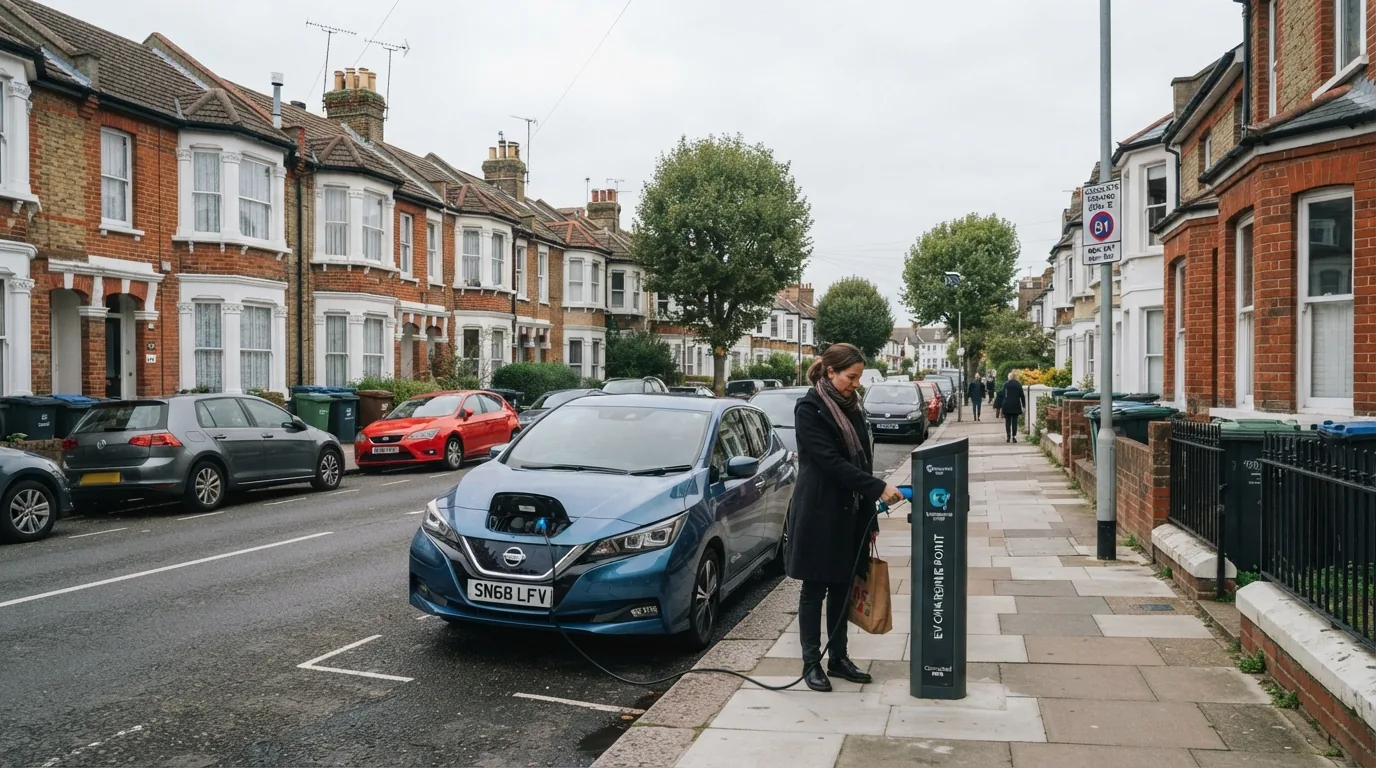
Councils pledge 100,000 on-street chargers for terraced-house drivers
A new local-authority funding round targets the households that have been left behind by the charging rollout. We explain how the scheme works, which streets qualify, and what drivers need to do.