Councils pledge 100,000 on-street chargers for terraced-house drivers
A new local-authority funding round targets the households that have been left behind by the charging rollout. We explain how the scheme works, which streets qualify, and what drivers need to do.
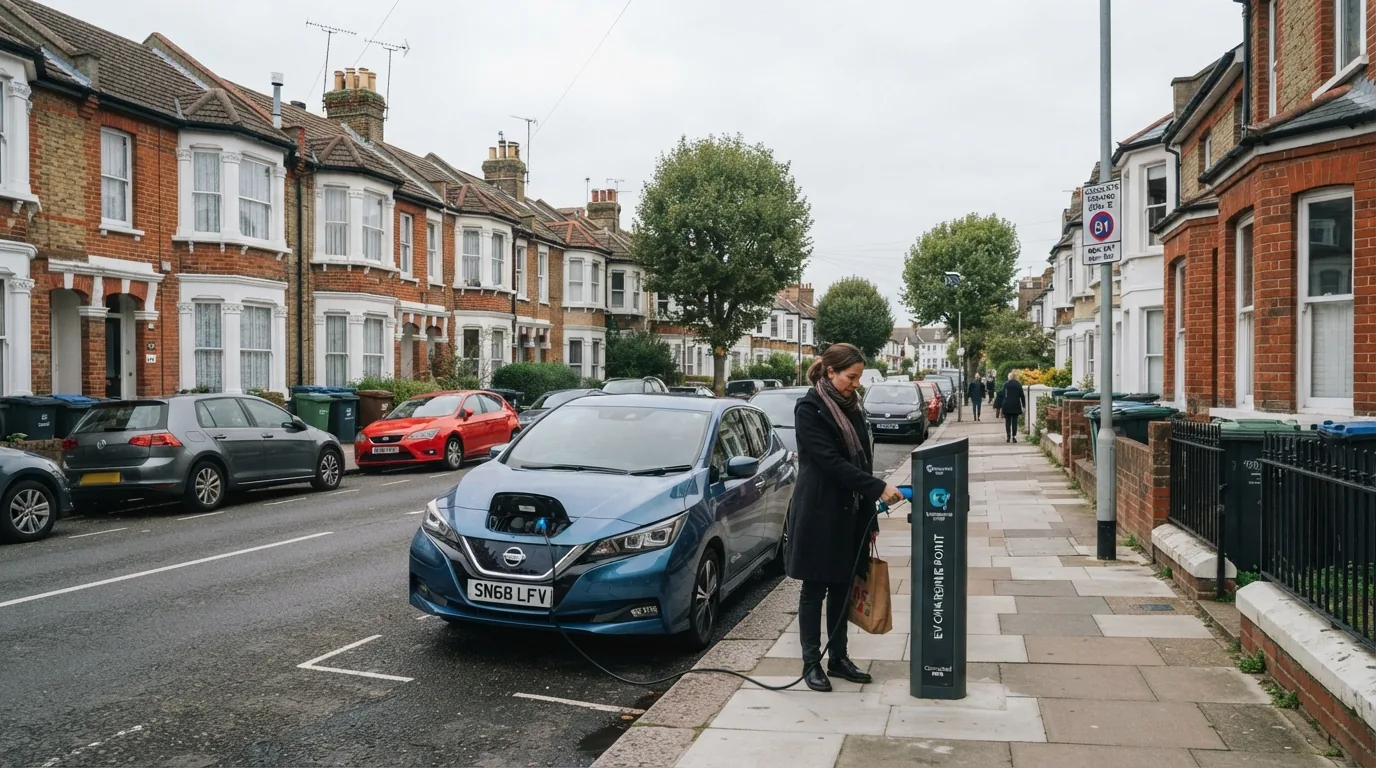
Quick answers
- Around 9 million UK households have no off-street parking; the LEVI fund's 100,000 chargepoint programme and two separate grant schemes represent the most direct policy response to date.
- The first LEVI-funded kerbside charger went live in Brighton in September 2025; over 44 councils have now received approved capital funding worth more than £185 million.
- Cross-pavement cable gullies now cost as little as £45 to install after government subsidy, following the £25 million DfT pavement channels fund launched in July 2025 (DfT's stated target cost; check with your council for the actual charge).
- Planning permission for cross-pavement installations was scrapped in April 2026, removing the biggest single bureaucratic barrier for terraced-house drivers, though you should verify the current legal status of the permitted development rights order.
- The OZEV EV Chargepoint Grant for renters and flat owners increased to £500 (75% of costs) from April 2026, confirmed until March 2027.
- Kerbside lamp-post chargers typically cost 35 to 45p/kWh, cheaper than PAYG public charging at 54p/kWh but roughly double the cost of off-peak domestic rates.
How to charge an EV without a driveway: the 2026 guide for terraced-house drivers
Around 9 million UK households park on the street and have no way to plug in at home overnight. That figure has sat as an awkward gap in the EV transition for years, but three overlapping programmes launched or significantly expanded in 2025 and 2026 are now targeting it directly. The LEVI fund, the £25 million pavement channels grant, and the updated OZEV chargepoint grant together represent the most concrete policy response yet, and the EV policy developments driving them are reshaping what home charging looks like for millions of households.
This guide covers four routes available to you right now: lamp-post and kerbside chargers installed by councils, cross-pavement cable gullies connected to your own domestic supply, financial grants that can reduce your costs, and the practical steps to get a charger on your street.
Why terraced-house drivers have been left behind
The scale of the problem is bigger than most people realise. Around 9 million UK households, roughly one third of all homes, lack any off-street parking. At the heart of that figure are approximately 7 million terraced houses (figures vary, verify current data) that were built before cars existed and whose residents park on the road outside. In London, 61% of households have no off-street parking at all, according to London Councils.
The practical consequence is stark. Drivers who rely entirely on public charging sometimes pay ten times more per kWh than those charging on a domestic overnight tariff, according to EVA England’s March 2026 analysis. That cost penalty feeds through directly into whether people feel an EV is worth switching to: 60% of petrol and diesel drivers without off-street parking say they would never consider an EV, compared to 43% of those who do have a driveway. Even among the no-driveway drivers who have already made the switch, only 50% report lower running costs versus petrol or diesel. For the majority of home-charging EV owners, savings are the norm; for those relying on public networks, the picture is far less clear.
EVA England’s January 2026 survey found that 35% of UK drivers park on-street, and 93% of them currently lack any cross-pavement charging solution. Perhaps the sharpest data point: 43% of surveyed drivers said that needing planning permission alone would completely deter them from getting an EV.
“Only 50% of EV drivers without off-street parking report lower running costs versus petrol or diesel.” — EVA England, 2026
This is the charging divide in concrete terms. Three separate programmes are now targeting it directly.
The 100,000 chargepoint programme: what LEVI means for your street
The Local Electric Vehicle Infrastructure (LEVI) Fund is a £381 million government programme that gives councils in England the money and capability to install on-street chargepoints for residents who have no driveway. Of that total, £343 million is capital funding for chargepoint hardware, electrical connection, and installation; a further £37.8 million goes toward helping councils build in-house EV expertise.
In June 2025, Future of Roads Minister Lilian Greenwood confirmed the programme is on track to deliver over 100,000 new local chargepoints across England. In her words: “This government is powering up the EV revolution by rolling out a chargepoint every 29 minutes.” That is a target, not a completed figure; delivery depends on councils completing procurement and installation, and timelines vary considerably between local authorities.
Progress is real, though. Suffolk County Council was the first local authority to sign a contract with a chargepoint operator under LEVI. The first LEVI-funded charger went live on 10 September 2025, at 28 Lawrence Road, Hove, installed by char.gy in partnership with Brighton & Hove City Council. Fewer than two months elapsed between contract signature and a working charger in the ground. Over 44 councils have now had LEVI capital funding approved, worth over £185 million, covering projects from Torbay to Tees Valley.
The charger types councils can deploy under LEVI include:
- Lamp-post “backpack” units running at 3kW, 5kW, or 7kW, attached to existing street furniture
- Bollard chargers, freestanding and usually dual-socket
- Kerbside posts with 22kW output, capable of a full charge in roughly two hours
- Standard kerbside units designed primarily for overnight charging
Most are designed for vehicles parked for six to twelve hours. They are public infrastructure: once installed, any driver with a compatible app or contactless payment can use them.
Connected Kerb, one of the largest on-street operators, plans to deploy 190,000 chargers by 2030 backed by £65 million from the National Wealth Fund and Aviva Investors. The pace of rollout outside London still varies enormously, but the direction is clear.
Cable gullies through the pavement: charging from your own home electricity
For drivers who park directly outside their own home, a cross-pavement cable gully offers something the LEVI network cannot: access to your own domestic electricity supply, at domestic overnight rates.
A gully is a narrow channel buried beneath the pavement, typically around 50mm wide, that routes a cable from your home’s consumer unit to a wallbox or socket at the kerbside. You charge from your own meter, on your own tariff. Providers such as Kerbo Charge, Gul-e, and Pavecross install and maintain these systems. Kerbo Charge operates across approximately 30 council areas from Stirling to Cornwall (figures vary, verify current data), making it the most widely deployed provider.
Before the current funding round, a full gully installation typically cost around £1,000 including labour. The government’s £25 million Electric Vehicle Pavement Channels Grant, announced on 12 July 2025, was designed to change that. The Department for Transport stated the fund would reduce operator installation costs from as much as £1,000 to as little as £45 per installation. The £45 figure is the DfT’s stated target cost after the subsidy; how much of that saving councils pass directly to residents varies, so check with your local authority for the actual charge you would face. The government estimates the scheme could help drivers save up to £1,500 a year versus an equivalent petrol or diesel car (government estimate, figures vary).
The grant had a council application deadline of 31 October 2025. According to industry reports, 19 councils had not applied by that date, leaving close to £3.2 million unclaimed; 11 of those were London boroughs. If your council is in that group, the subsidised route for gully installations may not currently be available to you.
The second major shift came in April 2026: the government scrapped the requirement for planning permission for cross-pavement charging installations. Previously, residents needed a Section 50 street works licence, which added time, cost, and bureaucratic friction. Under new permitted development rights, that layer is removed, though Section 178 permission from your council is still required. Operators such as Kerbo Charge typically manage the Section 178 process on your behalf. The April 2026 announcement confirmed the government would legislate to introduce these permitted development rights; check the current legal status at time of reading, as the PDR order may not yet be formally enacted in all cases.
A cable gully only makes sense if you park directly outside, or very close to, your own property. If your nearest parking space is a street or two away, a kerbside charger via LEVI is likely more practical.
Lamp-post and bollard chargers: overnight charging on your street
Kerbside chargers are not all the same. The most visible in urban streets is the lamp-post “backpack” unit, a compact charger bolted to an existing lamp-post and connected to the street’s electricity supply. Shell Recharge, operating under the ubitricity brand, has over 5,000 such units already in place across the UK. It has stated an ambition to reach 100,000 by 2030; a 2025 target of 50,000 was the company’s stated goal, though confirmation of whether it was met has not been independently retrieved, so treat longer-term targets as aspirations rather than commitments.
The UK had 33,177 on-street charging devices by the end of 2025, up 30% year-on-year from around 25,500 the previous year. Greater London accounts for 24,026 of those, a concentration that reflects both the density of terraced housing and the relative speed of London borough procurement. Outside the capital, availability is still patchy.
Most lamp-post chargers run at 3kW, 5kW, or 7kW, enough to add 25 to 35 miles of range per hour. Parked overnight for eight hours, a 7kW unit can fully replenish most mid-range EVs. Some 22kW units exist for a full charge in roughly two hours. The main operators you are likely to encounter:
- Connected Kerb: around 7,000 devices nationally, named Zapmap’s best on-street and destination network for 2025, with plans for 190,000 chargers by 2030
- char.gy: around 4,000 devices, operator of the UK’s first LEVI-funded charger in Brighton
- Shell Recharge (ubitricity): the largest lamp-post network, concentrated in London and major cities
- Urban Fox: retractable pavement units that sit flush with the kerb when not in use
Kerbside lamp-post chargers in residential areas typically cost 35 to 45p/kWh (figures vary, verify current rates with Connected Kerb or char.gy directly). That is below the PAYG public charging average of 54p/kWh (Zapmap Charge Price Index, April 2026). The public charging prices are starting to fall, but kerbside overnight rates at 35 to 45p/kWh still sit comfortably below the PAYG rapid charging average.
Payment on most networks accepts the Zapmap app, Zapmap charging card, Apple Pay, and Google Pay. Lambeth Council installed lamp-post chargers in 2026, generating both reduced local emissions and new income for the authority from charger operation.
Grants and financial help available right now
Three separate streams of financial support exist for drivers without driveways. They work quite differently, so it is worth understanding each one before deciding which applies to you.
OZEV EV Chargepoint Grant (renters and flat owners)
The Office for Zero Emission Vehicles grant for renters and flat owners increased from £350 to £500 per socket from 1 April 2026. It covers 75% of installation costs, capped at £500. To qualify, you need a dedicated off-street parking space (not a public car park) and your landlord’s or freeholder’s written consent. The grant is confirmed until 31 March 2027.
Note that the standard homeowner-with-driveway grant was discontinued in 2022. This grant applies to renters and flat owners only.
From April 2026, the application process moved to a new OZEV platform. You must receive eligibility confirmation before your charger is installed, not after. If your property qualifies for a wallbox, check whether you are eligible via the recently expanded home charger grants for flat owners and renters.
LEVI-funded kerbside chargers
Once a LEVI-funded charger is installed on your street, you can use it as a public resource. There is no direct grant for residents: your council secures the hardware via the LEVI fund, and you pay the per-kWh rate set by the operator. The benefit is availability and competitive pricing, not a cash subsidy.
Pavement gully subsidy
The £25 million DfT pavement channels fund, launched July 2025, reduces the resident-facing installation cost to as little as £45 per installation via your council (DfT’s stated target cost; actual resident charge varies by council). Not all councils applied by the October 2025 deadline. Check with your local authority to confirm whether your council claimed its share and whether the subsidy is still accessible to new applicants.
How to get a charger installed on your street
The route you take depends on whether you park directly outside your home or in a shared street nearby.
Route A: Request a lamp-post or kerbside charger via LEVI
- Check whether your council has signed a LEVI contract. Search “[council name] LEVI EV charger” or visit the Energy Saving Trust’s LEVI page at energysavingtrust.org.uk.
- Register your interest via your council’s EV or highways department. Brighton & Hove, Bradford, West Yorkshire, Plymouth, and Somerset all had live online registration forms as of 2025/2026.
- Councils prioritise areas with clusters of requests and limited off-street parking. Getting neighbours to register at the same time significantly increases your street’s chances of being selected.
- Once a charger is installed, register with the operator’s app for payment access. Zapmap, Apple Pay, and Google Pay work on most networks.
Note that the old On-Street Residential Chargepoint Scheme (ORCS) is now closed to new applications. LEVI is the current programme.
Route B: Cross-pavement gully
- Confirm you park directly outside, or within approximately 10 metres of, your property. Gullies are not practical for drivers who park further away.
- Contact Kerbo Charge, Gul-e, or Pavecross for a survey quote. These operators handle council liaison as part of the process.
- Since April 2026, planning permission is no longer required for cross-pavement installations. Section 178 permission via your council is still needed, but operators typically manage this on your behalf. Verify the current legal status of permitted development rights at time of reading.
- If you are a renter or flat owner with a dedicated parking space, apply for the OZEV EV Chargepoint Grant (up to £500, 75% of wallbox installation costs) before work begins.
Council processes vary and timelines are not always fast. Putting in a formal request and following up still places you in the queue for future rollout, even if your council has not yet signed a LEVI contract.
What does on-street charging actually cost?
The honest answer is: it depends on which route you use. Here is a direct comparison across the three scenarios, based on currently available data.
| Charging type | Typical rate (p/kWh) | Approx cost per 100 miles |
|---|---|---|
| Home domestic supply via gully (off-peak EV tariff) | 24-32p | ~£3-4 |
| Kerbside lamp-post charger (residential, on-street) | 35-45p (figures vary) | ~£4-5 |
| PAYG public charging (standard/fast, 3-49kW average) | 54p (Zapmap, Apr 2026) | ~£6-7 |
These figures assume an efficient EV averaging around 4 miles per kWh. Your actual costs will vary by vehicle, tariff, and operator. The 35 to 45p/kWh lamp-post rate is indicative; verify current rates with Connected Kerb or char.gy directly before making decisions based on it.
A driver relying exclusively on 54p/kWh PAYG public charging would spend approximately £1,140 more per year than one charging via a domestic gully supply at 28p/kWh, based on 10,000 annual miles (indicative figure; actual saving depends on vehicle and tariff). Even at lamp-post kerbside rates, you should still come out ahead of petrol running costs, just not by as wide a margin as driveway owners typically do.
The government estimates the pavement gully scheme could help drivers save up to £1,500 a year versus a petrol or diesel equivalent. That is a government estimate, presented as an upper bound.
The on-street charging picture is moving fast. Stay across the latest via our EV policy coverage — we track every significant development as it happens.
How we test and where our numbers come from
Range figures are official WLTP combined values taken from manufacturer UK specification pages, with real-world estimates drawn from independent comparative testing. Prices are UK list prices at the time of the latest update. Tax, grant and charging-scheme figures come from GOV.UK and HMRC publications. We re-check every guide when pricing, specification or policy changes. Last checked 11 August 2026.
Frequently asked questions
Can I charge an electric car if I have no driveway?
Yes. Three main routes are available: kerbside lamp-post chargers installed by councils via the LEVI fund (typically 3-7kW, designed for overnight parking); cross-pavement cable gullies that bring your domestic electricity supply to the kerbside; and standard public charging networks.
How does a cross-pavement EV charging gully work?
A gully is a narrow channel buried beneath the pavement that routes a charging cable from your home's electricity supply to a wallbox or socket at the kerbside. Providers such as Kerbo Charge, Gul-e, and Pavecross install and maintain them, handling council liaison as part of the service.
What is the LEVI fund and when will my council get chargers?
The Local Electric Vehicle Infrastructure (LEVI) Fund is a £381 million government programme for councils in England to install on-street chargepoints for residents without off-street parking. Over 44 councils had approved funding by early 2024, and the first LEVI-funded charger went live in Brighton in September 2025.
Is there a grant for installing an EV charger if I rent or live in a flat?
Yes. The OZEV EV Chargepoint Grant covers 75% of installation costs, up to £500 per socket, for renters and flat owners. You need a dedicated off-street parking space and your landlord's or freeholder's written consent.
How much does it cost to charge an EV using a lamp-post charger?
Residential kerbside lamp-post chargers (typically 3-7kW) generally cost 35 to 45p/kWh, depending on the operator and location (figures vary; verify with Connected Kerb or char.gy for current rates). That is cheaper than the PAYG public charging average of 54p/kWh (Zapmap, April 2026), but more expensive than charging at home via a domestic off-peak tariff (approximately 24-32p/kWh).
Sources and further reading
- gov.ukGOV.UK: Apply for Local Electric Vehicle Infrastructure (LEVI) funding-- official source for councils and residents wanting to understand the LEVI scheme; the most authoritative reference for policy detail and council participation
- energysavingtrust.org.ukEnergy Saving Trust: Local Electric Vehicle Infrastructure Scheme overview-- independent delivery body for LEVI; clearest plain-English explanation of the scheme for residents wanting to check their council's status
- zapmap.comZapmap: EV guide to on-street residential charging-- best independent guide to finding on-street chargers, operator networks, and payment methods; directly actionable for drivers looking to locate a kerbside charger today

EV Compared
The EV Compared editorial team tracks the UK electric vehicle market full time: new model launches, list prices, WLTP and real-world range, public charging tariffs and the tax rules that decide what an EV actually costs to run. Every guide is checked against manufacturer specifications and official GOV.UK figures, and updated whenever the numbers move.
Related reading
View all
Treasury reviews road-pricing plans as fuel-duty receipts fall
With petrol and diesel sales sliding, the Treasury is quietly weighing how to replace billions in lost fuel duty. Pay-per-mile is back on the table, and EV drivers need to understand what comes next.
ZEV mandate 2026: what the revised targets mean for car buyers
Carmakers must hit higher electric sales quotas this year. Here is how the rules translate into discounts, waiting lists and model availability for UK buyers.