National Grid confirms 6,000 new rapid chargers for motorway network by 2027
A major expansion of high-power charging promises to end the queues at motorway services. We break down where the new units are going, which networks are involved, and what it means for long trips.
Quick answers
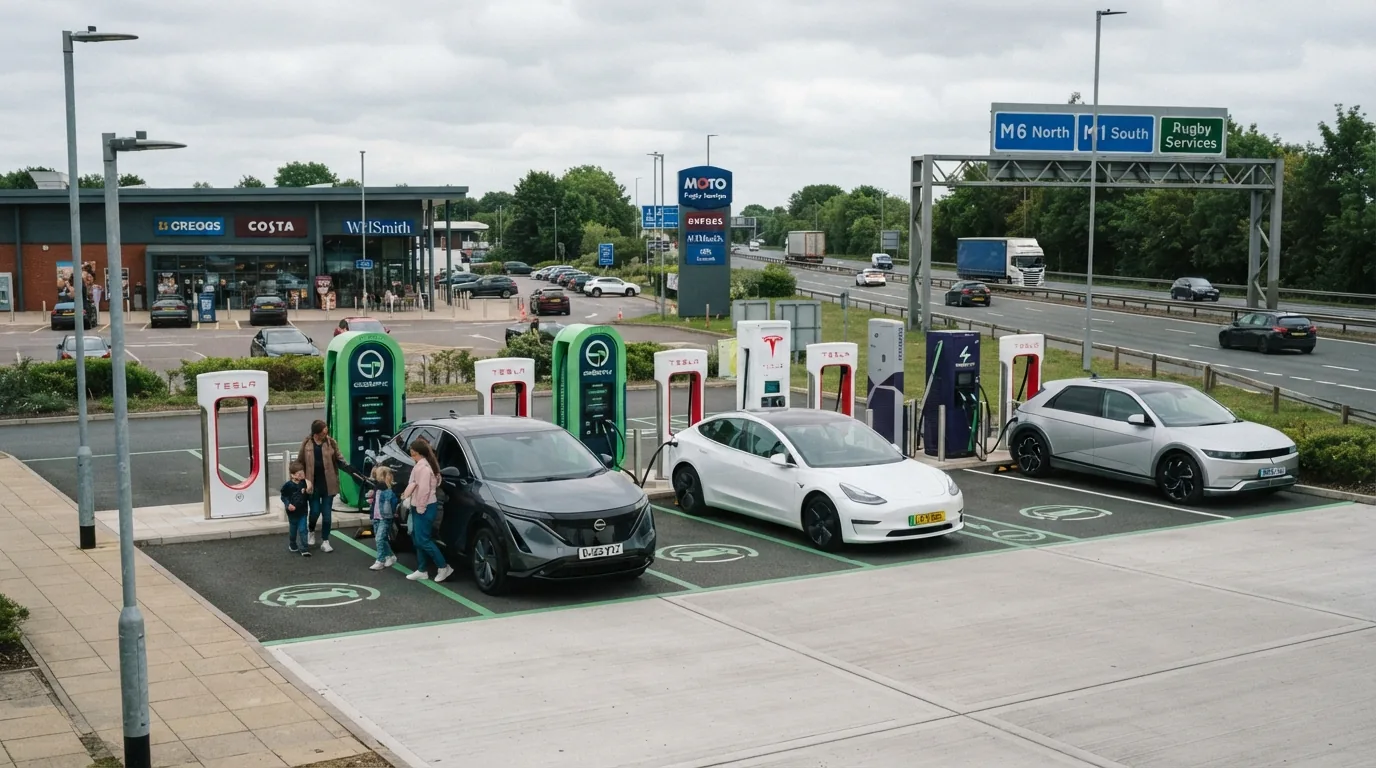
- More than 5,500 rapid and ultra-rapid chargepoints now sit within one mile of the strategic road network, with 1,100-plus specifically at motorway service areas. Provision has trebled in three years.
- Extra MSA, GRIDSERVE, bp pulse, and Ionity are all adding hundreds of new bays across named motorway services by late 2026, with 400kW-capable chargers becoming the new standard at major hubs.
- Only 10% of motorway service areas have sufficient grid capacity to meet forecast 2035 demand. The grid, not the hardware, is the real bottleneck.
- Battery storage systems from operators like InstaVolt are being deployed as a practical workaround at grid-constrained sites, boosting session energy by 33% at live sites.
- Motorway rapid charging averages 79p/kWh in April 2026, roughly 23p per mile, falling slowly as competition increases.
- The M180 and M18 remain poorly served by rapid charging compared with busier corridors. Always check Zapmap before planning a journey on less-trafficked routes.
UK motorway rapid chargers: what is actually being built, where, and when
The UK’s motorway charging network is growing faster than at any point since EVs went mainstream. Operators including GRIDSERVE, Extra MSA, bp pulse, Ionity, and InstaVolt are all mid-build on substantial new deployments, and by late 2026 several motorway service areas will have more high-power chargers than some continental countries manage in entire regions. But before you conclude that range anxiety on motorways is over, there are some important caveats worth knowing.
The latest wave of investment is the biggest the motorway network has seen, but the picture is more complicated than the headline numbers suggest. Here is what is actually happening on the UK’s motorway charging network. The ZEV mandate now requires 33% of all new cars sold in 2026 to be electric, the on-road EV population is growing fast, and the National Audit Office has found that the grid, not the hardware, may be the binding constraint. Read on for the full picture.
How many rapid chargers are on UK motorways right now?
Before looking at what is being built, it helps to understand the baseline. The numbers are larger than many drivers realise, but coverage is uneven.
As of April 2025, more than 5,500 open-access rapid and ultra-rapid chargepoints sit within one mile of the strategic road network, according to GOV.UK data compiled from Zapmap. Of those, more than 1,100 are specifically at motorway service areas, based on the July 2025 figure from the same publication. That represents a remarkable rate of growth: provision has trebled over the past three years.
Key figures from the end of 2025:
- 9,893 ultra-rapid chargers (150kW or above) are now in operation across the UK, up 41% year-on-year, according to Zapmap’s 2025 statistics report.
- 748 charging hubs exist nationally, defined as sites with six or more rapid or ultra-rapid devices. That is a 39% year-on-year rise.
- 48% of England’s 114 motorway service areas now have six or more ultra-rapid chargers. Four still have no 50kW-plus provision at all.
The largest hubs give a sense of what the best sites now look like. Killington Lake on the M6 has around 74 chargers, Hopwood Park on the M42 has around 73, and Moto Exeter has approximately 68 ultra-rapid units including a combination of GRIDSERVE and Tesla hardware (figures vary, verify current data against Zapmap before travelling). These sites are genuinely rapid in practice, with minimal queuing outside holiday peak periods.
Who is building the new chargers, and where?
Several operators are running substantial programmes in parallel, each with confirmed locations and published timelines.
Extra MSA and GRIDSERVE are the most visible partnership in the current expansion. Seven new EV Super Hubs are under development at Beaconsfield, Baldock, Cambridge, Cobham, Cullompton, Leeds Skelton Lake, and Peterborough. Together they will deliver 96 bays capable of charging at up to 400kW, with all seven targeting completion by late 2026. GRIDSERVE’s own records show the pace of delivery is accelerating: in the first quarter of 2026 alone, the company opened or expanded 12 Electric Super Hubs, including a new site at Folkestone M20 Services and locations in Scotland.
Extra MSA and Ionity are running a separate but parallel programme at the same operator’s sites. The plan is to expand from 60 to 234 chargers rated at 350kW across eight service stations, a 290% increase by the end of 2026. Cambridge, Cobham, and Peterborough are already at 24 Ionity bays each. Blackburn and Leeds Skelton Lake are next in the pipeline.
Moto and bp pulse are taking a different focus, prioritising electric HGV charging rather than passenger cars. Their collaboration targets Lymm, Toddington North, and Toddington South as the first sites for heavy-vehicle rapid charging, with an ambition of up to 300 HGV bays across 23 locations by 2030.
What this adds up to is hundreds of new bays at named, confirmed locations within roughly 18 months. For drivers on the busiest corridors, the improvement will be tangible. The question is what happens at sites where the grid cannot keep up.
The grid problem no one is talking about loudly enough
Here is the part that rarely makes the headlines: building chargers and actually powering them are two different problems. The grid is a genuine constraint, and the data is stark.
The National Audit Office, in its December 2024 report on public chargepoints for electric vehicles, found that only 10% of UK motorway service areas currently have sufficient grid capacity to meet forecast EV charging demand by 2035. That is not a projection about what might happen, it is a finding about infrastructure that exists right now. The same report noted that grid upgrades at some National Highways sites are not available for another seven years. Operators cannot build hubs that the grid cannot support.
The industry body ChargeUK, whose membership includes bp pulse, GRIDSERVE, and Ionity, has characterised grid connection delays as a “substantial bottleneck.” Part of the problem is structural: the UK has 14 distribution network operators, and their timelines and processes vary considerably, making national planning difficult. An operator ready to build today may be waiting years for a connection.
The government’s original answer to this was the £950m Rapid Charging Fund, intended to subsidise grid upgrades at motorway service areas where commercial investment alone was not viable. That fund was effectively scrapped by the Labour government after a pilot programme at ten sites concluded without making any awards. In its place, a narrower £10m competition was announced in November 2025, run through Innovate UK and the Office for Zero Emission Vehicles, targeting technologies that allow chargers to operate off-grid or with a smaller grid connection. Applications closed in March 2026.
One practical workaround already being deployed is battery energy storage. A battery energy storage system, or BESS, charges slowly from the grid overnight and then delivers high-power output to multiple cars simultaneously during peak hours, bypassing the need for a larger grid connection. InstaVolt is fitting BESS units at high-traffic sites: five are already live, with more than 20 further sites planned for completion by the end of 2026. InstaVolt reports a 33% increase in energy delivered per session at BESS-equipped sites. National Highways has also been involved in BESS deployments at constrained motorway sites. It is not a permanent fix, but it is a working bridge while grid upgrades proceed.
What does rapid charging actually cost on the motorway?
Motorway charging is expensive relative to home charging. Being clear about that matters, because the cost difference is significant enough to change how you plan long trips.
The weighted average pay-as-you-go price for rapid and ultra-rapid chargers (50kW and above) was 79p per kWh in April 2026, according to Zapmap’s price index. At that rate, a typical motorway charge adds roughly 23p per mile to your running costs. Compare that to overnight home charging on an off-peak tariff, where the equivalent is closer to 4-6p per mile, and the gap is considerable.
Network prices in May 2026 vary widely. According to Zapmap and chargenet.co.uk data:
- Tesla Supercharger: 63p/kWh (cheapest in the top 10 networks)
- Believ: 66p/kWh
- Sainsbury’s Smart Charge: 72p/kWh
- Fastned: 79p/kWh
- InstaVolt: 92p/kWh (highest in the top 10)
Ultra-rapid sites at motorway services (150kW and above) typically sit at 79-95p/kWh in 2026. Subscription or membership rates can bring the cost down at some networks, and Zapmap notes increasing evidence of promotional pricing as operators compete for market share, supported by a 22% year-on-year rise in rapid charger numbers.
One important change for drivers: since 24 November 2024, all rapid chargers rated at 50kW or above have been legally required to offer contactless bank card payment under the Public Charge Point Regulations 2023. You do not need an app or RFID card to use any compliant rapid charger. Many networks still offer cheaper rates via their apps, but the contactless option is mandatory.
For more on the forces pushing prices lower across the wider public network, see our explainer on why rapid charging prices are slowly coming down.
Which motorways still have charging gaps?
The expansion is concentrated on high-traffic corridors. Quieter routes, particularly in the north and east of England, remain underserved.
According to analysis of Zapmap and DfT data by carsa.co.uk (figures vary, verify current data), the M180 in Lincolnshire has just 0.22 chargers per junction, making it the worst-served motorway for EV drivers in England. Yorkshire’s M18 scores only marginally better at 0.92 chargers per junction. These are not obscure routes: the M180 connects the M18 to the Humber Bridge and is a key freight and leisure corridor.
More formally, GOV.UK and NAO data identify cold spots on the strategic road network where drivers cannot reach six ultra-rapid chargepoints within 20 miles. These tend to cluster on rural and remote stretches, exactly the routes where finding an alternative charging option is also hardest.
The £10m Innovate UK competition announced in November 2025 was specifically targeted at these cold spots and at motorway service areas with grid constraints. Whether £10m is sufficient to shift the picture materially on a national network is a fair question, but it at least directs funding to the right problem.
If you are planning a journey on any of these routes, check Zapmap before you travel and do not rely on finding a working charger at every service area.
What does this mean for your long-distance EV journey in 2026?
The infrastructure picture in 2026 is better than it was in 2024, meaningfully better than 2022, and still not yet where it needs to be for the EV fleet that the ZEV mandate will put on UK roads over the next five years. Here is what that means practically for a driver planning a motorway trip today.
- Check Zapmap or your car’s built-in navigation for real-time charger availability before any long motorway trip, particularly on less-served northern and rural routes. Live availability data prevents unpleasant surprises.
- Most new rapid chargers at motorway services operate at 150-400kW. If your car can accept 100kW or above, you should be able to add around 100 miles of range in well under 20 minutes at a modern hub.
- Budget approximately 79p/kWh for a motorway top-up in 2026 if you are paying PAYG. Subscription pricing on networks like Tesla brings this down to around 63p/kWh.
- If your car cannot accept above 50kW, queue times at busy sites on bank holidays can still be significant. The infrastructure is improving, but it has not yet scaled to the level that makes queueing a thing of the past at every site.
- The ZEV mandate requires 33% of new cars sold in 2026 to be electric. The on-road EV population will grow faster than the charge point network in the short term, which is the context behind the ongoing investment push.
For all our motorway and public charging coverage, including tested reviews of the fastest rapid chargers and the latest on public charging prices, visit our charging hub.
If you would like to understand the wider context for prices, read our piece on why public charging prices are starting to fall.
If you are also considering a home charger, home charger grants have returned for flat owners and renters.
How we test and where our numbers come from
Range figures are official WLTP combined values taken from manufacturer UK specification pages, with real-world estimates drawn from independent comparative testing. Prices are UK list prices at the time of the latest update. Tax, grant and charging-scheme figures come from GOV.UK and HMRC publications. We re-check every guide when pricing, specification or policy changes. Last checked 11 August 2026.
Frequently asked questions
How many rapid chargers are on UK motorways right now?
Before looking at what is being built, it helps to understand the baseline. The numbers are larger than many drivers realise, but coverage is uneven.
Who is building the new chargers, and where?
Several operators are running substantial programmes in parallel, each with confirmed locations and published timelines.
What does rapid charging actually cost on the motorway?
Motorway charging is expensive relative to home charging. Being clear about that matters, because the cost difference is significant enough to change how you plan long trips.
Which motorways still have charging gaps?
The expansion is concentrated on high-traffic corridors. Quieter routes, particularly in the north and east of England, remain underserved.
What does this mean for your long-distance EV journey in 2026?
The infrastructure picture in 2026 is better than it was in 2024, meaningfully better than 2022, and still not yet where it needs to be for the EV fleet that the ZEV mandate will put on UK roads over the next five years. Here is what that means practically for a driver planning a motorway trip today.
Sources and further reading
- zapmap.comZapmap UK charge point map (live)Real-time charger availability; the most reliable tool for journey planning on UK motorways
- gov.ukGOV.UK: Electric vehicle charging infrastructure on the strategic road networkOfficial DfT publication with current chargepoint numbers and funding context
- gov.ukGOV.UK: Public Charge Point Regulations 2023 guidanceDefinitive source on your rights as a driver at public charge points, including contactless payment requirements

EV Compared
The EV Compared editorial team tracks the UK electric vehicle market full time: new model launches, list prices, WLTP and real-world range, public charging tariffs and the tax rules that decide what an EV actually costs to run. Every guide is checked against manufacturer specifications and official GOV.UK figures, and updated whenever the numbers move.
Related reading
View all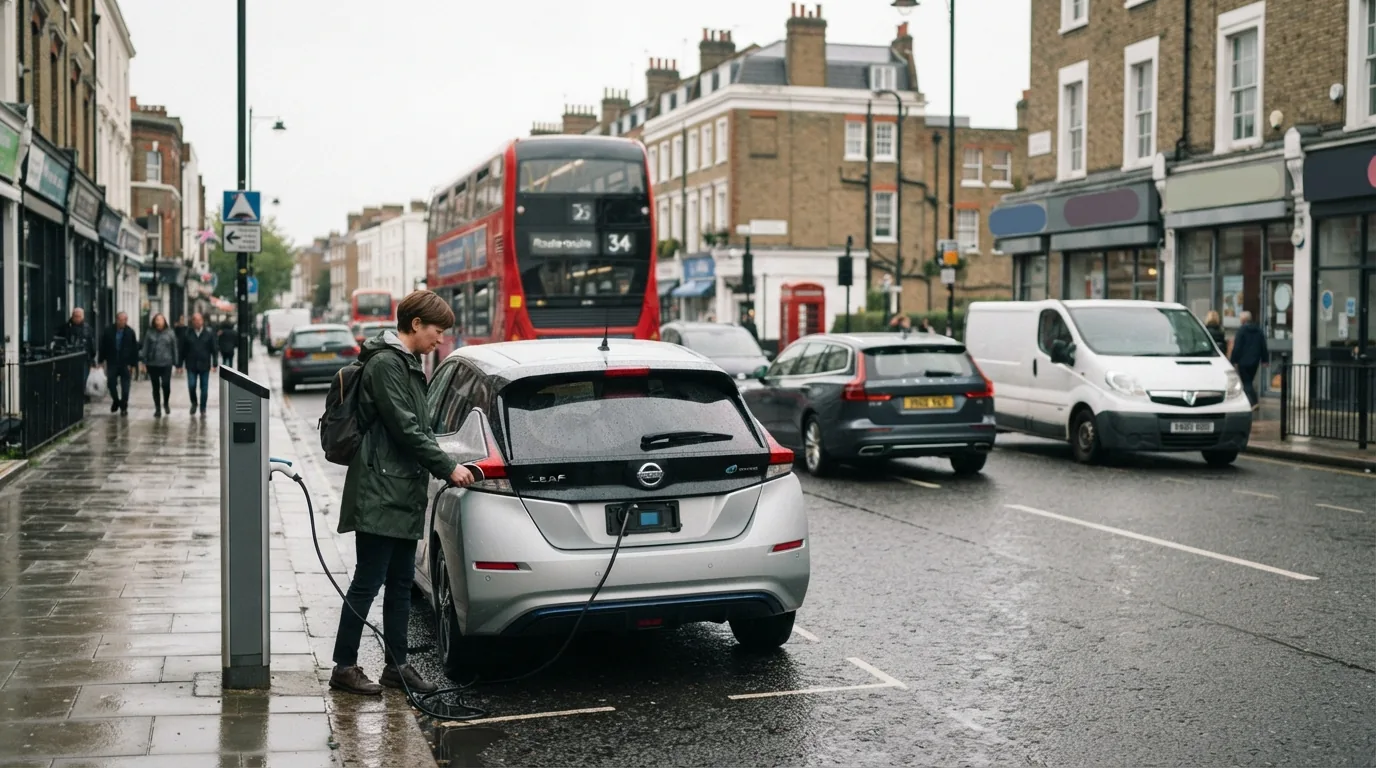
Why public charging prices are finally starting to fall, and where
Competition between rapid-charging networks is heating up. We break down the new per-kWh tariffs, which networks have cut prices most, and the cheapest places to plug in right now.
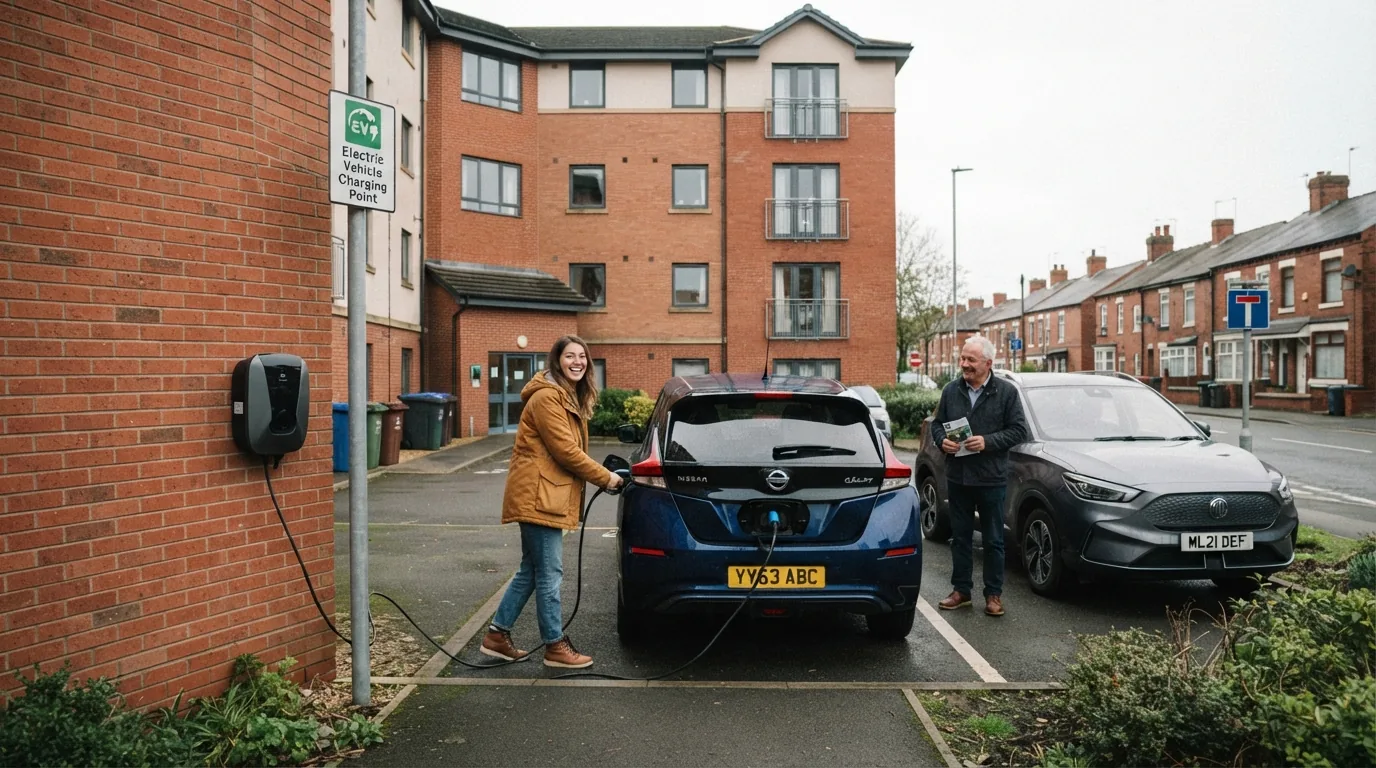
Home charger grants return for flat owners and renters
The reinstated EV chargepoint grant covers up to £350 of installation costs. We explain who qualifies, how to apply, and which chargers are eligible under the updated rules.
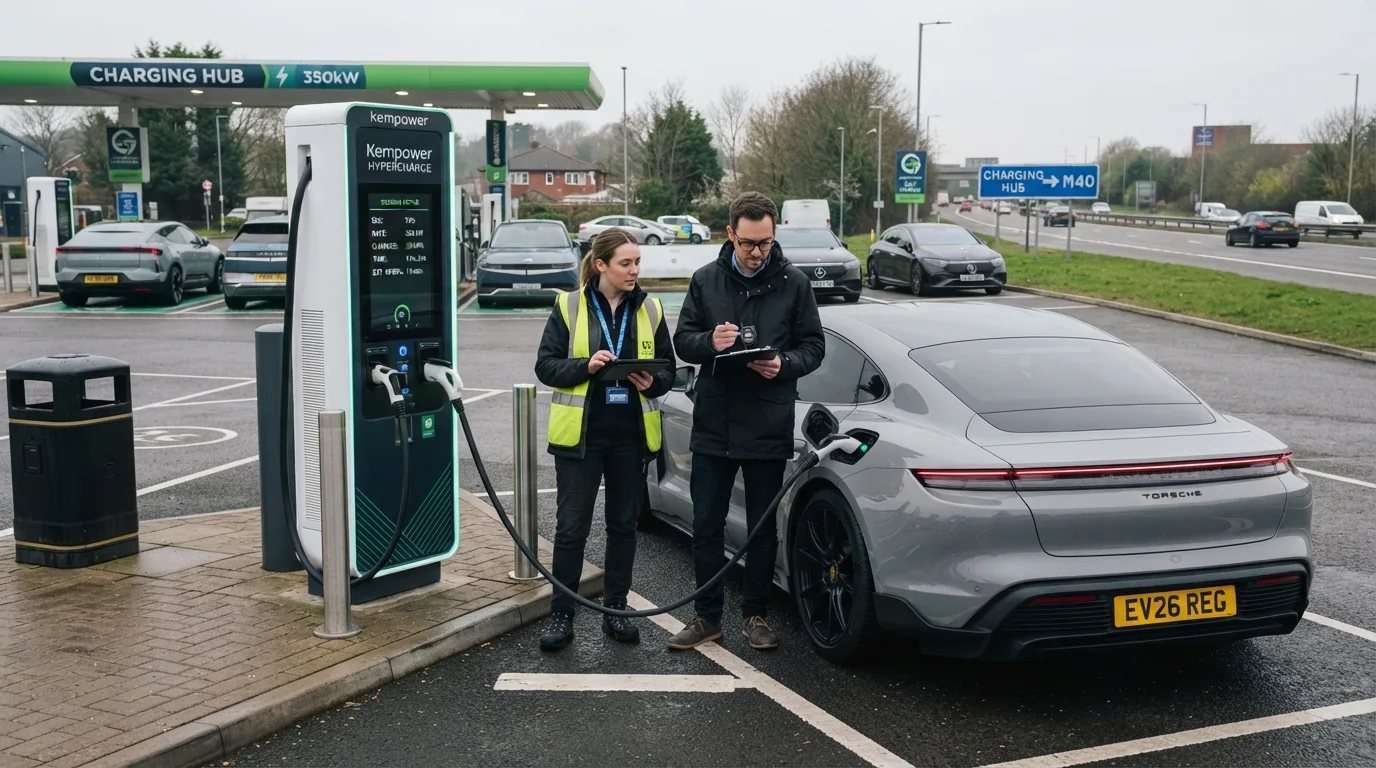
Tested: the fastest 10-80% rapid charge of any car on sale in 2026
We took five flagship EVs to the same 350kW charger to see which really delivers on its headline figures. The results reveal big gaps between claimed and real-world charging speeds.