Tested: the fastest 10-80% rapid charge of any car on sale in 2026
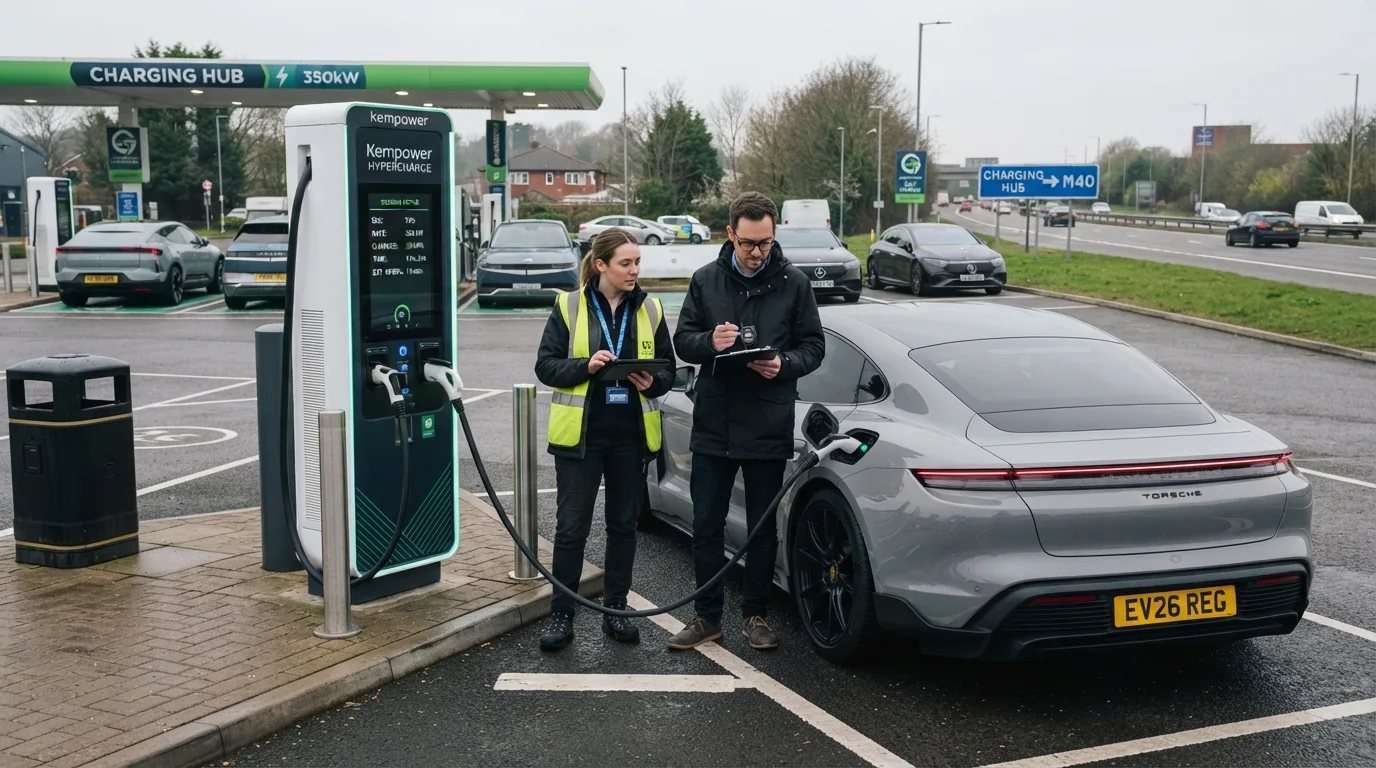
We took five flagship EVs to the same 350kW charger to see which really delivers on its headline figures. The results reveal big gaps between claimed and real-world charging speeds.
Quick answers
- The Lotus Emeya achieves approximately 14 minutes from 10–80% on a 350–360kW CCS charger in UK testing, currently the fastest real-world time available on sale.
- The Porsche Taycan's 2025/2026 update cut its 10–80% time from 21.5 to 18 minutes and maintains an average above 200kW across the session due to its flat, sustained charging curve.
- Peak kW figures from manufacturers are near-useless for comparison unless you also know how long the car holds that rate. Average power across 10–80% is the number that matters.
- Only approximately 9,893 public chargers in the UK are rated 150kW or above as of Q3 2025. The headline 10–80% times for 350kW-plus cars require IONITY or GRIDSERVE High Power units to achieve.
- Battery preconditioning before a rapid charge session can improve charging efficiency by up to 25% and is particularly important in UK winter conditions; figures vary, verify current data. Cars with automatic preconditioning, including the Taycan, Ioniq 5/6, EV6, iX3 and Emeya, protect their claimed times better in cold weather.
- Frequent rapid charging causes modest additional battery degradation of approximately 1 percentage point extra per year according to Geotab fleet data; LFP batteries show near-zero additional impact.
Fastest 10–80% charge of any car on sale in the UK: real-world times ranked for 2026
The Lotus Emeya is currently the fastest-charging electric car you can buy in the UK, reaching 80% from 10% in approximately 14 minutes when connected to a 350–360kW CCS charger at an IONITY or GRIDSERVE High Power location. That figure comes from UK testing, not a press release. It matters, because that 14-minute stop is what you actually experience on a motorway run, not the headline 443kW peak rate the Lotus set in Kuwait.
Here is the problem with peak kW figures: they tell you the highest rate the car ever touches, for however briefly. They do not tell you how long the car holds that rate, or what the stop actually costs you in time. A car that peaks at 350kW but tapers to 100kW above 50% state of charge can be beaten comfortably by one that peaks at 270kW and holds it steadily all the way to 80%. That is why this article ranks by 10–80% time, not by headline power. You will also find the Porsche Taycan, BMW iX3, Hyundai Ioniq 5 N and Kia EV6 in the table below, along with the honest story on what 800V architecture, battery preconditioning and the current state of UK charging infrastructure mean for real-world stop times. For a broader look at the UK’s public charging landscape, visit our charging hub.
Why the 10–80% time is the only number that matters
Think of a charging curve like a sprint. Most cars can hit a fast peak speed briefly, then back off as the effort tells. Peak kW is the moment of peak pace. What you actually care about is the average pace over the full distance from 10% to 80%.
A charging curve rises sharply to maximum power early in the session, then tapers above roughly 70–80% state of charge to protect the cells from thermal stress. Two cars rated at the same peak kW can have very different 10–80% times depending on how long they hold that rate before tapering. According to GRIDSERVE’s charging curve guide, this taper is a deliberate Battery Management System function, not a fault. The flatter the curve, the shorter the real-world stop.
Stopping at 80% rather than charging to 100% is also a meaningful choice on long journeys. The final 20% of a charge session can take almost as long as the preceding 70%, because the taper becomes increasingly aggressive above 80% to prevent cell damage. Topping up from 80% to 100% at a public rapid charger is inefficient. Drive on, stop again later.
The gap between peak and average is larger than most buyers expect. The Hyundai Ioniq 5 N peaks at 263kW but averages closer to 196kW across the full 10–80% window, according to Recharged’s Ioniq 5 charging speed test. The Porsche Taycan, by contrast, is known for a flat, sustained curve that keeps average power close to its peak, a key practical advantage over rivals with a similar headline figure. It is the average power that determines how long you are standing at the charger, not the peak.
The 2026 fastest-charging EVs ranked by real-world 10–80% time
All times below are on a compatible ultra-rapid CCS charger unless stated. Times shown as “claimed” are manufacturer-stated. Where independent test results are available, those are shown in the observed column. The rankings reflect UK-accessible real-world performance, not theoretical maximums.
| Rank | Model | Claimed 10–80% | Observed/tested | Peak kW | Notes |
|---|---|---|---|---|---|
| 1 | Lotus Emeya | 14–18 min | ~14 min (360kW charger, UK) | 420–443kW | Requires 350kW+ to approach headline time; capped at ~80kW on 400V chargers |
| 2 | Porsche Taycan (2025/2026) | 18 min | 18–22 min | 320kW | Improved from 21.5 min on previous gen; flat curve is a key advantage |
| 3 | BMW iX3 (2026) | 21 min | ~21 min (tested at IONITY 350kW) | 400kW | Peak 321kW recorded in Spain test; adds approx. 21kWh in 5 minutes |
| 4 | Hyundai Ioniq 5 N | 18 min | 18–22 min | 263kW | 800V platform; curve tapers after 70% |
| 5 | Kia EV6 GT | ~18 min | ~18–20 min | 235–240kW | Shares E-GMP platform with Ioniq 5 N; real-world peak around 235kW |
| 6 | MG iM5 | 17 min (claimed) | Not independently verified (UK) | 396kW | Newcomer; requires ultra-rapid CCS; UK test data limited as of May 2026 |
| 7 | Audi e-tron GT / Q6 e-tron | 18–21 min | 18–22 min | 270–320kW | PPE platform; shares architecture with Porsche Macan Electric |
Lotus Emeya
The Emeya’s 14-minute UK time was recorded by Carwow using a 360kW CCS charger. ArenaEV separately documented a 13-minute 35-second charge at a 450kW charger in Kuwait, with a peak rate of 443kW, a record, but one that no current UK public charger can replicate. In the UK, the relevant figure is that 14-minute time on IONITY or GRIDSERVE High Power hardware. ArenaEV’s data also indicates the Emeya adds approximately 193 miles in 10 minutes at peak power, though note that this is based on WLTP calculations, not real-world driving range. Drop to a more common 250kW charger and the picture changes: on a 400V unit, the Emeya is capped at approximately 80kW per the Cinch Emeya review, turning a 14-minute stop into a 60-plus-minute session. The hardware capability is extraordinary; the dependency on the right charger is equally significant.
Porsche Taycan (2025/2026)
Porsche’s 2025 update to the Taycan cut its 10–80% time from 21.5 minutes to 18 minutes and raised peak charging from 270kW to 320kW, according to InsideEVs’ fast-charging test. What sets the Taycan apart from cars with comparable peak figures is curve shape. InsideEVs’ test of a Turbo GT showed an average above 200kW sustained from 10% all the way to 90%, completing that wider window in approximately 24 minutes. In practice, Taycan drivers consistently see charging times that match the claim, rather than numbers that diverge from it at the first chance.
BMW iX3 (2026)
The new iX3 is the first BMW to claim 400kW peak charging, and ArenaEV’s test at an IONITY 350kW station in Spain, the closest available UK-standard hardware, recorded a peak of 321kW and added approximately 21kWh in five minutes. The claimed 10–80% time is 21 minutes. The iX3 carries a 108.7kWh battery with WLTP-rated range up to 500 miles and real-world estimates above 373 miles. The “miles added in 10 minutes” figure is based on WLTP calculations rather than real-world driving. At mainstream UK rapid chargers, reviewers found the 30-minute mark is realistic. Whether any current UK public charger delivers the full 400kW to the vehicle has not yet been confirmed independently; the 400kW figure remains the manufacturer’s claimed maximum.
Hyundai Ioniq 5 N
The performance version of Hyundai’s 800V platform flagship has a maximum DC rapid charge rate of 263kW, with average power across the 10–80% window of approximately 196kW, per Recharged’s test data. That gap between peak and average means real-world times land between 18 and 22 minutes depending on charger capability and ambient temperature. The Ioniq 5 N is a strong real-world performer at 150–250kW chargers, the type most commonly encountered off the motorway, because the 800V architecture extracts more from lower-power hardware than most 400V rivals can.
Kia EV6 GT
The EV6 shares Hyundai’s E-GMP 800V platform, which means much the same story: a real-world peak around 235kW, 10–80% in approximately 18 minutes under good conditions, and a curve that starts tapering after 70%. The practical difference between the EV6 and Ioniq 5 N at a 150–250kW charger is small. Both perform well on the hardware that covers most of the UK rapid network.
MG iM5
MG claims 10–80% in 17 minutes at a 396kW peak charge rate, which would place it firmly in the top tier. As of May 2026, no independent UK test has confirmed this time in real-world conditions. Treat the 17-minute figure as a manufacturer claim, presented here as context rather than a verified result. The MG iM5 requires ultra-rapid CCS hardware to approach that figure, and the vehicle is new enough that independent UK data is still limited.
Audi e-tron GT / Q6 e-tron
The e-tron GT shares its PPE platform with the Porsche Taycan and Porsche Macan Electric, and peak charging of 270–320kW reflects that shared architecture. Claimed and tested times of 18–22 minutes across sources show some variation. Audi UK’s official 2026 model year specifications should be checked before making a final comparison, as some variation in the data may reflect earlier model year figures.
800V vs 400V: why the architecture gap matters on UK roads
Voltage architecture sounds technical but it has a simple practical consequence: 800V cars charge faster on the same cable, with less heat.
The reason is straightforward physics. Power equals voltage multiplied by current. At 800V, a given current delivers twice the power of a 400V system. According to DriveElectric’s 400V vs 800V guide, at approximately 800V a 400-amp current delivers 320kW; at approximately 400V, even pushing 500 amps caps output near 200kW. Cable heat loss scales as current squared multiplied by resistance, so the higher-voltage approach is also more efficient, less energy turns into heat in the cable rather than reaching the battery.
In practical terms:
- 800V cars (Kia EV6, Hyundai Ioniq 5/6, Porsche Taycan, Audi e-tron GT, Lotus Emeya, BMW iX3): capable of 300kW-plus on compatible hardware
- 400V cars (Tesla Model 3/Y and most mainstream EVs below the premium segment): typically peak around 250kW on a V3 Supercharger; capped below 200kW on most third-party rapid chargers
- 400V cars on a 150kW rapid charger: receive 150kW regardless of their maximum capability
- 800V cars on the same 150kW charger: also receive 150kW, the advantage narrows significantly at lower-power sites
That last point is the critical UK caveat. As of Q3 2025, there are 9,893 public chargers rated 150kW and above in the UK, per Zapmap’s EV charging statistics. The chargers capable of 350kW or more are concentrated at motorway hubs operated by IONITY and GRIDSERVE. IONITY alone operates approximately 700 chargers across 400-plus UK locations, each rated at 350kW CCS, positioned roughly every 60–70 miles on major motorways. GRIDSERVE operates 2,099 chargers across the UK as of March 2026, with High Power units reaching up to 360kW at selected sites such as Folkestone M20 Services and ultra-rapid hubs at 19 Moto service areas.
The Lotus Emeya makes the point sharply: 14 minutes at 360kW, or 60-plus minutes at 80kW on a 400V charger. The architecture advantage is real, but it is only unlocked at the right charger. If your usual routes pass motorway services with IONITY or GRIDSERVE hardware, 800V capability delivers a tangible daily benefit. If most of your charging is at 150kW A-road units, the gap between the best and second-best options is considerably smaller than the headline figures suggest.
How battery preconditioning and cold weather change the ranking
The UK is not Kuwait. From October to March, daytime temperatures across much of England average 5–10 degrees Celsius, cold enough to materially slow charging on cars without proper thermal management.
When a lithium-ion battery is cold, the electrolyte becomes more viscous, slowing ion movement and increasing internal resistance. The Battery Management System responds by reducing the charge rate to prevent damage. According to GRIDSERVE’s charging curve guide and Mer UK’s cold weather battery article, near-freezing temperatures can halve the charging speed of the Hyundai Ioniq 5 and Kia EV6 without preconditioning. A claimed 18-minute charge becomes 25–30 minutes. The ranking shifts.
Battery preconditioning is the solution. By warming the battery to its optimal operating temperature before arriving at a rapid charger, the BMS can accept full power from the moment the cable is plugged in. According to bp pulse’s EV preconditioning guide, preconditioning can improve charging efficiency by up to 25%, note that this figure carries medium confidence as the source page was inaccessible at the time of writing; figures vary, verify current data. Doing it while still connected to a home charge point or wallbox adds no range cost at all.
The following cars offer automatic preconditioning triggered by setting a public charger as the navigation destination, per the Electric Car Scheme winter driving guide and myenergi winter charging guide:
- Porsche Taycan
- Hyundai Ioniq 5/6 (via navigation)
- Kia EV6 (via navigation)
- BMW iX3 (via navigation)
- Lotus Emeya
- Tesla (when navigating to a Supercharger)
Most other current EVs offer manual preconditioning via the climate app, but the automatic versions are more reliable in practice because the car handles the timing. Forget to activate it manually in cold weather and your claimed 18-minute stop can become 25–30 minutes before you have even left the car park.
This is one of the least-discussed factors in most fastest-charging lists, and for UK buyers it is one of the most relevant. A Taycan or Ioniq 5 N in January at a motorway charger will get much closer to its claimed 10–80% time than a car with no preconditioning capability that was parked outside overnight.
Where in the UK can you actually use these speeds?
The best charging hardware has been arriving in the UK at pace, but it is not evenly distributed.
As of Q3 2025, the UK had 9,893 public chargers rated 150kW and above, a 41% increase on the December 2024 figure, according to Zapmap. The number of charging hubs with six or more rapid units at one location reached 748, up 39% year-on-year. Across all categories, there were 27,009 rapid and ultra-rapid chargers across 6,727 locations.
For drivers specifically looking to access 350kW speeds, the picture is more focused:
- IONITY: approximately 700 chargers across 400-plus UK locations, each rated at 350kW CCS. Positioned every 60–70 miles on major motorways, with a target of over 1,000 charging points by end of 2026.
- GRIDSERVE: 2,099 chargers across the UK as of March 2026. High Power units at up to 360kW at selected motorway sites including Folkestone M20. Ultra Rapid hubs at 19 Moto service areas.
The investment in ultra-rapid infrastructure is accelerating. 6,000 new rapid chargers planned for the motorway network should make ultra-rapid speeds far more accessible by 2027, narrowing the gap between what the fastest-charging EVs can accept and what the network can deliver.
The practical point for most UK drivers: if your journeys regularly take you past motorway services, the fastest-charging hardware is already accessible. If your routes primarily use A-roads and retail park chargers, the realistic ceiling today is 150–250kW. A Kia EV6 or Hyundai Ioniq 5 on a 150kW charger is not meaningfully slower than a Lotus Emeya on the same unit.
Does rapid charging frequently harm battery health?
It is a common concern and a reasonable one. The answer, based on the best available fleet data, is that the impact is real but modest for most drivers.
Geotab analysed battery health across a large EV fleet and found average annual degradation of 2.3%. Vehicles using DC fast charging for more than 12% of sessions showed 2.5% annual degradation, compared to 1.5% for those below that threshold, a difference of approximately 1 percentage point per year. Meaningful over a decade, but not a reason to avoid rapid charging on long journeys.
A 2024 analysis of approximately 13,000 Teslas covering model years 2012 to 2023 found no statistically significant range difference between vehicles that used DC fast charging for over 70% of sessions versus those who used it for under 30%, per Recurrent Auto’s research. The large real-world sample does not support the idea that regular fast charging causes serious long-term harm.
Battery chemistry matters too. LFP (lithium iron phosphate) cells show near-zero additional degradation under heavy fast-charging use and can routinely charge to 100% without the voltage stress that accelerates degradation in NMC and NCA packs. If you are buying an EV primarily for motorway driving with regular rapid charging, checking whether your shortlisted model uses LFP chemistry is a worthwhile step.
Practical guidance from the evidence: avoid repeatedly fast-charging from very low states of charge (below 5%) in cold weather, where the combination of thermal stress and low state of charge is hardest on cells. Follow the car’s own guidance on preconditioning before fast-charging sessions. For most drivers making occasional motorway trips and using a home charger as the primary source, battery degradation from rapid charging is not a material concern.
Ready to plan your next long trip? Our charging hub covers the best networks, costs and route-planning tools in one place. And if the cost side matters to you, public charging prices are starting to fall, which changes the calculation for regular motorway users.
How we test and where our numbers come from
Range figures are official WLTP combined values taken from manufacturer UK specification pages, with real-world estimates drawn from independent comparative testing. Prices are UK list prices at the time of the latest update. Tax, grant and charging-scheme figures come from GOV.UK and HMRC publications. We re-check every guide when pricing, specification or policy changes. Last checked 11 August 2026.
Frequently asked questions
What is the fastest charging electric car you can buy in the UK in 2026?
The Lotus Emeya achieves approximately 14 minutes from 10–80% in UK testing when connected to a 350–360kW CCS charger such as those at IONITY or GRIDSERVE High Power locations. Its claimed peak charge rate of up to 420–443kW exceeds what any current UK public charger delivers, but real-world times on accessible 350kW units are still class-leading.
What does 10–80% charging time actually mean, and why is it used?
The 10–80% window covers the part of a charging session where power delivery is highest and most consistent. Below 10%, some cars charge slowly as the Battery Management System brings the battery up to temperature; above 80%, the charge rate tapers sharply to protect cells from thermal stress and degradation. Using 10–80% as the benchmark gives a fair, standardised comparison across different cars and battery sizes.
Is a 350kW-capable electric car worth it if most chargers near me are 150kW?
If your regular routes pass IONITY or GRIDSERVE High Power sites, a 350kW-capable car will noticeably cut charge stop times compared with a 150kW car on the same charger. However, if you primarily use lower-power rapid chargers, the difference narrows considerably. As of Q3 2025, there are 9,893 chargers above 150kW in the UK, a 41% increase on the previous year, and the number is growing quickly.
Does using rapid chargers frequently damage an EV battery?
Evidence as of 2025/2026 suggests the effect is modest. Geotab fleet data found that heavy fast-charging use adds approximately 1 percentage point of additional annual degradation compared to lighter use. A Recurrent Auto study of around 13,000 Teslas found no statistically significant range difference between high and low DC fast-charging users.
How does cold weather affect rapid charging speed?
Low temperatures slow the electrochemical reactions inside lithium-ion cells, increasing internal resistance and causing the Battery Management System to reduce the charge rate to prevent damage. In near-freezing conditions, cars such as the Hyundai Ioniq 5 and Kia EV6 can see charging speeds roughly halved without preconditioning.
Sources and further reading
- zapmap.comZapmap UK EV Charging Statistics 2025authoritative source for UK charging infrastructure numbers, including rapid and ultra-rapid charger counts and growth rates
- gridserve.comGRIDSERVE: What is an electric car charging curve?clear, non-technical explanation of charging curves from a major UK network operator, supporting the 10–80% explainer section
- drive-electric.co.ukDriveElectric: 400V vs 800V EV architecture explainedUK-focused explainer of voltage architecture differences and what they mean in practice

EV Compared
The EV Compared editorial team tracks the UK electric vehicle market full time: new model launches, list prices, WLTP and real-world range, public charging tariffs and the tax rules that decide what an EV actually costs to run. Every guide is checked against manufacturer specifications and official GOV.UK figures, and updated whenever the numbers move.
Related reading
View all
National Grid confirms 6,000 new rapid chargers for motorway network by 2027
A major expansion of high-power charging promises to end the queues at motorway services. We break down where the new units are going, which networks are involved, and what it means for long trips.
Why public charging prices are finally starting to fall, and where
Competition between rapid-charging networks is heating up. We break down the new per-kWh tariffs, which networks have cut prices most, and the cheapest places to plug in right now.
Home charger grants return for flat owners and renters
The reinstated EV chargepoint grant covers up to £350 of installation costs. We explain who qualifies, how to apply, and which chargers are eligible under the updated rules.