Inside Britain's £1.2bn gigafactory gamble, and the EVs it will power
The UK's largest battery plant breaks ground this summer. We report on who is building it, which carmakers are lined up, and whether the industrial bet can pay off.
Quick answers
- The UK now has two confirmed large-scale battery gigafactories: AESC's new plant in Sunderland (operational from December 2025, 15.8 GWh) and Agratas in Somerset (40 GWh, opening 2027 for JLR). A second AESC plant at 12 GWh is also under construction at Sunderland.
- Confirmed UK capacity by 2030 is 57.6 GWh; the Faraday Institution says 110 GWh is needed. Nearly half of projected 2030 demand is currently unaddressed.
- The new Nissan Leaf and future electric Juke and Qashqai are the first volume EVs powered by UK-made cells. JLR's electric Range Rover, Defender and Jaguar models will follow when Agratas opens in 2027.
- From 2027, full EU-UK Rules of Origin requirements take effect. EV batteries will need to originate in the UK or EU to avoid a 10% tariff on cars exported to Europe. The deadline is a forcing function, not a distant risk.
- Three practical obstacles stand between ambition and delivery: UK industrial electricity prices roughly double the EU average, a skills pipeline mismatched to the actual roles needed when 80 to 85% of gigafactory jobs are Level 2 to 3, and the absence of domestic cathode active material production at commercial scale.
- Without at least one additional gigafactory announcement by end-2026, the UK Commission warns that automotive jobs currently numbering around 160,000 could shrink dramatically in a worst-case scenario.
UK gigafactories: which ones are being built, which EVs they will power, and whether it will be enough
The UK has committed over £5bn in combined public and private investment to domestic battery manufacturing, with two large-scale gigafactories now either operational or under construction. Agratas, the battery arm of Tata Group and parent company of JLR, is building a 40 GWh plant on the Gravity Smart Campus in Bridgwater, Somerset. AESC, backed by Envision, has already started production at its 15.8 GWh Sunderland plant, with a second 12 GWh facility under construction next door. The new Nissan Leaf, built at Sunderland, is being powered by UK-made cells. JLR’s electric Range Rover, Defender and Jaguar models are lined up to follow when Somerset opens in 2027.
The problem is the arithmetic. The Faraday Institution, the UK’s leading independent battery research body, calculates that the country will need 110 GWh of annual cell production capacity by 2030. Confirmed projects will deliver 57.6 GWh. That leaves nearly half of projected demand unaddressed, and the UK Gigafactory Commission warned in January 2026 that the next 12 to 18 months are decisive. Meanwhile, a post-Brexit trade deadline is approaching that will make domestically produced cells a commercial necessity, not just an industrial aspiration. From 2027, full EU-UK Rules of Origin requirements apply: without UK or EU-sourced cells, cars assembled in Britain and exported to Europe face a 10% tariff. The deadline is not abstract. It is written into the EU-UK Trade and Cooperation Agreement.
For more analysis of how the EV industry is reshaping UK manufacturing, see our EV industry analysis section.
The two confirmed projects: what is actually being built
Two plants are under construction or in early production. They are not interchangeable, and conflating their scale or timeline leads to a distorted picture of where the UK actually stands.
Agratas Somerset
Agratas, wholly owned by Tata Group, is building what will be the UK’s largest gigafactory at the Gravity Smart Campus in Bridgwater, Somerset. At 40 GWh, it will rank among the largest battery plants in Europe. The first steel frames went up in June 2025. Production is expected to begin in 2027, having slipped from an earlier target of 2026. The anchor customer is JLR: Range Rover, Land Rover Defender and the revived Jaguar electric models will draw their cells from Somerset.
The public funding package is substantial. The UK government awarded Agratas a £380m grant under the DRIVE35 programme. The plant is being built entirely using British-sourced steel. When fully operational, Agratas Somerset is projected to support 4,200 direct jobs and generate £43bn of economic value over 25 years, according to government figures.
AESC Sunderland
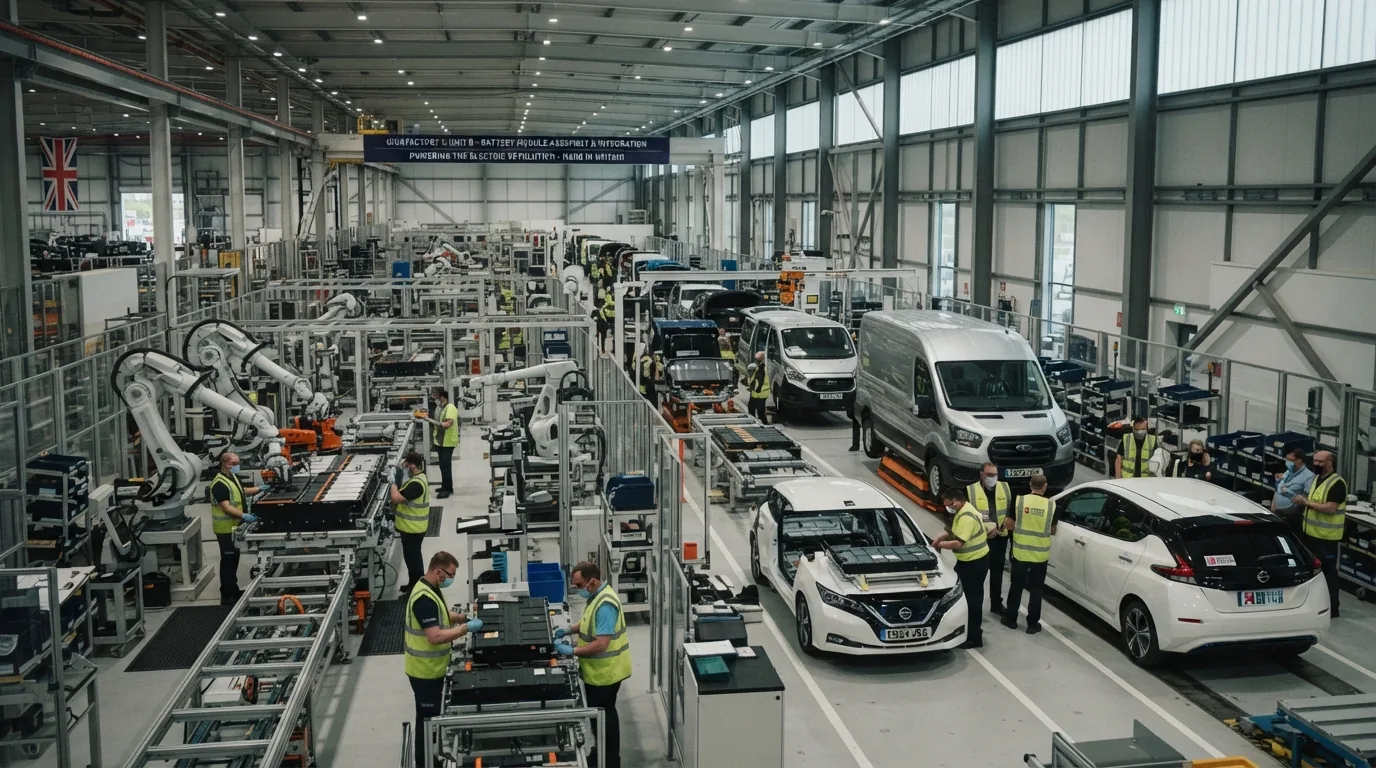
AESC’s position in Sunderland is more complex because there are now two plants, not one. The first, at 15.8 GWh, began production in December 2025 on a site adjacent to the Nissan car plant. A second plant, with 12 GWh of additional capacity, is under construction following a groundbreaking in December 2024. Total investment in the second plant is £1bn: a £150m grant from the government’s Automotive Transformation Fund, £680m in government-backed guarantees, and £320m in private financing. The second plant is expected to support around 1,000 jobs and supply batteries capable of powering roughly 100,000 additional electric vehicles per year.
These are distinct facilities. The 15.8 GWh first plant is running. The 12 GWh second plant is still being built. The combined Sunderland capacity, once both are operational, will be approximately 27.8 GWh.
The EVs these plants will actually power
Most coverage of UK gigafactories stops at the investment figures and job announcements. The more useful question for anyone following the EV market is simpler: which cars will actually contain these batteries?
Nissan
The clearest answer sits on showroom forecourts already. The new Nissan Leaf, now in its third generation, is built at Nissan’s Sunderland plant and uses cells produced at AESC’s adjacent factory. UK deliveries began from early 2026, making it the first volume EV to be powered by UK-made cells at scale. Two further Nissan models are in the pipeline for Sunderland production: an electric version of the Juke and, on a longer horizon, an electrified Qashqai. These models are confirmed as part of Nissan’s Sunderland EV strategy, but firm production start dates had not been publicly announced at the time this article was written. Treat them as planned rather than confirmed.
JLR
Agratas in Somerset has a single committed customer: JLR. The Range Rover, Land Rover Defender and the new electric Jaguar models are all expected to receive Somerset-made cells when the plant opens in 2027. These are premium vehicles with large battery packs, meaning each car consumes significantly more cell capacity per unit than a volume hatchback. The 40 GWh Somerset output is targeted at this high-value segment of the market.
Future volume models
The brief for cheaper, mass-market EVs powered by UK cells remains aspirational rather than named. The industry has discussed standardised cell formats for volume car platforms and lithium iron phosphate (LFP) pilot lines intended for lower-cost EVs, but no specific model names from other manufacturers have been publicly committed at the time of writing. This is worth watching. The economics of affordable UK-made EVs depend partly on whether a third gigafactory enters the picture, which is exactly what the Gigafactory Commission is pressing for.
Why the timing is not optional: the Rules of Origin deadline
To understand why gigafactories matter so urgently right now, you need to understand a piece of post-Brexit trade architecture that rarely makes mainstream headlines.
When the UK and EU struck the Trade and Cooperation Agreement in December 2020, they included provisions requiring an increasing share of an electric vehicle’s value to originate domestically in order to qualify for zero tariffs on export. Because neither side had sufficient domestic battery production at the time, they agreed a temporary relaxation. That relaxation was extended once, to 31 December 2026, confirmed by EU Council decision in December 2023.
What happens from 2027 is the relevant question. Under the full regime, battery cells used in EVs exported between the UK and EU must originate in the UK or EU. The permitted proportion of cells sourced from third countries drops to 35% by 2027 for cells. Without cells that meet local-origin criteria, a UK-assembled EV exported to Europe faces a 10% tariff on arrival. To put that in plain terms: applying a 10% tariff to a £20,000 to £40,000 vehicle adds roughly £2,000 to £4,000 to the cost at the border. That is an illustrative range based on the tariff rate and typical EV price brackets, not a figure published by any single source, but it gives a sense of the commercial exposure. Volume EVs are sold on tight margins. A cost jump of that scale would make UK-assembled cars uncompetitive against continental alternatives.
The ZEV mandate targets are pushing carmakers to build more electric cars in the UK at the same moment the supply chain rules are tightening. That double pressure is why the timeline feels urgent to the industry even if it has not yet translated into equivalent urgency in public debate.
The two confirmed UK gigafactories provide partial but not complete coverage. Agratas covers JLR’s premium segment. AESC covers Nissan’s volume cars. Other UK car manufacturers, including Stellantis at Ellesmere Port, remain dependent on imported cells and face the post-2027 tariff exposure unless further domestic capacity is built or supply agreements are structured around EU-sourced cells instead.
The capacity gap: how much is confirmed versus how much is needed
The Faraday Institution’s 2024 update to its UK Electric Vehicle and Battery Production Potential study is the most authoritative independent analysis of this question. The numbers are not comfortable reading.
By 2030, the UK will need approximately 110 GWh of annual battery cell capacity to supply its domestic automotive industry. That is the equivalent of six gigafactories each producing 20 GWh per year. By 2040, the requirement rises to 200 GWh, or ten factories of that size.
Confirmed UK capacity by 2030 stands at 57.6 GWh, per the Faraday Institution’s own figure. That accounts for the AESC Sunderland plants combined and Agratas Somerset. The arithmetic leaves 47% of projected 2030 demand unaddressed. On the 2040 horizon, 71% of demand remains unaddressed on current commitments. Expressed another way, the UK’s confirmed share of European battery capacity by 2030 is approximately 4%. Germany’s share is 21%.
The UK Gigafactory Commission, reporting in January 2026, described the next 12 to 18 months as decisive. It called for at least one additional large-scale plant to be announced by end-2026 with firm original equipment manufacturer offtake agreements in place. The Commission also identified the absence of domestic cathode and anode active material production as a structural gap that gigafactories alone cannot solve.
For car buyers, the practical consequence of a supply shortfall runs like this: if the gap is not filled, volume EV production in the UK shrinks or migrates to continental Europe where cells are more readily available. The Faraday Institution’s worst-case scenario, and it is explicitly a worst case, not a central forecast, estimates that direct automotive employment could fall from roughly 160,000 today toward 20,000 by 2040 if the supply chain does not develop. Against that, a successful supply chain build-out could support 270,000 UK jobs in the EV and battery industry by 2040.
The obstacles that could still derail the plans
Acknowledging the risks here is not doom-mongering. These are specific, quantified problems with specific policy responses, some of which are already in motion.
1. Energy costs
A gigafactory running at full capacity is one of the most electricity-intensive industrial facilities that can be built. UK energy-intensive industries were paying roughly double the EU average electricity price in 2024, according to figures cited by the Gigafactory Commission (figures vary, verify current data against the latest Ofgem and BEIS surveys). That cost differential goes directly to the economics of battery manufacturing: cells produced in the UK start with a structural cost disadvantage before a single worker has been paid.
The Gigafactory Commission has called specifically for industrial energy cost relief for battery manufacturers. Grid infrastructure is a related problem. National Grid’s £58bn infrastructure investment plan is designed to address the bottleneck between where UK renewable generation sits and where the demand is, but delivery timelines extend well beyond 2030. In the near term, energy costs remain a genuine competitive liability for UK battery production.
2. Skills and workforce
The narrative around gigafactories tends to invoke high-skill, high-wage knowledge jobs. The reality is more nuanced. Research cited by the Gigafactory Commission indicates that 80 to 85% of the roles in a gigafactory are Level 2 to 3: production operatives, maintenance technicians, process engineers. These are valuable, well-paid roles, but they require a very different training pipeline than graduate recruitment. The UK currently lacks the volume of technical apprentices and vocational training capacity to fill these positions at gigafactory scale.
The government has announced a £182m skills package covering engineering training and technical qualifications, alongside a new apprenticeship unit specifically for battery manufacturing. The Gigafactory Commission has recommended a dedicated “Destination Batteries” campaign to build public awareness and attract school leavers into the sector. Whether these measures can scale fast enough to meet production timelines at Somerset and the expanded Sunderland site remains an open question.
3. Supply chain depth
The most structurally significant gap is one that receives the least public attention. Cathode active material (CAM) is the component that accounts for more than 35% of a lithium-ion battery’s total value, according to figures cited by the Gigafactory Commission. The UK currently has no domestic CAM production at commercial scale. Altilium, a British startup, describes itself as the only UK company currently producing CAM at pilot scale, and that is the company’s own characterisation rather than an independently verified claim. Without a domestic CAM supply chain, UK gigafactories will depend on imported materials, primarily from Chinese-dominated supply chains, regardless of how much cell production capacity is built. The Commission has called for specific investment in upstream materials capacity as part of any credible gigafactory strategy.
China’s advantage and what the UK is up against
The scale difference between the UK’s confirmed battery ambitions and China’s existing capacity is not a matter of degree; it is a matter of order of magnitude.
Industry estimates put China’s total battery manufacturing capacity in 2025 at approximately 1,000 GWh. The UK’s confirmed capacity by 2030 is 57.6 GWh. The comparison does not flatter, and it is worth stating plainly.
On cost, EU and UK battery packs were priced at approximately €163 per kWh in 2025, against approximately €116 per kWh for Chinese-produced packs, a gap of roughly 40%, according to S&P Global automotive industry analysis. The global average pack price in 2025 was around $108 per kWh (figures vary, verify current data). The cost gap is not primarily about labour. It reflects manufacturing efficiency, supply chain integration, and decades of state-directed industrial investment.
Manufacturing scrap rates illustrate the efficiency gap in practical terms. Chinese gigafactories run scrap rates below 10%. European and UK plants, still early in the learning curve for this technology, report scrap rates of 30 to 40%, according to S&P Global data. Every scrapped cell is money written off before the battery reaches a car. Closing that gap requires operational maturity that takes years to build.
China’s state support for battery manufacturing has been substantial: billions in direct subsidies since 2018, local authorities providing factory buildings at no cost, fast-track planning approvals and equipment depreciation support. The UK’s total committed public support across both confirmed gigafactory projects is approximately £530m (£380m for Agratas and £150m in ATF grant for AESC). That is not a like-for-like comparison of the two industrial strategies, but it indicates the difference in scale.
One area where the UK has a credible path to competitiveness is battery chemistry. Lithium iron phosphate (LFP) cells are, on average, 32% cheaper than the nickel manganese cobalt (NMC) chemistry that European manufacturers have historically favoured, per APC UK analysis. China currently dominates global LFP production with approximately 70% market share. If UK gigafactories can build LFP capability at scale, the cost gap narrows considerably. LFP-powered EVs are widely expected to reach sticker-price parity with equivalent petrol cars as costs continue falling, though the precise timeline varies depending on the source, and lower estimates should be treated with caution. That shift in chemistry is reinforced by the broader trend of battery prices falling below $100/kWh, which we have covered separately.
What success looks like, and what failure means for the cars you buy
The two scenarios are not equally weighted by the evidence, but both are plausible. The next 18 months will do much to determine which trajectory the UK is on.
In the success scenario, both confirmed plants open on or close to schedule and together deliver 57.6 GWh of annual capacity. A third gigafactory is announced by end-2026 with binding OEM offtake agreements. The 2027 Rules of Origin deadline is met for JLR and Nissan, preserving tariff-free access to the European market for UK-assembled EVs. UK car output, which fell to a 73-year low of 764,715 units in 2025 (down 15.5% on the prior year), recovers toward the SMMT forecast of 790,000 in 2026 and potentially one million by 2027. The EV and battery supply chain supports 270,000 UK jobs by 2040.
In the failure scenario, production at Agratas or AESC runs into delays or scaling problems. No third gigafactory is announced in time. Post-2027 tariffs bite on UK exports to Europe, and car manufacturers respond by shifting EV production to Germany, France or Spain, where grid power is cheaper, CAM supply chains exist and industrial energy policy is more settled. UK automotive employment contracts toward the worst-case 20,000 direct jobs by 2040, down from around 160,000 today. To be clear: that is the Faraday Institution’s worst-case scenario, not its central projection, and it should be read as the floor to which things could fall under the least favourable conditions, not as a prediction.
For you as a buyer, the pipeline of UK-made EVs either holds or it fractures. If it holds, the electric Nissan Leaf, the future electric Juke and Qashqai, and JLR’s premium electric models remain viable and competitively priced products built close to where you live. Check current pricing at publication, as market conditions will shift as the supply chain develops. If the pipeline fractures, volume EVs will increasingly be imported, which typically means less choice and higher prices for the UK market specifically.
The investment is real. The policy intent is genuine. The gap between what has been committed and what the Faraday Institution says is necessary is also real. The next year or two will tell us which of these things matters most.
If you are thinking about your first EV or a switch from petrol, our EV industry analysis section covers everything from range in the real world to the best lease deals available now.
How we test and where our numbers come from
Range figures are official WLTP combined values taken from manufacturer UK specification pages, with real-world estimates drawn from independent comparative testing. Prices are UK list prices at the time of the latest update. Tax, grant and charging-scheme figures come from GOV.UK and HMRC publications. We re-check every guide when pricing, specification or policy changes. Last checked 11 August 2026.
Frequently asked questions
How many gigafactories does the UK have?
Two major plants are confirmed and either operational or under construction. AESC's Sunderland gigafactory began production in December 2025 with 15.8 GWh of capacity, and a second AESC plant adding 12 GWh is also under construction at the same site. Agratas is building a 40 GWh plant in Somerset due to open in 2027.
Which electric cars will be built using UK gigafactory batteries?
The new Nissan Leaf, available for UK delivery from early 2026, uses cells from AESC's Sunderland plant built adjacent to the Nissan factory. Electric versions of the Nissan Juke and Qashqai are planned to follow from Sunderland, though firm dates have not been publicly announced. From 2027, JLR's Range Rover, Land Rover Defender and new Jaguar electric models will use cells from Agratas in Somerset.
Why does the UK need domestic battery manufacturing?
Two reasons. Batteries are the single most expensive component in an EV; building them close to where cars are assembled reduces cost and logistical complexity. Second, post-Brexit trade rules require an increasing share of an EV's value to originate in the UK or EU from 2027 onwards.
Will the UK gigafactories be enough to meet demand?
Not on current plans. The Faraday Institution's 2024 report projects UK battery demand of 110 GWh per year by 2030. Confirmed plants will deliver approximately 57.6 GWh, leaving 47% of projected demand unaddressed.
What are the biggest risks to UK gigafactory plans?
Three main risks. UK industrial electricity prices are roughly double the EU average, threatening the economics of energy-intensive battery production at scale. The workforce pipeline is underdeveloped: 80 to 85% of the roles needed are Level 2 to 3, not graduate positions, and the UK lacks the vocational training capacity to fill them quickly.
Sources and further reading
- faraday.ac.ukFaraday Institution: UK EV and Battery Production Potential to 2040 (2024 update)The authoritative independent analysis behind the 110 GWh demand figure, the 57.6 GWh confirmed capacity figure, and the employment projections used throughout this article.
- gov.ukGOV.UK: £1 billion secured for new Sunderland gigafactoryPrimary government source for the AESC second plant funding breakdown, job numbers and investment structure.
- consilium.europa.euEU Council: Extension of rules of origin for electric vehicles until end of 2026The original EU Council decision confirming the 2026 extension and what follows it. Essential reading for anyone wanting to understand the 2027 tariff deadline.

EV Compared
The EV Compared editorial team tracks the UK electric vehicle market full time: new model launches, list prices, WLTP and real-world range, public charging tariffs and the tax rules that decide what an EV actually costs to run. Every guide is checked against manufacturer specifications and official GOV.UK figures, and updated whenever the numbers move.